


Did you see that? (9/10-9/16)
September 18, 2012
One of the state's premier regular-season cross country events plus some big-time volleyball in the Upper Peninsula highlight the non-football highlights from the week that was Sept. 10-16.
(Click for the Drive for Detroit football report.)
Cross country
Elite meet at MSU: The Spartan Invitational, run at Michigan State's Forest Akers East Golf Course, is arguably the most competitive regular season event in this sport and draws a number of top teams from all over the state for a series of races. Champions on Friday were the Waterford Mott boys and Grosse Pointe South girls in the Elite races, the Ithaca boys and North Muskegon girls in the White division, the Haslett boys and the Spring Lake girls in the Bronze division, and Bloomfield Hills Lahser boys and Jenison girls in the Green division. Click the "Playmakers" link for results and the others for coverage. (Playmakers.com) (Grand Haven Tribune) (Lansing State Journal)
Volleyball
Capital of UP volleyball: Calumet, ranked fourth in Class C this week. defended its title at the Articatz Invitational Autumn Classic in Marquette by winning all 12 of its games. The field also included Marquette, Houghton and Escanaba among others. (Marquette Mining Journal)
Trojans at home above the net: More of the Upper Peninsula's top teams met nearer the Wisconsin border. Crystal Falls Forest Park, ranked No. 6 in Class D, defended its home tournament title with a 2-1 win over No. 10 Lake Linden-Hubbell in the final. (Iron Mountain Daily News)
Golf
Lakeview owns Battle Creek: Lakeview continues to rank among the state's best teams in Division 2, at No. 3 this week. And there's no question it's the best in Battle Creek, as evidenced by a sixth-straight All-City championship won with a score of 176 -- 45 strokes better than runner-up Harper Creek. (Battle Creek Enquirer)
Recognition
Clawson names Judy Hacker Field: Hacker, who died in 2011, was a pioneer of girls sports in the southeastern corner of the state during her time at the school from 1963-95. She coached basketball, volleyball, softball, track and field and field hockey at the school. The school dedicated its softball diamond in her name Saturday. (Oakland Press)

Zeinstra Finishing 4-Year Byron Center Run Among School's All-Time Greats
By
Dean Holzwarth
Special for MHSAA.com
February 15, 2024
BYRON CENTER – As an incoming freshman four years ago, Lily Zeinstra was immediately thrust into a starting role on the Byron Center varsity girls basketball team.
 While it was an overwhelming experience, Zeinstra embraced the opportunity, and believes the early demands placed on her helped pave the way for what has become an outstanding high school career – and spot among the best in school history.
“My freshman year was scary,” she said. “Just coming in and starting on varsity. And in our first game, I had to guard Jillian Brown from East Grand Rapids, who was a really good player. I feel I was pushed into a big role on our team at a really early age, but I think that has helped me over the last four years to develop into the player I am today.”
Now a senior standout, the 5-foot-11 Zeinstra has been a mainstay in the Bulldogs’ starting line-up throughout while helping lead the program to four years of success.
She recently became the school’s all-time leading scorer, surpassing 1,500 points for her career.
“I have to give credit to my teammates,” Zeinstra said. “Through the years I've been in different scoring positions, but I've always been on a team that has trusted me with the ball in tight game scenarios.
“I’ve been told by my coaches since I was younger that I'm a scorer and they need me to score, and that's been my role so I feel like scoring all those points is what I needed to do to help our team win. That’s the most important part.”
Zeinstra, who committed to Division I Butler University last spring, has been the focal point every season and has enjoyed her role as a team leader. Byron Center (14-4) is a combined 68-14 over her four seasons.
“I’ve definitely learned a lot about being a leader and having different roles that I can have on teams,” she said. “Coming in freshman year, my job was to work hard and I was one of the top defenders, so I was guarding the other teams’ best players.
“As years went on, our team lacked numbers so I became more of a scorer, especially last year. I worked on posting up down low and scoring all around the basket, and this year even more trying to further my game and score better. I'm playing college basketball next year, and that’s what they need me to do.”
Zeinstra also had the opportunity to play two years at Byron Center with her older sister, Avery, who plays now at Grand Valley State.
 “I feel like I didn’t enjoy it enough when I was in it with her,” Zeinstra said. “But I loved her class so much. There were two other seniors who she played with all four years, and they were big leaders and taught me about the culture here at Byron Center. I really enjoyed playing with them.”
Zeinstra is averaging 25 points per game this season and had a career-high 39 points against Grandville in late December.
First-year Byron Center coach Cam Burns, who replaced longtime program leader Jen Slot, knew all about Zeinstra before being hired.
“I saw her on the AAU circuit and I watched her play for a couple years, and I have friends who spoke highly of her,” Burns said. “When I got the job I wanted to check her out, and I saw her pace and how she plays the game was very special.”
Burns said Zeinstra possesses unwavering confidence and the ability to score several ways.
That mentality has come from countless hours in the gym and a strong work ethic.
“She’s one of the hardest working kids in practice, and she just wants it,” he said. “And she’s a sponge, always looking at different skills and movements to try and get a better look at the rim.
“And it’s about the time and effort she puts into the little details. She makes plays, and I’m not surprised when I see something from her on the court when others are taken back by it. She continues to show why she is so good.”
The adjustment period for Zeinstra was difficult at the onset of this season.
She was getting accustomed to a new coach, as well as a new group of varsity players after the loss of several seniors.
“It was hard at the beginning because I had been running Coach Slot’s plays and offense for three years, and I knew what to expect going into every game and every practice,” Zeinstra said. “When Coach Burns came in, he brought a different vibe and a different culture, and it was the first year I had to get used to playing with new players and a new coach. I was learning things all over again.”
Zeinstra has adapted well to her new surroundings.
“It’s been going pretty good, and we had a couple big wins last week and we are in first place in our conference,” she said. “We should be able to pull another conference championship out – fingers crossed.”
The Bulldogs are chasing their fourth straight conference championship and have a one-game lead entering Friday’s Ottawa-Kent Conference White game against Grand Rapids Forest Hills Central. Their only conference loss was against Forest Hills Northern.
“It would be such a great accomplishment to win another one,” Zeinstra said. “We have had this winning culture in our program for so long, and with getting a new coach I was worried we were going to lose some of that. But I really feel like this team is buying into everything that Coach is saying and we are finally putting the pieces together and starting to win some big games.”
After a rocky start, Byron Center has adjusted well to its new coach and made giant strides. The Bulldogs dropped their first two games of the season to East Kentwood and reigning Division 1 champion Rockford, but since have won 13 of their last 15 games.
“We started out 0-2 against two of the top teams in the state, and it was just learning a new system and a new process and feeling each other out,” Burns said. “As weeks have gone by, they are starting to trust in each other and trust me. They’ve started to trust in the process.
“After that first win we got to celebrate that, and it was special. From then on we started rolling, and we’re getting better day by day, continuing to trust in one another.”
The Bulldogs also will seek a third consecutive District crown when the postseason begins in a few weeks. Zeinstra is looking forward to a potential rematch with East Kentwood.
“I want another stab at them, and we like challenges,” Zeinstra said. “We feed off that, so I feel like we have a shot to win (Districts) again.”
 Dean Holzwarth has covered primarily high school sports for Grand Rapids-based WOOD-TV for five years after serving at the Grand Rapids Press and MLive for 16 years along with shorter stints at the Ionia Sentinel and WZZM. Contact him at [email protected] with story ideas for Allegan, Kent and Ottawa counties.
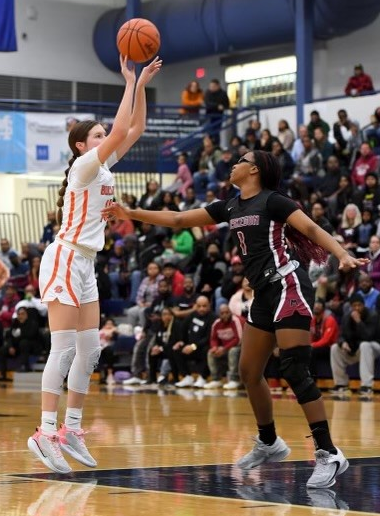
PHOTOS (Top) Byron Center’s Lily Zienstra considers her options during a game against Rockford. (Middle) Zienstra, left, puts up a shot against Muskegon. (Photos courtesy of the Byron Center girls basketball program.)