


Did you see that? (9/17-9/23)
September 25, 2012
The crowning of a new MHSAA soccer scoring champion and some statewide showdowns in golf and volleyball headline the best of the week that was Sept. 17-23.
Soccer
Chatfield fills it up: Senior Aaron Chatfield, a forward for Burt Lake Northern Michigan Christian, scored both of his team's goals in a 7-2 loss Friday to Elk Lake, but in doing so set the MHSAA career scoring record. He now has 174 goals, two more than former record holder Soony Saad of Dearborn. (Petoskey News)
Golf
Cougars edge Bulldogs: Two-time reigning MHSAA Division 4 champion Lansing Catholic edged Brighton 327-336 at the East Lansing Invitational on Sept. 17 at Walnut Hills Country Club. There were nine ranked teams in the 17-team field. Brighton is ranked No. 2 in Division 1. Lansing Catholic's Jacqueline Setas shot a 70 to take the individual medalist honor, and two of her teammates tied for second.
Volleyball
Blue streak: Richland Gull Lake downed Portage Central in three sets to win the Portage Central Invitational's gold division and a tournament the featured four teams ranked in Class A plus reigning champion Rockford and reigning Class B champion Fruitport (in A this season). Gull Lake moved up to No. 2 in Class A from No. 4 after the weekend, and Portage Central is No. 6. (Kalamazoo Gazette)
Tennis
Ludington on the move: The Orioles have moved up from No. 8 to No. 6 in the Division 4 rankings after downing formerly-No. 2 Grosse Pointe Woods University Liggett and No. 10 Almont at Saturday's Almont Invitational. (Mlive.com)
Cross Country
Flivver flies on: Kingsford's Dan Kulas claimed the individual championship at the Stephenson Invitational on Saturday in 16:58. He's won four straight races. (Iron Mountain Daily News)
Basketball
Pershing coach steps down: Detroit Pershing boys basketball coach A.W. Canada has resigned, but will remain with the program as an assistant. The Doughboys are regularly in contention in Class A, last winning the MHSAA title in 2009 after also making the Final in 2008. (Detroit News)
Story of the Week
Spring Lake setter lifts Lakers: It's been a little more than a year since Emily Blahnik's mother Brenda suffered a horrific fall that left her with a skull fracture, brain trauma and spinal cord injuries. But with her teammates and community in continuous support, Blahnik has remained a big part of Spring Lake's volleyball program. The Grand Haven Tribune has been covering this story throughout, and Nate Thompson provides us with this update. (Grand Haven Tribune)
Track Gaining Speed Toward Future with Electronic Starting Devices
By
Steve Vedder
Special for MHSAA.com
May 23, 2023
Aubrey Greenfield thinks it might be the perfect time to reevaluate 130 years of tradition.
For a number of reasons, from technical to personal, the Oxford senior sprinter believes it makes sense for the crack of a starting pistol to be eliminated from high school track meets.
Because track meets would benefit in various ways from lowering costs to easier setup at meets to the human factor of competitors not having to flinch at the crack of a pistol shot, Greenfield believes the sport has a chance to embrace new technology – electronic starting devices (ESD).
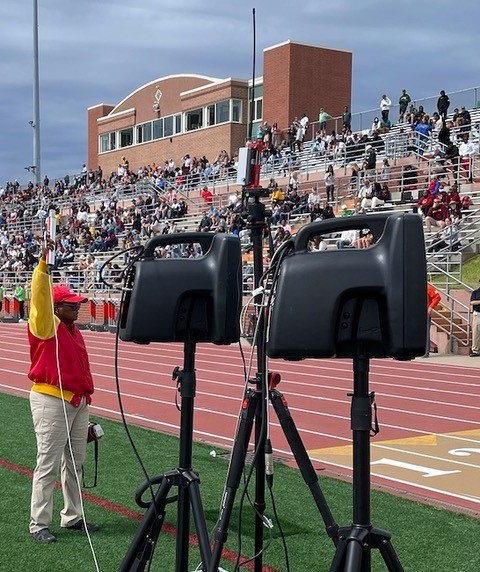
In essence, an ESD replaces the starting pistol with a light flash, tone sound or both to begin a race.
"High school sports should put the athlete first," Greenfield said. "We should promote sports, and eliminating starting pistols promotes health in terms of PTSD or trauma for athletes and spectators and that would be good. I would like to think people would say that's a good idea."
In fact, Greenfield would go as far as to say if there was not an implementation of electronic starting devices, many of her teammates would have considered giving up the sport.
"If it's something that helps us compete safely, we're all for it," she said.
Greenfield's opinion apparently is spreading. Michigan High School Athletic Association senior assistant director Cody Inglis said the use of ESD makes it both affordable for meet starters and sensible for athletes and fans to rethink the use of starting pistols. While the MHSAA is not mandating electronic starting devices, it does promote the use of what Inglis calls "emerging technology." He notes that ESD are becoming the norm for organizations such as USA Track & Field, the NCAA and an increasing number of high schools.
 "I think we have to embrace new technology, and we think this will be something that takes hold," Inglis said.
A key part of embracing ESD is the human element. The tragic Oxford High School shooting Nov. 30, 2021, that took the lives of four students while injuring seven others should not be relived even for a fleeting instance at a high school sporting event. Oxford athletic director Tony DeMare said the school began using ESD at every meet, including the MHSAA Lower Peninsula Division 1 Finals last June. He said that decision was embraced by virtually all schools Oxford encountered.
"We were very convinced that the alternative (of ESD) would promote a healthy attitude," DeMare said. "We were overwhelmed with the positive response. If a school was on the fence about it or might not be for it, I think we've started to see the tide turn in favor of people willing to listen and learn about electronic starting devices."
Inglis said the MHSAA is acutely aware of what the crack of a starting pistol can mean to athletes and fans.
"It's unimaginable what Oxford went through, and this is a small way we can help," he said. "We look at a (starting pistol) and think, ‘Could we do something else?’ It's a way of helping to solve a problem."
Over the last several years, the MHSAA has embraced finding an alternative to starting pistols. Inglis noted the discussion started with the cost and diminishing availability of 32-caliber ammunition that meet starters use. A box of ammunition, if it can be found, is around $75 a box.
In addition to cost, there is potential damage from excessive exposure to 150-plus decibels of sound generated by the traditional 32-caliber blanks. Medical studies show damage to ears caused by decibel levels above 120 dB.
The tragedy at Oxford accelerated the conversation.
Inglis said the cost of ESD can be likened to a school sinking money into artificial surfaces at football fields. Yes, there is a great cost at first, but over time money is ultimately saved. An ESD system itself ranges between $200 and $500. Speakers also may need to be purchased, but with ESD starting events like the 800 and 1,600-meter relays positioned near the outside lanes 8, 7, 6 and 5 would result in improved hearing by athletes at the start of a race.
There is one challenge with ESD that track administrators are working to overcome – lighting conditions that lessen the ability to see the ESD’s LED light or strobe when the button is pressed by a starter to begin a race. But that vision difficulty resulting from clear blue skies and backgrounds of setting suns can be substantially improved by incorporating a black background with an ESD – something as simple as a starter holding up black cardboard behind the lighting mechanism at the start of an event.
Inglis said when all factors are considered, the use of ESD makes sense.
 "With the climate we live in nowadays, no lookalike guns is good," he said. "We're not mandating this. But people are saying this is affordable."
While switching to ESD would break 130 years of tradition, the timing could be a step forward, said Jeff Hollobaugh, co-author of the book "The Fleet Feet of Spring: Michigan's High School State Championships in Track & Field." He said while no definitive answer is possible, it's likely starting pistols were used at the inaugural state meet at the Jackson Fairgounds in 1895. The meet, which included events like tossing a 16-pound shot put, bike races and a 100-meter sprint, was sponsored by the Michigan Interscholastic Athletic Association (a predecessor to the MHSAA) and comprised mostly of the state's larger schools.
Hollobaugh's sentiments echo what many involved in today's high school track & field believe in terms of making a transition from starting pistols to electronic starting devices.
"It's a change, not necessarily good or bad, just different," he said. "It's not a drastic change, but it will take some getting used to. But it is the future. In the end, we'll all be fine."
DeMare believes the future of high school track will definitely include ESD.
"Our desire is that the practicality and sensibility of this will overcome the alternative," he said. "I think we'll see the automation and electronics taking hold of certain elements in track, and people will embrace it."
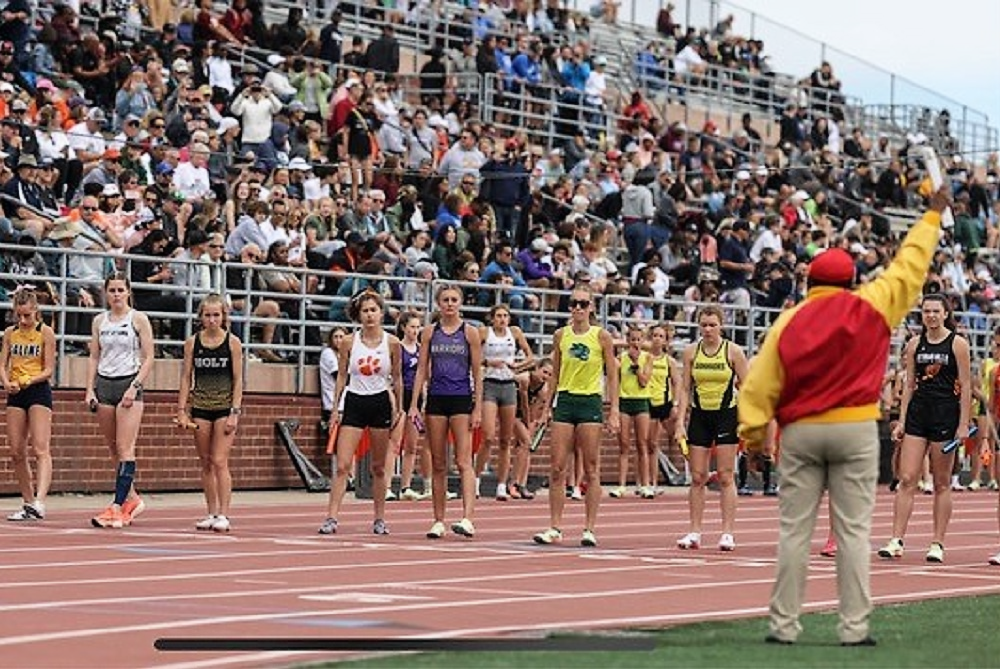
PHOTOS (Top) Runners watch official Bertha Smiley as they prepare to begin a race during last season's Lower Peninsula Division 1 Finals at Rockford. (Middle) An electronic starting device provided by VS Athletics was used to start those races. (Below) Smiley sets to begin an event. (Photos provided by David Kuderka/VS Athletics.)