


Did you see that? (9/3-9/9)
September 10, 2012
School is back in session, and MHSAA teams should be hitting their best strides as league competition gets underway in most sports.
Here's a look at some of the highlights from the first full week of September, with links to additional coverage.
Volleyball
Spikes under the sun: Muskegon Mona Shores finished 3-0 in its home invitational Wednesday against a strong field of Grand Haven, Fruitport and Spring Lake. That's reason to celebrate on its own. But the best part of this story is where the Sailors did their damage -- on two portable courts stretched across the school's football field. (Muskegon Chronicle)
St. Philip takes Cereal City: Despite being one of the smallest schools in the state, it's rare that Battle Creek St. Philip doesn't leave a tournament as champion -- especially in its home town. But the Tigers hadn't won the Cereal City Invitational since 2007, until it did so with a two-set win over Class A honorable mention Temperance-Bedford this weekend. (Battle Creek Enquirer)
FHE is No. 1: Ada Forest Hills Eastern more than justified its ranking as best in the state in Class B by besting many of the best from the Grand Rapids area at the East Kentwood Invitational. Among others in the field were Class A No. 8 East Grand Rapids and reigning MHSAA Class A champion Rockford. (Grand Rapids Press)
Put them in the book: Johannesburg-Lewiston swept Gaylord St. Mary on Tuesday, thanks in part to 10 aces by junior Brittany Cherwinski, a total which will qualify for the MHSAA record book once documentation is submitted. In the team's previous match, junior Julia Nieman qualified for most assists in a match. (Gaylord Herald Times)
Cross Country
Harbor Springs rules the mud: Both the Harbor Springs boys and girls teams won their Charlevoix Classic Mud Runs on Saturday on a course that featured standing water and hay bales among other obstacles. It was the 21st year of the race. (Charlevoix Courier)
Running to records: Sault Ste. Marie has a freshman to watch in Parker Scott, who won his school's Bill Lynn Trails race Saturday in a time of 16:36 -- at least 26 seconds faster than any of the three first-place times from last season's MHSAA Upper Peninsula Finals. The time was a school record. (Soo Evening News)
Swimming and Diving
West Ottawa wins West Michigan: Facing many of the biggest and best from that side of the state, Holland West Ottawa won the West Michigan Relays after finishing third in the event each of the last three seasons. Among those also in the field was reigning MHSAA Division 2 champion Holland. (Holland Sentinel)
Tennis
Dow rises again: The Division 2 top-ranked Midland Dow tennis team remained perfect this season by winning its third tournament of the fall, at Grosse Pointe North. Among others in the field were No. 2-ranked Portage Central and No. 3 Grand Rapids Forest Hills Central (Midland Daily News)
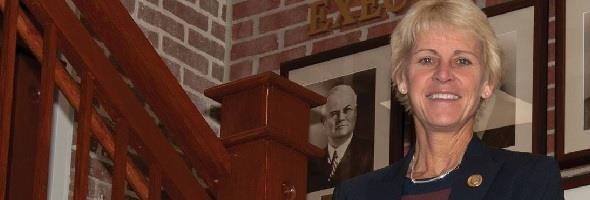
NFHS Voice: Amateurism Benefits
October 9, 2019
By Karissa Niehoff
NFHS Executive Director
While we addressed a number of important issues with our member state associations at section meetings the past month, perhaps none of the topics are as significant as the tremor that occurred in California on September 30 – the signing of the “Fair Pay to Play Act” by California Governor Gavin Newsom.
Although there are more questions than answers at this point, this ruling would allow college athletes in the state of California to make money from their name, image and likeness through endorsement deals, sponsorships, autograph signings and other opportunities. The legislation is due to take effect in 2023.
Obviously, the NCAA opposes this legislation and is working through its governance structure to address the issue. As Mark Emmert, NCAA president, told the Indianapolis Star, “for all intents and purposes, athletes become employees of the schools. This is just a new form of professionalism and a different way of converting students into employees.”
And since it would not work for athletes in one state to be receiving money legally while athletes in the other 49 could not, a national bill similar to California’s is already being considered by U. S. Representative Anthony Gonzalez of Ohio.
Needless to say, the NFHS and its member state associations oppose the California ruling as it could further erode the concept of amateurism in the United States. At the high school level, current issues with parents pushing their kids into specialization in the fight for scholarships would only be exacerbated as they considered the “best offer” from colleges.
In the aforementioned Indianapolis Star article, Emmert noted the following: “Under the California law, there would be complete elimination of all of those rules (regulations related to shoe companies). It would also include the use of agents in that process and the agent could represent high school students.”
There is nothing more sacred and fundamental to the past – and future – history of high school sports in the United States than the concept of amateurism. While this California ruling addresses college sports directly, it undoubtedly would have an impact on sports at the high school level as well.
The signing of the “Fair Pay to Play Act” comes on the heels of the Alston v. NCAA case earlier this year in which a federal judge in California found the NCAA’s scholarship rules to be illegal – to a point. The NFHS filed an amicus curiae brief in support of the NCAA noting the following:
“Amateurism in athletics is not only valuable for its own sake, but also is a key aspect of a well-rounded education. The NFHS is concerned that the district court’s opinion does not fully appreciate either the concept of amateurism or the many benefits it brings to college and high school sports – and to American sports in general.
“... If amateurism were to give way to professionalism at the collegiate level ... high schools would struggle to fulfill their ultimate goal of preparing large numbers of well-rounded individuals for futures beyond athletics. … The NCAA should be afforded the freedom to define amateurism in a way that preserves the ideal of the student-athlete in higher education which would protect important values of education-based sports at all levels.”
The NFHS will continue to support the NCAA in its efforts to preserve amateurism as it is our belief that paying student-athletes – whether it is in the form of selling one’s name, image or likeness, or whether it eventually becomes a paycheck – will erode the spirit of sport at all levels in this country.
Dr. Karissa L. Niehoff is in her second year as executive director of the National Federation of State High School Associations (NFHS) in Indianapolis, Indiana. She is the first female to head the national leadership organization for high school athletics and performing arts activities and the sixth full-time executive director of the NFHS, which celebrated its 100th year of service during the 2018-19 school year. She previously was executive director of the Connecticut Association of Schools-Connecticut Interscholastic Athletic Conference for seven years.