

Former MHSAA Coach Lands in NHL
By
Geoff Kimmerly
MHSAA.com senior editor
April 5, 2013
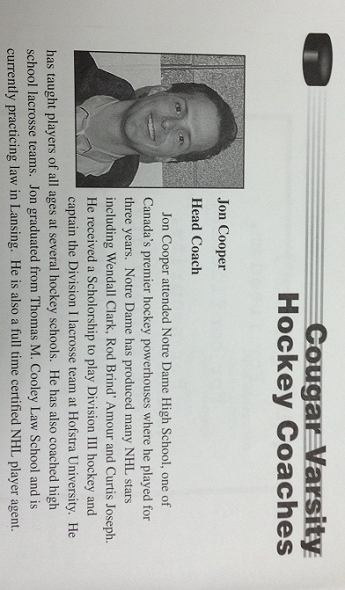
This week in the year 2000, Jon Cooper had just finished his first season coaching at any level, having guided the Lansing Catholic hockey team to its first Regional championship in 25 seasons.
 It would be the only season Cooper – a local lawyer and former player at Hofstra – would coach the Cougars. But it also was the start of a nearly unimaginable rise that saw him hired to coach the NHL’s Tampa Bay Lightning two weeks ago.
As the saying goes, it couldn't have happened to a nicer guy. Cooper always was friendly and helpful to this then just-starting local media member, and despite his lone season coaching the Cougars quickly built a local fan base that continues to cheer him on from afar.
An NHL.com piece last week led with the high school angle. Click here to check it out. He took over a team 16-18-2 and near the bottom of the Eastern Conference, but Cooper surely will have plenty rooting him on from the MHSAA hockey ranks as he works to bring the franchise back to the playoffs – and we’ll work to catch up with him this summer during his first NHL offseason.
Grand Haven athletics 'Exemplary'
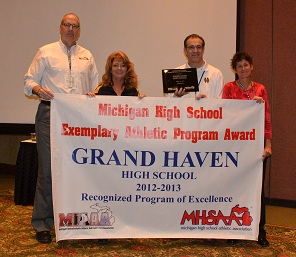 The Grand Haven High School athletic department received this year’s Exemplary Athletic Program Award from the Michigan Interscholastic Athletic Administrators Association during its annual conference last month in Traverse City.
The program was established in 1998 to recognize outstanding athletic programs and give high school administrators a vehicle by which to self-assess their practices and measure improvements.
Characteristics of “exemplary” programs include district-wide commitment, excellence in advancing the growth of well-rounded participants and serving the needs of all involved including parents and staff, and sustained success in teaching the values of high school athletics.
Click for more details on award criteria and a list of previous winners, and additional coverage by Grand Rapids’ WZZM.
Volleyball teams 'dug' deep
Michigan high school volleyball teams playing "Dig Pink" matches combined to raise more than $50,500 for cancer research last fall to rank sixth nationally, according to the Side-Out Foundation, a non-profit organization that heads up the “Dig Pink” initiative.
Class D Engadine raised the most among MHSAA schools – $5,200 – with Kent City, Bronson, Grand Ledge, Allendale, Stevensville Lakeshore, Monroe, Waterford Mott, Coldwater and Grand Blanc also contributing to the grand total. Also, Grand Ledge’s Katie Everts received a Side-Out Ambassador Program award, one of 10 handed out to individuals nationally.
Total, more than $1.1 million was raised nationwide.
Name that trophy
 Few if any schools in Michigan have done more work in researching and identifying the trophies in its case than Orchard Lake St. Mary’s, which will celebrate its 100th season of boys basketball in 2013-14.
It's rare the Eaglets historians can’t determine what a trophy celebrated. In this case, hopefully you can help.
We believe it’s a basketball trophy from the 1930s – but haven’t been able to pin down a season or a level of the MHSAA tournament. A few things that make this one unique are the plaque presentation, as opposed to a standard trophy, and the large MHSAA seal in the center. Any ideas? Email me at [email protected].
Giving back to those who gave
Those from the U.S. 23/I-94 area surely remember the tornado that tore through Dexter a little more than a year ago, on March 15, 2012.
Dexter track coaches Bob and Katie Jazwinski are remembering those who helped them rebuild after their home was destroyed by the storm.
In a Second Half report last year, Bob Jazwinski said he’d seen athletes and coaches from Adrian, Ann Arbor Pioneer, Pinckney, Chelsea, Ann Arbor Skyline, Whitmore Lake and the USA junior hockey team among the many who flocked to the community to lend a hand in the cleanup.
The Jazwinskis began repaying the favor three weeks ago on the storm's one-year anniversary with the Dexter F 3.1 Tornado Run/Walk that benefited non-profit organizations that had donated for storm recovery the year before.
Click to read the March 30, 2012 story about Adrian athletes’ contributions to the clean-up.
Last call for basketball
We got off to a late start on entering basketball schedules for this winter – but thanks to some incredibly helpful school, official and fan inputters, we were able to catch up quickly and finish with a nearly-complete list of results and standings for this season.
Still, there are some schools with incomplete schedules or a few scores missing. And before everyone forgets completely about this season, we’re hoping for a little help in finishing this enormous task.
Please check out your team’s page on MHSAA.com and help us fill in missing scores and fix inaccuracies. The latter could include just about anything – an incorrect game date, incorrect opponent or score, team missing from league standings, etc. For corrections, please email me directly at [email protected]. (Note: If a game was cancelled, don’t just delete it – contact me and I’ll add “cancelled” to avoid confusion.)
Why is this important? Two big reasons. First, MHSAA.com publishes the most complete statewide scoreboard with results from every corner of Michigan. And we have the most complete archive of basketball seasons available, currently dating to 2009-10. Help us fill in the blanks, and they’ll be saved for everyone’s benefit for years to come.
I thank you in advance for any help you are able to provide.
PHOTOS: (Top) Jon Cooper's bio appeared in the Lansing Catholic hockey team's yearbook for the 1999-2000 season. (Middle) Grand Haven athletic director Robin Bye (second from right) poses with Gull Lake athletic director and MIAAA Exemplary Committee co-char Marc Troop, Grand Haven athletic secretary Rita Way and Ann Arbor Greenhills athletic director and MIAAA Exemplary Committee co-chair Meg Seng after the Buccaneers received this year's award. (Bottom) Orchard Lake St. Mary's is hoping to identify the championship recognized by this trophy, believed to be from the 1930s.
Workout Basics: Warm-Ups & Cool-Downs
February 3, 2021

By Nick Parkinson, M.Ed., AT, ATC, TSAC-F
Henry Ford Health Systems
You may know a good warm-up — and cool-down — are essential to getting a good workout. You may also know that warming up your muscles and stretching them out after exercise can help prevent injury and keep you at the top of your game.
They’re the two bookends that help maximize a workout. Unfortunately, a lot of exercise enthusiasts don’t know how to warm up and cool down correctly.
Warm-Up Basics
A warm-up is exactly what it sounds like: The goal is to warm up your muscles and prepare your body for whatever you’re asking it to do. Warming up increases your body temperature and helps blood flow to the muscles that you’re using.
So if you’re going to play soccer, your warm-up should touch all of the muscles in your legs and core. Shooting hoops? You’ll need to add shoulders and arms to your routine. Circuit training at the gym? Choose a warm-up that flexes all of the muscles you’re about to use.
The thing that all warm-ups have in common is that they require dynamic (or constantly moving) motion, not static stretching (holding poses for a certain amount of time). In fact, static stretching prior to a workout can inhibit power and strength, especially if you’re doing something like weightlifting.
The anatomy of a solid warm-up:
• Before any activity, do about 10 minutes of light cardiovascular activity, whether walking, biking or jogging.
• Dynamic stretches. After you get your muscles moving, do a series of lunges, jumping jacks or toe touches to stretch a bit.
• Dive in. When you start your workout, begin slowly and gradually increase power and speed.
Cool-Down Basics
After you’ve put your body through a challenge, a good cool-down is essential. It helps slow down your heart rate gradually, relax your muscles and stretch them out.
Cool-down routines should always include some type of motion before you get to static stretching, especially if you’ve just finished a high-intensity workout. Static stretching improves flexibility and performance and it can also help stave off future injury.
As with warm-ups, the right cool-down exercises depend on the activity you engaged in. If you biked for 20 miles, you might coast on your cycle for a while before coming to a stop. If you ran, you might jog or walk before you begin stretching. As with your warm-up, the key is addressing every muscle group you worked during your workout.
The anatomy of a solid cool-down:
• At the end of your workout, slow the pace and intensity of whatever activity you’re doing. So, if you’re running, slow to a jog and then a walk for 5 to 10 minutes before stopping.
• Stretch out the muscles you work, but don’t push past the point where you feel tight. Then, hold the position for at least 30 seconds. That’s how long it takes for the body to overcome its stretch reflex.
• Breathe through your stretches and make sure to finish your cool-down with deep, belly breaths.
Running short on time? Target muscle groups you may have injured in the past or that tend to get sore after activity. Cooling down will preserve your athleticism — and your ability to participate in daily activities — over the long term.
Be Good to Your Body
While there’s some controversy about whether warming up and cooling down can help prevent injury, there’s little dispute that they can help you ease in and out of activity.
The key is to find something that works for you. Your warm-up could be as simple as walking to the gym and doing a set of jumping jacks when you arrive. Your cool-down might just involve ending your workout 10 minutes early so you can slow down.
It doesn’t have to be complicated. It just has to give your heart and blood vessels a chance to breathe before and after activity.
Nick Parkinson, M.Ed., AT, ATC, TSAC-F, is the Supervisor of Athletic Training with Henry Ford Sports Medicine and also leads Sports Performance training at the William Clay Ford Center for Athletic Medicine. Learn more about Nick.
Want to learn more? Henry Ford Health System sports medicine experts are treating the whole athlete, in a whole new way. From nutrition to neurology, and from injury prevention to treatment of sports-related conditions, they can give your athlete a unique game plan.
Visit henryford.com/sports or call (313) 972-4216.