

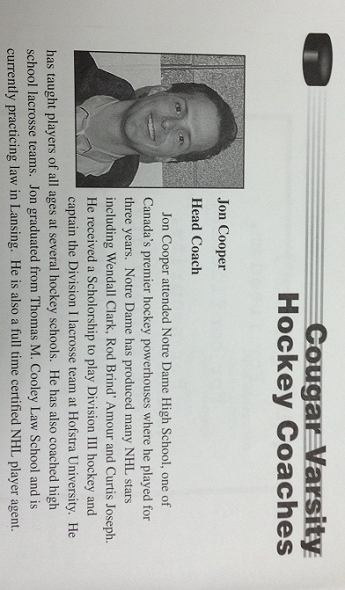
Former MHSAA Coach Lands in NHL
By
Geoff Kimmerly
MHSAA.com senior editor
April 5, 2013
This week in the year 2000, Jon Cooper had just finished his first season coaching at any level, having guided the Lansing Catholic hockey team to its first Regional championship in 25 seasons.
 It would be the only season Cooper – a local lawyer and former player at Hofstra – would coach the Cougars. But it also was the start of a nearly unimaginable rise that saw him hired to coach the NHL’s Tampa Bay Lightning two weeks ago.
As the saying goes, it couldn't have happened to a nicer guy. Cooper always was friendly and helpful to this then just-starting local media member, and despite his lone season coaching the Cougars quickly built a local fan base that continues to cheer him on from afar.
An NHL.com piece last week led with the high school angle. Click here to check it out. He took over a team 16-18-2 and near the bottom of the Eastern Conference, but Cooper surely will have plenty rooting him on from the MHSAA hockey ranks as he works to bring the franchise back to the playoffs – and we’ll work to catch up with him this summer during his first NHL offseason.
Grand Haven athletics 'Exemplary'
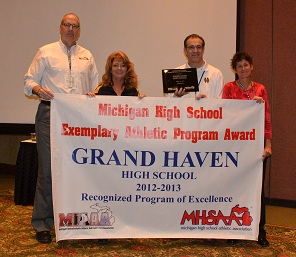 The Grand Haven High School athletic department received this year’s Exemplary Athletic Program Award from the Michigan Interscholastic Athletic Administrators Association during its annual conference last month in Traverse City.
The program was established in 1998 to recognize outstanding athletic programs and give high school administrators a vehicle by which to self-assess their practices and measure improvements.
Characteristics of “exemplary” programs include district-wide commitment, excellence in advancing the growth of well-rounded participants and serving the needs of all involved including parents and staff, and sustained success in teaching the values of high school athletics.
Click for more details on award criteria and a list of previous winners, and additional coverage by Grand Rapids’ WZZM.
Volleyball teams 'dug' deep
Michigan high school volleyball teams playing "Dig Pink" matches combined to raise more than $50,500 for cancer research last fall to rank sixth nationally, according to the Side-Out Foundation, a non-profit organization that heads up the “Dig Pink” initiative.
Class D Engadine raised the most among MHSAA schools – $5,200 – with Kent City, Bronson, Grand Ledge, Allendale, Stevensville Lakeshore, Monroe, Waterford Mott, Coldwater and Grand Blanc also contributing to the grand total. Also, Grand Ledge’s Katie Everts received a Side-Out Ambassador Program award, one of 10 handed out to individuals nationally.
Total, more than $1.1 million was raised nationwide.
Name that trophy
 Few if any schools in Michigan have done more work in researching and identifying the trophies in its case than Orchard Lake St. Mary’s, which will celebrate its 100th season of boys basketball in 2013-14.
It's rare the Eaglets historians can’t determine what a trophy celebrated. In this case, hopefully you can help.
We believe it’s a basketball trophy from the 1930s – but haven’t been able to pin down a season or a level of the MHSAA tournament. A few things that make this one unique are the plaque presentation, as opposed to a standard trophy, and the large MHSAA seal in the center. Any ideas? Email me at [email protected].
Giving back to those who gave
Those from the U.S. 23/I-94 area surely remember the tornado that tore through Dexter a little more than a year ago, on March 15, 2012.
Dexter track coaches Bob and Katie Jazwinski are remembering those who helped them rebuild after their home was destroyed by the storm.
In a Second Half report last year, Bob Jazwinski said he’d seen athletes and coaches from Adrian, Ann Arbor Pioneer, Pinckney, Chelsea, Ann Arbor Skyline, Whitmore Lake and the USA junior hockey team among the many who flocked to the community to lend a hand in the cleanup.
The Jazwinskis began repaying the favor three weeks ago on the storm's one-year anniversary with the Dexter F 3.1 Tornado Run/Walk that benefited non-profit organizations that had donated for storm recovery the year before.
Click to read the March 30, 2012 story about Adrian athletes’ contributions to the clean-up.
Last call for basketball
We got off to a late start on entering basketball schedules for this winter – but thanks to some incredibly helpful school, official and fan inputters, we were able to catch up quickly and finish with a nearly-complete list of results and standings for this season.
Still, there are some schools with incomplete schedules or a few scores missing. And before everyone forgets completely about this season, we’re hoping for a little help in finishing this enormous task.
Please check out your team’s page on MHSAA.com and help us fill in missing scores and fix inaccuracies. The latter could include just about anything – an incorrect game date, incorrect opponent or score, team missing from league standings, etc. For corrections, please email me directly at [email protected]. (Note: If a game was cancelled, don’t just delete it – contact me and I’ll add “cancelled” to avoid confusion.)
Why is this important? Two big reasons. First, MHSAA.com publishes the most complete statewide scoreboard with results from every corner of Michigan. And we have the most complete archive of basketball seasons available, currently dating to 2009-10. Help us fill in the blanks, and they’ll be saved for everyone’s benefit for years to come.
I thank you in advance for any help you are able to provide.
PHOTOS: (Top) Jon Cooper's bio appeared in the Lansing Catholic hockey team's yearbook for the 1999-2000 season. (Middle) Grand Haven athletic director Robin Bye (second from right) poses with Gull Lake athletic director and MIAAA Exemplary Committee co-char Marc Troop, Grand Haven athletic secretary Rita Way and Ann Arbor Greenhills athletic director and MIAAA Exemplary Committee co-chair Meg Seng after the Buccaneers received this year's award. (Bottom) Orchard Lake St. Mary's is hoping to identify the championship recognized by this trophy, believed to be from the 1930s.
From the Director: Back to School
August 7, 2020
By Mark Uyl
MHSAA Executive Director
Since March 12, our world has been anything but normal. These times have tested most everything in life, and as summer turns toward fall, we find ourselves still with far more questions than answers. It has been said that an abnormal reaction to an abnormal situation is normal behavior.
Let me start with these abnormal times. I’ve had many conversations with administrators over the past month about the start of school and school sports. The one constant theme is these are anything but normal times. Many of these conversations have moved to the issue of schools starting the academic year virtually while considering whether or not to offer school sports opportunities this fall. Let me share the things that have been part of almost all conversations on this topic.
The loudest message I hear is kids are going to be playing sports this fall someplace. Period. If we believe that kids are going to take the fall off if school sports aren’t offered, we haven’t been paying much attention since May. Since that time, athletic activity has taken place in the club, travel, AAU and non-school space nearly every day. From first-hand experience, many of these events have implemented ZERO of the safety standards and protocols that businesses and schools have adopted for their plans of return. The non-school world generally has plowed ahead this summer with few-to-no rules, regulations, enforcement, oversight and accountability to anyone. If kids are going to be playing sports, our member schools are telling us that activity needs to be in the safest environment possible – which is with professional educators and trained coaches in our school sports world.
Schools are quick to point out that kids have been conditioning and training with school coaches in school-sponsored workouts most of the summer. We believe that the absence of virus outbreaks among our 749 high schools’ summer activities, involving thousands of kids, has been because schools have been following the return-to-activity plans. Districts have told us they can continue doing what they’ve been doing safely since June by following all COVID guidance and regulations we have put in place with government’s leadership and partnership.
Schools starting the year virtually are telling us they will use the lessons learned from the start of sports for when students return to campus later in the fall. School administrators have shared this view privately as this has become a highly-charged topic among various groups within our school communities. Sports allow schools to bring students back to campus in small, consistent and defined groups with the same adults working with those students each day. In school sports, there is little mixing of students from one sport with those students in another – making it much easier to monitor, track and trace kids when needed than if all students were in the buildings, hallways and classrooms all day. We hear from administrators that valuable lessons can be learned with athletics in August and September for a successful school start-up with students back on campus in October.
All of us share the fundamental belief that we must protect the health and safety of individuals first. This doesn’t include only COVID prevention measures, but also the mental health of teenage students and adults as well. In districts that are starting the school year online, they see athletics being the one shred of normalcy students, and staff members who choose to coach, will have during the fall. It’s a chance to safely interact with peers and get needed physical activity that hasn’t been happening for some kids since March. Health and safety has to include all facets of the individual, and more research is being shared each day about how mental health is becoming a critical issue. For many at-risk kids, sports is the one motivating factor to keep them in school and progressing toward graduation. Given the challenges of all online education for these at-risk kids, sports and the daily routine they bring perhaps would be more important for this group of students than ever before.
With no school sports, the affluent communities and families can navigate online learning during the day and then afford the non-school athletic opportunities that kids and families in less-affluent areas simply cannot. In many communities, school sports can provide opportunities and open doors that would not appear if kids become priced-out from participating and competing.
The past five months have been the most abnormal in a century. School sports being the one pathway back to school for students in our state – the one norm for this fall – run by professional educators who put kids first, would be an incredible boost to the physical and mental health of all of us. We believe that school sports can be done safely and smartly, and the MHSAA has developed plans that do just that. While the optics of sports taking place while waiting for in-person education is not what any of us prefer, we believe we must react to these abnormal times by thinking differently and looking at these unique times through a unique lens.
Trying to find one normal for our kids in these abnormal school days might just be the best thing we can do.