


High 5s: 11/14/12
November 19, 2012
All three of this week's honorees have achieved some sort of first-time stardom this fall, either individually or as a team. And both Carli Snyder and Alex Grace will be back next fall to continue building on these accomplishments.
 Carli Snyder
Macomb Dakota junior
Volleyball
(UPDATED 11/19) Snyder, a 6-foot-1 outside hitter, was an all-stater her first two seasons of high school. But she will be remembered even more for leading Macomb Dakota this fall to its first MHSAA championship in any girls sport. The Cougars defeated Temperance Bedford in three games in Saturday's Class A Final at Kellogg Arena. Snyder unofficially finished this season with 913 kills, good for seventh in the MHSAA record book since the beginning of the rally scoring era in 2004-05. Her 31 kills against Bedford were third-most for a Final during that time. Snyder already has committed to sign with the University of Florida next year. She likely will be among frontrunners for next fall's Miss Volleyball award.
Title talk: "We wanted this thing so bad. Every girl on this team wanted it so badly. Megan (Manierski) was setting the ball perfectly. She made it very easy to get kills. ... Just talking about this moment, this gym, it makes you just want to play harder than you ever have."
Winning recipe: "We've been a competitive team in practice and in games all year, so I think that helped us at that moment (in three close Finals games) when we just didn't want to lose. We refused to lose. ... We support each other no matter what. And we hustled so hard."
Shake it up: "We have some secret handshakes with other people, but mine are very complex. I don't know how we went about that. Megan and mine is from "Parent Trap," and then Megan Downey and mine, we just made it up at team dinner. We make it a bit more complex than it needs to be, but it's fun. And it's a great thing to calm us down for a game when we've played a bad one before."
Had to be a Gator: "I like warm weather. I love the coaches. I actually called Florida for my recruiting phone call because I was kinda bored one day at home and I was like, 'I got a letter from them.' I fell in love with the coaching staff, and I told my mom that I needed to go on a visit down there. It's incredible, and when I went down there I was even more in love. Even on the phone, I knew this is where I would end up. It's just that feeling. You know when you get that feeling, and it's incredible."
 Alex Grace
Saginaw Swan Valley sophomore
Football
The Vikings' leading rusher is also one of the leading rushers in the state this season heading into Saturday's Division 4 Semifinal against Detroit Country Day. Grace has gained 2,091 yards plus run for 27 touchdowns, and needs only 109 yards and three more scores to make the MHSAA record book in both categories. He ran for 182 yards and three scores in the Vikings' Regional Final win over Croswell-Lexington. Grace took over as Swan Valley's running back this season after the graduation of his brother Johnathan, who rushed for 1,790 yards last season and now plays at Michigan Tech. Both brothers ran on Swan Valley's 400-meter relay that finished runner-up at the Lower Peninsula Division 2 Track and Field Final in the spring. Alex is 6-0 and 185 pounds and runs the 40-yard dash in 4.5 seconds.
I'd like to run like: "Even my brother. I like to look at myself as close to him. Professionally, (Minnesota Vikings back) Adrian Peterson. He's a tough runner, fast. He's strong."
Underdogs again: "The last game against Croswell, they were the No. 2 team and we were predicted to lose. But we came back and beat them. I use that underdog feeling to work harder each day."
Best brotherly advice: "Work hard, and if there are doubters, don't let them get you down."
Science and math: (My favorite classes are) biology and economics. They just come easy to me. I enjoy it."
 Flint Beecher football
The Buccaneers, coached by former Michigan State and NFL standout Courtney Hawkins, were one of the final teams selected for the playoffs, at 5-4 after a 3-4 start. But Beecher advanced to this week's Division 7 Semifinal against Detroit Loyola by eliminating reigning champion Saginaw Nouvel, 19-15, in last week's Regional championship game. Beecher, now 8-4, has made the playoffs six straight years. The first of that run came in Hawkins' second as coach and after 12 straight losing seasons.
Previous 2012-13 honorees:
- Julia Bos, Grand Rapids Christian cross country - Click for more
- Morgan Bullock, Zeeland swimming - Click for more
- Nathan Burnand, Waterford Mott cross country - Click for more
- Aaron Chatfield, Burt Lake Northern Michigan Christian soccer - Click for more
- Erin Finn, West Bloomfield cross country - Click for more
- Billy Heckman, Portage Central tennis - Click for more
- Codi Jenshak, Escanaba tennis - Click for more
- Amanda McKinzie, Battle Creek St. Philip cross country - Click for more
- Connor Mora, Cedar Springs cross country - Click for more
- Kelsey Murphy, Plymouth golf - Click for more
- Dewey Lewis, Rockford soccer - Click for more
- Nick Raymond, Erie Mason cross country - Click for more
- Jacqueline Setas, Lansing Catholic golf - Click for more
- Michael Sienko, Williamston tennis - Click for more
- Beal City volleyball - Click for more
- East Kentwood soccer - Click for more
- Grand Blanc boys soccer - Click for more
- Ithaca football - Click for more
- Lansing Everett football - Click for more
- Ludington boys tennis - Click for more
- Muskegon Mona Shores girls golf - Click for more
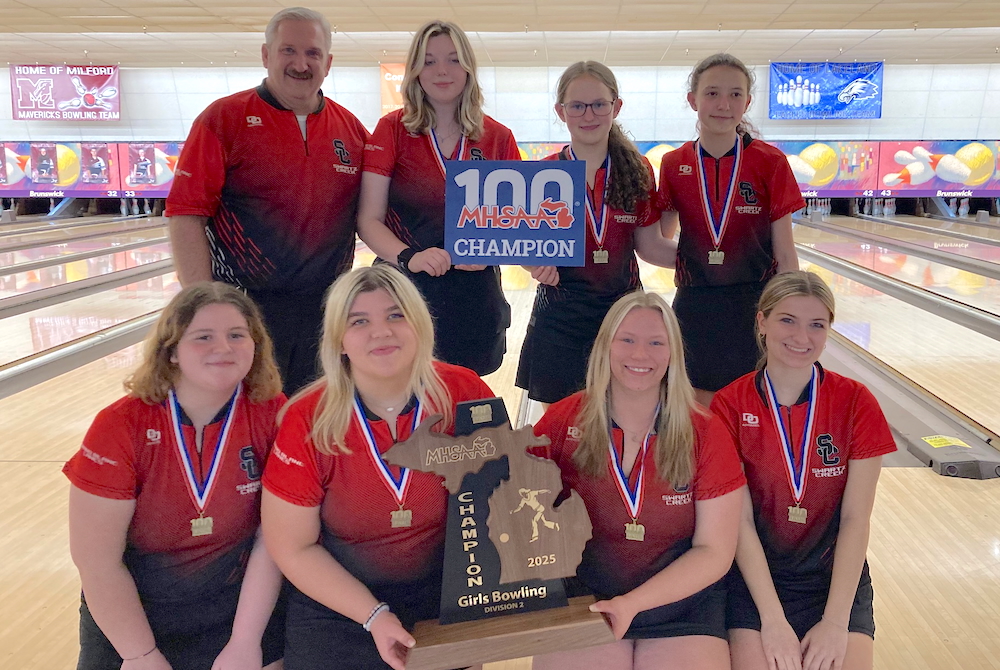
Swartz Creek Girls Complete Championship Climb with Historic Sweep
By
Keith Dunlap
Special for MHSAA.com
February 28, 2025
WATERFORD —Swartz Creek girls bowling coach Mike Vanderkuur has never had to look far to try and emulate the state’s gold standard.
Ever since starting the middle school bowling program for Swartz Creek 12 years ago and taking over as head coach of the high school team seven years later, Vanderkuur has soaked up everything league rival and neighbor Flint Kearsley did en route to winning nine Division 2 titles over the last 11 seasons.
“It’s always been my goal to do what Kearsley has done,” Vanderkuur said. “It was definitely where I wanted to get to.”
Vanderkuur and Swartz Creek arrived Friday during the Division 2 Team Final at Century Bowl, finishing first out of the qualifying block and then rolling to its first championship.
The Dragons finished their run with a three-game sweep of Cedar Springs in the final, winning 148-138, 223-115 and 201-196 in the best-of-five Baker game format.
Vanderkuur and his bowlers were obviously emotional afterward, reflecting on the fact they spent years together through the middle school program and on the high school team working for this moment.
“Every one of these girls besides two started in sixth grade,” Vanderkuur said. “They’ve stuck, stuck and stuck all the way up.”
As it advanced, Swartz Creek felt like it was destined for a championship match against Kearsley, but the bracket didn’t pan out that way.
In the semifinals, Cedar Springs earned a four-game win (146-162, 172-157, 188-158, 175-148) over Kearsley to set up the matchup with Swartz Creek, which defeated Sparta 210-148 in the fifth game of a semifinal match.
But in its first appearance in the championship match, Cedar Springs couldn’t muster the same energy against Swartz Creek.
“Honestly, I just think our girls ran out of steam,” Cedar Springs head coach Crystal Morales said. “I think the energy was pretty much out. It kind of fell apart at the end.”
Swartz Creek had a score of 3,337 out of the qualifying block, well ahead of No. 2 seed Bay City John Glenn’s total of 3,196.
The Dragons then earned a four-game win over Mason in the quarterfinals.
Swartz Creek was a bit surprised to not see Kearsley in the championship match, but didn’t let up against Cedar Springs.
“I dreamt of it,” said Swartz Creek senior Kaidance Gates-Leonard. “I wish the older girls (before) would have made it. But we do good every year, and we deserve it.”
Morales said the main goal for her team was to make it out of the qualifying block, and Cedar Springs managed to do that by 74 pins as the No. 7 seed.
The Red Hawks then got hot, starting with a four-game win over John Glenn in the quarterfinals before knocking off Kearsley.
“After the first individual game, I didn’t think we were in the cut,” Morales said. “That last (individual game), we pulled a 934, and I was like ‘We might have just pulled ourselves in this.’
Kearsley was the third seed out of the qualifying block and defeated Three Rivers in the quarterfinals in four games.
Sparta recorded a five-game win over New Boston Huron in the other quarterfinal.