


High 5s: 11/14/12
November 19, 2012
All three of this week's honorees have achieved some sort of first-time stardom this fall, either individually or as a team. And both Carli Snyder and Alex Grace will be back next fall to continue building on these accomplishments.
 Carli Snyder
Macomb Dakota junior
Volleyball
(UPDATED 11/19) Snyder, a 6-foot-1 outside hitter, was an all-stater her first two seasons of high school. But she will be remembered even more for leading Macomb Dakota this fall to its first MHSAA championship in any girls sport. The Cougars defeated Temperance Bedford in three games in Saturday's Class A Final at Kellogg Arena. Snyder unofficially finished this season with 913 kills, good for seventh in the MHSAA record book since the beginning of the rally scoring era in 2004-05. Her 31 kills against Bedford were third-most for a Final during that time. Snyder already has committed to sign with the University of Florida next year. She likely will be among frontrunners for next fall's Miss Volleyball award.
Title talk: "We wanted this thing so bad. Every girl on this team wanted it so badly. Megan (Manierski) was setting the ball perfectly. She made it very easy to get kills. ... Just talking about this moment, this gym, it makes you just want to play harder than you ever have."
Winning recipe: "We've been a competitive team in practice and in games all year, so I think that helped us at that moment (in three close Finals games) when we just didn't want to lose. We refused to lose. ... We support each other no matter what. And we hustled so hard."
Shake it up: "We have some secret handshakes with other people, but mine are very complex. I don't know how we went about that. Megan and mine is from "Parent Trap," and then Megan Downey and mine, we just made it up at team dinner. We make it a bit more complex than it needs to be, but it's fun. And it's a great thing to calm us down for a game when we've played a bad one before."
Had to be a Gator: "I like warm weather. I love the coaches. I actually called Florida for my recruiting phone call because I was kinda bored one day at home and I was like, 'I got a letter from them.' I fell in love with the coaching staff, and I told my mom that I needed to go on a visit down there. It's incredible, and when I went down there I was even more in love. Even on the phone, I knew this is where I would end up. It's just that feeling. You know when you get that feeling, and it's incredible."
 Alex Grace
Saginaw Swan Valley sophomore
Football
The Vikings' leading rusher is also one of the leading rushers in the state this season heading into Saturday's Division 4 Semifinal against Detroit Country Day. Grace has gained 2,091 yards plus run for 27 touchdowns, and needs only 109 yards and three more scores to make the MHSAA record book in both categories. He ran for 182 yards and three scores in the Vikings' Regional Final win over Croswell-Lexington. Grace took over as Swan Valley's running back this season after the graduation of his brother Johnathan, who rushed for 1,790 yards last season and now plays at Michigan Tech. Both brothers ran on Swan Valley's 400-meter relay that finished runner-up at the Lower Peninsula Division 2 Track and Field Final in the spring. Alex is 6-0 and 185 pounds and runs the 40-yard dash in 4.5 seconds.
I'd like to run like: "Even my brother. I like to look at myself as close to him. Professionally, (Minnesota Vikings back) Adrian Peterson. He's a tough runner, fast. He's strong."
Underdogs again: "The last game against Croswell, they were the No. 2 team and we were predicted to lose. But we came back and beat them. I use that underdog feeling to work harder each day."
Best brotherly advice: "Work hard, and if there are doubters, don't let them get you down."
Science and math: (My favorite classes are) biology and economics. They just come easy to me. I enjoy it."
 Flint Beecher football
The Buccaneers, coached by former Michigan State and NFL standout Courtney Hawkins, were one of the final teams selected for the playoffs, at 5-4 after a 3-4 start. But Beecher advanced to this week's Division 7 Semifinal against Detroit Loyola by eliminating reigning champion Saginaw Nouvel, 19-15, in last week's Regional championship game. Beecher, now 8-4, has made the playoffs six straight years. The first of that run came in Hawkins' second as coach and after 12 straight losing seasons.
Previous 2012-13 honorees:
- Julia Bos, Grand Rapids Christian cross country - Click for more
- Morgan Bullock, Zeeland swimming - Click for more
- Nathan Burnand, Waterford Mott cross country - Click for more
- Aaron Chatfield, Burt Lake Northern Michigan Christian soccer - Click for more
- Erin Finn, West Bloomfield cross country - Click for more
- Billy Heckman, Portage Central tennis - Click for more
- Codi Jenshak, Escanaba tennis - Click for more
- Amanda McKinzie, Battle Creek St. Philip cross country - Click for more
- Connor Mora, Cedar Springs cross country - Click for more
- Kelsey Murphy, Plymouth golf - Click for more
- Dewey Lewis, Rockford soccer - Click for more
- Nick Raymond, Erie Mason cross country - Click for more
- Jacqueline Setas, Lansing Catholic golf - Click for more
- Michael Sienko, Williamston tennis - Click for more
- Beal City volleyball - Click for more
- East Kentwood soccer - Click for more
- Grand Blanc boys soccer - Click for more
- Ithaca football - Click for more
- Lansing Everett football - Click for more
- Ludington boys tennis - Click for more
- Muskegon Mona Shores girls golf - Click for more
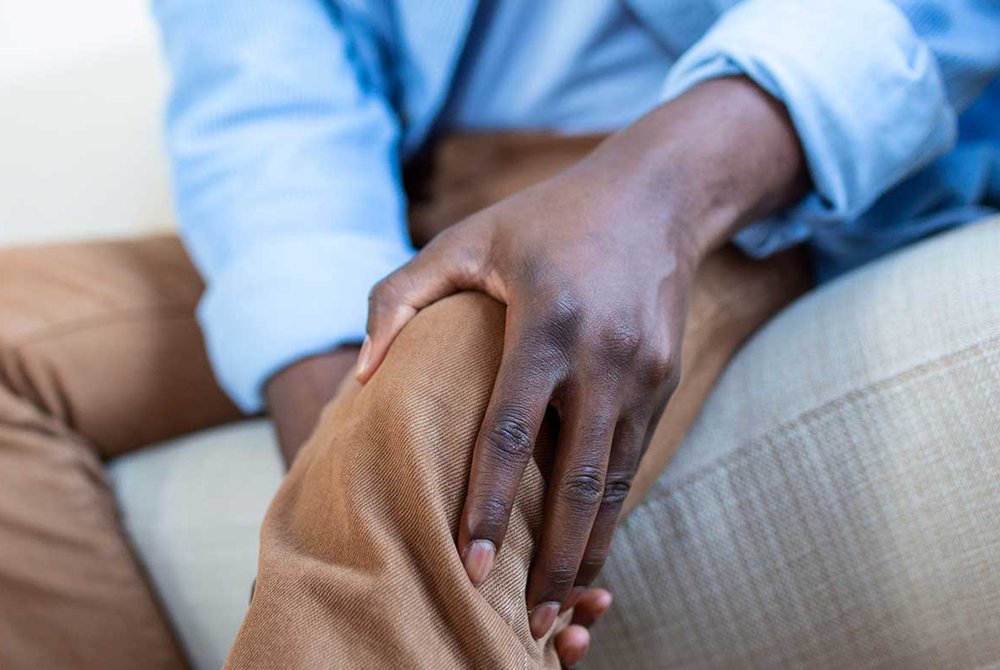
Symptoms of a Meniscus Tear — and When to Seek Treatment
April 2, 2024
Meniscus tears are not one size fits all: Sometimes they cause no pain, other times they’re excruciating.
 Once in a while they heal or adapt on their own, but more often than not they require physical therapy or surgery.
“Your meniscus is a fiber elastic cartilage that acts as a shock absorber for the knee,” says Ahmad Bazzi, M.D., a sports medicine physician at Henry Ford Health. “It also helps stabilize the knee joint. But when it tears — which can occur in young athletes after a pivot injury or in older people who have arthritis — it can be painful.”
Here, Dr. Bazzi shares symptoms of a meniscus tear and when to see a doctor.
What Does A Meniscus Tear Feel Like?
Depending upon the level of injury and type of tear, meniscus tears can either be asymptomatic or cause symptoms like:
- Locking. When the meniscus tears, a piece of it might move into the knee joint, causing mechanical issues like stiffness and locking of the knee joint.
- Catching or clicking. This often feels like a sudden ‘click’ in the knee joint, where it suddenly gives out while you’re walking or doing certain movements.
- Localized pain on the inner or outer part of the knee. In young athletes, a meniscus tear often causes an impaired range of motion and localized pain on the inner or outer part of the knee.
- Pain and swelling. In older people, a meniscus tear often causes swelling and an overall aching pain in the knee.
Treatment Options For Meniscus Tears
A meniscus tear can only heal on its own if the tear is on the outer part of the knee where it has better access to blood supply. If you’re experiencing pain a few days after injury and you have limited range of motion, instability and/or swelling in the knee, Dr. Bazzi recommends seeing a doctor to get an examination and, if needed, an MRI for diagnosis.
“It’s hard to tell what type of meniscus tear you have if you haven’t seen a doctor,” says Dr. Bazzi. “If you have a mechanically unstable tear and it goes untreated, it could lead to worsening range of motion and stiffness, or worsening arthritis. It’s important to get seen by a doctor to get an accurate diagnosis and the proper treatment. It may take one to three months for a full recovery.”
Here, Dr. Bazzi shares treatment options:
Surgery
If someone is having mechanical symptoms like locking or catching, surgery may be considered right away, especially if it’s an athlete younger than 40 years old. “Meniscus tear surgery has a shorter recovery compared to other knee surgeries,” says Dr. Bazzi. “Surgery could either consist of a meniscectomy, which is partial or complete removal of the meniscus, or sometimes just a meniscus repair.”
Hyaluronic acid or cortisone injections
Non-operative treatments are often recommended for older people who have degenerative tears due to arthritis. “This is because meniscus surgery doesn’t often relieve their pain since they have underlying arthritis, meaning they have cartilage loss in the meniscus,” says Dr. Bazzi.
Instead, a cortisone injection, which is an anti-inflammatory medication that can be injected into the knee, can reduce inflammation, swelling and pain caused by arthritis.
A hyaluronic acid injection may also be considered, which adds cushioning in the knee. “Hyaluronic acid is one of the substances that make up our cartilage, so this injection helps us mimic the lost cartilage,” says Dr. Bazzi. “It also has anti-inflammatory properties.”
Physical therapy
Physical therapy is another great option, especially for older people who need non-operative treatment options. It can help the knee adapt to the tear, reduce pain and encourage full range of motion. “Physical therapy for meniscus tears focuses on balance exercises and exercises to strengthen the muscles around the knee,” says Dr. Bazzi. “This helps to uphold the knee joint to achieve full range of motion and strength while being pain-free.”
To find a sports medicine provider at Henry Ford Health, visit henryford.com/athletes or call 313-651-1969.
Reviewed by Ahmad Bazzi, M.D., a sports medicine physician who sees patients at Henry Ford Medical Center – Fairlane.