


High 5s: 11/7/12
November 7, 2012
This past Saturday saw eight teams and eight individuals crowned MHSAA champions, and this week we feature a few who will be listed among the best for all time.
 Erin Finn
West Bloomfield senior
Cross country
Finn won her second straight MHSAA individual Lower Peninsula Division 1 championship, this time in 17:07.9. Her finish was the fastest from any of the four divisions that raced Saturday at Michigan International Speedway, and gave her the victory in hers by 27 seconds. Finn’s time was the fourth-best ever at an MHSAA Final. She has three of the top 15 times ever run at MIS, more than any other runner.
On track for more: Finn also won an MHSAA Track and Field championship last season, setting an all-division/class record in the 1,600 with a time of 10:17.86. That time was nearly five seconds better than the previous best.
Maize and Blue: Finn will run next season at the University of Michigan. The Wolverines cross country team is ranked No. 7 nationally heading into Friday's NCAA Great Lakes Regional.
Scientifically speaking: Finn intends to study biomechanical engineering at U-M. "My junior year, I found out I love physics, and I already knew I loved bio and chemistry. So, what's better than to combine those?"
Runners to chase: “I looked up to Megan Goethals (of Rochester), number one, and Shannon Osika (of Waterford Mott). They’re people I competed with. I know that one day I can be like that. It’s more real to me.”
 Nick Raymond
Erie Mason senior
Cross country
After dashing to the lead last season and finishing fourth, Nick Raymond dominated the Lower Peninsula Division 3 Final at MIS with a time of 15:05.1 – the second-fastest time for a Division 3/Class C MHSAA Final to only Maverick Darling's 14:52.8 for Ovid-Elsie in 2007. Raymond is the first individual cross country champion from Erie Mason (not counting another who finished first among individuals before team and individual placers were combined for one race beginning in 1997) and also placed in both the 1,600 and 3,200 at the spring's Lower Peninsula Division 3 Track and Field Final.
A long drive: "I've been working hard, since the first time (I ran) in sixth grade. Working hard and training hard over the summer and during mandatory practices too."
Brotherly influence: Raymond began running cross country in the footsteps of his older brother Andrew Raymond, a 2010 graduate. "He told me, 'If you just keep working hard, just look forward at your dream, your goal, you will achieve it.'"
Now the pool, then the track: Raymond swims during the winter, specializing in butterfly and breaststroke. Then it's on to track. Raymond finished fourth in the 1,600 (4:21.84) and seventh in the 3,200 (9:44.91) at last season's Lower Peninsula Division 3 Final.
Looking up to Pre: Like many in the running community, Raymond considers former Oregon and international star Steve Prefontaine a major influence. "I liked how he had a lot of faith in himself."
 East Kentwood soccer
The top-ranked Falcons edged Grand Blanc 1-0 at Troy Athens to claim their fourth Division 1 championship in six seasons. They finished 22-1-4, their seventh with at least 20 wins in the last eight years.
Previous 2012-13 honorees:
- Julia Bos, Grand Rapids Christian cross country - Click for more
- Morgan Bullock, Zeeland swimming - Click for more
- Nathan Burnand, Waterford Mott cross country - Click for more
- Aaron Chatfield, Burt Lake Northern Michigan Christian soccer - Click for more
- Billy Heckman, Portage Central tennis - Click for more
- Codi Jenshak, Escanaba tennis - Click for more
- Amanda McKinzie, Battle Creek St. Philip cross country - Click for more
- Connor Mora, Cedar Springs cross country - Click for more
- Kelsey Murphy, Plymouth golf - Click for more
- Dewey Lewis, Rockford soccer - Click for more
- Jacqueline Setas, Lansing Catholic golf - Click for more
- Michael Sienko, Williamston tennis - Click for more
- Beal City volleyball - Click for more
- Grand Blanc boys soccer - Click for more
- Ithaca football - Click for more
- Lansing Everett football - Click for more
- Ludington boys tennis - Click for more
- Muskegon Mona Shores girls golf - Click for more
Century of School Sports: Why Does the MHSAA Have These Rules?
By
Geoff Kimmerly
MHSAA.com senior editor
September 18, 2024
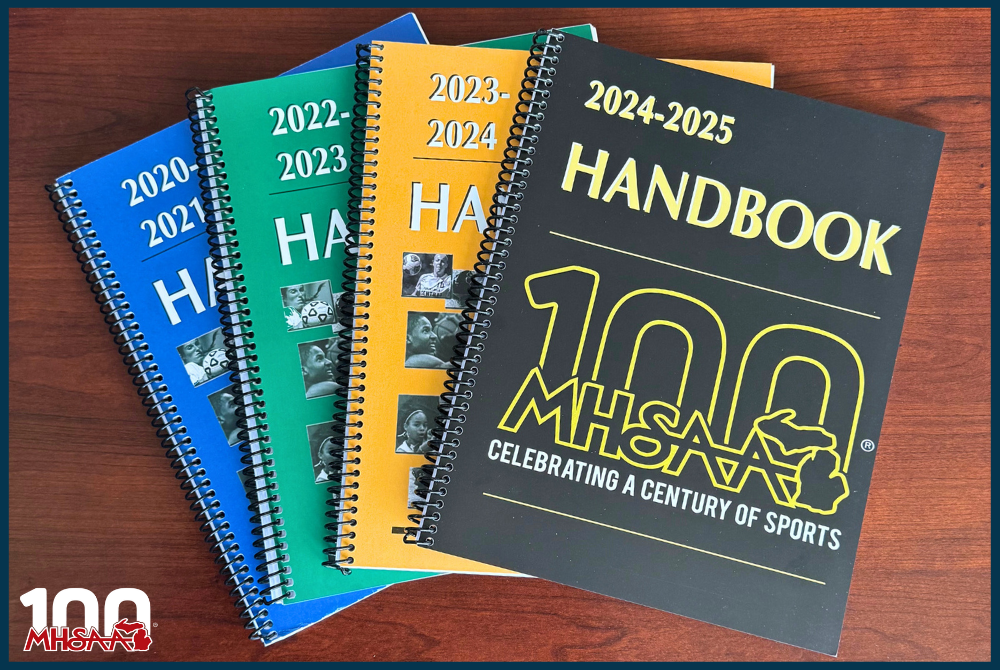
MHSAA administrators are two trips into their annual seven-stop fall tour that has become a tradition during nearly half of the Association’s “Century of School Sports” – and this year, a focus has been on answering a key question at the heart of educational athletics since long before the MHSAA was formed during the 1924-25 school year.
The MHSAA’s Update meeting series is in its 47th year and includes half-day conferences in seven locations – generally in the Kalamazoo, Metro Detroit, Grand Rapids, Saginaw, northern Lower Peninsula and mid-Michigan areas, and at Northern Michigan University in Marquette. The six Lower Peninsula sessions begin with an athletic director in-service during which MHSAA assistant directors explain recent rules changes and discuss challenges our administrators face on a daily basis (with Upper Peninsula athletic directors participating in a similar in-service during the spring).
Those in-services are followed by a session with executive director Mark Uyl, who speaks to athletic directors, superintendents, principals and school board members on a variety of topics including the MHSAA’s current objectives and ideas for the future, while also reinforcing the longstanding values that remain the bedrock of our daily work.
And that leads to the question he’s presenting across the state this fall:
Why does the MHSAA have these rules?
Frankly, the answer goes back to the beginning of school sports in Michigan – all the way back to 1895, when the first MHSAA predecessor organization was formed.
The first MHSAA Representative Council president Lewis L. Forsythe explained in his book “Athletics in Michigan High Schools – The First Hundred Years” how regulations always have been necessary:
“Eligibility rules are a necessity in interscholastic competition. It was common acknowledgement of this fact that led to the first State inter-school organization in 1895. The rules at first were few, simple and liberal. But with the passing of the years they came to be more numerous, more complex, and more restrictive, again through common acknowledgment of desirability if not of necessity.”
That necessity – and the reasoning behind it – has not changed.
Two main points explain why rules are absolutely imperative for educational athletics to thrive.
► 1. Participation – through providing as many opportunities as possible for students to play – has been the mission of school sports since their start. Rules contribute to the value of participation.
If there are requirements for children to participate in athletics – for example, an academic standard or rules that dissuade students from switching schools every year – then school sports programs mean more to all involved.
If we raise the bar, raise the standards of eligibility and conduct, we raise the value of our school sports programs. If we lower the bar, we lower the value of being part of school sports – because without rules, contest results are meaningless, and the value of participating is diminished.
► 2. We have rules where the stakes are higher, and agreement is lower – because where the stakes are highest, there is the greatest tendency for some people to try to gain an unfair advantage, and the greatest need for rules to curb possible dishonest activity.
This statement goes to the heart of the history, rationale and application of MHSAA rules. Obviously and simply put, school sports mean a lot to those who take part, and that significance is high enough to stoke disagreement – and we need rules to govern those disagreements. We have the most rules for high school sports, where championships are at stake and the possibility of disagreement is greatest.
***
Finally – and perhaps providing the strongest reinforcement of the two points above – is this:
Schools choose to make MHSAA rules their own.
Quite literally, school districts vote annually to be part of the MHSAA – and confirming this voluntary membership comes with the requirement to follow all MHSAA rules.
When schools challenge our rules, they literally are seeking to break the rules they already have committed to uphold.
These rules, and this commitment, are the strength of our organization across 752 member high schools and several hundred more middle schools and junior high schools. They have been constructed on a century of precedents and after considerations by representatives of those same member schools – representatives those schools have voted to elect every school year during the MHSAA’s history.
Previous "Century of School Sports" Spotlights
Sept. 10: Special Medals, Patches to Commemorate Special Year - Read
Sept. 4: Fall to Finish with 50th Football Championships - Read
Aug. 28: Let the Celebration Begin - Read