


High 5s: 11/7/12
November 7, 2012
This past Saturday saw eight teams and eight individuals crowned MHSAA champions, and this week we feature a few who will be listed among the best for all time.
 Erin Finn
West Bloomfield senior
Cross country
Finn won her second straight MHSAA individual Lower Peninsula Division 1 championship, this time in 17:07.9. Her finish was the fastest from any of the four divisions that raced Saturday at Michigan International Speedway, and gave her the victory in hers by 27 seconds. Finn’s time was the fourth-best ever at an MHSAA Final. She has three of the top 15 times ever run at MIS, more than any other runner.
On track for more: Finn also won an MHSAA Track and Field championship last season, setting an all-division/class record in the 1,600 with a time of 10:17.86. That time was nearly five seconds better than the previous best.
Maize and Blue: Finn will run next season at the University of Michigan. The Wolverines cross country team is ranked No. 7 nationally heading into Friday's NCAA Great Lakes Regional.
Scientifically speaking: Finn intends to study biomechanical engineering at U-M. "My junior year, I found out I love physics, and I already knew I loved bio and chemistry. So, what's better than to combine those?"
Runners to chase: “I looked up to Megan Goethals (of Rochester), number one, and Shannon Osika (of Waterford Mott). They’re people I competed with. I know that one day I can be like that. It’s more real to me.”
 Nick Raymond
Erie Mason senior
Cross country
After dashing to the lead last season and finishing fourth, Nick Raymond dominated the Lower Peninsula Division 3 Final at MIS with a time of 15:05.1 – the second-fastest time for a Division 3/Class C MHSAA Final to only Maverick Darling's 14:52.8 for Ovid-Elsie in 2007. Raymond is the first individual cross country champion from Erie Mason (not counting another who finished first among individuals before team and individual placers were combined for one race beginning in 1997) and also placed in both the 1,600 and 3,200 at the spring's Lower Peninsula Division 3 Track and Field Final.
A long drive: "I've been working hard, since the first time (I ran) in sixth grade. Working hard and training hard over the summer and during mandatory practices too."
Brotherly influence: Raymond began running cross country in the footsteps of his older brother Andrew Raymond, a 2010 graduate. "He told me, 'If you just keep working hard, just look forward at your dream, your goal, you will achieve it.'"
Now the pool, then the track: Raymond swims during the winter, specializing in butterfly and breaststroke. Then it's on to track. Raymond finished fourth in the 1,600 (4:21.84) and seventh in the 3,200 (9:44.91) at last season's Lower Peninsula Division 3 Final.
Looking up to Pre: Like many in the running community, Raymond considers former Oregon and international star Steve Prefontaine a major influence. "I liked how he had a lot of faith in himself."
 East Kentwood soccer
The top-ranked Falcons edged Grand Blanc 1-0 at Troy Athens to claim their fourth Division 1 championship in six seasons. They finished 22-1-4, their seventh with at least 20 wins in the last eight years.
Previous 2012-13 honorees:
- Julia Bos, Grand Rapids Christian cross country - Click for more
- Morgan Bullock, Zeeland swimming - Click for more
- Nathan Burnand, Waterford Mott cross country - Click for more
- Aaron Chatfield, Burt Lake Northern Michigan Christian soccer - Click for more
- Billy Heckman, Portage Central tennis - Click for more
- Codi Jenshak, Escanaba tennis - Click for more
- Amanda McKinzie, Battle Creek St. Philip cross country - Click for more
- Connor Mora, Cedar Springs cross country - Click for more
- Kelsey Murphy, Plymouth golf - Click for more
- Dewey Lewis, Rockford soccer - Click for more
- Jacqueline Setas, Lansing Catholic golf - Click for more
- Michael Sienko, Williamston tennis - Click for more
- Beal City volleyball - Click for more
- Grand Blanc boys soccer - Click for more
- Ithaca football - Click for more
- Lansing Everett football - Click for more
- Ludington boys tennis - Click for more
- Muskegon Mona Shores girls golf - Click for more
Block Party: 2026 Girls Volleyball Week 8 Report
By
Geoff Kimmerly
MHSAA.com senior editor
October 14, 2026
Girls Volleyball District play begins in three weeks, and you won’t find any contenders slowing things down as we speed toward the beginning of the postseason.
Arguably this fall’s most prestigious tournament – the Beast of the East – will be played Saturday with all four state divisions sending ranked teams into the field, and the Upper Peninsula also is hosting one of its most competitive events this season, at Crystal Falls Forest Park. Several teams are attempting to put finishing touches on league championships, and many more have lined up other contenders as they prepare for the playoffs and the ultimatum of win to play again.
Records below are those reported and tracked on this website, and rankings referred to below reflect the latest polls posted by the Michigan Interscholastic Volleyball Coaches Association (MIVCA).
Week in Review
The countdown of last week’s five most intriguing results:
1. Bloomfield Hills Marian d. Farmington Hills Mercy (25-21, 25-23, 22-25, 25-17) After suffering two earlier losses to Mercy, Marian (28-3) took this match in four sets, clinched their Catholic High School League Tournament title and has taken over the No. 1 ranking in Division 1, sending the Marlins (20-4) to No. 2.
2. Parma Western d. Hanover-Horton (26-24, 25-17) Division 2 No. 3 Western’s 6-0 run through Hanover-Horton’s Karen Abbott Invitational pushed its record to 32-0 and also included wins over Division 3 No. 7 Grass Lake, No. 6 Traverse City St. Francis, Hudson, Brooklyn Columbia Central and Division 4 No. 1 Adrian Lenawee Christian, in addition to the Division 3 No. 10 Comets (21-7-5).
3. Midland Dow d. Saginaw Valley Lutheran (30-28, 20-25, 25-20) The Chargers (36-4-4) also handed Division 2 No. 4 Frankenmuth its first during this home quad, but the night’s most exciting set may have been the first one of this win over Division 3 top-ranked Saginaw Valley Lutheran (38-6-1).
4. Traverse City Central d. Grand Rapids South Christian (25-20, 25-18) The Trojans (22-2-1) finished 4-0 at the Hudsonville Unity Christian Invitational, with this sweep of the Division 2 No. 8 Sailors (22-7) the highlight but a three-set win over honorable mention Vicksburg also of note.
5. Roscommon d. Traverse City St. Francis (25-20, 25-15) These two top-10 teams in Division 3 locked up as part of a quad, with the No. 3-ranked and host Bucks (29-6-5) avenging last year’s loss to the No. 6 Gladiators (24-13-2).
Watch List
With an eye toward November, here are two teams in each division making sparks:
DIVISION 1
Clarkston (20-2) The Wolves have held down the No. 3 ranking in Division 1 since Sept. 8, trailing only Mercy and Marian after falling to both in August. Those are Clarkston’s only losses this season as it looks to bounce back from last year’s District exit against Oxford – which the Wolves defeated to start this season and again last week. A pair of wins over No. 8 Lowell and singles over No. 10 Grand Rapids Forest Hills Northern and No. 5 South Lyon East also pop off the page.
South Lyon East (25-5) The No. 5 Cougars’ most recent win also was the best of several memorable ones this fall, as they downed No. 2 Mercy in three sets last week after losing the first 25-12. They also have defeated No. 10 Forest Hills Northern twice, honorable mention Orchard Lake St. Mary’s and No. 9 Grand Haven once, and honorable mention South Lyon twice after the Lions ended East’s 2025 season in their District. Those two rivals are headed to the same District again next month.
DIVISION 2
Detroit Country Day (12-6-1) The Yellowjackets haven’t played as many matches as most contenders, but they’ve tested themselves against some of the state’s elite with losses to Division 1 No. 2 Mercy, top-ranked Marian and honorable mention St. Mary’s among others. The two-time reigning Division 2 champion is ranked No. 2 currently and tonight has an opportunity to avenge its Sept. 30 defeat against the Eaglets. Country Day also will see Division 1 No. 5 South Lyon East a second time Oct. 22 after winning their first matchup Sept. 3.
Marshall (23-9-1) The unranked Redhawks have navigated tough competition all season, going five sets before falling to No. 3 Parma Western in Interstate 8 Athletic Conference play, but defeating honorable mention Vicksburg, Division 3 No. 2 Plymouth Christian Academy, No. 4 Clinton and honorable mention Morley Stanwood and going 1-2 against Division 1 honorable mention Battle Creek Lakeview. Total, five defeats have come against teams ranked or honorable mention in Divisions 1 and 2.
DIVISION 3
Cass City (18-6-4) These Red Hawks have tested themselves substantially as they look next month to run their District title streak to six and potentially return to the season’s final weekend for what would be the fourth time this decade. Cass City went 2-2-1 at the opening Cadillac Invitational, 0-2-2 at the MI Elite Program Cup and 1-2-1 at the D3/D4 Showdown, facing elite and/or often much larger opponents at all three. The Red Hawks are otherwise 15-0 this fall.
Muskegon Western Michigan Christian (26-6) WMC matched up with a tough crew of larger opponents at the Unity Christian Invitational over the weekend and finished only 1-3 there. But the No. 5-ranked Warriors are otherwise 25-3 this season with a 5-0 day over a field that included honorable mention Hart and Fruitport in winning Mona Shores’ Best of the West, plus an earlier victory over Division 2 previously-honorable mention Fremont.
DIVISION 4
Atlanta (25-0) The Huskies are an honorable mention in this week’s poll and one of three teams statewide still undefeated. They’ve won Regional titles the last two seasons and this fall have lost only six sets. Atlanta went 5-0 winning all 10 sets during the Onaway Tournament and finished 6-0 winning all 12 sets it played at the Oscoda Invitational last month. The Huskies will travel Oct. 20 to face Hale, which delivered their only regular-season defeat of 2025.
Mount Pleasant Sacred Heart (23-6-3) The No. 2-ranked Irish have won nine of their last 10 matches, the lone loss during that time to Division 3 top-ranked Valley Lutheran, and they also defeated Division 4 No. 7 Ubly that day. Three losses total have come to Valley Lutheran, with the other three to Division 2 No. 8 North Branch, Division 3 No. 3 Roscommon and No. 9 Elk Rapids. Sacred Heart also can count a win over Division 4 No. 4 Traverse City Christian and a tie with No. 9 Crystal Falls Forest Park.
Can’t-Miss Contests
Be on the lookout for results of these matches and tournaments coming up:
Thursday – Grand Haven (26-8-1) at Hudsonville (28-3) – The best from the always-strong Ottawa-Kent Conference Red are the No. 9 Buccaneers and No. 6 Eagles, and Hudsonville won the first match Sept. 17 in three sets.
Thursday – Detroit Country Day (12-6-1) at Macomb Lutheran North (23-1) – The Nos. 2 and 6 teams in Division 2, respectively, face off in what could be a Regional Final preview.
Thursday – Elk Rapids (14-7-3) at Traverse City Christian (27-6) – The Division 3 No. 9 Elks and Division 4 No. 4 Sabres meet in one of northern Michigan’s most anticipated matchups of the season.
Saturday – Beast of the East at Trinity Health Sports Center – The field of 32 includes 18 teams currently ranked or receiving honorable mentions in Divisions 1-4, and a few others formerly in that group. Division 1 top-ranked Bloomfield Hills Marian and Division 2 No. 1 Grand Rapids Christian are among those taking the court.
Tuesday – Grand Rapids Forest Hills Central (11-18), Forest Hills Northern (22-8) at Grand Rapids Christian (22-3) – As noted above, the Eagles are ranked No. 1 in Division 2, and Forest Hills Northern is No. 10 in Division 1.
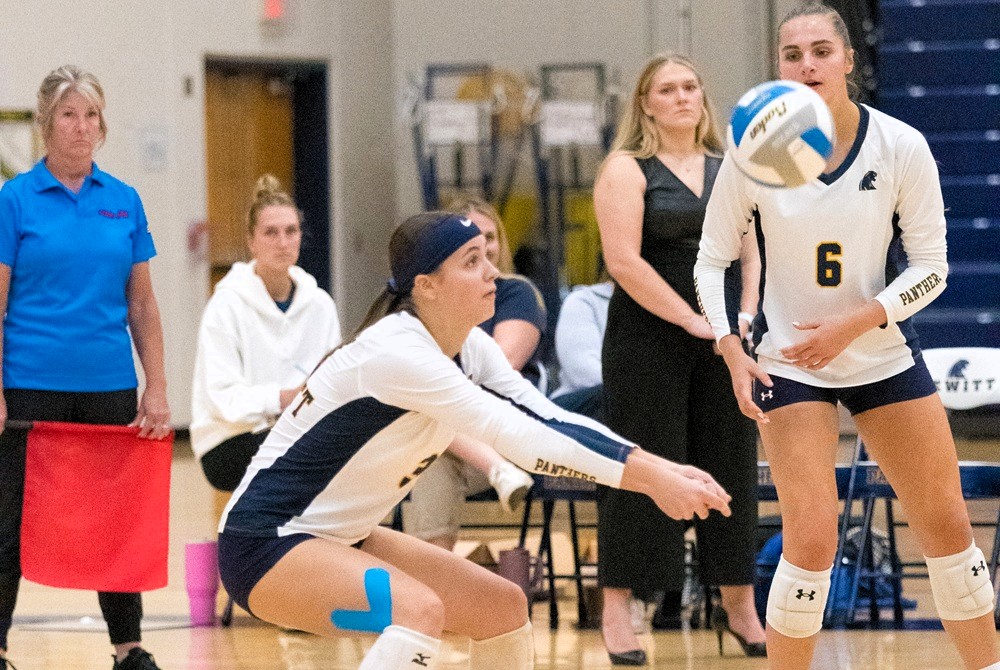
PHOTO (Top) DeWitt returns a volley during a match this season against Okemos. (Photo by TCP Photography.)