


High 5s: More to come this fall
June 28, 2012
The end of the 2011-12 school year also signaled our final High 5s until the fall season begins.
Check back in mid-August for our first High 5s of 2012-13. Below is the list, with links, of this spring's honorees.
This spring's previous honorees
- Sarah Appold, Saginaw Valley Lutheran softball
- Katie Brozovich, Clarkston tennis
- Latipha Cross, Southfield track and field
- Sarita Dotson, Battle Creek Lakeview track and field
- Lauren Hooker, East Grand Rapids lacrosse
- Drake Johnson, Ann Arbor Pioneer track and field
- Bailey LaFreniere, Ishpeming Westwood golf
- Megan Manninen, Ishpeming Westwood golf
- Jake McFadden, Clare track and field
- Sami Michell, Reed City track and field
- Mike Nagy, Manistique golf
- Cullen Prena, Walled Lake Central track and field
- Erika Southworth, Decatur softball
- Nick Stiles, Bath baseball
- Josh Vyletel, Howell baseball
- Malloy Weber, Northville soccer
- Zack Zingsheim, Lansing Catholic track and field
- Garret Zuk, White Lake Lakeland track and field
- Birmingham Seaholm tennis
- Dansville softball
- Detroit Western International baseball
- Grand Rapids West Catholic golf
- Grandville Calvin Christian soccer
- Grosse Pointe South girls track and field
- Muskegon Mona Shores golf
- Remus Chippewa Hills girls track and field
- Richland Gull Lake baseball
- Stevensville Lakeshore softball
Preview: Softball Finals Filled with Opportunities for Unforgettable Finishes
By
Geoff Kimmerly
MHSAA.com senior editor
June 12, 2024
Admittedly, we say this a lot. And we do so because every championship weekend has the potential to be remembered as one of the all-time greats.
But this weekend’s MHSAA Softball Finals at Michigan State are just about guaranteed to make the list.
Unionville-Sebewaing is playing to tie the record for most consecutive Finals championships, and Gaylord is playing to repeat in Division 2 and continue one of the most dominating runs we’ve seen outside of USA in some time.
But the runners-up in both of those divisions are back as well, as are the runners-up in Division 3 from the last three seasons. And Division 1 features a recent champion and its returning ace against a team that played at Secchia Stadium last year, and No. 2 vs. No. 1 in the other Semifinal.
Division 1 – Thursday
South Lyon vs. Lake Orion - 10 a.m.
Hudsonville vs. Farmington Hills Mercy - 12:30 p.m.
Division 2 – Thursday
Gaylord vs. Milan - 3 p.m.
North Branch vs. Vicksburg - 5:30 p.m.
Division 3 – Friday
Ottawa Lake Whiteford vs. Clare - 10 a.m.
Evart vs. Buchanan - 12:30 p.m.
Division 4 – Friday
Hillman vs. Holton - 3 p.m.
Unionville-Sebewaing vs. Mendon - 5:30 p.m.
FINALS – Saturday
Division 1 – 10 a.m.
Division 2 – 12:30 p.m.
Division 3 – 3 p.m.
Division 4 – 5:30 p.m.
Tickets cost $11 and may be purchased online only at GoFan. One ticket is good for all baseball, softball and girls soccer games at MSU’s Old College Field that day. All Semifinals and Finals will be broadcast and available with subscription from MHSAA.tv, with free audio broadcasts on the MHSAA Network.
Below is a glance at all 16 teams taking the field (with statistics through Regional Finals):
Division 1
FARMINGTON HILLS MERCY
Record/rank: 38-1, No. 1
Coach: Corey Burras, fourth season (130-11)
League finish: First in Catholic High School League Central
Championship history: Division 1 champion 2016, runner-up 2002.
Players to watch: Charlie Lambert, jr. SS (.449, 43 R, 8 HR, 38 RBI); Kaitlyn Pallozzi, jr. P/1B (.396, 10 HR, 37 RBI, 28-1 pitching, 0.44 ERA, 399 K/173 1/3 IP); Sophia Chaput, soph. CF (.459, 53 R, 7 HR, 31 RBI); Kat Burras, sr. C (.520, 12 HR, 43 RBI).
Outlook: Corey Burras’ four seasons leading this program have included four league and District titles and three Regional championships, the only loss this spring coming during a split with reigning Division 2 champion Gaylord. Mercy downed No. 7 Allen Park a second time this spring in Tuesday’s Quarterfinal, and the Marlins also defeated honorable mention Livonia Stevenson during this run and No. 3 South Lyon, No. 4 Grand Blanc, No. 5 Saline and No. 6 Macomb Dakota during the regular season. Pallozzi is a returning all-state first-teamer, and Kat Burras earned honorable mention in 2023. Seven regulars hit .350 or higher, and Evelyn Miller (.425, 9 HR, 42 RBI) is another power bat in the middle of the lineup. Burras will continue at Sacred Heart in Connecticut.
HUDSONVILLE
Record/rank: 40-0, No. 2
Coach: Tom Vruggink, 43rd season (1,196-290)
League finish: First in Ottawa-Kent Conference Red
Championship history: Three MHSAA titles (most recent 2012).
Players to watch: Megan Beemer, sr. OF (.573, 72 R, 14 2B, 31 RBI, 60 SB); Elly Koopman, sr. P/1B (.448, 30 R, 8 HR, 63 RBI, 16-0 pitching, 0.89 ERA, 108 K/87 IP); Tessa Heffelbower, soph. SS (.477, 56 R, 44 RBI, 24 SB); Ava Snip, sr. P (18-0, 0.42 ERA, 191 K/116 IP).
Outlook: Hudsonville is making its second trip to the Semifinals in three seasons and has won at least 32 games all of the last four under Vruggink, the fifth-winningest coach in MHSAA softball history. Beemer and Koopman made the all-state first team last season, and junior outfielder Ava Gardner (.491, 45 runs, 42 RBI) earned an honorable mention. Freshman Lauren Luchies (.408) and junior Autumn Dennis (.380, 32 RBI) also help fill a lineup that has scored double-digit runs in 24 games. Hudsonville needed eight innings to get past honorable mention Midland in Tuesday’s Quarterfinal and also has defeated honorable mentions Muskegon Reeths-Puffer and Jenison during this run. Beemer has signed with Michigan.
LAKE ORION
Record/rank: 37-5, No. 10 (tied)
Coach: Joe Woityra, 15th season (408-121-2)
League finish: First in Oakland Activities Association Red
Championship history: Has never played in an MHSAA Final.
Players to watch: Rylee Limberger, jr. P (22-4, 2.15 ERA, 210 K/153 IP, .375, 35 RBI); Ellie Britt, sr. SS (.330, 32 R, 30 RBI); Grace Luby, sr. OF (.423, 42 R, 47 RBI); Addy Dukus, jr. OF (.493, 60 R, 27 2B, 32 RBI).
Outlook: Lake Orion is making a return trip to the Semifinals after falling to eventual Division 1 champion Hartland last year. The entire starting hitting lineup is back from that team, with Limberger, Britt and senior second baseman Sydney Bell (.302, 41 runs) having earned all-state honorable mentions in 2023. Limberger is joined in the circle by junior Jada Lopez (14-0, 2.15 ERA, .387, 32 RBI), and seniors Alexis Hazen (.302), Anna Gardner (.301, 38 runs) and Maddie Eckert (.298, 27 RBI) also are returning starters. This Dragons’ run has included a pair of 5-4 championship wins – over No. 6 Macomb Dakota in the Regional and No. 9 Rochester Hills Stoney Creek in the District.
SOUTH LYON
Record/rank: 33-6-1, No. 3
Coach: Dave Langlois, third season (88-25-1)
League finish: First in Lakes Valley Conference
Championship history: Division 1 champion 2021.
Players to watch: Isabelle Nooe, jr. SS (.449, 45 R, 14 2B, 34 RBI); Maggie Badrak, jr. OF (.320, 23 R); Ava Bradshaw, sr. P (.398, 7 HR, 36 RBI, 27-4, 0.66 ERA, 368 K/189 2/3 IP); Olivia Simeone, sr. 2B (.328, 12 SB).
Outlook: South Lyon won its championship with Bradshaw in the circle as a freshman and will attempt to win another as she closes her career. She missed last season with a knee injury but has returned at full power and signed with Duke along the way. The Lions shut out reigning champion Hartland 6-0 in the Quarterfinal – their fourth shutout in five tournament games – and have also defeated No. 10 Northville and No. 5 Saline during the postseason after emerging from a league that included No. 8 Walled Lake Northern.
Division 2
GAYLORD
Record/rank: 36-4, No. 1
Coach: Ron Moeggenberg, first season (36-4)
League finish: First in Big North Conference
Championship history: Division 2 champion 2023.
Players to watch: Aubrey Jones, jr. P/SS (.425, 61 R, 24 HR, 77 RBI, 19 SB, 13-0 pitching, 0.61 ERA, 110 K/69 IP); Jayden Jones, sr. SS/P (.467, 63 R, 17 2B, 13 HR, 54 RBI, 12-2 pitching, 1.49 ERA); Taylor Moeggenberg, sr. C (.380, 12 HR, 52 RBI); Braleigh Miller, sr. OF (.492, 60 R, 27 RBI, 24 SB).
Outlook: A run that began with a trip to the Semifinals in 2021 can now add a repeat championship as Gaylord brings back almost the same team that won it all last season. Taylor Moeggenberg and the Jones sisters all made the all-state first team last season, and Miller, senior Alexis Shepherd (.406, 67 runs, 55 RBI), senior Hali Lenartowicz (.352, 36 runs), junior Kennedy Wangler (.479, 41 RBI) and senior Addison Wangler (.305, 35 runs) also started last year’s Final. The team’s 399 RBI heading into this week rank fourth in MHSAA history for one season, and its 68 home runs rank second. Jayden Jones has signed with Virginia Tech, Aubrey Jones has committed to Oklahoma State, Shepherd has signed with Toledo, and four more seniors will play collegiately as well.
MILAN
Record/rank: 27-7, honorable mention
Coach: Kirk Davis, fourth season (83-33)
League finish: First in Huron League
Championship history: Division 2 runner-up 2011.
Players to watch: Mariah Stines, sr. P (18-4, 1.98 ERA, 182 K/137 1/3 IP, .298, 11 HR, 34 RBI); Leila Daniels, jr. C (.529, 14 HR, 41 RBI); Reese Knox, soph. SS (.438, 41 R, 11 2B, 43 RBI); Georgia Linzell, fr. OF (.434, 33 R).
Outlook: Milan is making its second trip to the Semifinals after outscoring its five postseason opponents by a combined 54-9, its only single-digit output coming in Tuesday’s 4-0 Quarterfinal victory over honorable mention Carleton Airport. That and a Regional Final win over Chelsa avenged late regular-season losses, and Big Reds also have tested themselves against Mercy and Ottawa Lake Whiteford among others. Four of the top six hitters in the lineup are seniors – including as well Hailey Knox (.363, 33 runs) – but those are the only four seniors on the team as several younger players contribute including sophomores Virginia Heikka (.390, 23 runs) and Mackenzie Chrysler (.376, 29 runs, 28 RBI).
NORTH BRANCH
Record/rank: 15-19, unranked
Coach: Alyssa Welling, seventh season (132-79-1)
League finish: Fifth in Blue Water Area Conference
Championship history: Has never played in an MHSAA Final.
Players to watch: Alana Deshetsky, sr. P (10-7, 2.95 ERA, 225 K/152 IP, .495, 31 R, 39 RBI); Brookelynn Franklin, sr. SS (.310, 20 R); Cate Welch, sr. 1B (.486, 6 HR, 39 RBI); Ella Swoish jr. LF (.309, 30 R).
Outlook: Taking into account just its overall record, North Branch would be considered the surprise of this tournament. But the Broncos have won eight straight games including a Regional Final victory over No. 7 Goodrich, and its District Final win over Imlay City avenged a regular-season sweep. That District title was the team’s second straight and fourth under Welling. Deshetsky was a volleyball all-stater and standout on the Division 2 championship team in the fall, and all five seniors on this team start including catcher Gabby Polly (.316) as well.
VICKSBURG
Record/rank: 36-7, No. 4
Coach: Paul Gephart, 11th season (331-101-1)
League finish: First in Wolverine Conference
Championship history: Division 2 runner-up 2023 and 2016.
Players to watch: Brooklyn Ringler, sr. OF (.453, 54 R, 19 2B, 50 SB); Peyton Smith, sr. 2B (.423, 44 R, 34 RBI); Maddison Diekman, sr. SS (.577, 73 R, 11 2B, 26 SB); Delaney Monroe, sr. P/3B (.447, 33 R, 16 2B, 70 RBI, 15-4 pitching, 1.90 ERA).
Outlook: Vicksburg returns all but its pitcher from last season’s Finals lineup, and Ringler, Diekman, Smith and Monroe all made the all-state first team last season. As a team, Vicksburg is hitting .407 this spring, with sophomore Kayla Chisholm (.393, 47 runs, 49 RBI) another of nine regulars hitting at least .331. Monroe and senior Audrie Dugan (16-3) have split most of the pitching starts. Vicksburg earned wins over Division 1 honorable mention Jenison and Division 3 No. 3 Buchanan toward the end of the regular season, and defeated honorable mention Edwardsburg and No. 2 Hudsonville Unity Christian on the way to East Lansing. Diekman has signed with Central Michigan.
Division 3
BUCHANAN
Record/rank: 35-5, No. 3
Coach: Rachel Carlson, seventh season (179-47)
League finish: First in Lakeland Athletic Conference
Championship history: Division 3 runner-up 2021.
Players to watch: Caitlyn Horvath, jr. CF (.504, 58 R); Hannah Herman, sr. SS (.504, 51 R, 48 RBI); Camille Lozmack, sr. 3B/P (.476, 45 R, 55 RBI, 15-1 pitching, 2.04 ERA); Hailee Kara, sr. P/IF (.375, 41 RBI, 19-4 pitching, 3.18 ERA, 145 K/141 IP).
Outlook: Herman, Lozmack and Kara were in the starting lineup as freshman for Buchanan’s first championship game and will try to lead the Bucks to their first title as seniors. Herman, Kara and Horvath were all-state first-team selections a year ago, and Herman has signed with Michigan State and Kara with Western Michigan. Buchanan defeated No. 5 Ravenna in the Quarterfinal to advance. Four more regulars entered this week hitting at least .358, with senior Faith Bartley (.444) and sophomore Aspen Berry (.397, 54 runs, 10 home runs, 46 RBI) nearest the top of the list.
CLARE
Record/rank: 36-5-1, No. 8
Coach: Shane Kelly, third season (86-28-2)
League finish: First in Jack Pine Conference
Championship history: Has never played in an MHSAA Final.
Players to watch: Alissa Brandon, jr. 2B (.439, 60 R, 14 2B, 38 RBI, 18 SB); Madison Jones, jr. P (.345, 8 HR, 35 RBI, 26-4 pitching, 1.86 ERA, 250 K/188 2/3 IP); Morgan Campbell, jr. 1B (.410, 34 R, 34 RBI); Tessa Kelly, jr. SS (.403, 42 R, 11 HR, 56 RBI).
Outlook: Clare is playing in its first Semifinal since 1986, and with only two seniors may be on the verge of an extended run among the elite. The Pioneers defeated honorable mentions New Lothrop and Standish-Sterling on the way to East Lansing and are on an 11-0-1 run heading into this weekend. Freshman Breez Yarger (.415, 25 RBI) and junior Addison McMillan (.397, 55 runs, 17 doubles, 45 RBI) are also among leading hitters for a lineup averaging .366 overall.
EVART
Record/rank: 35-4, No. 4
Coach: Shaun Gray, first season (35-4)
League finish: Tied for first in Highland Conference
Championship history: Division 3 runner-up 2022.
Players to watch: Kyrah Gray, soph. P (.391, 54 R, 11 3B, 36 RBI); Allyson Theunick, sr. C (.354, 51 R, 10 HR, 41 RBI); Katelyn Gostlin, sr. OF (.339, 35 R, 31 RBI); Mattisen Tiedt, soph. IF (.383, 32 R, 36 RBI, 6-0 pitching).
Outlook: Evart is back at the Semifinals for the second time in three seasons, thanks to a Quarterfinal win over honorable mention Gladstone. The Wildcats also have recent sweeps of No. 5 Ravenna and Division 4 top-ranked Unionville-Sebewaing and an early sweep of Clare to their credit, and they split the Highland Conference title with Division 4 No. 8 Beal City. Theunick earned an all-state honorable mention last season and was part of the 2022 championship game lineup along with Gostlin and seniors Kayanne Tiedt and Brooklyn Decker.
OTTAWA LAKE WHITEFORD
Record/rank: 29-5-1, honorable mention
Coach: Matt VanBrandt, fourth season (138-15-1)
League finish: First in Tri-County Conference
Championship history: Three MHSAA titles (most recent 1987), five runner-up finishes.
Players to watch: Unity Nelson, sr. P/IF (.429, 26 RBI, 18-2 pitching, 0.82 ERA, 260 K/127 2/3); Shaylin Alexander, sr. C/OF (.369, 38 R); Karlei Conard, sr. 1B/P (.418, 11 2B, 28 RBI, 9-3 pitching); Koralynn Billau, soph. 2B (.381, 30 R, 16 SB).
Outlook: Whiteford finished runner-up in Division 3 last season and Division 4 in 2022, and brought back all-state first-teamers Nelson and senior catcher Kaydence Sheldon this spring. The Bobcats have defeated No. 9 Leslie and honorable mentions Clinton and Algonac during this tournament run after navigating a regular-season schedule filled with strong larger opponents – and defeating Division 1 No. 5 Saline and Division 2 No. 9 Trenton and honorable mentions Milan and Carleton Airport among others. Junior Brooklyn Mills (.359, 35 runs) and sophomore Addeson Cousino (.333) bolster the lineup. Nelson will continue at North Dakota.
Division 4
HILLMAN
Record/rank: 40-3, No. 7
Coach: Jason Weiland, first season (40-3)
League finish: First in North Star League Little Dipper
Championship history: Class D runner-up 1996.
Players to watch: Cassidy Benac, sr. 1B (.449, 52 R, 26 2B, 47 RBI); Nicole Barbeau, sr. SS/P (.586, 87 R, 27 2B, 12 HR, 78 RBI, 27 SB, 14-0 pitching, 1.16 ERA, 107 K/72 IP); Gretchen Weiland, soph. P/3B (.484, 65 R, 21 2B, 47 RBI, 17-3 pitching, 1.38 ERA, 166 K/108 1/3 IP); Aubrey Weiland, fr. 3B/P (.448, 63 R, 10 3B, 50 RBI, 22 SB, 8-0 pitching, 1.02 ERA).
Outlook: Hillman has emerged after Quarterfinal trips in 2021 and 2022, paced by the most productive offense in MHSAA history. After opening the season losing 4-0 to Mendon, the Tigers have put up 561 runs – an average of 13.4 per game, and 18 more total than the previous record set by Taylor Light & Life Christian in 1993. Barbeau made the all-state first team last season, with Gretchen Weiland, Benac and senior outfielder Saige Flaugher (.313, 31 R, 20 SB) earning honorable mentions. Junior Hannah Crane (.448, 57 runs, 37 RBI, 26 stolen bases), freshman Madelyn Oswald (.433, 60 runs, 16 doubles, 47 RBI, 27 stolen bases) and junior Autumn Lis (.424, 33 runs, 32 RBI) give the team seven regulars hitting .400 or higher.
HOLTON
Record/rank: 28-12-1, No. 5
Coach: Kirk Younts, 10th season (276-77-2)
League finish: Second in West Michigan Conference Rivers
Championship history: Has never played in an MHSAA Final.
Players to watch: Abbie Fowler, sr. SS/P (.437, 62 R, 11 3B, 30 RBI, 29 SB, 6-2 pitching, 1.59 ERA); Ryann Robins, sr. 1B/P (.440, 47 R, 18 HR, 58 RBI, 9-4 pitching, 2.40 ERA, 116 K/84 1/3 IP); Kenzie Greene, jr. P/1B (.457, 56 R, 11 HR, 46 RBI, 12-6 pitching, 2.74 ERA, 148 K/99 1/3 IP); Grace Thompson, jr. C (.402, 39 R, 21 RBI).
Outlook: Holton just missed making the championship game in 2021 with a nine-inning Semifinal loss to Rudyard, and Robins and Fowler were in the lineup that day and have earned another opportunity at history. Those two and Thompson made the all-state first team last season, while Greene earned an honorable mention, and they make up the majority of the top of a lineup that advanced with a 12-9 Quarterfinal win over No. 8 Beal City and has scored double-digit runs in four of five postseason games. The win over the Aggies avenged a 10-4 regular-season defeat.
MENDON
Record/rank: 38-4, No. 3
Co-coaches: Steve Butler & Mike Smith, seventh seasons (172-45)
League finish: First in Southern Central Athletic Association
Championship history: Division 4 runner-up 2023, Class D runner-up 1992.
Players to watch: Jadyn Samson, soph. SS/P (.574, 87 R, 42 RBI, 54 SB, 5-0 pitching, 1.50 ERA); Kaidee Gonser, jr. C (.444, 34 R, 48 RBI); Brielle Bailey, jr. 3B (.487, 56 R, 18 2B, 64 RBI); Rowan Allen, soph. P/LF (.449, 67 R, 50 RBI, 23 SB, 17-2 pitching, 1.37 ERA, 187 K/111 2/3 IP).
Outlook: Mendon was a 5-4 loss away from unseating USA last season, and the Hornets will bring seven starters back to MSU this weekend. After having only two seniors on the roster last year, Mendon doesn’t have any this time but does bring seven sophomores to go with four juniors and two freshmen. Allen earned an all-state honorable mention last season, and four more regulars join those listed above hitting at least .380: sophomore Cienna Nightingale (434, 20 doubles, 55 RBI), juniors Ally Butler (.391, 42 runs, 42 RBI) and Abby Butler (.389, 37 runs) and sophomore Taya Bingaman (.381, 39 runs, 35 RBI). Ally Butler also is 13-2 in the circle.
UNIONVILLE-SEBEWAING
Record/rank: 29-11, No. 1
Coach: Marc Reinhardt, second season (63-21)
League finish: Tied for first in Greater Thumb Conference West
Championship history: Nine MHSAA titles (most recent 2023), three runner-up finishes.
Players to watch: Gabriella Crumm, sr. C (.513, 39 R, 22 2B, 11 HR, 55 RBI); Rylie Betson, sr. P/3B (.411, 34 R, 29 RBI, 15-6 pitching, 2.59 ERA, 140 K/116 IP); Ella Neumann, sr. SS (.432, 40 R, 31 RBI), Olivia Green, soph. P/1B (.406, 8 HR, 34 RBI, 11-5 pitching, 1.51 ERA, 163 K/92 2/3 IP).
Outlook: Unionville-Sebewaing has won the last four Division 4 championships, stretching five years (because of COVID-canceled 2020), and a fifth straight this weekend would tie the record set by Kalamazoo Christian from 1996-2000. USA has brought back five starters from last season’s finale and again packed the schedule with larger opponents to prepare for a run that’s included wins over No. 4 Plymouth Christian Academy and honorable mention Marlette. Crumm, Betson and senior outfielder Jenna Gremel made the all-state first team last season, and sophomore Erin Jubar (.416, 37 runs) adds a fifth .400-or-higher hitter to the lineup.
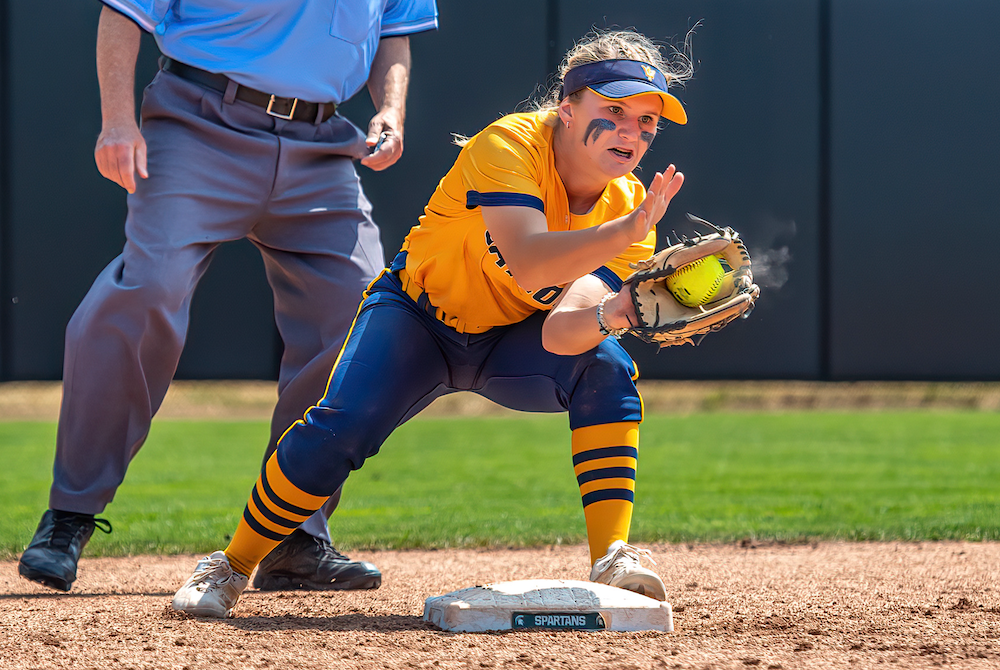
PHOTO Gaylord's Alexis Shepherd makes a play at second base during last season's Division 2 Final against Vicksburg.