

MI Army National Guard Presents MHSAA Events
February 24, 2016
By Geoff Kimmerly
Second Half editor
Sharing in the values of leadership, sportsmanship and ethics emphasized by the Michigan High School Athletic Association, the Michigan Army National Guard is serving as the official military branch supporting MHSAA events and digital initiatives through the 2015-16 school year.
 The Michigan Army National Guard provides trained and ready forces in support of the National Military Strategy, and responds as needed to state, local, and regional emergencies to ensure peace, order, and public safety. Guardsmen typically train one weekend per month and two weeks in the summer, and soldiers are eligible for educational benefits including state and federal tuition assistance programs, the G.I. Bill and grants at Michigan colleges and universities that combined usually exceed the total cost of tuition, books and fees at most Michigan post-secondary institutions.
The Guard adds value to our communities through continuous interaction. National Guard soldiers are part of the local community. Monthly and annual summer training maintains readiness when needed, be it either to defend our nation's freedom, or protecting lives and property of Michigan citizens during a local natural disaster.
“The National Guard provides opportunities for young men and women to mature into productive citizens,” MHSAA Executive Director John E. “Jack” Roberts said. “The emphasis the Guard puts on physical fitness, leadership and doing things the right way parallels what we strive to teach in school sports.”
The Guard has served as presenter of the MHSAA Cross Country Regionals and Finals and Football Playoffs during the fall, and this winter of the MHSAA Wrestling Tournament, which will conclude with the Team Wrestling Finals hosted Feb. 26-27 at Central Michigan University’s McGuirk Arena and the Individual Wrestling Finals scheduled for March 3-5 at The Palace of Auburn Hills. Guard recruiters also have been on-site attending numerous District, Regional and additional Finals events during the first half of the 2015-16 school year.
The Guard also is featured prevalently as part of the MHSAA’s online presence on both MHSAA.com and the MHSAA mobile app, and supports the “Michigan National Guard Performance of the Week” honoring a successful student-athlete on the MHSAA’s Second Half website.
“The Michigan Army National Guard is proud to support the MHSAA and student-athletes across Michigan,” said Lt. Col. Scott L. Meyers, who serves as recruiting and retention battalion commander for the Guard. “The Guard not only plays a key role in our national defense; we have a responsibility to serve our communities during times of state emergencies. As individuals, we are stewards in our communities and have an inherent responsibility to support our community in that role. One way to do this is to encourage student-athletes to live up to the ethics, values, and positive life choices common to the MHSAA and the Michigan Army National Guard.
“The National Guard is actively seeking these student-athletes to join our team. Their dedication combined with our education benefits and leadership training will provide the tools needed for them to become future leaders of Michigan’s communities.”
Click for additional information on the Michigan Army National Guard.
The MHSAA is a private, not-for-profit corporation of voluntary membership by more than 1,400 public and private senior high schools and junior high/middle schools which exists to develop common rules for athletic eligibility and competition. No government funds or tax dollars support the MHSAA, which was the first such association nationally to not accept membership dues or tournament entry fees from schools. Member schools which enforce these rules are permitted to participate in MHSAA tournaments, which attract more than 1.4 million spectators each year.
Track Gaining Speed Toward Future with Electronic Starting Devices
By
Steve Vedder
Special for MHSAA.com
May 23, 2023
Aubrey Greenfield thinks it might be the perfect time to reevaluate 130 years of tradition.
For a number of reasons, from technical to personal, the Oxford senior sprinter believes it makes sense for the crack of a starting pistol to be eliminated from high school track meets.
Because track meets would benefit in various ways from lowering costs to easier setup at meets to the human factor of competitors not having to flinch at the crack of a pistol shot, Greenfield believes the sport has a chance to embrace new technology – electronic starting devices (ESD).
In essence, an ESD replaces the starting pistol with a light flash, tone sound or both to begin a race.
"High school sports should put the athlete first," Greenfield said. "We should promote sports, and eliminating starting pistols promotes health in terms of PTSD or trauma for athletes and spectators and that would be good. I would like to think people would say that's a good idea."
In fact, Greenfield would go as far as to say if there was not an implementation of electronic starting devices, many of her teammates would have considered giving up the sport.
"If it's something that helps us compete safely, we're all for it," she said.
Greenfield's opinion apparently is spreading. Michigan High School Athletic Association senior assistant director Cody Inglis said the use of ESD makes it both affordable for meet starters and sensible for athletes and fans to rethink the use of starting pistols. While the MHSAA is not mandating electronic starting devices, it does promote the use of what Inglis calls "emerging technology." He notes that ESD are becoming the norm for organizations such as USA Track & Field, the NCAA and an increasing number of high schools.
 "I think we have to embrace new technology, and we think this will be something that takes hold," Inglis said.
A key part of embracing ESD is the human element. The tragic Oxford High School shooting Nov. 30, 2021, that took the lives of four students while injuring seven others should not be relived even for a fleeting instance at a high school sporting event. Oxford athletic director Tony DeMare said the school began using ESD at every meet, including the MHSAA Lower Peninsula Division 1 Finals last June. He said that decision was embraced by virtually all schools Oxford encountered.
"We were very convinced that the alternative (of ESD) would promote a healthy attitude," DeMare said. "We were overwhelmed with the positive response. If a school was on the fence about it or might not be for it, I think we've started to see the tide turn in favor of people willing to listen and learn about electronic starting devices."
Inglis said the MHSAA is acutely aware of what the crack of a starting pistol can mean to athletes and fans.
"It's unimaginable what Oxford went through, and this is a small way we can help," he said. "We look at a (starting pistol) and think, ‘Could we do something else?’ It's a way of helping to solve a problem."
Over the last several years, the MHSAA has embraced finding an alternative to starting pistols. Inglis noted the discussion started with the cost and diminishing availability of 32-caliber ammunition that meet starters use. A box of ammunition, if it can be found, is around $75 a box.
In addition to cost, there is potential damage from excessive exposure to 150-plus decibels of sound generated by the traditional 32-caliber blanks. Medical studies show damage to ears caused by decibel levels above 120 dB.
The tragedy at Oxford accelerated the conversation.
Inglis said the cost of ESD can be likened to a school sinking money into artificial surfaces at football fields. Yes, there is a great cost at first, but over time money is ultimately saved. An ESD system itself ranges between $200 and $500. Speakers also may need to be purchased, but with ESD starting events like the 800 and 1,600-meter relays positioned near the outside lanes 8, 7, 6 and 5 would result in improved hearing by athletes at the start of a race.
There is one challenge with ESD that track administrators are working to overcome – lighting conditions that lessen the ability to see the ESD’s LED light or strobe when the button is pressed by a starter to begin a race. But that vision difficulty resulting from clear blue skies and backgrounds of setting suns can be substantially improved by incorporating a black background with an ESD – something as simple as a starter holding up black cardboard behind the lighting mechanism at the start of an event.
Inglis said when all factors are considered, the use of ESD makes sense.
 "With the climate we live in nowadays, no lookalike guns is good," he said. "We're not mandating this. But people are saying this is affordable."
While switching to ESD would break 130 years of tradition, the timing could be a step forward, said Jeff Hollobaugh, co-author of the book "The Fleet Feet of Spring: Michigan's High School State Championships in Track & Field." He said while no definitive answer is possible, it's likely starting pistols were used at the inaugural state meet at the Jackson Fairgounds in 1895. The meet, which included events like tossing a 16-pound shot put, bike races and a 100-meter sprint, was sponsored by the Michigan Interscholastic Athletic Association (a predecessor to the MHSAA) and comprised mostly of the state's larger schools.
Hollobaugh's sentiments echo what many involved in today's high school track & field believe in terms of making a transition from starting pistols to electronic starting devices.
"It's a change, not necessarily good or bad, just different," he said. "It's not a drastic change, but it will take some getting used to. But it is the future. In the end, we'll all be fine."
DeMare believes the future of high school track will definitely include ESD.
"Our desire is that the practicality and sensibility of this will overcome the alternative," he said. "I think we'll see the automation and electronics taking hold of certain elements in track, and people will embrace it."
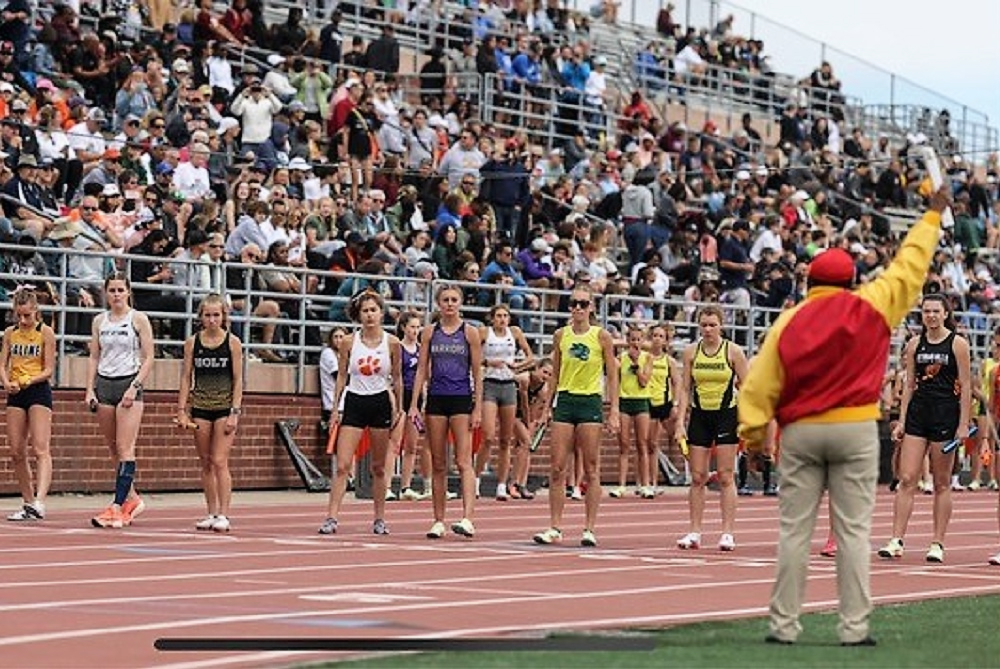
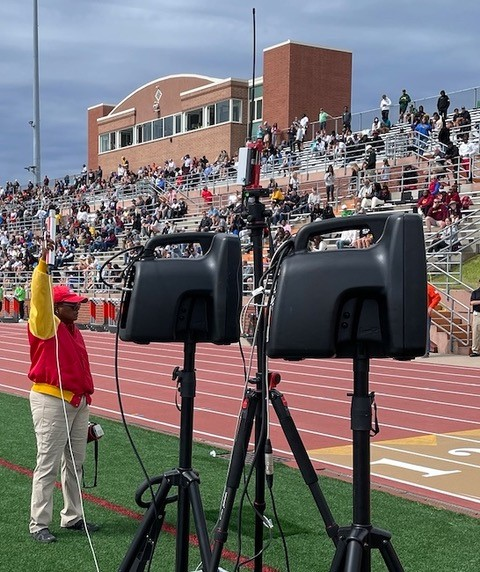
PHOTOS (Top) Runners watch official Bertha Smiley as they prepare to begin a race during last season's Lower Peninsula Division 1 Finals at Rockford. (Middle) An electronic starting device provided by VS Athletics was used to start those races. (Below) Smiley sets to begin an event. (Photos provided by David Kuderka/VS Athletics.)