

MI Army National Guard Presents MHSAA Events
February 24, 2016
By Geoff Kimmerly
Second Half editor
Sharing in the values of leadership, sportsmanship and ethics emphasized by the Michigan High School Athletic Association, the Michigan Army National Guard is serving as the official military branch supporting MHSAA events and digital initiatives through the 2015-16 school year.
 The Michigan Army National Guard provides trained and ready forces in support of the National Military Strategy, and responds as needed to state, local, and regional emergencies to ensure peace, order, and public safety. Guardsmen typically train one weekend per month and two weeks in the summer, and soldiers are eligible for educational benefits including state and federal tuition assistance programs, the G.I. Bill and grants at Michigan colleges and universities that combined usually exceed the total cost of tuition, books and fees at most Michigan post-secondary institutions.
The Guard adds value to our communities through continuous interaction. National Guard soldiers are part of the local community. Monthly and annual summer training maintains readiness when needed, be it either to defend our nation's freedom, or protecting lives and property of Michigan citizens during a local natural disaster.
“The National Guard provides opportunities for young men and women to mature into productive citizens,” MHSAA Executive Director John E. “Jack” Roberts said. “The emphasis the Guard puts on physical fitness, leadership and doing things the right way parallels what we strive to teach in school sports.”
The Guard has served as presenter of the MHSAA Cross Country Regionals and Finals and Football Playoffs during the fall, and this winter of the MHSAA Wrestling Tournament, which will conclude with the Team Wrestling Finals hosted Feb. 26-27 at Central Michigan University’s McGuirk Arena and the Individual Wrestling Finals scheduled for March 3-5 at The Palace of Auburn Hills. Guard recruiters also have been on-site attending numerous District, Regional and additional Finals events during the first half of the 2015-16 school year.
The Guard also is featured prevalently as part of the MHSAA’s online presence on both MHSAA.com and the MHSAA mobile app, and supports the “Michigan National Guard Performance of the Week” honoring a successful student-athlete on the MHSAA’s Second Half website.
“The Michigan Army National Guard is proud to support the MHSAA and student-athletes across Michigan,” said Lt. Col. Scott L. Meyers, who serves as recruiting and retention battalion commander for the Guard. “The Guard not only plays a key role in our national defense; we have a responsibility to serve our communities during times of state emergencies. As individuals, we are stewards in our communities and have an inherent responsibility to support our community in that role. One way to do this is to encourage student-athletes to live up to the ethics, values, and positive life choices common to the MHSAA and the Michigan Army National Guard.
“The National Guard is actively seeking these student-athletes to join our team. Their dedication combined with our education benefits and leadership training will provide the tools needed for them to become future leaders of Michigan’s communities.”
Click for additional information on the Michigan Army National Guard.
The MHSAA is a private, not-for-profit corporation of voluntary membership by more than 1,400 public and private senior high schools and junior high/middle schools which exists to develop common rules for athletic eligibility and competition. No government funds or tax dollars support the MHSAA, which was the first such association nationally to not accept membership dues or tournament entry fees from schools. Member schools which enforce these rules are permitted to participate in MHSAA tournaments, which attract more than 1.4 million spectators each year.
EGR 5-Year Title Run Remains Awe-Inspiring, Product of More Than Talent Alone
By
Steve Vedder
Special for MHSAA.com
November 25, 2022
It was Peter Stuursma's first year at East Grand Rapids and while the wolves weren't necessarily knocking at the door, they were definitely on the prowl.
The tradition-rich Pioneers football team had slumped to an uncharacteristic 3-6 record in Stuursma's first season as varsity head coach in 2000, and there were subtle signs a community used to winning was growing restless with the program's direction.
That's when Stuursma bumped into one of his players coming out of the weight room, and the two had a quick conversation which he clearly remembers 22 years later.
"It was this senior offensive lineman and all he said was, 'Don't worry about it Coach, it's not going to happen again. We got this,’" Stuursma said. "We had just gone 3-6, and I'm wondering how we're going to get this going and that they might get rid of me. You never underestimate what people can do."
East Grand Rapids, under legendary coach George Barcheski, had been the dominant football program in West Michigan with 28 winning seasons over 29 from 1970-99, and 38 victories in 39 games from 1993-95, along with Class B championships in 1976 and 1983. After Stuursma replaced the retiring Barcheski,, some in the community were expecting more of the same when it came to success.
Those fans never dreamed what they would see as the Pioneers promptly pieced together arguably the greatest decade-long stretch in Michigan high school football history – and without doubt one of the most incredible five-year runs of dominance.
Even that optimistic offensive lineman couldn't have imagined a remarkable 126-7 record over the next 11 years, a 40-3 MHSAA Tournament mark and seven Finals championships. Five of those titles (2006-10) came in a row, a feat accomplished just three times in the now 46-year history of the playoffs.
 The five straight championships were part of an amazing era that Stuursma and his players say has not diminished with time. They recall no single factor explained going 67-3 overall over those five seasons. There was talent, obviously, but coaching, tradition, confidence and strength of community all played vital parts. There were Thanksgiving practices attended by hundreds of former football alumni, dedicated fan support that included playing before more than 30,000 fans at least twice at Ford Field, and a program-wide attitude that, while some may call it a cliché, proved that success did indeed breed success.
"I'm in awe of the scope of things," said Stuursma, whose team used back-to-back Division 3 championships in 2002-03 as a springboard to later success. "Because we had won a couple times before it just started to feel normal. We had such support the community used to think Thanksgiving break ended at Ford Field."
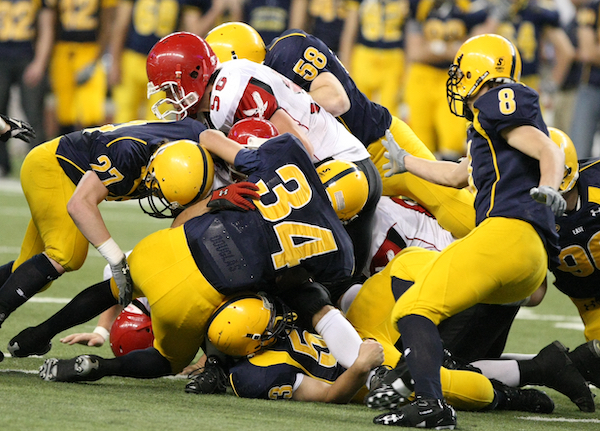
EGR teams would find all kinds of ways to win during the five-year title stretch. The 2009 team, for instance, barreled through its first four playoff opponents by a combined score of 164-29 until a 24-21 win over Orchard Lake St. Mary’s in the Final. The 2010 team had to win three playoff games by eight points or fewer to finish off its perfect 14-0 record. And then there was the wild 46-39 five-overtime win over St. Mary's in the 2007 Final during which the Pioneers had to score on all five possessions in overtime to outlast the Eaglets.
While teams always seemed to find ways to get the victory, former players remember what it was like to be part of a seemingly endless tradition of success on the football field.
"One of the things that was so special about East Grand Rapids were the expectations," said Luke Glendening, a running back on the 2006 team who has gone on to a long NHL career with the Detroit Red Wings and Dallas Stars. "During the game I'd look around and see guys who had played here a long time ago. I viewed it as a privilege to have the opportunity to play before the alumni and community."
Quarterback Ryan Elble, who completed a combined 34 passes for 483 yards and seven touchdowns during the 2008 and 2009 Finals, also used the word "honored" to describe his high school experience.
"The culture was to win. Coach Stuursma made it fun, and it always seemed to take shape on the field," said Elble, who went on to play baseball at Miami (Ohio) "I think each team had different skill sets, but at the end of the day it was our culture and putting in the work to spend Thanksgiving weekend at Ford Field."
The players point to that winning culture over talent. Elble said he played with only one eventual Division I college player in linebacker/running back Trent Voss, who went on to Toledo. Nobody wins without talent, of course, but they point to many other factors as being just as critical. Because EGR coaches would always work juniors into the lineup, Stuursma said the program faced only one major rebuild, in 2007. That team wound up 13-1 and the second of those five straight champions.
 "We had some incredible players," said Stuursma, who left EGR in 2016 to lead Hope College to two Michigan Intercollegiate Athletic Association titles, three second-place finishes and a 46-15 overall record over his seven seasons. "We returned only two starters (in 2007), but we still had good guys who wanted to win."
The players say the culture started with Barcheski and the program's tradition. As Hope College's coach, Stuursma said there’s a similar common thread among schools he sees on recruiting visits: a winning tradition that, in Stuursma's words "screams excellence," from every corner of the building. He sees it the minute he walks into some schools, and East Grand Rapids had the same culture before he arrived. The past players say it played a major part in their careers.
That tradition didn't start with the five straight titles, said former quarterback Kyle Cunningham, who played on the 2002-03 teams and went 46-0 over four years from his freshman to senior seasons. Those two championship teams’ most recognizable player was running back Kevin Grady, who still holds multiple MHSAA records including for career rush yardage and went on to play at University of Michigan.
"We worked hard and had a lot of pride," he said. "I remember watching film of earlier teams, and I remember hoping our team could stand up the same way."
While the players point to tradition and community, Ryan Blair, a tight end/defensive tackle on the 2006-08 champion clubs, said talent remained critical – but EGR was outmanned physically in some of those title games. That's when camaraderie and the confidence that someone was going to make a key play took over. The Pioneers' remarkable run was teeming with such plays.
"Certainly we were never one of the biggest teams there, we never had a big size advantage in any game," he said. "But we had this camaraderie on every team. We had guys who really liked playing with each other. When things got tight we stuck together, and we'd fight to the fourth quarter or beyond."
Despite the long odds of winning a single state title let alone repeating, Stuursma believes there could be a team one day which wins six straight. That team will have the same characteristics of those EGR teams – the talent, coaching, tradition and fortune of catching timely breaks – but it can be done, he said.
"Absolutely," Stuursma said. "The only record I can think of that won't be broken is Wayne Gretzky's (NHL) scoring record. It will take a lot, but records are made to be broken. I think high school football is on the upswing and there would have to be an emphasis on winning. You would have to have a good path to get there, but I can see someone getting six one day."
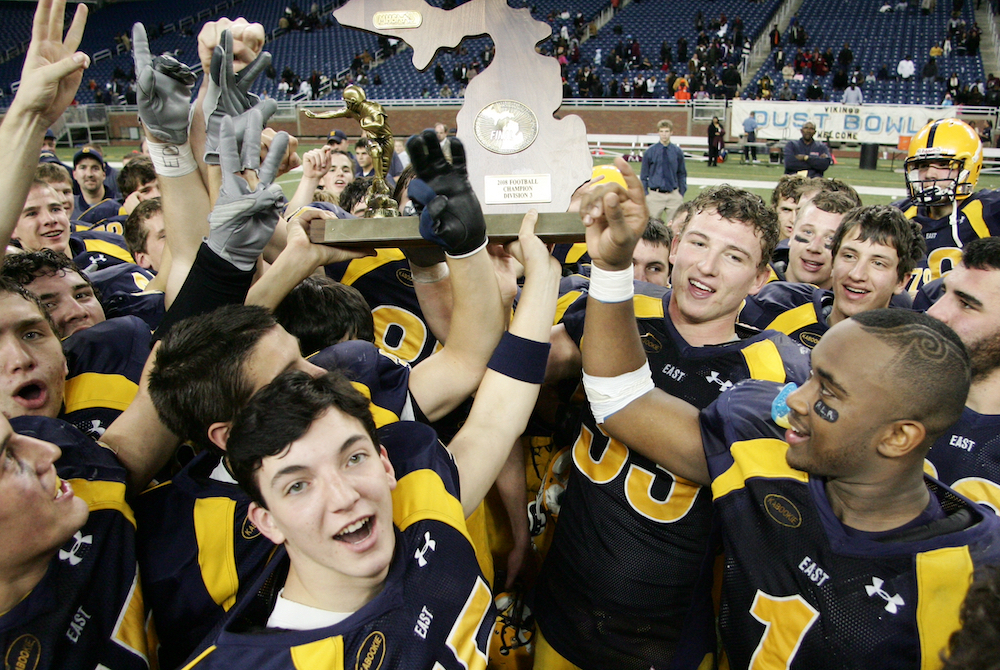
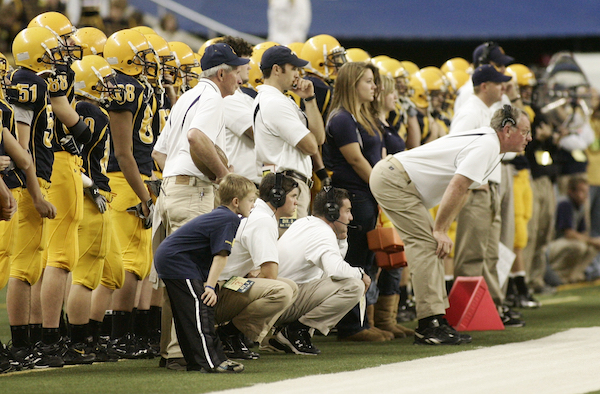
PHOTOS (Top) East Grand Rapids celebrates its third-straight Division 3 championship win in 2008. (Middle) Pioneers converge on an Orchard Lake St. Mary’s ball carrier during the 2007 five-overtime title decider. (Below) EGR coach Peter Stuursma, kneeling center, monitors the action during the 2010 championship game.