

MI Army National Guard Presents MHSAA Events
February 24, 2016
By Geoff Kimmerly
Second Half editor
Sharing in the values of leadership, sportsmanship and ethics emphasized by the Michigan High School Athletic Association, the Michigan Army National Guard is serving as the official military branch supporting MHSAA events and digital initiatives through the 2015-16 school year.
 The Michigan Army National Guard provides trained and ready forces in support of the National Military Strategy, and responds as needed to state, local, and regional emergencies to ensure peace, order, and public safety. Guardsmen typically train one weekend per month and two weeks in the summer, and soldiers are eligible for educational benefits including state and federal tuition assistance programs, the G.I. Bill and grants at Michigan colleges and universities that combined usually exceed the total cost of tuition, books and fees at most Michigan post-secondary institutions.
The Guard adds value to our communities through continuous interaction. National Guard soldiers are part of the local community. Monthly and annual summer training maintains readiness when needed, be it either to defend our nation's freedom, or protecting lives and property of Michigan citizens during a local natural disaster.
“The National Guard provides opportunities for young men and women to mature into productive citizens,” MHSAA Executive Director John E. “Jack” Roberts said. “The emphasis the Guard puts on physical fitness, leadership and doing things the right way parallels what we strive to teach in school sports.”
The Guard has served as presenter of the MHSAA Cross Country Regionals and Finals and Football Playoffs during the fall, and this winter of the MHSAA Wrestling Tournament, which will conclude with the Team Wrestling Finals hosted Feb. 26-27 at Central Michigan University’s McGuirk Arena and the Individual Wrestling Finals scheduled for March 3-5 at The Palace of Auburn Hills. Guard recruiters also have been on-site attending numerous District, Regional and additional Finals events during the first half of the 2015-16 school year.
The Guard also is featured prevalently as part of the MHSAA’s online presence on both MHSAA.com and the MHSAA mobile app, and supports the “Michigan National Guard Performance of the Week” honoring a successful student-athlete on the MHSAA’s Second Half website.
“The Michigan Army National Guard is proud to support the MHSAA and student-athletes across Michigan,” said Lt. Col. Scott L. Meyers, who serves as recruiting and retention battalion commander for the Guard. “The Guard not only plays a key role in our national defense; we have a responsibility to serve our communities during times of state emergencies. As individuals, we are stewards in our communities and have an inherent responsibility to support our community in that role. One way to do this is to encourage student-athletes to live up to the ethics, values, and positive life choices common to the MHSAA and the Michigan Army National Guard.
“The National Guard is actively seeking these student-athletes to join our team. Their dedication combined with our education benefits and leadership training will provide the tools needed for them to become future leaders of Michigan’s communities.”
Click for additional information on the Michigan Army National Guard.
The MHSAA is a private, not-for-profit corporation of voluntary membership by more than 1,400 public and private senior high schools and junior high/middle schools which exists to develop common rules for athletic eligibility and competition. No government funds or tax dollars support the MHSAA, which was the first such association nationally to not accept membership dues or tournament entry fees from schools. Member schools which enforce these rules are permitted to participate in MHSAA tournaments, which attract more than 1.4 million spectators each year.
MHSAA Vault: MIS Rose to Challenges to Host 2020 LP Finals
By
Rob Kaminski
MHSAA benchmarks editor
November 12, 2021
The “MHSAA Vault” features stories from past publications and other documents in the MHSAA Library. This issue takes a look at the MHSAA Cross Country Finals at Michigan International Speedway, which celebrated 25 years in 2020 – although it was an event that nearly didn’t happen last fall …
In 1996, the MHSAA and Michigan International Speedway began a partnership the changed the course of the Lower Peninsula Cross Country Finals – quite literally.
The land in and around the track at Brooklyn would host the Finals for all classes of runners in one place on one day, an annual festival of nearly 2,000 runners competing for the MHSAA’s top honors.
Even skeptics – and there were several among running purists who thought the course was too flat, for example – can’t deny the results.
Finals attendance nearly doubled in that first year, and crowds in excess of 10,000 have enjoyed a day of racing several times, including a record 12,153 in 2011.
Enthusiastic crowds were the norm in recent years, with 11,232 in 2017, and nearly 11,000 in 2018 (10,989) and 2019 (10,873).
In fact, attendance failed to reach at least 8,000 only twice since the move to MIS.
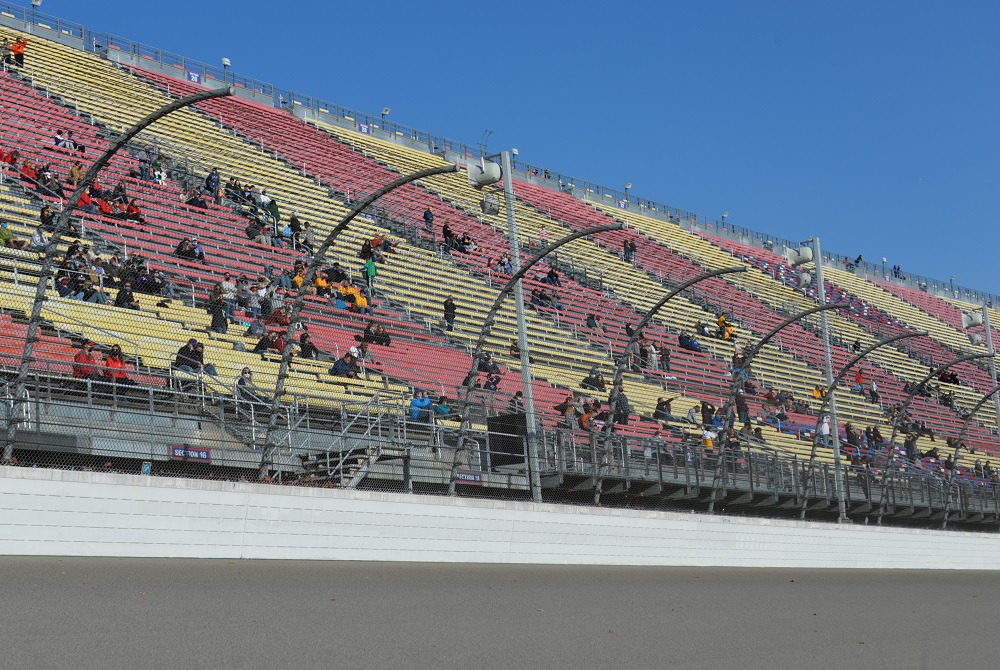
Of course, last year was an exception, when attendance was limited to 1,000 spectators per session due to the COVID-19 Pandemic. Fans also were restricted to the grandstands rather than following the action throughout locations on the course.
To reduce the number of runners in each race, the event was spread over two days, with each Division being run in two separate “sections” with times then combined at the end to determine team and individual champions.
While not ideal, the end result was another year of fantastic efforts at MIS – both from student-athletes and those behind the scenes.
“Even at the last hour, less than a week ahead of the Finals, we were closer to not having the Finals than we were to having them,” said MHSAA Assistant Director Cody Inglis, who coordinates the cross country postseason. “Rumors and challenges of mandated shutdowns, testing and other requirements were being discussed and caused a lot of unknowns. Even at the Regional level, we had schools, Regional courses and hosts shutting down their facilities; we had to relocate four Regionals 48 hours prior to race times. That scenario just could not happen at the Finals level where far more runners and much more travel would be involved.”
Among the many last-minute hurdles was the edict from NASCAR – which owns MIS – that all persons on site be temperature checked upon entry. That meant securing thermometers that were easy to operate in short order, along with personnel necessary to conduct the readings.
The attendance limitations certainly helped to implement the temperature screening, but brought their own issues.
“Limiting spectators was not a popular decision, but it really was the only way to have a race,” Inglis said. “We were taking direction and working with policies and protocols from the MDHHS, the Governor’s office, Lenawee County Health Department, MIS and NASCAR.”
Part of the solution was to utilize the grandstands as a “barrier” between participants and spectators. The reduced number of fans were dispersed over thousands of seats while still allowing them the chance to watch their student-athletes compete.
“It wasn’t the same, it wasn’t easy or perfect, but it was what we had to do to have a race,” Inglis said. “Separating the Finals into two days and different sections also allowed us to spread out the event and limit the number of people on site at any one time. This was a key part of the plan and worked well even though it separated races within a Division.”
The MHSAA, MIS and the cross country community never lost focus of the main goal: a culmination of the season for the student-athletes, who deserved something last year more than ever. And, more than ever, MIS once again displayed its advantage as a venue that could adapt to the fluid nature of the times to pull off the event.
“There were some thoughts of using four different sites, but as we learned during the Regionals, the climate of things was so tenuous from one area of the state to another that we couldn’t be 100-percent certain that there wouldn’t again be last-minute cancelations,” Inglis said. “MIS was wonderful to work and collaborate with, and was the best option to get it done. It was never mentioned once publicly about the possibility of not having the Finals – only how we could best do it under uncharted conditions.”
The moving parts and ever-changing scenarios created more complexity than ever in finalizing a season, but every decision was made with the complete desire to conduct the Finals as close to normal as possible.
“I firmly believe that a finish to the season, no matter the differences in race formatting and fan experience, was something everyone would have taken when the season began in August,” Inglis said.
Indeed, the finish line in Year 25 at MIS might have been the most gratifying of them all.