


Michel Finishes with Story to Tell
June 11, 2013
By Geoff Kimmerly
Second Half editor
Andrew Michel received the heart-breaking news only moments before leaving his golf team’s Regional on Friday to get ready for that night’s Brownstown-Woodhaven prom.
But missing making the MHSAA Finals by a stroke was not the first thing he shared with those who asked about his day at West Shore Golf and Country Club in Grosse Ile.
 Instead, the graduating senior told of the 132-yard shot he dropped for a hole-in-one on the par-3 12th hole, his second ace but first in competition.
Michel finished with a season-best 76, missing the cut for this weekend’s Lower Peninsula Division 1 Final by a stroke despite firing another eagle during the final holes of his round.
“At the start of the day, I told myself don’t leave anything on the table. Go for it on every hole, make every shot and just have fun at your last tournament,” Michel said Tuesday afternoon as he readied for that night’s graduation ceremony. “Being a senior, I went for everything.”
The best part might’ve been how he came back from a disappointing previous hole.
Michel had just finished off a triple bogey on No. 11, and admitted he was down on himself. He stepped to the next tee with his pitching wedge, and “I didn’t really care what happened. I chose the club I like to hit on that hole, and in the air I was thinking it was really good,” he said.
The ball touched down on the green and spun back into the hole.
Michel also played golf and soccer at Brownstown-Woodhaven. He’ll attend Grand Valley State University in the fall, study engineering, and will try to walk-on the Lakers’ golf team.
“Deep down inside,” he said he’s disappointed he won’t be playing at Michigan State’s Forest Akers West on Friday. But he’s got a quite a highlight to take with him from his final high school round.
“It was very bittersweet. I really wanted to go to state,” Michel said. “But the hole-in-one balanced it out a bit.”
Eye on the official
Hopefully you caught our MHSAA benchmarks piece (also published on Second Half) on longtime official Lamont Simpson, who has worked not only MHSAA Finals but NCAA tournaments and is one of 32 officials in the WNBA. (Here’s the link in case you missed it.)
He also became that league’s first to wear the referee cam, debuting the new gear during a recent game between the Phoenix Mercury and Indiana Fever.
The camera provides plenty of ref’s-eye views. Click the video below to check it out.
Wheels of Steele
We’ve been watching the inspiring progress of Frankenmuth runner Bobby Steele especially over the last few years as his story became known across the Lower Peninsula.
Steele, who is visually impaired, has run cross country and track for the Eagles, thanks to the help of guides who ran with him to help him stay on course.
If you haven’t heard Steele’s awesome story, check out this 8-minute video. Not only did Steele run, but he cut roughly 12 minutes off his first cross country times over the course of his career.
Symptoms of a Meniscus Tear — and When to Seek Treatment
April 2, 2024
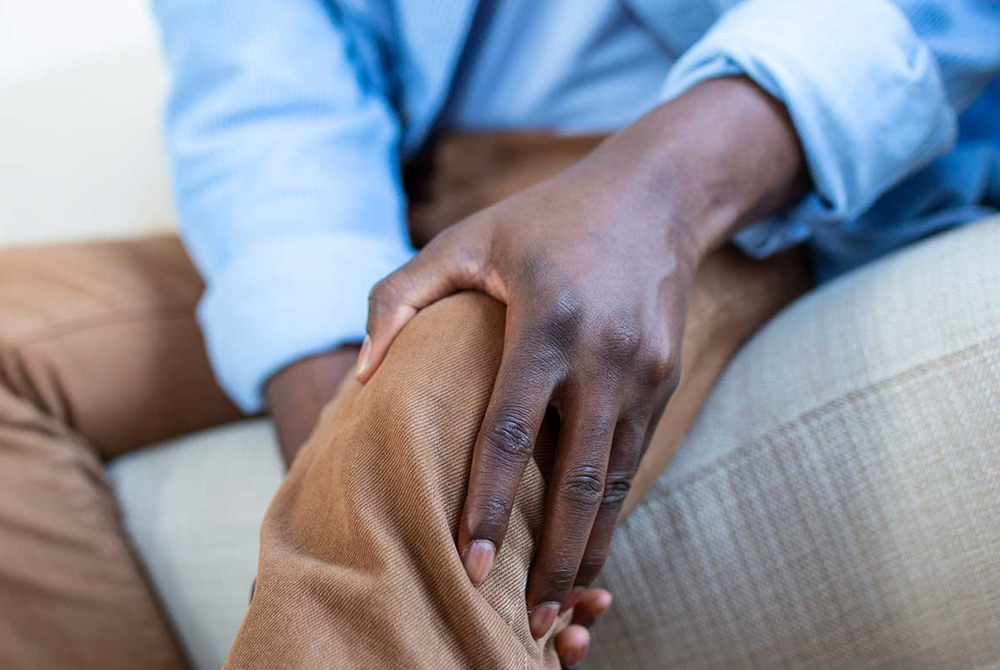
Meniscus tears are not one size fits all: Sometimes they cause no pain, other times they’re excruciating.
 Once in a while they heal or adapt on their own, but more often than not they require physical therapy or surgery.
“Your meniscus is a fiber elastic cartilage that acts as a shock absorber for the knee,” says Ahmad Bazzi, M.D., a sports medicine physician at Henry Ford Health. “It also helps stabilize the knee joint. But when it tears — which can occur in young athletes after a pivot injury or in older people who have arthritis — it can be painful.”
Here, Dr. Bazzi shares symptoms of a meniscus tear and when to see a doctor.
What Does A Meniscus Tear Feel Like?
Depending upon the level of injury and type of tear, meniscus tears can either be asymptomatic or cause symptoms like:
- Locking. When the meniscus tears, a piece of it might move into the knee joint, causing mechanical issues like stiffness and locking of the knee joint.
- Catching or clicking. This often feels like a sudden ‘click’ in the knee joint, where it suddenly gives out while you’re walking or doing certain movements.
- Localized pain on the inner or outer part of the knee. In young athletes, a meniscus tear often causes an impaired range of motion and localized pain on the inner or outer part of the knee.
- Pain and swelling. In older people, a meniscus tear often causes swelling and an overall aching pain in the knee.
Treatment Options For Meniscus Tears
A meniscus tear can only heal on its own if the tear is on the outer part of the knee where it has better access to blood supply. If you’re experiencing pain a few days after injury and you have limited range of motion, instability and/or swelling in the knee, Dr. Bazzi recommends seeing a doctor to get an examination and, if needed, an MRI for diagnosis.
“It’s hard to tell what type of meniscus tear you have if you haven’t seen a doctor,” says Dr. Bazzi. “If you have a mechanically unstable tear and it goes untreated, it could lead to worsening range of motion and stiffness, or worsening arthritis. It’s important to get seen by a doctor to get an accurate diagnosis and the proper treatment. It may take one to three months for a full recovery.”
Here, Dr. Bazzi shares treatment options:
Surgery
If someone is having mechanical symptoms like locking or catching, surgery may be considered right away, especially if it’s an athlete younger than 40 years old. “Meniscus tear surgery has a shorter recovery compared to other knee surgeries,” says Dr. Bazzi. “Surgery could either consist of a meniscectomy, which is partial or complete removal of the meniscus, or sometimes just a meniscus repair.”
Hyaluronic acid or cortisone injections
Non-operative treatments are often recommended for older people who have degenerative tears due to arthritis. “This is because meniscus surgery doesn’t often relieve their pain since they have underlying arthritis, meaning they have cartilage loss in the meniscus,” says Dr. Bazzi.
Instead, a cortisone injection, which is an anti-inflammatory medication that can be injected into the knee, can reduce inflammation, swelling and pain caused by arthritis.
A hyaluronic acid injection may also be considered, which adds cushioning in the knee. “Hyaluronic acid is one of the substances that make up our cartilage, so this injection helps us mimic the lost cartilage,” says Dr. Bazzi. “It also has anti-inflammatory properties.”
Physical therapy
Physical therapy is another great option, especially for older people who need non-operative treatment options. It can help the knee adapt to the tear, reduce pain and encourage full range of motion. “Physical therapy for meniscus tears focuses on balance exercises and exercises to strengthen the muscles around the knee,” says Dr. Bazzi. “This helps to uphold the knee joint to achieve full range of motion and strength while being pain-free.”
To find a sports medicine provider at Henry Ford Health, visit henryford.com/athletes or call 313-651-1969.
Reviewed by Ahmad Bazzi, M.D., a sports medicine physician who sees patients at Henry Ford Medical Center – Fairlane.