

Michel Finishes with Story to Tell
June 11, 2013
By Geoff Kimmerly
Second Half editor
Andrew Michel received the heart-breaking news only moments before leaving his golf team’s Regional on Friday to get ready for that night’s Brownstown-Woodhaven prom.
But missing making the MHSAA Finals by a stroke was not the first thing he shared with those who asked about his day at West Shore Golf and Country Club in Grosse Ile.
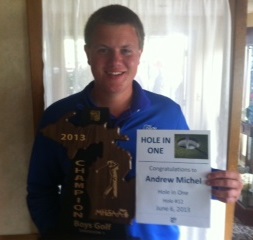 Instead, the graduating senior told of the 132-yard shot he dropped for a hole-in-one on the par-3 12th hole, his second ace but first in competition.
Michel finished with a season-best 76, missing the cut for this weekend’s Lower Peninsula Division 1 Final by a stroke despite firing another eagle during the final holes of his round.
“At the start of the day, I told myself don’t leave anything on the table. Go for it on every hole, make every shot and just have fun at your last tournament,” Michel said Tuesday afternoon as he readied for that night’s graduation ceremony. “Being a senior, I went for everything.”
The best part might’ve been how he came back from a disappointing previous hole.
Michel had just finished off a triple bogey on No. 11, and admitted he was down on himself. He stepped to the next tee with his pitching wedge, and “I didn’t really care what happened. I chose the club I like to hit on that hole, and in the air I was thinking it was really good,” he said.
The ball touched down on the green and spun back into the hole.
Michel also played golf and soccer at Brownstown-Woodhaven. He’ll attend Grand Valley State University in the fall, study engineering, and will try to walk-on the Lakers’ golf team.
“Deep down inside,” he said he’s disappointed he won’t be playing at Michigan State’s Forest Akers West on Friday. But he’s got a quite a highlight to take with him from his final high school round.
“It was very bittersweet. I really wanted to go to state,” Michel said. “But the hole-in-one balanced it out a bit.”
Eye on the official
Hopefully you caught our MHSAA benchmarks piece (also published on Second Half) on longtime official Lamont Simpson, who has worked not only MHSAA Finals but NCAA tournaments and is one of 32 officials in the WNBA. (Here’s the link in case you missed it.)
He also became that league’s first to wear the referee cam, debuting the new gear during a recent game between the Phoenix Mercury and Indiana Fever.
The camera provides plenty of ref’s-eye views. Click the video below to check it out.
Wheels of Steele
We’ve been watching the inspiring progress of Frankenmuth runner Bobby Steele especially over the last few years as his story became known across the Lower Peninsula.
Steele, who is visually impaired, has run cross country and track for the Eagles, thanks to the help of guides who ran with him to help him stay on course.
If you haven’t heard Steele’s awesome story, check out this 8-minute video. Not only did Steele run, but he cut roughly 12 minutes off his first cross country times over the course of his career.

5 Strategies To Improve Range Of Motion
March 6, 2024
When it comes to health and fitness, regular exercise and strength training get the most attention. But it turns out that improving your range of motion may pay greater dividends, particularly over the long haul.
“All kinds of things can impact our range of motion,” says Jennifer Burnham, an athletic trainer at Henry Ford Health. “As we age, our joints become less pliable, but any kind of surgery or injury can also impact our range of motion. And if you're somebody who sits at a desk all day long, that can affect your range of motion as well.”
Why Is Improving Flexibility Important?
Staying active with regular cardiovascular exercise and strength training is a great way to maintain your overall physical health. But it’s important to remember that flexibility exercises come with plenty of perks, too, including:
- Preventing injury
- Staving off arthritis by lubricating joints and tissues
- Improving posture and balance
"Unfortunately, if you have limited range of motion, you may perform tasks incorrectly, causing other muscles and joints to overcompensate for the lack of mobility,” Burnham says. “Over time, that compensation mechanism can increase the risk of injury.”
To complicate matters, our lifestyles often don’t support our range of motion goals. Many of us spend most of our days sitting at a desk or hunched over a screen. And when we’re not sitting still, most of us are slouching.
What Are Some Ways To Improve Range Of Motion?
You don’t have to be able to twist your limbs into a pretzel to achieve full range of motion. Instead, try to improve on your current level of flexibility with these five simple strategies:
- Pay attention to timing. If you’re not ready to add a stretching day to your workout regimen, consider adding a set of flexibility exercises at the end of every session. Pre-workout stretching is helpful, too, but stretching when your muscles are warm is a more effective way to stave off injuries.
- Focus on mobility and stability. Even if you can do the splits or touch your toes to the back of your head, you won’t be able to hold the position if you don’t also have strong core muscles. “Most people do stabilizing exercises such as strength training and lifting weights without paying much attention to mobilizing activities like stretching and yoga,” Burnham says. “But you really need to do both stabilizing and flexibility exercises to get an effective workout.”
- Do a mix of dynamic and static stretches. Two types of stretches can help you gain an edge when it comes to improving range of motion: Dynamic (an active type of stretching where you’re moving within your range of motion) and static stretching (where you hold a stretch). Dynamic stretching with arm and head circles, side stretches, and hip circles before exercise is a good way to warm up cool muscles and help lubricate the joints. With static stretching such as touching your toes to stretch your hamstrings, the goal is to hold a position for 30 seconds or more. Static stretches are often best performed after a workout when your muscles are warm.
- Try foam rolling. Foam rollers act almost like a rolling pin to smooth out tight muscles. Used correctly, they can help improve range of motion — and release stress and tension. You can use foam rollers to prime your body for exercise, or to recover after a workout.
- Aim for balance. If one part of your body is super flexible, focus on increasing range of motion in the opposing muscle group. “So, for example, if your hamstrings are very flexible, make sure to target your quadriceps with flexibility exercises,” Burnham says. “The goal is to make sure you’re aiming for balancing in your body.”
While stretching is an important way to achieve and maintain balance, flexibility and range of motion, it isn’t always intuitive. Not sure where to begin? Consider meeting with a personal trainer or athletic trainer to help you devise a program.
“Watching YouTube videos can be helpful, but if you’ve never done flexibility exercises before, you could overstretch your muscles or find yourself in an incorrect position to stretch,” Burnham says. “And yes, you can create bodily injury by overstretching.”
To find a sports medicine provider at Henry Ford Health, visit henryford.com/sportsmedicine or call 313-651-1969.
Reviewed by Jennifer Burnham, MS, AT, ATC, CSCS, a certified athletic trainer at the Henry Ford Center for Athletic Medicine.