

Michel Finishes with Story to Tell
June 11, 2013
By Geoff Kimmerly
Second Half editor
Andrew Michel received the heart-breaking news only moments before leaving his golf team’s Regional on Friday to get ready for that night’s Brownstown-Woodhaven prom.
But missing making the MHSAA Finals by a stroke was not the first thing he shared with those who asked about his day at West Shore Golf and Country Club in Grosse Ile.
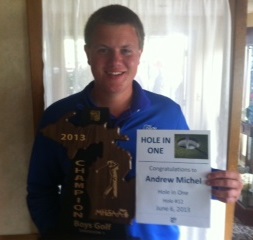 Instead, the graduating senior told of the 132-yard shot he dropped for a hole-in-one on the par-3 12th hole, his second ace but first in competition.
Michel finished with a season-best 76, missing the cut for this weekend’s Lower Peninsula Division 1 Final by a stroke despite firing another eagle during the final holes of his round.
“At the start of the day, I told myself don’t leave anything on the table. Go for it on every hole, make every shot and just have fun at your last tournament,” Michel said Tuesday afternoon as he readied for that night’s graduation ceremony. “Being a senior, I went for everything.”
The best part might’ve been how he came back from a disappointing previous hole.
Michel had just finished off a triple bogey on No. 11, and admitted he was down on himself. He stepped to the next tee with his pitching wedge, and “I didn’t really care what happened. I chose the club I like to hit on that hole, and in the air I was thinking it was really good,” he said.
The ball touched down on the green and spun back into the hole.
Michel also played golf and soccer at Brownstown-Woodhaven. He’ll attend Grand Valley State University in the fall, study engineering, and will try to walk-on the Lakers’ golf team.
“Deep down inside,” he said he’s disappointed he won’t be playing at Michigan State’s Forest Akers West on Friday. But he’s got a quite a highlight to take with him from his final high school round.
“It was very bittersweet. I really wanted to go to state,” Michel said. “But the hole-in-one balanced it out a bit.”
Eye on the official
Hopefully you caught our MHSAA benchmarks piece (also published on Second Half) on longtime official Lamont Simpson, who has worked not only MHSAA Finals but NCAA tournaments and is one of 32 officials in the WNBA. (Here’s the link in case you missed it.)
He also became that league’s first to wear the referee cam, debuting the new gear during a recent game between the Phoenix Mercury and Indiana Fever.
The camera provides plenty of ref’s-eye views. Click the video below to check it out.
Wheels of Steele
We’ve been watching the inspiring progress of Frankenmuth runner Bobby Steele especially over the last few years as his story became known across the Lower Peninsula.
Steele, who is visually impaired, has run cross country and track for the Eagles, thanks to the help of guides who ran with him to help him stay on course.
If you haven’t heard Steele’s awesome story, check out this 8-minute video. Not only did Steele run, but he cut roughly 12 minutes off his first cross country times over the course of his career.
How To Be Proactive About Concussions In Student Athletes
December 5, 2023
Most people have seen the headlines about concussions as a common sports injury—and it's natural that parents of athletes may have concerns. A large misconception in sports is that previous concussions are to be blamed for ongoing headaches, blurred vision and memory loss, among other symptoms.
 “It’s really important to think about concussions in tandem with overall brain health,” says Jake Carpenter-Thompson, M.D., Ph.D., a board-certified neurologist at the Henry Ford Kutcher Clinic for Concussion and Sports Neurology. “Concussions can be concerning, but they shouldn’t be looked at in a vacuum. It is important to understand an athlete’s overall brain health to help manage recovery after any impact.”
One way to do that is to consult with your child’s doctor or a sports neurologist for an annual evaluation. A sports neurologist focuses on managing sports-related brain and nervous system injuries and conditions in athletes, such as concussions, post-concussion syndrome, peripheral nerve injuries, migraines, epilepsy and more.
“Having an annual evaluation of your athlete’s brain health when they are at their baseline – and uninjured – can help diagnose and treat issues when they arise,” says Dr. Carpenter-Thompson.
A qualified healthcare professional can use the baseline evaluation results as an important comparison tool if an athlete develops a suspected concussion.
Best Practices For Keeping Athletes Safe
Dr. Carpenter-Thompson shares these tips to ensure you keep front of mind your child’s brain health and safety, not just their athletic performance:
- Get a brain health baseline test. This should include a personal and family neurological history, with a focus on current issues. It is important to note any neurological conditions that may influence concussion recovery, such as ADHD, depression, anxiety or migraine headaches.
- Encourage your children to listen to their body. There are risks to playing any sport. Encourage your child to listen to and be honest about how they’re feeling. It’s the best way to prevent and treat injuries.
- In the event of an injury, look for the signs. Within 24 hours after an injury, an athlete should be evaluated if they are experiencing: headaches, fatigue, dizziness and nausea, changes in sleep habits, trouble with memory, confusion, irritability and anxiety, or light sensitivity.
- Know that brain injuries don’t just occur with a blow to the head. They can also occur from falls, car accidents or even whiplash. If your child is experiencing any symptoms, consult your physician.
- Remember that brain health is more than just concussions. If your athlete is complaining of chronic headaches, migraines, dizziness, memory or mood issues, there may be an underlying issue.
“There is no magic number of concussions a brain can sustain. Each person is different,” says Dr. Carpenter-Thompson. “The severity of the impact and recovery time can vary greatly for numerous reasons. By getting a brain health assessment before the injury, we can provide more targeted care to improve an athlete's overall clinical course.”
To find a sports medicine doctor or athletic trainer at Henry Ford, visit henryford.com/athletes.