


Michel Finishes with Story to Tell
June 11, 2013
By Geoff Kimmerly
Second Half editor
Andrew Michel received the heart-breaking news only moments before leaving his golf team’s Regional on Friday to get ready for that night’s Brownstown-Woodhaven prom.
But missing making the MHSAA Finals by a stroke was not the first thing he shared with those who asked about his day at West Shore Golf and Country Club in Grosse Ile.
 Instead, the graduating senior told of the 132-yard shot he dropped for a hole-in-one on the par-3 12th hole, his second ace but first in competition.
Michel finished with a season-best 76, missing the cut for this weekend’s Lower Peninsula Division 1 Final by a stroke despite firing another eagle during the final holes of his round.
“At the start of the day, I told myself don’t leave anything on the table. Go for it on every hole, make every shot and just have fun at your last tournament,” Michel said Tuesday afternoon as he readied for that night’s graduation ceremony. “Being a senior, I went for everything.”
The best part might’ve been how he came back from a disappointing previous hole.
Michel had just finished off a triple bogey on No. 11, and admitted he was down on himself. He stepped to the next tee with his pitching wedge, and “I didn’t really care what happened. I chose the club I like to hit on that hole, and in the air I was thinking it was really good,” he said.
The ball touched down on the green and spun back into the hole.
Michel also played golf and soccer at Brownstown-Woodhaven. He’ll attend Grand Valley State University in the fall, study engineering, and will try to walk-on the Lakers’ golf team.
“Deep down inside,” he said he’s disappointed he won’t be playing at Michigan State’s Forest Akers West on Friday. But he’s got a quite a highlight to take with him from his final high school round.
“It was very bittersweet. I really wanted to go to state,” Michel said. “But the hole-in-one balanced it out a bit.”
Eye on the official
Hopefully you caught our MHSAA benchmarks piece (also published on Second Half) on longtime official Lamont Simpson, who has worked not only MHSAA Finals but NCAA tournaments and is one of 32 officials in the WNBA. (Here’s the link in case you missed it.)
He also became that league’s first to wear the referee cam, debuting the new gear during a recent game between the Phoenix Mercury and Indiana Fever.
The camera provides plenty of ref’s-eye views. Click the video below to check it out.
Wheels of Steele
We’ve been watching the inspiring progress of Frankenmuth runner Bobby Steele especially over the last few years as his story became known across the Lower Peninsula.
Steele, who is visually impaired, has run cross country and track for the Eagles, thanks to the help of guides who ran with him to help him stay on course.
If you haven’t heard Steele’s awesome story, check out this 8-minute video. Not only did Steele run, but he cut roughly 12 minutes off his first cross country times over the course of his career.
MHSAA Vault: MIS Rose to Challenges to Host 2020 LP Finals
By
Rob Kaminski
MHSAA benchmarks editor
November 12, 2021
The “MHSAA Vault” features stories from past publications and other documents in the MHSAA Library. This issue takes a look at the MHSAA Cross Country Finals at Michigan International Speedway, which celebrated 25 years in 2020 – although it was an event that nearly didn’t happen last fall …
In 1996, the MHSAA and Michigan International Speedway began a partnership the changed the course of the Lower Peninsula Cross Country Finals – quite literally.
The land in and around the track at Brooklyn would host the Finals for all classes of runners in one place on one day, an annual festival of nearly 2,000 runners competing for the MHSAA’s top honors.
Even skeptics – and there were several among running purists who thought the course was too flat, for example – can’t deny the results.
Finals attendance nearly doubled in that first year, and crowds in excess of 10,000 have enjoyed a day of racing several times, including a record 12,153 in 2011.
Enthusiastic crowds were the norm in recent years, with 11,232 in 2017, and nearly 11,000 in 2018 (10,989) and 2019 (10,873).
In fact, attendance failed to reach at least 8,000 only twice since the move to MIS.
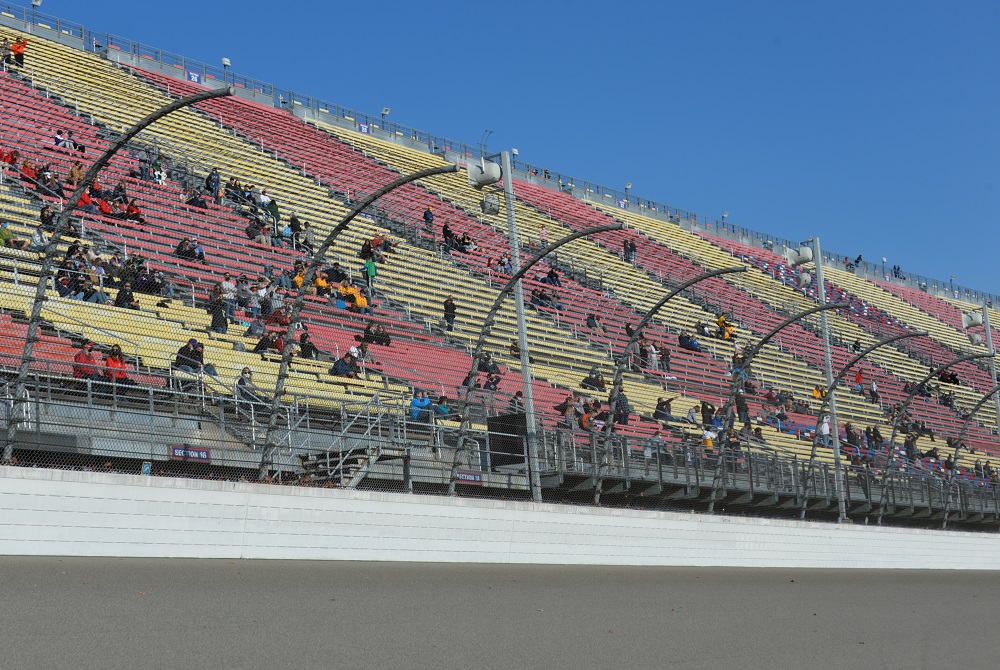
Of course, last year was an exception, when attendance was limited to 1,000 spectators per session due to the COVID-19 Pandemic. Fans also were restricted to the grandstands rather than following the action throughout locations on the course.
To reduce the number of runners in each race, the event was spread over two days, with each Division being run in two separate “sections” with times then combined at the end to determine team and individual champions.
While not ideal, the end result was another year of fantastic efforts at MIS – both from student-athletes and those behind the scenes.
“Even at the last hour, less than a week ahead of the Finals, we were closer to not having the Finals than we were to having them,” said MHSAA Assistant Director Cody Inglis, who coordinates the cross country postseason. “Rumors and challenges of mandated shutdowns, testing and other requirements were being discussed and caused a lot of unknowns. Even at the Regional level, we had schools, Regional courses and hosts shutting down their facilities; we had to relocate four Regionals 48 hours prior to race times. That scenario just could not happen at the Finals level where far more runners and much more travel would be involved.”
Among the many last-minute hurdles was the edict from NASCAR – which owns MIS – that all persons on site be temperature checked upon entry. That meant securing thermometers that were easy to operate in short order, along with personnel necessary to conduct the readings.
The attendance limitations certainly helped to implement the temperature screening, but brought their own issues.
“Limiting spectators was not a popular decision, but it really was the only way to have a race,” Inglis said. “We were taking direction and working with policies and protocols from the MDHHS, the Governor’s office, Lenawee County Health Department, MIS and NASCAR.”
Part of the solution was to utilize the grandstands as a “barrier” between participants and spectators. The reduced number of fans were dispersed over thousands of seats while still allowing them the chance to watch their student-athletes compete.
“It wasn’t the same, it wasn’t easy or perfect, but it was what we had to do to have a race,” Inglis said. “Separating the Finals into two days and different sections also allowed us to spread out the event and limit the number of people on site at any one time. This was a key part of the plan and worked well even though it separated races within a Division.”
The MHSAA, MIS and the cross country community never lost focus of the main goal: a culmination of the season for the student-athletes, who deserved something last year more than ever. And, more than ever, MIS once again displayed its advantage as a venue that could adapt to the fluid nature of the times to pull off the event.
“There were some thoughts of using four different sites, but as we learned during the Regionals, the climate of things was so tenuous from one area of the state to another that we couldn’t be 100-percent certain that there wouldn’t again be last-minute cancelations,” Inglis said. “MIS was wonderful to work and collaborate with, and was the best option to get it done. It was never mentioned once publicly about the possibility of not having the Finals – only how we could best do it under uncharted conditions.”
The moving parts and ever-changing scenarios created more complexity than ever in finalizing a season, but every decision was made with the complete desire to conduct the Finals as close to normal as possible.
“I firmly believe that a finish to the season, no matter the differences in race formatting and fan experience, was something everyone would have taken when the season began in August,” Inglis said.
Indeed, the finish line in Year 25 at MIS might have been the most gratifying of them all.