


Michel Finishes with Story to Tell
June 11, 2013
By Geoff Kimmerly
Second Half editor
Andrew Michel received the heart-breaking news only moments before leaving his golf team’s Regional on Friday to get ready for that night’s Brownstown-Woodhaven prom.
But missing making the MHSAA Finals by a stroke was not the first thing he shared with those who asked about his day at West Shore Golf and Country Club in Grosse Ile.
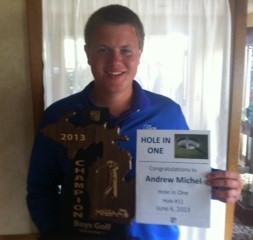 Instead, the graduating senior told of the 132-yard shot he dropped for a hole-in-one on the par-3 12th hole, his second ace but first in competition.
Michel finished with a season-best 76, missing the cut for this weekend’s Lower Peninsula Division 1 Final by a stroke despite firing another eagle during the final holes of his round.
“At the start of the day, I told myself don’t leave anything on the table. Go for it on every hole, make every shot and just have fun at your last tournament,” Michel said Tuesday afternoon as he readied for that night’s graduation ceremony. “Being a senior, I went for everything.”
The best part might’ve been how he came back from a disappointing previous hole.
Michel had just finished off a triple bogey on No. 11, and admitted he was down on himself. He stepped to the next tee with his pitching wedge, and “I didn’t really care what happened. I chose the club I like to hit on that hole, and in the air I was thinking it was really good,” he said.
The ball touched down on the green and spun back into the hole.
Michel also played golf and soccer at Brownstown-Woodhaven. He’ll attend Grand Valley State University in the fall, study engineering, and will try to walk-on the Lakers’ golf team.
“Deep down inside,” he said he’s disappointed he won’t be playing at Michigan State’s Forest Akers West on Friday. But he’s got a quite a highlight to take with him from his final high school round.
“It was very bittersweet. I really wanted to go to state,” Michel said. “But the hole-in-one balanced it out a bit.”
Eye on the official
Hopefully you caught our MHSAA benchmarks piece (also published on Second Half) on longtime official Lamont Simpson, who has worked not only MHSAA Finals but NCAA tournaments and is one of 32 officials in the WNBA. (Here’s the link in case you missed it.)
He also became that league’s first to wear the referee cam, debuting the new gear during a recent game between the Phoenix Mercury and Indiana Fever.
The camera provides plenty of ref’s-eye views. Click the video below to check it out.
Wheels of Steele
We’ve been watching the inspiring progress of Frankenmuth runner Bobby Steele especially over the last few years as his story became known across the Lower Peninsula.
Steele, who is visually impaired, has run cross country and track for the Eagles, thanks to the help of guides who ran with him to help him stay on course.
If you haven’t heard Steele’s awesome story, check out this 8-minute video. Not only did Steele run, but he cut roughly 12 minutes off his first cross country times over the course of his career.
Women & ACL Injuries: Know Risks, Steps for Prevention
August 10, 2021

Whether you’re a casual jogger or elite athlete, you’re at risk for an injury to your anterior cruciate ligament (ACL). If you’re a woman, you are at even greater risk for these injuries.
But there are steps you can take to prevent them.
“Among athletes, women are more than twice as likely to have an ACL injury than men,” says Nithin Natwa, M.D., a sports medicine specialist and primary care physician at Henry Ford Health System. “Once you have an ACL injury, you are at greater risk for having further soft tissue injuries in the future. That’s why it is important to prevent these injuries and follow your treatment plan if injured.”
What Is An ACL Injury?
An ACL injury is a strain or tear in the ACL, one of the four major ligaments that support the knee so it can flex and bend. The ACL is a strong band of tissue that helps connect your thigh bone (femur) to your shin bone (tibia). “An ACL injury usually occurs without contact when you turn suddenly while running or land off-balance on one leg. These actions overload the knee joint and cause the ACL to be torn,” says Dr. Natwa.
In the United States, 100,000 people have ACL injuries each year. Anyone can experience an ACL injury, though athletes participating in sports like football, basketball, soccer and gymnastics are at highest risk. And summer is a peak time for outdoor sports injuries.
Seek immediate care if you have any of these signs of an ACL injury:
• An audible “pop” in the knee
• Intense knee pain and rapid-onset swelling (within hours)
• Loss of range of motion
• An unstable feeling or locking of your knee
The most common treatment for ACL injuries is surgery followed by physical therapy. After treatment, you can expect to return to normal activities in 6 to 9 months. However, peak athletic performance can take up to two years.
Why Are Women At Higher Risk For ACL Injuries?
According to Dr. Natwa, the differences in athletic training techniques for males versus females have left women at greater risk for ACL injuries. “There has been more emphasis on overall conditioning and mechanics for boys participating in sports compared to girls,” he says.
As a result, women are at greater risk for ACL tears and sprains due to:
• Differences in neuromuscular control: Without conditioning from an early age, women may not have the same ability to land and perform athletic motions that men do. For example, women are at higher risk for an ACL injury after landing from a jump.
• Strength imbalance for muscles that support the knee: Female athletes tend to have more defined quadriceps muscles but weaker hamstrings than men, putting them at greater risk for injury.
According to Dr. Natwa, there are many theories about women’s risk for ACL injury that lack scientific evidence, including:
• Width of the pelvis: Some people have suggested that the wider width of a woman’s pelvis puts more pressure on the knee joint and increases the risk for injury. However, this difference has not been shown to impact a women’s risk for ACL tears or sprains.
• Knee anatomy: The ACL runs through a section of the femur called the intercondylar notch. Women tend to have a narrower notch than men. Regardless of gender, individuals who possess smaller notch dimensions appear to be at greater risk for injury than individuals with larger notches.
• Hormones: Men and women have different hormone levels. But there is currently no concrete evidence that female hormones place women at higher risk for ACL injures.
Steps To Prevent ACL Injuries – Conditioning Early, Often
“The best way to prevent ACL injuries is to begin and maintain regular conditioning exercises at an early age,” Dr. Natwa says. “The more frequently you engage in proper exercises, the lower your risk for injury.”
Consult with a sports medicine specialist, physical therapist or athletic trainer to develop a training routine to prevent ACL and other injuries. Your training program should include exercises that:
• Strengthen the muscles that support your knee: Add strength training to build up your calves, hamstrings and quadriceps muscles. These muscles help stabilize your knee as you move. By strengthening these muscle groups evenly, you can lower your risk for injury.
• Improve overall neuromuscular control: Focus on adding neuromuscular exercises that train your nerves and muscles to react and communicate. For example, you may work on your balance by standing on one leg or sit upright on an exercise ball for short periods of time. And core exercises can strengthen the muscles that support your abdomen and back and help improve your posture as you move. These moves can strengthen your joints and help you learn appropriate balance and technique.
“Exercise really is the best medicine. It can improve your balance and agility as you participate in a sport or prevent injury as you move through your daily activities,” says Dr. Natwa. “Consider adding these exercises to your wellness program.”
Dr. Nithin Natwa is a sports medicine doctor who sees patients at Henry Ford Macomb Health Center in Chesterfield and Henry Ford Macomb Orthopedics and Wound Care in Clinton Township.
Want to learn more? Henry Ford Health System sports medicine experts are treating the whole athlete, in a whole new way. From nutrition to neurology, and from injury prevention to treatment of sports-related conditions, they can give your athlete a unique game plan. To find a sports medicine physician at Henry Ford, visit henryford.com or call 1-800-436-7936.