


Michel Finishes with Story to Tell
June 11, 2013
By Geoff Kimmerly
Second Half editor
Andrew Michel received the heart-breaking news only moments before leaving his golf team’s Regional on Friday to get ready for that night’s Brownstown-Woodhaven prom.
But missing making the MHSAA Finals by a stroke was not the first thing he shared with those who asked about his day at West Shore Golf and Country Club in Grosse Ile.
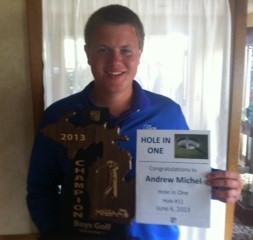 Instead, the graduating senior told of the 132-yard shot he dropped for a hole-in-one on the par-3 12th hole, his second ace but first in competition.
Michel finished with a season-best 76, missing the cut for this weekend’s Lower Peninsula Division 1 Final by a stroke despite firing another eagle during the final holes of his round.
“At the start of the day, I told myself don’t leave anything on the table. Go for it on every hole, make every shot and just have fun at your last tournament,” Michel said Tuesday afternoon as he readied for that night’s graduation ceremony. “Being a senior, I went for everything.”
The best part might’ve been how he came back from a disappointing previous hole.
Michel had just finished off a triple bogey on No. 11, and admitted he was down on himself. He stepped to the next tee with his pitching wedge, and “I didn’t really care what happened. I chose the club I like to hit on that hole, and in the air I was thinking it was really good,” he said.
The ball touched down on the green and spun back into the hole.
Michel also played golf and soccer at Brownstown-Woodhaven. He’ll attend Grand Valley State University in the fall, study engineering, and will try to walk-on the Lakers’ golf team.
“Deep down inside,” he said he’s disappointed he won’t be playing at Michigan State’s Forest Akers West on Friday. But he’s got a quite a highlight to take with him from his final high school round.
“It was very bittersweet. I really wanted to go to state,” Michel said. “But the hole-in-one balanced it out a bit.”
Eye on the official
Hopefully you caught our MHSAA benchmarks piece (also published on Second Half) on longtime official Lamont Simpson, who has worked not only MHSAA Finals but NCAA tournaments and is one of 32 officials in the WNBA. (Here’s the link in case you missed it.)
He also became that league’s first to wear the referee cam, debuting the new gear during a recent game between the Phoenix Mercury and Indiana Fever.
The camera provides plenty of ref’s-eye views. Click the video below to check it out.
Wheels of Steele
We’ve been watching the inspiring progress of Frankenmuth runner Bobby Steele especially over the last few years as his story became known across the Lower Peninsula.
Steele, who is visually impaired, has run cross country and track for the Eagles, thanks to the help of guides who ran with him to help him stay on course.
If you haven’t heard Steele’s awesome story, check out this 8-minute video. Not only did Steele run, but he cut roughly 12 minutes off his first cross country times over the course of his career.
Workout Basics: Warm-Ups & Cool-Downs
February 3, 2021

By Nick Parkinson, M.Ed., AT, ATC, TSAC-F
Henry Ford Health Systems
You may know a good warm-up — and cool-down — are essential to getting a good workout. You may also know that warming up your muscles and stretching them out after exercise can help prevent injury and keep you at the top of your game.
They’re the two bookends that help maximize a workout. Unfortunately, a lot of exercise enthusiasts don’t know how to warm up and cool down correctly.
Warm-Up Basics
A warm-up is exactly what it sounds like: The goal is to warm up your muscles and prepare your body for whatever you’re asking it to do. Warming up increases your body temperature and helps blood flow to the muscles that you’re using.
So if you’re going to play soccer, your warm-up should touch all of the muscles in your legs and core. Shooting hoops? You’ll need to add shoulders and arms to your routine. Circuit training at the gym? Choose a warm-up that flexes all of the muscles you’re about to use.
The thing that all warm-ups have in common is that they require dynamic (or constantly moving) motion, not static stretching (holding poses for a certain amount of time). In fact, static stretching prior to a workout can inhibit power and strength, especially if you’re doing something like weightlifting.
The anatomy of a solid warm-up:
• Before any activity, do about 10 minutes of light cardiovascular activity, whether walking, biking or jogging.
• Dynamic stretches. After you get your muscles moving, do a series of lunges, jumping jacks or toe touches to stretch a bit.
• Dive in. When you start your workout, begin slowly and gradually increase power and speed.
Cool-Down Basics
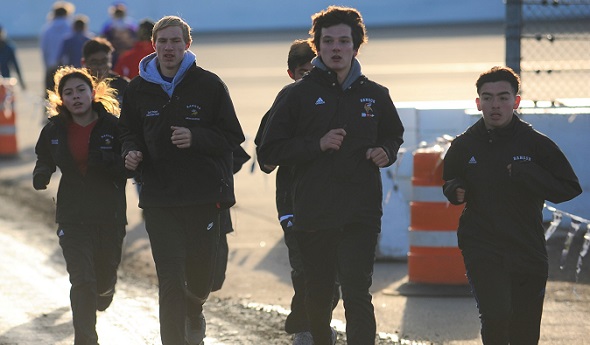
After you’ve put your body through a challenge, a good cool-down is essential. It helps slow down your heart rate gradually, relax your muscles and stretch them out.
Cool-down routines should always include some type of motion before you get to static stretching, especially if you’ve just finished a high-intensity workout. Static stretching improves flexibility and performance and it can also help stave off future injury.
As with warm-ups, the right cool-down exercises depend on the activity you engaged in. If you biked for 20 miles, you might coast on your cycle for a while before coming to a stop. If you ran, you might jog or walk before you begin stretching. As with your warm-up, the key is addressing every muscle group you worked during your workout.
The anatomy of a solid cool-down:
• At the end of your workout, slow the pace and intensity of whatever activity you’re doing. So, if you’re running, slow to a jog and then a walk for 5 to 10 minutes before stopping.
• Stretch out the muscles you work, but don’t push past the point where you feel tight. Then, hold the position for at least 30 seconds. That’s how long it takes for the body to overcome its stretch reflex.
• Breathe through your stretches and make sure to finish your cool-down with deep, belly breaths.
Running short on time? Target muscle groups you may have injured in the past or that tend to get sore after activity. Cooling down will preserve your athleticism — and your ability to participate in daily activities — over the long term.
Be Good to Your Body
While there’s some controversy about whether warming up and cooling down can help prevent injury, there’s little dispute that they can help you ease in and out of activity.
The key is to find something that works for you. Your warm-up could be as simple as walking to the gym and doing a set of jumping jacks when you arrive. Your cool-down might just involve ending your workout 10 minutes early so you can slow down.
It doesn’t have to be complicated. It just has to give your heart and blood vessels a chance to breathe before and after activity.
Nick Parkinson, M.Ed., AT, ATC, TSAC-F, is the Supervisor of Athletic Training with Henry Ford Sports Medicine and also leads Sports Performance training at the William Clay Ford Center for Athletic Medicine. Learn more about Nick.
Want to learn more? Henry Ford Health System sports medicine experts are treating the whole athlete, in a whole new way. From nutrition to neurology, and from injury prevention to treatment of sports-related conditions, they can give your athlete a unique game plan.
Visit henryford.com/sports or call (313) 972-4216.