


Michel Finishes with Story to Tell
June 11, 2013
By Geoff Kimmerly
Second Half editor
Andrew Michel received the heart-breaking news only moments before leaving his golf team’s Regional on Friday to get ready for that night’s Brownstown-Woodhaven prom.
But missing making the MHSAA Finals by a stroke was not the first thing he shared with those who asked about his day at West Shore Golf and Country Club in Grosse Ile.
 Instead, the graduating senior told of the 132-yard shot he dropped for a hole-in-one on the par-3 12th hole, his second ace but first in competition.
Michel finished with a season-best 76, missing the cut for this weekend’s Lower Peninsula Division 1 Final by a stroke despite firing another eagle during the final holes of his round.
“At the start of the day, I told myself don’t leave anything on the table. Go for it on every hole, make every shot and just have fun at your last tournament,” Michel said Tuesday afternoon as he readied for that night’s graduation ceremony. “Being a senior, I went for everything.”
The best part might’ve been how he came back from a disappointing previous hole.
Michel had just finished off a triple bogey on No. 11, and admitted he was down on himself. He stepped to the next tee with his pitching wedge, and “I didn’t really care what happened. I chose the club I like to hit on that hole, and in the air I was thinking it was really good,” he said.
The ball touched down on the green and spun back into the hole.
Michel also played golf and soccer at Brownstown-Woodhaven. He’ll attend Grand Valley State University in the fall, study engineering, and will try to walk-on the Lakers’ golf team.
“Deep down inside,” he said he’s disappointed he won’t be playing at Michigan State’s Forest Akers West on Friday. But he’s got a quite a highlight to take with him from his final high school round.
“It was very bittersweet. I really wanted to go to state,” Michel said. “But the hole-in-one balanced it out a bit.”
Eye on the official
Hopefully you caught our MHSAA benchmarks piece (also published on Second Half) on longtime official Lamont Simpson, who has worked not only MHSAA Finals but NCAA tournaments and is one of 32 officials in the WNBA. (Here’s the link in case you missed it.)
He also became that league’s first to wear the referee cam, debuting the new gear during a recent game between the Phoenix Mercury and Indiana Fever.
The camera provides plenty of ref’s-eye views. Click the video below to check it out.
Wheels of Steele
We’ve been watching the inspiring progress of Frankenmuth runner Bobby Steele especially over the last few years as his story became known across the Lower Peninsula.
Steele, who is visually impaired, has run cross country and track for the Eagles, thanks to the help of guides who ran with him to help him stay on course.
If you haven’t heard Steele’s awesome story, check out this 8-minute video. Not only did Steele run, but he cut roughly 12 minutes off his first cross country times over the course of his career.
NFHS Voice: Madness to Maddening
March 23, 2020
By Karissa Niehoff
NFHS Executive Director
March Madness took on another meaning for everyone in the sports world during the week of March 9 – a week like none other in the history of organized sports with the acceleration of the coronavirus (COVID-19) in the United States.
The Madness was not the bouncing of basketballs in arenas around the country. Instead it was organization after organization trying to determine the viability of continuing to operate – particularly after the suspension of the NBA season and the cancellation of the NCAA Division I Men’s and Women’s Basketball Championships.
And NFHS-member state high school associations were among those organizations faced with making decisions because the heightened state of the coronavirus pandemic occurred in the middle of state high school basketball tournaments across the country. While 13 states had completed their tournaments, the remainder were faced with tough decisions throughout the week.
By the end of that week, another four states were able to complete their girls and boys basketball tournaments – although all of these states had to impose extreme limits on the number of fans in attendance.
About two-thirds of our member state associations had to shut down their tournaments. At this point, 19 state associations have cancelled their state basketball tournaments, while 15 others have postponed or suspended their events, although the hope of completing them seems to fade with each passing day.
In addition to basketball, some states were in the midst of conducting ice hockey, gymnastics and swimming championships. While most of those sports championships, along with wrestling, were completed, some states were forced to suspend or cancel these as well.
Because of varying information from state health leaders, the Centers for Disease Control and Prevention (CDC) and state governors, some states were able to continue playing longer than others. Each state’s high school basketball tournament is one of the anticipated events of the year – particularly for residents in towns with schools playing for a state title.
From start to finish of state basketball tournaments in the 50 states plus the District of Columbia, more than one million fans trek to gymnasiums to watch these events. This year, however, many of these fans, along with about half of the 950,000 boys and girls who play high school basketball, were not able to experience March Madness.
And if this wasn’t enough, spring sports seasons and championships are at risk – mainly because schools are closed in many states, which means the discontinuation of school activity programs. The NCAA has cancelled all spring sports championships; and while state associations haven’t cancelled spring championships yet, athletics and activities programs are on hold for a set period of time – or indefinitely in some states.
While the loss of college and professional sports has an enormous impact on everyday life, considering that events surrounding the coronavirus affect some 19,500 high schools and 12 million participants in high school sports and performing arts activities, the impact on high school sports is perhaps even larger.
We support our 51 member state association leaders as they continue to work through these challenges. The loss of state basketball championships in many states is a sizeable financial challenge ahead as they work to continue to make state-level athletics and activities programs available.
On many occasions, we have written about the value of high school sports and activities. This month, we have witnessed the disappointment of thousands and thousands of players and fans who were not able to experience a state championship – many of whom were “going to state” for the first time.
High school sports is different from every other level of sport as these programs are a vital part of communities across our nation. Two weeks ago, when the doors were closed in many gymnasiums, it was confirmation of the desire and need for education-based high school sports and activities in the United States.
During this time of imposed social distancing, it is a time to step back and be thankful for these programs in our nation’s schools.
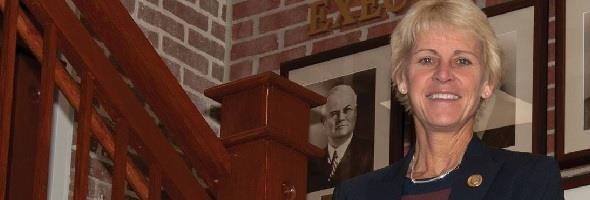
Dr. Karissa L. Niehoff is in her second year as executive director of the National Federation of State High School Associations (NFHS) in Indianapolis, Indiana. She is the first female to head the national leadership organization for high school athletics and performing arts activities and the sixth full-time executive director of the NFHS, which celebrated its 100th year of service during the 2018-19 school year. She previously was executive director of the Connecticut Association of Schools-Connecticut Interscholastic Athletic Conference for seven years.