


Michel Finishes with Story to Tell
June 11, 2013
By Geoff Kimmerly
Second Half editor
Andrew Michel received the heart-breaking news only moments before leaving his golf team’s Regional on Friday to get ready for that night’s Brownstown-Woodhaven prom.
But missing making the MHSAA Finals by a stroke was not the first thing he shared with those who asked about his day at West Shore Golf and Country Club in Grosse Ile.
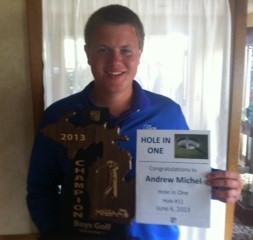 Instead, the graduating senior told of the 132-yard shot he dropped for a hole-in-one on the par-3 12th hole, his second ace but first in competition.
Michel finished with a season-best 76, missing the cut for this weekend’s Lower Peninsula Division 1 Final by a stroke despite firing another eagle during the final holes of his round.
“At the start of the day, I told myself don’t leave anything on the table. Go for it on every hole, make every shot and just have fun at your last tournament,” Michel said Tuesday afternoon as he readied for that night’s graduation ceremony. “Being a senior, I went for everything.”
The best part might’ve been how he came back from a disappointing previous hole.
Michel had just finished off a triple bogey on No. 11, and admitted he was down on himself. He stepped to the next tee with his pitching wedge, and “I didn’t really care what happened. I chose the club I like to hit on that hole, and in the air I was thinking it was really good,” he said.
The ball touched down on the green and spun back into the hole.
Michel also played golf and soccer at Brownstown-Woodhaven. He’ll attend Grand Valley State University in the fall, study engineering, and will try to walk-on the Lakers’ golf team.
“Deep down inside,” he said he’s disappointed he won’t be playing at Michigan State’s Forest Akers West on Friday. But he’s got a quite a highlight to take with him from his final high school round.
“It was very bittersweet. I really wanted to go to state,” Michel said. “But the hole-in-one balanced it out a bit.”
Eye on the official
Hopefully you caught our MHSAA benchmarks piece (also published on Second Half) on longtime official Lamont Simpson, who has worked not only MHSAA Finals but NCAA tournaments and is one of 32 officials in the WNBA. (Here’s the link in case you missed it.)
He also became that league’s first to wear the referee cam, debuting the new gear during a recent game between the Phoenix Mercury and Indiana Fever.
The camera provides plenty of ref’s-eye views. Click the video below to check it out.
Wheels of Steele
We’ve been watching the inspiring progress of Frankenmuth runner Bobby Steele especially over the last few years as his story became known across the Lower Peninsula.
Steele, who is visually impaired, has run cross country and track for the Eagles, thanks to the help of guides who ran with him to help him stay on course.
If you haven’t heard Steele’s awesome story, check out this 8-minute video. Not only did Steele run, but he cut roughly 12 minutes off his first cross country times over the course of his career.

NFHS Voice: Committed to HS Football
February 12, 2020
By Karissa Niehoff
NFHS Executive Director
The enduring popularity of football in the United States was celebrated in the past year at all levels of the sport.
The NFHS celebrated its 100th year of service in all areas of high school sports, including the writing of football playing rules, although the first-known games date to the 1870s.
This past year, the NCAA recognized the 150th anniversary of college football which started in 1869 when Princeton and Rutgers met for the first time. And the National Football League just closed its 100th season, which started with a 1919 game between Dayton and Columbus.
From those beginnings to today, the impact of football on life in America is incalculable. From the youth leagues, through high school and college, and on to the NFL, football is the runaway leader as this country’s most popular sport – both from a participant standpoint with about three million players annually at all levels, to the millions of fans who attend or watch games.
Every fall, millions of families spend a portion of their weekends supporting their grade-school kids in youth football programs. Through these programs, kids are exposed to the basics of the sport and, more importantly, they begin to learn teamwork, sportsmanship and how to win and lose in a proper manner.
On Friday nights, beyond the one million high school students – boys and girls – actually playing football, there are more than 150 million fans who attend games each year. Parents are involved in booster club activities, and homecoming activities occur during one football game every year. In many communities – particularly smaller cities and towns – Friday night football is often the most anticipated event of the week.
Another 50,000-plus players are involved in college football on Saturdays. As is the case at the high school level, homecoming events are tied to one football game every fall. Postseason bowl games have been a part of American culture for decades, and the new College Football Playoff has brought even more excitement to the end of the season.
NFL games on Sunday complete the three-day weekend focus on the country’s favorite sport. Thanks, in part, to the singular weekly focus as opposed to multiple games each week in the other three major professional sports, football dwarfs its competitors.
The interest level in playing football – and following the sport at all levels – has never been higher. With that continued interest in the sport comes the expectation that everything possible is being done – at all levels – to ensure that the safety of each and every participant is of the upmost concern.
With that backdrop, last week we met with leaders from USA Football, several state high school association executive directors and high school coaches and athletic directors representing the National High School Football Coaches Alliance and the National Interscholastic Athletic Administrators Association, respectively.
Collectively, these groups are committed to consistent messaging and support to ensure the ongoing popularity of the sport for the next 100 years. We believe the Football Development Model (FDM) enacted by USA Football will re-invigorate interest in the sport at the youth levels. The FDM reduces contact in youth football and advances the game through comprehensive education, game progressions and safety standards.
There was also agreement about the importance of high school football coaches. By connecting with coaches of youth football programs in their communities, high school football coaches can spur excitement on the part of youth players and their parents and improve chances of kids continuing to play the sport. Without a doubt, high school football coaches can be the focal point to success of programs in communities across the nation.
Working together, we can count on a continuation of the sport’s popularity at the high school level.
Dr. Karissa L. Niehoff is in her second year as executive director of the National Federation of State High School Associations (NFHS) in Indianapolis, Indiana. She is the first female to head the national leadership organization for high school athletics and performing arts activities and the sixth full-time executive director of the NFHS, which celebrated its 100th year of service during the 2018-19 school year. She previously was executive director of the Connecticut Association of Schools-Connecticut Interscholastic Athletic Conference for seven years.