


Michel Finishes with Story to Tell
June 11, 2013
By Geoff Kimmerly
Second Half editor
Andrew Michel received the heart-breaking news only moments before leaving his golf team’s Regional on Friday to get ready for that night’s Brownstown-Woodhaven prom.
But missing making the MHSAA Finals by a stroke was not the first thing he shared with those who asked about his day at West Shore Golf and Country Club in Grosse Ile.
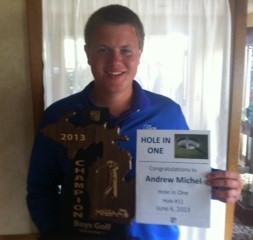 Instead, the graduating senior told of the 132-yard shot he dropped for a hole-in-one on the par-3 12th hole, his second ace but first in competition.
Michel finished with a season-best 76, missing the cut for this weekend’s Lower Peninsula Division 1 Final by a stroke despite firing another eagle during the final holes of his round.
“At the start of the day, I told myself don’t leave anything on the table. Go for it on every hole, make every shot and just have fun at your last tournament,” Michel said Tuesday afternoon as he readied for that night’s graduation ceremony. “Being a senior, I went for everything.”
The best part might’ve been how he came back from a disappointing previous hole.
Michel had just finished off a triple bogey on No. 11, and admitted he was down on himself. He stepped to the next tee with his pitching wedge, and “I didn’t really care what happened. I chose the club I like to hit on that hole, and in the air I was thinking it was really good,” he said.
The ball touched down on the green and spun back into the hole.
Michel also played golf and soccer at Brownstown-Woodhaven. He’ll attend Grand Valley State University in the fall, study engineering, and will try to walk-on the Lakers’ golf team.
“Deep down inside,” he said he’s disappointed he won’t be playing at Michigan State’s Forest Akers West on Friday. But he’s got a quite a highlight to take with him from his final high school round.
“It was very bittersweet. I really wanted to go to state,” Michel said. “But the hole-in-one balanced it out a bit.”
Eye on the official
Hopefully you caught our MHSAA benchmarks piece (also published on Second Half) on longtime official Lamont Simpson, who has worked not only MHSAA Finals but NCAA tournaments and is one of 32 officials in the WNBA. (Here’s the link in case you missed it.)
He also became that league’s first to wear the referee cam, debuting the new gear during a recent game between the Phoenix Mercury and Indiana Fever.
The camera provides plenty of ref’s-eye views. Click the video below to check it out.
Wheels of Steele
We’ve been watching the inspiring progress of Frankenmuth runner Bobby Steele especially over the last few years as his story became known across the Lower Peninsula.
Steele, who is visually impaired, has run cross country and track for the Eagles, thanks to the help of guides who ran with him to help him stay on course.
If you haven’t heard Steele’s awesome story, check out this 8-minute video. Not only did Steele run, but he cut roughly 12 minutes off his first cross country times over the course of his career.

NFHS Voice: Source of HS Playing Rules
November 12, 2019
By Karissa Niehoff
NFHS Executive Director
When it comes to writing playing rules for major sports in the United States, it’s all in the acronyms. In football, you have the NFL, NCAA and NFHS. In basketball, it’s the NBA, NCAA and NFHS. In baseball, the rules-makers are MLB, NCAA and NFHS.
While the NFL, NBA, MLB and NCAA can be used on first reference without explanation, many people are unfamiliar with the NFHS. And yet the NFHS has been around as long – or longer – than the other four major sports organizations.
In many cases, references to NFHS rules – not only in these three major sports but the other 14 sports for which the organization writes rules – are simply noted as “high school rules.” The reality, however, is that the NFHS – the National Federation of State High School Associations – has been the national organization most directly focused on sports playing rules in the past 90 years since it published its first Football Rules Book in 1932.
With almost eight million participants in high school sports, NFHS rules are written for more individuals than all other levels of sports combined. As a result, risk minimization and the fundamentals of good sportsmanship are paramount to the rules-writing process for the NFHS and often are the distinguishing factors from rules at the higher levels of the sport.
Perhaps football is the best example of the commitment to risk minimization. In the mid-1970s, the NFHS was at the forefront of change when it outlawed spearing in high school football. The 1976 rule revision changed the landscape of high school football from an injury standpoint – from a high of 36 direct fatalities in 1968 to an average of about two per year by 2018.
Some people have questioned why there are multiple rules codes for a sport. Very simply, NFHS rules for high school play must be different than at the college and professional levels.
As an example, while professional baseball is concerned with how fast a baseball exits the batter’s box (Velocity Exit Speed) and how far the ball travels on a home run, the NFHS has enacted bat standards during the past 20 years to reduce the speed of balls coming off aluminum bats. In wrestling, the NFHS has enacted strict weight-management plans to reduce the risk of health issues. In ice hockey, while fighting is an accepted part of the sport at the professional level, NFHS rules have strict rules prohibiting all forms of unsportsmanlike conduct. In football, NFHS rules do not permit the excessive celebration displays following touchdowns that occur during NFL games.
In addition to risk minimization and sportsmanship, the NFHS must also weigh financial implications for schools when considering equipment and uniform changes. With schools ranging in size from less than 100 to more than 5,000 students, decisions must be made for the masses and cannot put undue financial hardships on schools.
NFHS rules are also written with the understanding that appropriate behavior begins with the coach, who is responsible for ensuring that his or her team exhibits good sporting behavior. Many penalties for unsportsmanlike conduct on the team are first directed against the coach.
While the NFHS and its member state associations govern the high school place in various sports – not only with playing rules but other issues as well – we maintain relationships with the National Governing Bodies (NGBs) in these sports to assist in meeting the needs of all participants.
Last week, the NFHS hosted a summit of various leaders of NGBs in Indianapolis. Leaders from about 15 NGBs were set to meet with NFHS staff to discuss various initiatives and opportunities for collaborative programs. We hope this is the first of many such meetings as it is crucial that all levels of sport work together to ensure ongoing opportunities for all sports participants.
Dr. Karissa L. Niehoff is in her second year as executive director of the National Federation of State High School Associations (NFHS) in Indianapolis, Indiana. She is the first female to head the national leadership organization for high school athletics and performing arts activities and the sixth full-time executive director of the NFHS, which celebrated its 100th year of service during the 2018-19 school year. She previously was executive director of the Connecticut Association of Schools-Connecticut Interscholastic Athletic Conference for seven years.