


Michel Finishes with Story to Tell
June 11, 2013
By Geoff Kimmerly
Second Half editor
Andrew Michel received the heart-breaking news only moments before leaving his golf team’s Regional on Friday to get ready for that night’s Brownstown-Woodhaven prom.
But missing making the MHSAA Finals by a stroke was not the first thing he shared with those who asked about his day at West Shore Golf and Country Club in Grosse Ile.
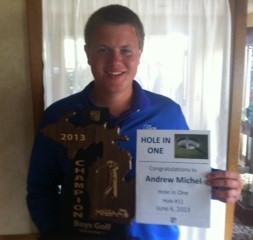 Instead, the graduating senior told of the 132-yard shot he dropped for a hole-in-one on the par-3 12th hole, his second ace but first in competition.
Michel finished with a season-best 76, missing the cut for this weekend’s Lower Peninsula Division 1 Final by a stroke despite firing another eagle during the final holes of his round.
“At the start of the day, I told myself don’t leave anything on the table. Go for it on every hole, make every shot and just have fun at your last tournament,” Michel said Tuesday afternoon as he readied for that night’s graduation ceremony. “Being a senior, I went for everything.”
The best part might’ve been how he came back from a disappointing previous hole.
Michel had just finished off a triple bogey on No. 11, and admitted he was down on himself. He stepped to the next tee with his pitching wedge, and “I didn’t really care what happened. I chose the club I like to hit on that hole, and in the air I was thinking it was really good,” he said.
The ball touched down on the green and spun back into the hole.
Michel also played golf and soccer at Brownstown-Woodhaven. He’ll attend Grand Valley State University in the fall, study engineering, and will try to walk-on the Lakers’ golf team.
“Deep down inside,” he said he’s disappointed he won’t be playing at Michigan State’s Forest Akers West on Friday. But he’s got a quite a highlight to take with him from his final high school round.
“It was very bittersweet. I really wanted to go to state,” Michel said. “But the hole-in-one balanced it out a bit.”
Eye on the official
Hopefully you caught our MHSAA benchmarks piece (also published on Second Half) on longtime official Lamont Simpson, who has worked not only MHSAA Finals but NCAA tournaments and is one of 32 officials in the WNBA. (Here’s the link in case you missed it.)
He also became that league’s first to wear the referee cam, debuting the new gear during a recent game between the Phoenix Mercury and Indiana Fever.
The camera provides plenty of ref’s-eye views. Click the video below to check it out.
Wheels of Steele
We’ve been watching the inspiring progress of Frankenmuth runner Bobby Steele especially over the last few years as his story became known across the Lower Peninsula.
Steele, who is visually impaired, has run cross country and track for the Eagles, thanks to the help of guides who ran with him to help him stay on course.
If you haven’t heard Steele’s awesome story, check out this 8-minute video. Not only did Steele run, but he cut roughly 12 minutes off his first cross country times over the course of his career.
Participation Again Outpaces Population
August 26, 2019
By Geoff Kimmerly
Second Half editor
For the third straight school year, Michigan in 2018-19 had the eighth-most participants in high school sports nationally according to statistics recently released by the National Federation of State High School Associations, again outpacing the state’s national ranking of 10th for total number of residents of high school age.
Michigan’s participation ranking was based on a number of 292,947, with 126,342 girls and 166,605 boys taking part in high school athletics, and included sports in which the Michigan High School Athletic Association does not conduct postseason tournaments. The totals count students once for each sport in which he or she participates, meaning students who are multiple-sport athletes are counted more than once.
The state’s girls participation ranked eighth nationally for the third straight year, while boys participation fell back to eighth, after moving up one spot to seventh during 2017-18. However, as with overall population, Michigan continued to rank 10th for both females and males ages 14-17 according to the latest U.S. Census Bureau estimates from 2018.
A total of 19 sports bested the state’s overall national participation ranking of eighth by placing seventh or higher on their respective lists. Four Michigan sports improved in national ranking during 2018-19, while the state fell in the rankings of five sports.
Perhaps the most notable improvement among Michigan sports came in boys bowling, where Michigan moved up one spot to second – its highest ranking in any of the 28 sports under MHSAA administration. Michigan previously ranked second nationally in boys bowling as recently as 2013-14 before falling to third for the last four years. Michigan’s boys tennis participation moved up one spot as well to fifth on its ranking list, while girls track & field moved up one spot to seventh and girls lacrosse moved up one spot to 13th after a one-year drop back in 2017-18.
Three of five sports that fell on participation lists still outpaced Michigan’s overall participation rank – girls volleyball fell one spot to fifth, while girls golf and girls competitive cheer both fell one spot to sixth on their respective rankings lists. Other Michigan sports that ranked eighth or higher in 2018-19 were baseball (eighth), girls basketball (sixth), boys basketball (seventh), girls bowling (fourth), girls and boys cross country (both seventh), 11 and 8-player football (sixth and seventh, respectively), boys golf (sixth), boys ice hockey (fourth), girls and boys skiing (both third), girls softball (seventh), girls tennis (third) and boys track & field (seventh).
Boys lacrosse, girls soccer and boys and girls swimming & diving participation all slotted ninth on their respective lists, holding to their 2017-18 rankings and placing still ahead of where Michigan slotted for high school-aged population. Michigan wrestling participation fell two spots to ninth nationally, but still outpaced population, and boys soccer fell one spot to 10th. Girls gymnastics participation ranked 11th nationally for the second straight year.
National participation in high school sports in 2018-19 declined for the first time in 30 years – but the total of 7,937,491 participants still ranked third highest all-time, consisting of 4,534,758 boys and 3,402,733 girls.
Girls volleyball saw the largest increase in participants nationally with 6,225 more this past year over 2017-18, followed by boys track & field (+5,257), girls soccer (+3,623) and girls lacrosse (+3,164).
Football, despite a 5.8-percent decrease from 2017-18, remained the most-played high school sport nationally with 1,006,013 participants. Boys track & field (605,354), boys basketball (540,769), girls track & field (488,267), baseball (482,740), boys soccer (459,077) and girls volleyball (452,808) all saw at least 400,000 participants, while girls basketball (399,067) and girls soccer (394,105) approached that total.
The top 10 states by participants remained the same in 2018-19. Texas and California topped the list again with 825,924 and 824,709 participants, respectively, followed by New York (369,266), Ohio (339,158), Illinois (333,838), Pennsylvania (316,429), Florida (308,173), Michigan (292,947), New Jersey (281,058) and Minnesota (240,487). Only Texas, California and Minnesota reported higher figures than the previous year.
The participation survey has been compiled in its current form by the NFHS since 1971 through numbers it receives from its 51 member state associations, including the District of Columbia. Click to see the complete 2018-19 High School Athletics Participation Survey.
The NFHS, based in Indianapolis, Indiana, is the national leadership organization for high school sports and performing arts activities. Since 1920, the NFHS has led the development of education-based interscholastic sports and performing arts activities that help students succeed in their lives. The NFHS sets direction for the future by building awareness and support, improving the participation experience, establishing consistent standards and rules for competition, and helping those who oversee high school sports and activities. The NFHS writes playing rules for 16 sports for boys and girls at the high school level. Through its 50 member state associations and the District of Columbia, the NFHS reaches more than 19,500 high schools and 12 million participants in high school activity programs, including almost 8 million in high school sports. As the recognized national authority on interscholastic activity programs, the NFHS conducts national meetings, sanctions interstate events, offers online publications and services for high school coaches and officials, sponsors professional organizations for high school coaches, officials, speech and debate coaches, and music adjudicators; serves as the national source for interscholastic coach training and serves as a national information resource of interscholastic athletics and activities.
The MHSAA is a private, not-for-profit corporation of voluntary membership by more than 1,500 public and private senior high schools and junior high/middle schools which exists to develop common rules for athletic eligibility and competition. No government funds or tax dollars support the MHSAA, which was the first such association nationally to not accept membership dues or tournament entry fees from schools. Member schools which enforce these rules are permitted to participate in MHSAA tournaments, which attract more than 1.4 million spectators each year.