


Michel Finishes with Story to Tell
June 11, 2013
By Geoff Kimmerly
Second Half editor
Andrew Michel received the heart-breaking news only moments before leaving his golf team’s Regional on Friday to get ready for that night’s Brownstown-Woodhaven prom.
But missing making the MHSAA Finals by a stroke was not the first thing he shared with those who asked about his day at West Shore Golf and Country Club in Grosse Ile.
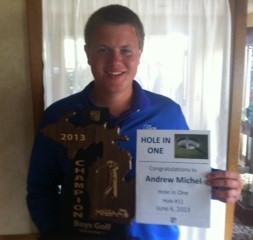 Instead, the graduating senior told of the 132-yard shot he dropped for a hole-in-one on the par-3 12th hole, his second ace but first in competition.
Michel finished with a season-best 76, missing the cut for this weekend’s Lower Peninsula Division 1 Final by a stroke despite firing another eagle during the final holes of his round.
“At the start of the day, I told myself don’t leave anything on the table. Go for it on every hole, make every shot and just have fun at your last tournament,” Michel said Tuesday afternoon as he readied for that night’s graduation ceremony. “Being a senior, I went for everything.”
The best part might’ve been how he came back from a disappointing previous hole.
Michel had just finished off a triple bogey on No. 11, and admitted he was down on himself. He stepped to the next tee with his pitching wedge, and “I didn’t really care what happened. I chose the club I like to hit on that hole, and in the air I was thinking it was really good,” he said.
The ball touched down on the green and spun back into the hole.
Michel also played golf and soccer at Brownstown-Woodhaven. He’ll attend Grand Valley State University in the fall, study engineering, and will try to walk-on the Lakers’ golf team.
“Deep down inside,” he said he’s disappointed he won’t be playing at Michigan State’s Forest Akers West on Friday. But he’s got a quite a highlight to take with him from his final high school round.
“It was very bittersweet. I really wanted to go to state,” Michel said. “But the hole-in-one balanced it out a bit.”
Eye on the official
Hopefully you caught our MHSAA benchmarks piece (also published on Second Half) on longtime official Lamont Simpson, who has worked not only MHSAA Finals but NCAA tournaments and is one of 32 officials in the WNBA. (Here’s the link in case you missed it.)
He also became that league’s first to wear the referee cam, debuting the new gear during a recent game between the Phoenix Mercury and Indiana Fever.
The camera provides plenty of ref’s-eye views. Click the video below to check it out.
Wheels of Steele
We’ve been watching the inspiring progress of Frankenmuth runner Bobby Steele especially over the last few years as his story became known across the Lower Peninsula.
Steele, who is visually impaired, has run cross country and track for the Eagles, thanks to the help of guides who ran with him to help him stay on course.
If you haven’t heard Steele’s awesome story, check out this 8-minute video. Not only did Steele run, but he cut roughly 12 minutes off his first cross country times over the course of his career.
Pay-to-Play Use Hovers at 50 percent
By
Geoff Kimmerly
MHSAA.com senior editor
July 30, 2019
By Geoff Kimmerly
Second Half editor
Half of MHSAA member high schools continued to assess sports participation fees during the 2018-19 school year, according to a survey that has measured the prevalence of charging students to help fund interscholastic athletics annually over the last 15 years.
Of the 604 schools which responded to the 2018-19 survey, exactly half – 302 – assessed a participation fee, while 302 did not during the past school year. This year’s survey results are in line with those of the last two schools years, which saw 49.7 percent of schools charging participation fees for 2016-17 and 49 percent in 2017-18. For the purposes of the survey, a participation fee was anything $20 or more regardless of what the school called the charge (registration fee, insurance fee, transportation fee, etc.).
The MHSAA conducted its first participation fee survey during the 2003-04 school year, when 24 percent of responding schools reported they charged fees. The percentage of member schools charging fees crossed 50 percent in 2010-11 and reached a high of 56.6 percent in 2013-14 before falling back below 50 percent in 2016-17.
A record number of member high schools responded to the survey for the second straight year – 81 percent of the MHSAA’s 750 member schools provided data for 2018-19. Class A schools again remained the largest group charging fees, with 69 percent of respondents doing so. Class B and Class C schools followed, both with 48 percent charging fees, and Class D schools also remained in line with the previous year with 35 percent charging for participation.
Charging a standardized fee for each team on which a student-athlete participates – regardless of the number of teams – remains the most popular method among schools assessing fees, with that rate at 45 percent of schools. Schools charging a one-time standardized fee per student-athlete remained constant at 28 percent. A slight uptick was seen in the percentage of schools assessing fees based on tiers of the number of sports a student-athlete plays (for example, charging a larger fee for the first team and less for additional sports), with 20 percent of responding schools charging in this way compared to 15 percent a year ago.
The amounts of most fees remained consistent or similar as well during 2018-19. The median annual maximum fee per student of $150 and the median annual maximum family fee of $300 both remained constant for at least the fifth straight year, while the median fee assessed by schools that charge student-athletes once per year held steady at $125 for the third straight school year. The median per-team fee increased slightly, $5, to $80 for 2018-19.
The survey for 2018-19 and surveys from previous years can be found on the MHSAA Website.
The MHSAA is a private, not-for-profit corporation of voluntary membership by more than 1,500 public and private senior high schools and junior high/middle schools which exists to develop common rules for athletic eligibility and competition. No government funds or tax dollars support the MHSAA, which was the first such association nationally to not accept membership dues or tournament entry fees from schools. Member schools which enforce these rules are permitted to participate in MHSAA tournaments, which attract more than 1.4 million spectators each year.