


Michel Finishes with Story to Tell
June 11, 2013
By Geoff Kimmerly
Second Half editor
Andrew Michel received the heart-breaking news only moments before leaving his golf team’s Regional on Friday to get ready for that night’s Brownstown-Woodhaven prom.
But missing making the MHSAA Finals by a stroke was not the first thing he shared with those who asked about his day at West Shore Golf and Country Club in Grosse Ile.
 Instead, the graduating senior told of the 132-yard shot he dropped for a hole-in-one on the par-3 12th hole, his second ace but first in competition.
Michel finished with a season-best 76, missing the cut for this weekend’s Lower Peninsula Division 1 Final by a stroke despite firing another eagle during the final holes of his round.
“At the start of the day, I told myself don’t leave anything on the table. Go for it on every hole, make every shot and just have fun at your last tournament,” Michel said Tuesday afternoon as he readied for that night’s graduation ceremony. “Being a senior, I went for everything.”
The best part might’ve been how he came back from a disappointing previous hole.
Michel had just finished off a triple bogey on No. 11, and admitted he was down on himself. He stepped to the next tee with his pitching wedge, and “I didn’t really care what happened. I chose the club I like to hit on that hole, and in the air I was thinking it was really good,” he said.
The ball touched down on the green and spun back into the hole.
Michel also played golf and soccer at Brownstown-Woodhaven. He’ll attend Grand Valley State University in the fall, study engineering, and will try to walk-on the Lakers’ golf team.
“Deep down inside,” he said he’s disappointed he won’t be playing at Michigan State’s Forest Akers West on Friday. But he’s got a quite a highlight to take with him from his final high school round.
“It was very bittersweet. I really wanted to go to state,” Michel said. “But the hole-in-one balanced it out a bit.”
Eye on the official
Hopefully you caught our MHSAA benchmarks piece (also published on Second Half) on longtime official Lamont Simpson, who has worked not only MHSAA Finals but NCAA tournaments and is one of 32 officials in the WNBA. (Here’s the link in case you missed it.)
He also became that league’s first to wear the referee cam, debuting the new gear during a recent game between the Phoenix Mercury and Indiana Fever.
The camera provides plenty of ref’s-eye views. Click the video below to check it out.
Wheels of Steele
We’ve been watching the inspiring progress of Frankenmuth runner Bobby Steele especially over the last few years as his story became known across the Lower Peninsula.
Steele, who is visually impaired, has run cross country and track for the Eagles, thanks to the help of guides who ran with him to help him stay on course.
If you haven’t heard Steele’s awesome story, check out this 8-minute video. Not only did Steele run, but he cut roughly 12 minutes off his first cross country times over the course of his career.
Inside Selection Sunday: Mapnalysis '18
October 21, 2018
By Geoff Kimmerly
Second Half editor
For a fading moment, we thought we saw the Big Dipper floating through the second floor of the MHSAA office Sunday morning.
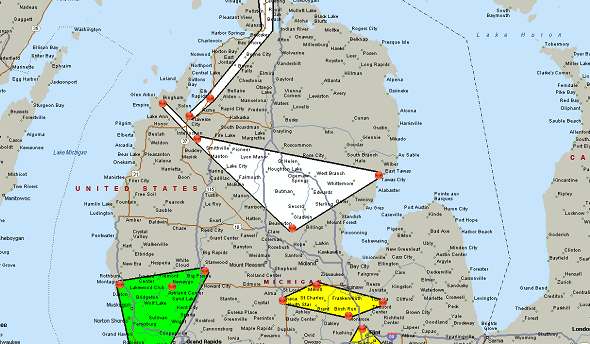
Michigan’s northernmost high school in Calumet held the handle – but the only place the rest of the Region pointed was to questions about how we could come up with such a disjointed scenario for this season’s Division 6 Playoffs.
Below – as has become an annual tradition – we’ll answer that question and a few more about this year’s selection process.
Our mission Sunday was to map 213 automatic qualifiers for 11-player football – and a record 43 additional qualifiers with 5-4 or 4-4 records – plus our top 32 8-player teams across 10 divisions of playoffs that will conclude with the latter Nov. 17 at Northern Michigan University and 11-player Nov. 23-24 at Ford Field.
As often noted in the past, this process didn’t start Sunday morning – but months and in some cases more than a year ago when athletic directors began scheduling games for this fall. We make sure all are loaded into our system by early summer, and then follow every score/cancellation/forfeit/additional change through Week 9’s final games – including this season those for 46 teams from other states or Ontario that played Michigan schools and needed to be followed as well because their successes affected MHSAA teams’ strengths of schedule.
Now that the maps are drawn, we line up all that will come with the next five weeks of games including assigning officials, gathering potential Semifinal sites and continuing our work with our Finals hosts to create memorable experiences as teams play for championships.
So we’re off. For those familiar with our playoff selection process, or who have read this report in the past and don’t want a refresher on how we do what we do, skip the next section and go directly to the “Observations & Answers: 2018.” For the rest, what follows is an explanation of how we selected the playoff pairings during the morning hours Sunday, followed by how we made some of the toughest decisions plus a few thoughts on the breakdown of the field. Go to this page on MHSAA.com to see the pairings in full.
Ground Rules
Our past: The MHSAA 11-player playoff structure – with 256 teams in eight divisions, and six wins equaling an automatic berth (or five wins for teams playing eight or fewer games) – debuted in 1999. An 8-player tournament was added in 2011, and in 2017 a second division of 8-player football was introduced.
The first playoffs were conducted in 1975 with four champions. Four more football classes were added in 1990 for a total of eight champions each fall. Through 1998, only 128 teams made the postseason, based on their playoff point averages within regions (four for each class) that were drawn before the beginning of the season. The drawing of Districts and Regionals after the end of the regular season did not begin until the most recent 11-player playoff expansion.
In early years of the current process, lines were drawn by hand. Dots representing qualifying schools were pasted on maps, one map for each division, and those maps were then covered by plastic sheets. Districts and Regionals literally were drawn with dry-erase markers.
Our present: After a late Saturday night tracking scores, we file in Sunday morning for a final round of gathering results we may still need (which can include making a few early a.m. calls to athletic directors and coaches). Re-checking and triple-checking of enrollments, what schools played in co-ops and opted to play as a higher class start a week in advance, and more numbers are crunched Sunday morning as the fields are set.
As noted above, this season there were 213 automatic qualifiers for the 11-player field by win total with the final 43 additional qualifiers then selected, by playoff-point average, one from each class in order (A, B, C, D) until the field was filled. There were only five Class D additional qualifiers with 5-4 or 4-4 (playing eight games) records from which we could choose – so with those five we added 13 teams from Class A and B and 12 from Class C.
Those 256 11-player teams are then split into eight equal divisions based on enrollment, and their locations are marked on digital maps that are projected on wall-size screens and then discussed by nearly half of the MHSAA staff plus a representative from the Michigan High School Football Coaches Association. Only the locations themselves are marked (by red dots) – not records, playoff point averages or names of the schools or towns. In fact, mentions of those are strictly prohibited. Records and playoff points are not part of the criteria. Matchups, rivalries, previous playoff pairings, etc. also DO NOT come into play.
The 8-player process is different for team selection and similar for designation of Regionals. We take the top 32 teams in 8-player based on playoff point average as our field, then re-sort those 32 by enrollment – the 16 biggest make up Division 1, followed by the next 16 in Division 2. There are no automatic qualifiers by record for 8-player.
Geography rules: This long has been rule number one for drawing MHSAA brackets in any sport. Travel distance and ease DO come into play. Jumping on a major highway clearly is easier than driving across county-wide back roads, and that’s taken into consideration. Also, remember there’s only one Mackinac Bridge and hence only one way to cross between peninsulas – and boats are not considered a possible form of transportation. When opponents from both peninsulas will be in the same District, distance to the bridge is far more important than as the bird flies.
Tradition doesn’t reign: Every group of 32 (or in 8-player, 16) dots is a new group – these 32 teams have not been placed in a bracket together before. How maps have been drawn in the past isn’t considered – it’s hard to say a division has been drawn in a certain way traditionally when this set of 32 teams is making up a division for the first time.
Observations & Answers: 2018
We always start with CONGRATULATIONS: And this season they go first to Detroit Community, Detroit Public Safety Academy and Dexter, which made the MHSAA Football Playoffs for the first time. Of 611 football varsities across the state, all but 12 have made the playoffs at least once. Rockford missed out on an automatic bid with a Week 9 loss, but received an additional qualifier berth to set the record by making the MHSAA Playoffs for the 24th straight season. Crystal Falls Forest Park (22 seasons), Stevensville Lakeshore (21), Macomb Dakota (18), Climax-Scotts (16) and Grand Rapids West Catholic (16) also extended their stays on the list for longest MHSAA playoff streaks.
Break the tie: We again had to break a tie (actually two for District rounds) as teams that will or could meet ended up with the same playoff point averages. Ties are broken by head-to-head competition first – if the teams played each other during the regular season – followed by opponents’ winning percentage as the second criteria and then a coin flip if those two won’t do it. Our tie-breaks this season both took place in Division 4 – Grand Rapids South Christian received a home game against Wyoming Godwin Heights this week and St. Clair will host North Branch if they meet in a District Final. There are more possible meetings of teams with same averages in later rounds, and those ties will be broken the same way.
What is up with Division 6: Last year I had a “worst map ever,” and two of them this year would be in contention. Division 6 is the first – but the explanation for how we came up with what we did is simple. Region 1 is made up of two Districts with six schools from the northern Lower Peninsula and two from the Upper Peninsula. So however the Districts were sliced, two Lower Peninsula schools had to go with the U.P. And we settled this one strictly by comparing highway mileages of those Lower Peninsula teams to Mackinac Bridge (again, the only way to travel between the peninsulas). In the end, we placed Elk Rapids (93 miles) and Traverse City St. Francis (124) with Escanaba and Ishpeming Westwood because they are closest to the Bridge – followed by Kingsley (126), Maple City Glen Lake (144), Beaverton (161) and Tawas (168). The optics are strange – it may look like Glen Lake is driving past Elk Rapids and St. Francis on the way to Beaverton this week and potentially Tawas next. But Glen Lake’s route still travels south of those two schools this week (and depending on its chosen route on the way to Tawas as well), making everything fit – strangely looking, but nonetheless.
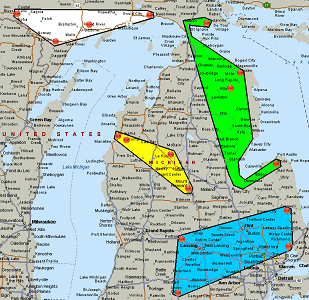 Lake Huron tour: You could see most of the American side by checking out this week’s Region 2 games in 8-player Division 2. This map also looks odd – there’s a bridge crossing and a drive around Saginaw Bay. Yet, after drawing this at least two more ways, we settled here – although Region 2 looks a little odd, all four teams are east of I-75 and north of Bay City.
Get your zoom on: We don’t enjoy splitting up teams that live next door to each other, but sometimes it’s a must. In Division 7 we were able to keep all eight Detroit-area and southeastern schools in Region 4, but the distance between its Districts came down to a few miles along I-96. In Division 2, we had to factor in outliers Port Huron Northern and Temperance Bedford – and the resulting Districts ended up splitting Livonia Churchill and Livonia Franklin.
At the end of the day …
I include this every year, but we draw the maps not knowing which schools are represented by the dots. At one point Sunday morning, I was wrong about which division we were considering at the time – and that’s a good thing. For the map drawing portion, it doesn’t matter.
But now that we know who is going where, here’s a glance at some stories that might emerge this week:
• We’ve got rivalries, like Portage Northern at Portage Central and Birmingham Groves at Birmingham Seaholm in Division 2, St. Johns at DeWitt and Haslett at East Lansing in Division 3, Constantine at Schoolcraft in Division 6 and Waterford Our Lady at Clarkston Everest Collegiate in Division 8 – plus Kingston at Deckerville in 8-player Division 1. There are many more we could mention – and some potential feuds renewed in two weeks as well depending on who wins this round.
• The Macomb Area Red, generally considered one of the strongest leagues annually in the state, sent four of six teams to the Division 1 playoffs – and they’re all in the same District. Champion Clinton Township Chippewa Valley (9-0) takes on Utica Eisenhower this week, and with a win would face either Macomb Dakota or Romeo after defeating both by just seven points during the regular season.
• Perhaps the most intriguing opener statewide is River Rouge (8-1) at Detroit Martin Luther King (7-2) in Division 3. Neither gets tested much during their league seasons, but both played tough nonleague opponents and the winner will be considered a favorite to make it to Ford Field.
• Farmington Hills Harrison holds the records for most MHSAA Finals appearances (18) and titles (13) and will play its final playoffs in Division 4 after finishing Division 3 runner-up a year ago. The school is closing next spring. Coach John Herrington is the winningest in state history with 441 wins and counting against only 111 losses (and a tie).
• There are a few annual powers not in the bracket this season – most notably Lowell, Muskegon Catholic Central and Menominee – and others like Rockford, Mendon and Grand Rapids West Catholic got in as additional qualifiers. West Catholic has won five straight Division 5 championships and opens at Hudsonville Unity Christian. The Falcons won the 2013 title after also entering as a 5-4 team.
• There are 34 teams entering the playoffs unbeaten, but only four Districts have multiple – Manistee and Reed City share one in Division 5, Traverse City St. Francis and Calumet in Division 6, Reading and Ottawa Lake Whiteford in Division 8, and Wyoming Tri-unity Christian and Morrice in 8-player Division 1. All of those potential matchups would happen in 11-Player District or 8-Player Regional Finals.
• This will be the eighth year of the 8-player tournament, and in Division 1 only Deckerville in 2012 has won an MHSAA championship in this format. In Division 2, reigning champion Crystal Falls Forest Park opens with 2015-16 back-to-back champion Powers North Central.
• In 8-player, three teams with 5-4 records didn’t make the field of 32, and two teams with 4-5 records advanced. This is the reality of measuring by playoff point average. Fife Lake Forest Area and Webberville are the 4-5 teams, and their opponents this season won more than 61 percent of their games. The three teams at 5-4 and one at 4-4 had opponents’ winning percentages between 38-56 percent.
Every school and every community can tell a story of making these playoffs, and over the next five weeks the fortunate will continue to write chapters filled with moments that will never be forgotten. We’re looking forward to watching them all unfold.
PHOTOS: (Top) The Division 6 map shows an odd-looking scenario with two Traverse City-area teams in the same District as two from the Upper Peninsula. (Middle) The 8-player Division 2 map shows how schools are connected to a District along the Lake Huron shoreline.