


Michel Finishes with Story to Tell
June 11, 2013
By Geoff Kimmerly
Second Half editor
Andrew Michel received the heart-breaking news only moments before leaving his golf team’s Regional on Friday to get ready for that night’s Brownstown-Woodhaven prom.
But missing making the MHSAA Finals by a stroke was not the first thing he shared with those who asked about his day at West Shore Golf and Country Club in Grosse Ile.
 Instead, the graduating senior told of the 132-yard shot he dropped for a hole-in-one on the par-3 12th hole, his second ace but first in competition.
Michel finished with a season-best 76, missing the cut for this weekend’s Lower Peninsula Division 1 Final by a stroke despite firing another eagle during the final holes of his round.
“At the start of the day, I told myself don’t leave anything on the table. Go for it on every hole, make every shot and just have fun at your last tournament,” Michel said Tuesday afternoon as he readied for that night’s graduation ceremony. “Being a senior, I went for everything.”
The best part might’ve been how he came back from a disappointing previous hole.
Michel had just finished off a triple bogey on No. 11, and admitted he was down on himself. He stepped to the next tee with his pitching wedge, and “I didn’t really care what happened. I chose the club I like to hit on that hole, and in the air I was thinking it was really good,” he said.
The ball touched down on the green and spun back into the hole.
Michel also played golf and soccer at Brownstown-Woodhaven. He’ll attend Grand Valley State University in the fall, study engineering, and will try to walk-on the Lakers’ golf team.
“Deep down inside,” he said he’s disappointed he won’t be playing at Michigan State’s Forest Akers West on Friday. But he’s got a quite a highlight to take with him from his final high school round.
“It was very bittersweet. I really wanted to go to state,” Michel said. “But the hole-in-one balanced it out a bit.”
Eye on the official
Hopefully you caught our MHSAA benchmarks piece (also published on Second Half) on longtime official Lamont Simpson, who has worked not only MHSAA Finals but NCAA tournaments and is one of 32 officials in the WNBA. (Here’s the link in case you missed it.)
He also became that league’s first to wear the referee cam, debuting the new gear during a recent game between the Phoenix Mercury and Indiana Fever.
The camera provides plenty of ref’s-eye views. Click the video below to check it out.
Wheels of Steele
We’ve been watching the inspiring progress of Frankenmuth runner Bobby Steele especially over the last few years as his story became known across the Lower Peninsula.
Steele, who is visually impaired, has run cross country and track for the Eagles, thanks to the help of guides who ran with him to help him stay on course.
If you haven’t heard Steele’s awesome story, check out this 8-minute video. Not only did Steele run, but he cut roughly 12 minutes off his first cross country times over the course of his career.
The Official View: Night with the Crew
By
Brent Rice
MHSAA Assistant Director
October 1, 2018
By Brent Rice
MHSAA Assistant Director
In this week’s edition we discuss the power of our words and delivering them proactively, examine a football rule regarding rushing the punter and take a look at an “It’s Your Call” at the volleyball net.
It’s Official!
The Words We Use: Officials face criticisms regularly for their rule enforcement, judgment decisions and even positioning. As we know, these criticisms will be tossed about whether you get plays and rulings correct or not, so there is very little we can control in this area. One area we can control the criticisms we receive is the way we speak to others.
I’ve heard people say, “I’ll give them respect when they earn it.” If that’s your line of thinking, maybe you should consider giving respect simply because it’s the right thing to do. The way you communicate as an official to coaches, players and administrators reflects on you professionally, and often is a determining factor on how these parties view you in carrying out the rest of your responsibilities. If they think you’re a bad person, they often don’t give you the benefit of the doubt in close-call situations.
There are a number of books written on the art of diffusing situations through the words you use. One that immediately comes to mind is “Verbal Judo” by George Thompson. It is rather succinct and definitely worth the read. It provides much more detail on the philosophy of word usage, but let me provide you with a couple of seemingly innocuous phrases that can draw the ire of a coach and should be avoided:
“Well, that’s the rule” – Rules citation is very important when providing explanations, but simply stating that the rule says so sounds flippant and is looked at as a cop-out. Instead, start with “By rule,” then use rulebook terminology to describe the situation and ruling.
“Calm down” – While this is much better than the cringe worthy “Shut up” or “Hush” we hear being used from time to time, it still can provoke a primal urge to respond and can actually have the opposite effect of what is intended. Instead, try getting the results you desire by having them talk it through. Try statements like “All right, I’m listening to you,” or “Okay, explain to me what you’re asking.” And when using a phrase like “calm down,” trying adding an “if” statement along with it. For instance, “I’ll explain to you what I have if you calm down.”
Rule of the Week
FOOTBALL Team R loads up the box with rushers to put pressure on K’s punt deep in its own zone. As K1 punts, R1, coming from the center of the line, just gets fingers on the ball and partially blocks it. R2, from the edge, then firmly contacts the kicker’s plant leg and sends him to the ground.
Ruling: This is not a foul (in itself). The rulebook does not provide that only the player who touches the kick is excused from contacting the kicker. This exception to the rule refers only to when “the defense touches the kick.” (9-4-5-b) Of course, this does not give carte blanche to defensive players to go out of their way to unnecessarily rough the kicker just because the ball is touched.
It’s Your Call
VOLLEYBALL The clip from this week picks up after an extended volley. As Team S plays the ball over the net for its third hit, a front row member of Team R makes a play on the ball. The questions is, are the two contacts by the front row R player legal? Why or why not?
Last Week’s IYC Ruling: The basic spot on the play is the end of the run. Using the all-but-one principle, this foul would be penalized from the spot of the foul (A’s 35). If the defense accepts the penalty, it would be A’s ball, 3rd-and-27 on A’s 20. If the defense declines, it would be 4th-and-8 on A’s 39. This is definitely an instance that you want to run the options by B’s coach before enforcing the penalty. (Click to see the video from last week.)
Official View
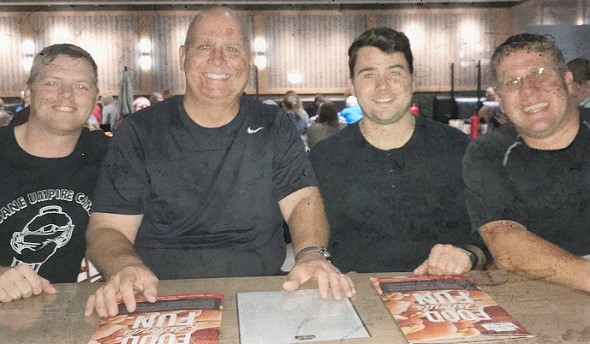
After a long, hard-fought Friday night contest between Rockford and Greenville, crew members (left to right) Dale Feutz, Brian Donovan, Sam Boland, and Luke Griemsman stop in at a local Rockford eatery to discuss the night’s game over a meal.