


Michel Finishes with Story to Tell
June 11, 2013
By Geoff Kimmerly
Second Half editor
Andrew Michel received the heart-breaking news only moments before leaving his golf team’s Regional on Friday to get ready for that night’s Brownstown-Woodhaven prom.
But missing making the MHSAA Finals by a stroke was not the first thing he shared with those who asked about his day at West Shore Golf and Country Club in Grosse Ile.
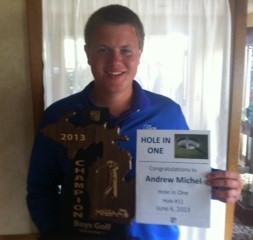 Instead, the graduating senior told of the 132-yard shot he dropped for a hole-in-one on the par-3 12th hole, his second ace but first in competition.
Michel finished with a season-best 76, missing the cut for this weekend’s Lower Peninsula Division 1 Final by a stroke despite firing another eagle during the final holes of his round.
“At the start of the day, I told myself don’t leave anything on the table. Go for it on every hole, make every shot and just have fun at your last tournament,” Michel said Tuesday afternoon as he readied for that night’s graduation ceremony. “Being a senior, I went for everything.”
The best part might’ve been how he came back from a disappointing previous hole.
Michel had just finished off a triple bogey on No. 11, and admitted he was down on himself. He stepped to the next tee with his pitching wedge, and “I didn’t really care what happened. I chose the club I like to hit on that hole, and in the air I was thinking it was really good,” he said.
The ball touched down on the green and spun back into the hole.
Michel also played golf and soccer at Brownstown-Woodhaven. He’ll attend Grand Valley State University in the fall, study engineering, and will try to walk-on the Lakers’ golf team.
“Deep down inside,” he said he’s disappointed he won’t be playing at Michigan State’s Forest Akers West on Friday. But he’s got a quite a highlight to take with him from his final high school round.
“It was very bittersweet. I really wanted to go to state,” Michel said. “But the hole-in-one balanced it out a bit.”
Eye on the official
Hopefully you caught our MHSAA benchmarks piece (also published on Second Half) on longtime official Lamont Simpson, who has worked not only MHSAA Finals but NCAA tournaments and is one of 32 officials in the WNBA. (Here’s the link in case you missed it.)
He also became that league’s first to wear the referee cam, debuting the new gear during a recent game between the Phoenix Mercury and Indiana Fever.
The camera provides plenty of ref’s-eye views. Click the video below to check it out.
Wheels of Steele
We’ve been watching the inspiring progress of Frankenmuth runner Bobby Steele especially over the last few years as his story became known across the Lower Peninsula.
Steele, who is visually impaired, has run cross country and track for the Eagles, thanks to the help of guides who ran with him to help him stay on course.
If you haven’t heard Steele’s awesome story, check out this 8-minute video. Not only did Steele run, but he cut roughly 12 minutes off his first cross country times over the course of his career.
50 Years Later, 'Charlie' Remains Legendary
By
Ron Pesch
MHSAA historian
September 30, 2018
There is no official record of the proceedings, only a short newspaper recap of the event that was hosted 50 years ago at Michigan State’s Kellogg Center. In attendance was a who’s who of high school sports administrators. They were there to honor the man, affectionately known to his friends as “Charlie.”
A parade of guests presented gifts and citations, then sang his praises.
Dr. Clifford Fagan, Executive Secretary of the National Federation of High School Athletics, attended. State Directors of Athletics from Indiana and Ohio were on hand for the Monday, October 7, 1968, celebration.
Dr. Ira Polly, State Superintendent of Public Instruction, called him “noble, honest and courageous.” John F. Toepp, a state senator and radio sports broadcaster from the Cadillac area, “hailed him as ‘Mr. High School Athletics.’”
Sportswriter Bob Gross, six years into his career at the Lansing State Journal, wrote that Charles E. Forsythe, seated next to his wife Josephine, “only grinned with each word of gratitude.”
More than 350 friends attended the testimonial dinner, honoring the second director of the Michigan High School Athletic Association upon his retirement. For 39 years, Forsythe had served the MHSAA, dedicated to bettering the world of high school sports in Michigan and beyond. His years of service would formulate the mold for those who would follow in his footsteps.
“For five minutes they applauded,” wrote Gross, capturing the moment. Forsythe was humbled by the appreciation. When it was his turn to speak, he thanked the assembled crowd.
 “This is a great night. It’s just wonderful so many of you came to my party. I’m deeply honored,” Forsythe said. “I can’t stand here and accept all the thanks. It was teamwork that made our organization go. And, may I ask of all of you to please help make it grow bigger and better than it is.”
The MHSAA had announced Forsythe’s retirement in late May.
With the exception of a 39-month tour as a Navy Commander, assisting former heavyweight boxing champion Gene Tunney in directing Navy physical fitness activities during World War II, Forsythe had been with the Association since July of 1929, originally as an assistant to Alden W. Thompson, the first director of the MHSAA. (Forsythe remains considered the Association’s first fulltime executive director.)
A graduate and prominent athlete at Milan High School, Forsythe earned his undergraduate degree from Michigan State Normal College (today’s Eastern Michigan University) in 1920 and his Master of Arts degree from the University of Michigan in 1926. He coached basketball and baseball at Milan High School during 1922-23 and taught science. He moved to Lansing Central High School the following year, where he taught history. In the fall of 1926, Forsythe was named director of athletics. According to news reports, he was also “one (of) the leading high school football and basketball officials in the state, working in the district and regional basketball tournaments …”
In his introduction of Forsythe as his new assistant, Thompson said “his presence in this office will make it possible to extend the service rendered by the State Association for the ultimate good of the athletic program throughout the state. The growth of the basketball tournaments, the addition of regional track meets as well as tournaments in tennis and golf, and state association participation in swimming and cross country have all added to the details of business handled through the office of the state director …”
In his book, “Athletics in Michigan High Schools: The First Hundred Years” published in 1950, Lewis L. Forsythe noted that additional help definitely was needed. The elder Forsythe, who was Charles’ uncle, was principal of Ann Arbor High School from 1917 until his retirement in 1946. He twice had served as president of the Michigan Interscholastic Athletic Association, the predecessor to the MHSAA. Elected president of the MHSAA Representative Council in 1924, Lewis Forsythe continued serving in that role until 1942. He had seen, first-hand, Thompson’s need for help.
 “Ever since the new association was organized, it had been the wonder of every informed person that Mr. Thompson could stand up under the strain of the work he felt compelled (or impelled) to do. We knew the strain was terrible and unwise,” Lewis Forsythe wrote.
“(Charles’) appointment not only relieved Mr. Thompson of a great deal of detail, but enabled the association to enlarge and improve its services to the schools.”
As assistant director, Charlie traveled Michigan, supervising state officials and conducting MHSAA tournaments. While he was in the office, he improved Association communication with member schools by preparing and expanding the State Association Bulletin. When Thompson was appointed to State Director of Health and Physical Education in Michigan in 1931, it opened the door for Forsythe to become director of the MHSAA.
“Thompson had the job of building the Michigan High School Athletic Association ‘from scratch’ and he built very well,” said Charles several years later. “He was thorough in his application of rules and in seeing that they all were interpreted alike both to large and small schools, so no favoritism or any difference were shown.” If there has been any success in the (years I) served, much of it can be credited to the background and good training I received during the period that I served under Thompson …”
In 1939, Forsythe released the first of four editions of his book, “The Administration of High School Athletics.” It quickly found a home as a textbook at various colleges and universities around the country. For 19 summers, he travelled as a visiting lecturer or staff member of the Universities of Michigan, Wisconsin, Ohio State, Southern California, West Virginia, Indiana, Oregon and elsewhere.
In 1941, George Maskin of the Detroit Times wrote about Charlie’s impact after 12 years in the position.
“This Forsythe fellow is a short, stocky gent of 41. There’s a touch of gray circling around the edge of his head, probably caused by the nights he’s stayed awake worrying whether one of his new ventures would turn out successfully,” Maskin wrote.
“There have been some mighty changes, as well as improvements, since Forsythe was hired to boss the preps. But when he talks, Forsythe speaks in terms of ‘we.’ There’s nothing egotistical about Forsythe’s way of doing things. “
Maskin noted some of the achievements that had occurred under the Forsythe regime. During those dozen years, the number of schools competing in Michigan prep sports jumped from 600 to 750. Six-man football had spread to 100 of Michigan’s smaller schools, which formerly passed over the fall sport. Under Forsythe’s leadership, local and regional tournaments in basketball play increased, “thus reducing the amount of traveling and time lost from school during the state championships.” A team competing in state tournament basketball games would play no more than one game per day – against two in other states adjoining Michigan. Minor sports – tennis, golf, cross country, swimming – had come into their own. Forsythe recognized their value in drawing additional students into athletics and increasing athletic participation. He would take that knowledge with him when he entered the Navy (and would return from the service with an even broader view of their value).
 Yet, perhaps his greatest achievement was his emphasis on safety in sports.
In 1937, at the 13th annual MHSAA football rules meeting, “leaders drafted a program to address and demonstrate “techniques intended to make football a safer game for high school boys.” A mandatory rule to require “a three minute warm-up on the practice field before the start of the second half of each game” was put in place. The association had recognized that more serious injuries in football occurred at the start of the second half, because players had rested between periods and weren’t stretching out before resuming play. The creation of an accident benefit plan administered by the MHSAA for the state’s athletes had been discussed for six years, but had failed to engage because of a lack of participation. In December of 1939, it was finally ratified. The plan went into effect with the 1940-41 school year and required schools participating in the program to report all injuries. That led to more accurate data, and, in turn, an increased focus on safety and attention to equipment.
“There has been a decided improvement in the type of equipment worn, especially in football” said Forsythe to Maskin in 1954. “Rules have been written much more with the idea of protecting participants than formerly used to be the case.”
In 1961, Forsythe noted that face guards helped reduce the number of eye injuries and fractured noses. In the fall of 1962 a compulsory mouth guard rule went into effect in football, resulting in a 58-percent reduction in claims filed against the plan for dental injuries.
But at the time of his retirement, it was still apparent that the state basketball tournament was Forsythe’s pride and joy, and the event that allowed the MHSAA to function financially. Attendance at all District, Regional and Final games in 1930 was 126,000. At the time of his retirement in 1968, postseason attendance topped 775,000.
“I remember the time when we used to have to advertise to try to get people to come to our Finals,” said Forsythe to an Associated Press reporter shortly before his final day. “Now they all are automatic sellouts before the games are played,”
Tighter regulation reduced the use of illegal players, as seen in the earliest years of the tournament.
“Some of the coaches used to go out recruiting,” continued Forsythe. “… In the old days, we were more of a police agency. The coaches would try anything they thought they could get by with. Now they generally ask us first or turn themselves in if they discover they are playing a boy who is ineligible.”
“At 69, he still looks fit enough to play running instead of standing guard in any basketball game. He credits this mostly to a strict diet and sensible exercise, such as working in his garden. Forsythe also plans some traveling. “I might take in next year’s basketball finals,” he added with a grin, “If I can get a ticket.”
But a return trip to Michigan State University’s Jenison Field House, home to the MHSAA Basketball Finals since 1940, wasn’t in the cards. The September 1968 issue of the MHSAA Bulletin featured Forsythe on the cover, celebrating his career. In December, he passed away unexpectedly at his Lansing home. The February 1969 Bulletin presented a memoriam, praising his service and “his keen appraisal of athletics, their place in our society and their administration.”
With the August retirement of John E. “Jack” Roberts after 32 years of service, and the appointment of Mark Uyl as executive director, there have been only seven executive directors since the MHSAA was formed in 1924. Beside Thompson and Forsythe, Julian Smith handled the organization between 1943 and 1944 during Forsythe’s military service. Allen W. Bush (1968-78), who served as an MHSAA assistant for eight years to Forsythe, was followed by Vern Norris (1978-86).
 Ron Pesch has taken an active role in researching the history of MHSAA events since 1985 and began writing for MHSAA Finals programs in 1986, adding additional features and "flashbacks" in 1992. He inherited the title of MHSAA historian from the late Dick Kishpaugh following the 1993-94 school year, and resides in Muskegon. Contact him at [email protected] with ideas for historical articles.
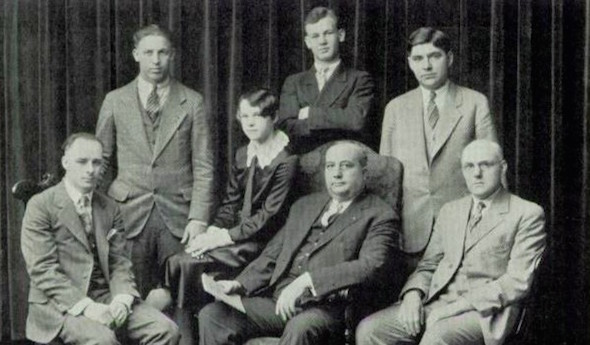
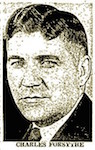
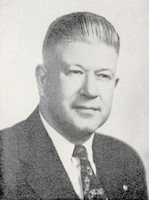
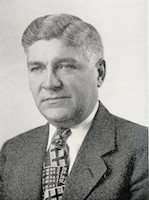
PHOTOS: (Top) Charlie Forsythe, standing far right, served at Lansing Central at the time of this photo in 1927. (Top middle) Forsythe in 1938. (Middle) MHSAA Executive Director Alden Thompson. (Below) Forsythe. (Photos gathered by Ron Pesch.)