


Michel Finishes with Story to Tell
June 11, 2013
By Geoff Kimmerly
Second Half editor
Andrew Michel received the heart-breaking news only moments before leaving his golf team’s Regional on Friday to get ready for that night’s Brownstown-Woodhaven prom.
But missing making the MHSAA Finals by a stroke was not the first thing he shared with those who asked about his day at West Shore Golf and Country Club in Grosse Ile.
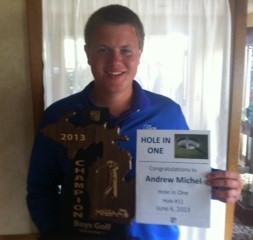 Instead, the graduating senior told of the 132-yard shot he dropped for a hole-in-one on the par-3 12th hole, his second ace but first in competition.
Michel finished with a season-best 76, missing the cut for this weekend’s Lower Peninsula Division 1 Final by a stroke despite firing another eagle during the final holes of his round.
“At the start of the day, I told myself don’t leave anything on the table. Go for it on every hole, make every shot and just have fun at your last tournament,” Michel said Tuesday afternoon as he readied for that night’s graduation ceremony. “Being a senior, I went for everything.”
The best part might’ve been how he came back from a disappointing previous hole.
Michel had just finished off a triple bogey on No. 11, and admitted he was down on himself. He stepped to the next tee with his pitching wedge, and “I didn’t really care what happened. I chose the club I like to hit on that hole, and in the air I was thinking it was really good,” he said.
The ball touched down on the green and spun back into the hole.
Michel also played golf and soccer at Brownstown-Woodhaven. He’ll attend Grand Valley State University in the fall, study engineering, and will try to walk-on the Lakers’ golf team.
“Deep down inside,” he said he’s disappointed he won’t be playing at Michigan State’s Forest Akers West on Friday. But he’s got a quite a highlight to take with him from his final high school round.
“It was very bittersweet. I really wanted to go to state,” Michel said. “But the hole-in-one balanced it out a bit.”
Eye on the official
Hopefully you caught our MHSAA benchmarks piece (also published on Second Half) on longtime official Lamont Simpson, who has worked not only MHSAA Finals but NCAA tournaments and is one of 32 officials in the WNBA. (Here’s the link in case you missed it.)
He also became that league’s first to wear the referee cam, debuting the new gear during a recent game between the Phoenix Mercury and Indiana Fever.
The camera provides plenty of ref’s-eye views. Click the video below to check it out.
Wheels of Steele
We’ve been watching the inspiring progress of Frankenmuth runner Bobby Steele especially over the last few years as his story became known across the Lower Peninsula.
Steele, who is visually impaired, has run cross country and track for the Eagles, thanks to the help of guides who ran with him to help him stay on course.
If you haven’t heard Steele’s awesome story, check out this 8-minute video. Not only did Steele run, but he cut roughly 12 minutes off his first cross country times over the course of his career.
Multi-Sport Survey Helps Set Benchmark
July 31, 2018
By Geoff Kimmerly
Second Half editor
NOTE: This report includes a revision Aug. 3 to account for incorrect data for Jenison, which previously was listed with the second-highest percentage of multi-sport athletes in Class A. The updated data changed only two percentages updated below (*), and both by only one tenth of a percent.
Nearly 43 percent of athletes at Michigan High School Athletic Association member high schools participated in more than one sport during the 2017-18 school year, according to the first-ever Multi-Sport Participation Survey conducted this spring and inspired by the work of the MHSAA’s Task Force on Multi-Sport Participation.
Early and intense sport specialization has become one of the most serious issues related to health and safety at all levels of youth sports, as overuse injuries and burnout among athletes have been tied to chronic injuries and health-related problems later in life. In early 2016, the MHSAA appointed the Task Force on Multi-Sport Participation as part of a continued effort to promote and protect participant health and address the issues leading to early sport specialization.
While there is a growing amount of research detailing the negative effects of early sport specialization, there is little research on the prevalence of sport specialization, including at the high school level. This MHSAA survey received responses from 79.9 percent of member high schools and will be conducted annually to measure how multi-sport participation exists at schools of different sizes and also the progress being made to increase it at all schools.
“It’s now well-known that students who specialize in one sport year-round are prone to all kinds of health hazards. This is serious business; we have to find out the ways and means to promote the multi-sport experience,” MHSAA Executive Director John E. “Jack” Roberts said. “This survey will help us identify best practices. If I’m an administrator, and another school of the same size and same demographics has twice the multi-sport participation as my school, I want to know why. What are they doing to encourage that culture?”
From schools that responded to this year’s survey, 42.5 percent of students participated in athletics in 2017-18 – 46.3 percent of boys and 38.7 percent of girls. As anticipated, Class D schools enjoyed the highest percentage of athletes among the entire student body, at 55.2 percent, followed by Class C (50.1), Class B (45.1) and Class A (39.1*).
Of those athletes counted by responding schools, 42.8 percent participated in more than one sport – including 44.6 percent of boys and 40.6 percent of girls. Class D again enjoyed the highest percentage of multi-sport athletes, 58.1 percent, followed by Class C (55.2), Class B (46.7) and Class A (35.9*).
Similar results for overall sport participation and multi-sport participation relative to enrollment size were seen by further breaking down Class A into schools of fewer than 1,000 students, 1,000-1,500 students, 1,501-2,000 students and more than 2,000 students. For both sport participation as a whole and multi-sport participation specifically, the smallest Class A schools enjoyed the highest percentages, while percentages then decreased for every larger size group of schools.
The MHSAA Task Force on Multi-Sport Participation also recommended measuring multi-sport participation in MHSAA member schools to recognize “achievers” – that is, schools that surpass the norm given their enrollment and other factors that affect school sports participation. An achievement program is being developed for future years, and this year’s survey results will assist in setting a benchmark for that recognition.
In Class A, Marquette (82.6 percent), Grand Rapids Union (74.1) and Holland West Ottawa (74.0) posted the highest percentages of multi-sport athletes. In Class B, four schools achieved at least 80 percent multi-sport participation – Birch Run (87.1), Gladstone (83.8), Clawson (81.0) and Shepherd (80).
Class C saw 13 schools with more than 80 percent of its athletes taking part in more than one sport, led by Ubly (90.2 percent) and Detroit Southeastern (89.2). Four Class D schools responded at higher than 90 percent multi-sport participation – Brethren (95.4), DeTour (94.3), Jackson Christian (91.7) and Waterford Our Lady (90.8).
The full summary report on the Multi-Sport Participation Survey is available on the “Health & Safety” page of the MHSAA Website.