


Michel Finishes with Story to Tell
June 11, 2013
By Geoff Kimmerly
Second Half editor
Andrew Michel received the heart-breaking news only moments before leaving his golf team’s Regional on Friday to get ready for that night’s Brownstown-Woodhaven prom.
But missing making the MHSAA Finals by a stroke was not the first thing he shared with those who asked about his day at West Shore Golf and Country Club in Grosse Ile.
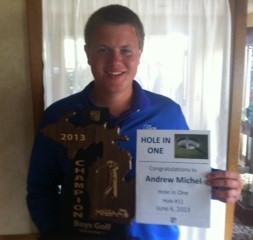 Instead, the graduating senior told of the 132-yard shot he dropped for a hole-in-one on the par-3 12th hole, his second ace but first in competition.
Michel finished with a season-best 76, missing the cut for this weekend’s Lower Peninsula Division 1 Final by a stroke despite firing another eagle during the final holes of his round.
“At the start of the day, I told myself don’t leave anything on the table. Go for it on every hole, make every shot and just have fun at your last tournament,” Michel said Tuesday afternoon as he readied for that night’s graduation ceremony. “Being a senior, I went for everything.”
The best part might’ve been how he came back from a disappointing previous hole.
Michel had just finished off a triple bogey on No. 11, and admitted he was down on himself. He stepped to the next tee with his pitching wedge, and “I didn’t really care what happened. I chose the club I like to hit on that hole, and in the air I was thinking it was really good,” he said.
The ball touched down on the green and spun back into the hole.
Michel also played golf and soccer at Brownstown-Woodhaven. He’ll attend Grand Valley State University in the fall, study engineering, and will try to walk-on the Lakers’ golf team.
“Deep down inside,” he said he’s disappointed he won’t be playing at Michigan State’s Forest Akers West on Friday. But he’s got a quite a highlight to take with him from his final high school round.
“It was very bittersweet. I really wanted to go to state,” Michel said. “But the hole-in-one balanced it out a bit.”
Eye on the official
Hopefully you caught our MHSAA benchmarks piece (also published on Second Half) on longtime official Lamont Simpson, who has worked not only MHSAA Finals but NCAA tournaments and is one of 32 officials in the WNBA. (Here’s the link in case you missed it.)
He also became that league’s first to wear the referee cam, debuting the new gear during a recent game between the Phoenix Mercury and Indiana Fever.
The camera provides plenty of ref’s-eye views. Click the video below to check it out.
Wheels of Steele
We’ve been watching the inspiring progress of Frankenmuth runner Bobby Steele especially over the last few years as his story became known across the Lower Peninsula.
Steele, who is visually impaired, has run cross country and track for the Eagles, thanks to the help of guides who ran with him to help him stay on course.
If you haven’t heard Steele’s awesome story, check out this 8-minute video. Not only did Steele run, but he cut roughly 12 minutes off his first cross country times over the course of his career.
Pay-to-Play Down Slightly, Survey Shows
July 24, 2018
By Geoff Kimmerly
Second Half editor
Slightly less than 50 percent of MHSAA member high schools assessed sports participation fees during the 2017-18 school year, according to an annual survey that enjoyed its highest response rate in 14 years of measuring the prevalence of charging students to help fund interscholastic athletics.
This year’s survey was completed by a record 80 percent of the MHSAA’s 751 member high schools, and 49 percent of respondents charged participation fees – down slightly from 49.7 percent in 2016-17, when the rate dropped below 50 percent for the first time since 2009-10.
The MHSAA conducted its first participation fee survey during the 2003-04 school year, when 24 percent of responding schools reported they charged fees. The percentage of member schools charging fees crossed 50 percent in 2010-11 and reached a high of 56.6 percent in 2013-14.
Class A schools remained the largest group charging fees in 2017-18, with 65 percent of respondents doing so – although that percentage was the lowest for Class A since 66 percent reported using fees in 2011-12. Class B schools fell to 47 percent charging fees (from 52 percent in 2016-17), while Class C (46 percent) and Class D (37) schools remained below 50 percent as well.
Charging a standardized fee for each team on which a student-athlete participates – regardless of the number of teams – remains the most popular method among schools assessing fees, with that rate at 43 percent of schools. Schools charging a one-time standardized fee per student-athlete showed a slight decrease to 28 percent, while assessing fees based on tiers of the number of sports a student-athlete plays (for example, charging a larger fee for the first team and less for additional sports) and assessing fees based on the specific sport being played (some being more expensive than others) both showed slight upticks to 15 and 5 percent, respectively.
The amounts of most fees remained consistent during 2017-18: the median annual maximum fee per student at $150, the median annual maximum family fee at $300 and the median per-team fee at $75 – all for at least the fourth straight year. The median fee assessed by schools that charge student-athletes once per year held steady at $125 for the second straight school year.
Click for the survey for 2017-18, and surveys from previous years can be found here.