


Michel Finishes with Story to Tell
June 11, 2013
By Geoff Kimmerly
Second Half editor
Andrew Michel received the heart-breaking news only moments before leaving his golf team’s Regional on Friday to get ready for that night’s Brownstown-Woodhaven prom.
But missing making the MHSAA Finals by a stroke was not the first thing he shared with those who asked about his day at West Shore Golf and Country Club in Grosse Ile.
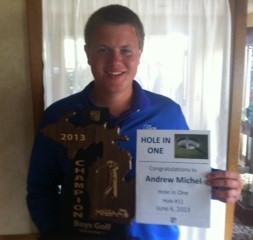 Instead, the graduating senior told of the 132-yard shot he dropped for a hole-in-one on the par-3 12th hole, his second ace but first in competition.
Michel finished with a season-best 76, missing the cut for this weekend’s Lower Peninsula Division 1 Final by a stroke despite firing another eagle during the final holes of his round.
“At the start of the day, I told myself don’t leave anything on the table. Go for it on every hole, make every shot and just have fun at your last tournament,” Michel said Tuesday afternoon as he readied for that night’s graduation ceremony. “Being a senior, I went for everything.”
The best part might’ve been how he came back from a disappointing previous hole.
Michel had just finished off a triple bogey on No. 11, and admitted he was down on himself. He stepped to the next tee with his pitching wedge, and “I didn’t really care what happened. I chose the club I like to hit on that hole, and in the air I was thinking it was really good,” he said.
The ball touched down on the green and spun back into the hole.
Michel also played golf and soccer at Brownstown-Woodhaven. He’ll attend Grand Valley State University in the fall, study engineering, and will try to walk-on the Lakers’ golf team.
“Deep down inside,” he said he’s disappointed he won’t be playing at Michigan State’s Forest Akers West on Friday. But he’s got a quite a highlight to take with him from his final high school round.
“It was very bittersweet. I really wanted to go to state,” Michel said. “But the hole-in-one balanced it out a bit.”
Eye on the official
Hopefully you caught our MHSAA benchmarks piece (also published on Second Half) on longtime official Lamont Simpson, who has worked not only MHSAA Finals but NCAA tournaments and is one of 32 officials in the WNBA. (Here’s the link in case you missed it.)
He also became that league’s first to wear the referee cam, debuting the new gear during a recent game between the Phoenix Mercury and Indiana Fever.
The camera provides plenty of ref’s-eye views. Click the video below to check it out.
Wheels of Steele
We’ve been watching the inspiring progress of Frankenmuth runner Bobby Steele especially over the last few years as his story became known across the Lower Peninsula.
Steele, who is visually impaired, has run cross country and track for the Eagles, thanks to the help of guides who ran with him to help him stay on course.
If you haven’t heard Steele’s awesome story, check out this 8-minute video. Not only did Steele run, but he cut roughly 12 minutes off his first cross country times over the course of his career.
Rep Council Wrap-Up: Spring 2018
By
Geoff Kimmerly
MHSAA.com senior editor
May 14, 2018
The adoption of major changes to the Michigan High School Athletic Association transfer regulation was among notable actions taken by the Representative Council during its annual Spring Meeting, May 6-7, in Gaylord, in addition to the selection of the Association’s next executive director announced in a previous release May 8.
The Spring Meeting of the 19-member legislative body of the Association’s more than 1,400 member schools is generally the busiest of its three sessions each year. The Council considered 29 committee proposals and dealt with a variety of eligibility rule, postseason tournament and operational issues.
The revised transfer regulation will go into effect for the 2019-20 school year, based on a student-athlete’s sports participation during 2018-19. The new transfer rule will make transferring student-athletes ineligible for one year in any sport played during the previous year at the previous school – unless that student-athlete’s situation fits one of the current 15 exceptions that allow for immediate eligibility. However, the revised transfer regulation also allows that transferring student-athlete immediate eligibility in any other MHSAA-sponsored sport not participated in during that previous year at the previous school.
The additions to the transfer rule received vast support from member schools in surveys leading up to the Council’s vote.
“We are hopeful this ‘sport-specific’ transfer rule will be easier to understand, and therefore, more consistently enforced,” MHSAA Executive Director John E. “Jack” Roberts said. “This rule better addresses the changing landscape of transfers, hopefully dissuading those considering moving for athletic reasons while still allowing a full range of sports for those who do switch. It may seem like a punishment to some, but the new rule is actually more permissive for many transfer students, and we saw growing support for these changes from our schools since we began discussing this proposal a year ago.”
A number of significant actions at the Spring Meeting will affect the junior high/middle school levels, as the Council continued growing its impact among those who represent the future of educational athletics.
The Council approved Junior High/Middle School Committee recommendations to increase the number of contests and days of competition in three sports, beginning in 2018-19. Softball teams will have 12 days of competition over 13 weeks, with doubleheaders counting as one of those 12 days. Basketball teams may play 12 games over 13 weeks with one game a day allowed, except that two games may be played on a day not followed by a school day up to four times a season; each of those doubleheader days will count as one of the 12 games. Soccer teams may play 12 games over 13 weeks with one game a day allowed, except that two games may be played on a day not followed by a school day up to two times a season; each of those doubleheader days also will count as one of the 12 games.
Another committee recommendation approved by the Council will allow a middle school student-athlete to compete in two non-school events during the school season in team sports except football – making the rule for team sports at the junior high/middle school level the same as the individual sport model currently enforced.
The Council also approved of continuing to develop and expand opportunities for the MHSAA to act as a “presenting sponsor” of already-existing junior high/middle school meets, invitationals and tournaments conducted by leagues, conferences and schools around Michigan. Staff was authorized to approach MHSAA sport committees and sport coaches association to explore possible junior high/middle school area or sectional competitions in cross country, track & field, wrestling, swimming & diving and potentially other sports.
“The Representative Council continued to consider ways to better serve the youngest student-athletes in our membership – the junior high/middle school participants who are the future of high school sports,” Roberts said. “While these actions may not gain as much attention as changes at the high school level, they are just as important if not more critical to the status of educational athletics moving forward. Nurturing this youngest level must continue to be a focus in the years to come as we work to strengthen and provide more opportunities at all levels.”
The Council approved a number of recommendations by respective sport committees that will alter the tournament setup beginning this fall. In ice hockey, the Pre-Regional system of tournament assignments has been eliminated; all teams will instead be organized into traditional Regionals, 24 total with no more than eight teams assigned to each. In boys lacrosse, a game will end when an 18-goal margin is reached any time after the completion of the third quarter; the 12-goal differential that starts a running clock during the second half will continue. In soccer, beginning with the 2019 season, the first round of District games will be required to be played the week before the current District week on that Wednesday, Thursday or Friday. District Semifinals and Finals will be scheduled for the following week – but Saturday games can be used only as a weather backup during the District round.
To better assist with scheduling and provide transportation relief, the Council approved a number of adjustments to the non-traditional draw policies for District and Regional tournaments; non-traditional draws do not require all contests be played as a designated host site, assisting primarily teams that might be located far from their tournament host but closer to their opponent(s). For the 2018-19 MHSAA Basketball and Volleyball Tournaments, non-traditional draws will be mandated for Districts made up of (a) all Upper Peninsula teams, (b) a combination of Upper and Lower Peninsula teams, or (c) seven or eight-team District grouping in any location of the state. In Districts with circumstances (a) and (b), a traditional draw may be conducted if all participating teams agree to that format. At the Regional level, any that include more than one District located in the Upper Peninsula will require geographic neutral sites be used. The Council also authorized a work group to review all aspects of non-traditional draws and all affected sports and report at the Council’s Fall meeting this Nov. 30.
Additionally, the Council approved a Classification Committee recommendation to move the “opt-up” deadline for fall sports from April 15 to May 1, while keeping the dates for winter (Aug. 15) and spring sports (Oct. 15) the same.
Here is a summary of other actions taken by the Representative Council at the Spring Meeting, which will take effect during the 2018-19 school year unless noted:
Sport Matters
• In baseball, the Council approved a committee recommendation altering tournament trophies to match the tournament format previously approved to begin with the 2019 season. Starting that spring, baseball teams will play what previously were Quarterfinals as the final game of a “Super Regional” tournament, and trophies awarded to those 16 winners will read “Super Regional Champion.” Trophies awarded to losing teams in that round will read “Regional Champion” as they still will have won the Regional level of the tournament.
• In basketball, the Council approved a committee recommendation to adopt the 28-foot coaching box for competition allowed under National Federation of State High School Associations (NFHS) rules. Previously, the MHSAA allowed for a 14-foot coaches box in front of the team’s bench.
• In competitive cheer, the Council approved four committee recommendations. The first allows junior high/middle school athletes to perform an inverted exit-cradle to back walkover out only. At the high school level, any catch that originates from shoulder level or below and transitions from a vertical body position to a horizontal body position now will require only three catchers, while four catchers are still required for any catch that exceeds shoulder level. The two other recommendations affect scoring: the first will allow at the high school level a mountain climber to an unbraced OLE to receive the OLE choreography bonus, while the second will allow for all levels (grades 7-12) four difficulty points to be awarded for a ground-up to an elevator.
• In cross country and track & field, the Council approved a Committee recommendation to adopt a recommendation from the state coaches and officials associations to use a one-turn stagger for the 3,200-meter relay and open 800, 1,600 and 3,200 meter runs. This stagger will begin to be used in 2020. The Council also approved a Committee recommendation to alter the junior high/middle school meet order to closely align with the high school order; eight events will switch so that relays and similar sprints and distance runs are ordered in the same way.
• In football, the Council approved a Football Committee recommendation that the MHSAA continue for the third year to experiment with a 40-second clock for use between plays. Teams taking part in the experiment will have 40 seconds from the end of the previous play to snap the ball to begin the next, unless there is an administrative stoppage (for penalty, measurement, etc.). MHSAA schools began experimenting with the 40-second clock during the 2016 season.
• In boys lacrosse, the Council approved a Committee recommendation to allow contests with out-of-state schools from states that do not sponsor a statewide boys lacrosse tournament only as long as those opponents follow comparable regulations of other spring sport teams in that state – including practice and contest limits, use of NFHS playing rules and prohibitions on undue influence and recruiting. Member schools must receive pre-approval from the MHSAA to play these opponents.
• In skiing, the Council approved a Committee recommendation to increase the maximum number of contests from 15 to 17 while reducing the number of scrimmages allowed from four to two.
• In soccer, the Council approved a Committee recommendation to allow at the high school level, as a part of the multi-team tournament rule, teams to play two full games on a non-school day and have those two count as one of the 18 regular-season contests. Teams still have the option to play 180 minutes under the current multi-team tournament rule. The only overtime allowed would be a shootout if part of a bracket tournament.
The Council also discussed a number of topics that will require action as quickly as its Nov. 30 meeting. The Council considered options for the Girls and Boys Basketball Tournaments for the 2019-20 season; one option follows the current format of playing tournaments with a one week offset and Finals at separate sites, and a second option would have the tournaments conducted simultaneously over three weeks with Semifinals at sites around the state and all eight championship games (four for girls, four for boys) at the same arena during the same weekend.
The possible scheduling by the MHSAA of regular-season games for 8-player football teams also was discussed and may be voted upon Nov. 30.
Make-up of the MHSAA’s sport committees is an emerging topic, and the Council considered suggestions for making them more effective. The committee appointment procedure originally was adopted by the Council in 1987 and modified in 2007.
The Council also reviewed reports on membership, with 751 senior high schools and 752 junior high/middle schools in 2017-18 plus 42 elementary schools with 6th-grader participation; eligibility advancement applications, which totaled six for this school year; the use of Educational Transfer Forms, which fell eight percent this year; out-of-state practice requests, school violations, attendance at athletic director in-service workshops and Coaches Advancement Program sessions, officials’ registrations, rules meetings attendance and officials reports submitted for the past three sports seasons. The Association’s $11.6 million budget for the 2018-19 school year also was approved.
The Representative Council is the 19-member legislative body of the MHSAA. All but five are elected by member schools. Four members are appointed by the Council to facilitate representation of females and minorities, and the 19th position is occupied by the Superintendent of Public Instruction or designee.
The MHSAA is a private, not-for-profit corporation of voluntary membership by more than 1,500 public and private senior high schools and junior high/middle schools which exists to develop common rules for athletic eligibility and competition. No government funds or tax dollars support the MHSAA, which was the first such association nationally to not accept membership dues or tournament entry fees from schools. Member schools which enforce these rules are permitted to participate in MHSAA tournaments, which attract more than 1.4 million spectators each year.