


Michel Finishes with Story to Tell
June 11, 2013
By Geoff Kimmerly
Second Half editor
Andrew Michel received the heart-breaking news only moments before leaving his golf team’s Regional on Friday to get ready for that night’s Brownstown-Woodhaven prom.
But missing making the MHSAA Finals by a stroke was not the first thing he shared with those who asked about his day at West Shore Golf and Country Club in Grosse Ile.
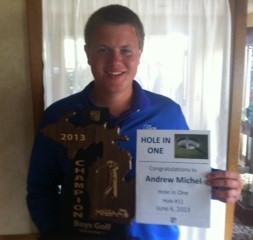 Instead, the graduating senior told of the 132-yard shot he dropped for a hole-in-one on the par-3 12th hole, his second ace but first in competition.
Michel finished with a season-best 76, missing the cut for this weekend’s Lower Peninsula Division 1 Final by a stroke despite firing another eagle during the final holes of his round.
“At the start of the day, I told myself don’t leave anything on the table. Go for it on every hole, make every shot and just have fun at your last tournament,” Michel said Tuesday afternoon as he readied for that night’s graduation ceremony. “Being a senior, I went for everything.”
The best part might’ve been how he came back from a disappointing previous hole.
Michel had just finished off a triple bogey on No. 11, and admitted he was down on himself. He stepped to the next tee with his pitching wedge, and “I didn’t really care what happened. I chose the club I like to hit on that hole, and in the air I was thinking it was really good,” he said.
The ball touched down on the green and spun back into the hole.
Michel also played golf and soccer at Brownstown-Woodhaven. He’ll attend Grand Valley State University in the fall, study engineering, and will try to walk-on the Lakers’ golf team.
“Deep down inside,” he said he’s disappointed he won’t be playing at Michigan State’s Forest Akers West on Friday. But he’s got a quite a highlight to take with him from his final high school round.
“It was very bittersweet. I really wanted to go to state,” Michel said. “But the hole-in-one balanced it out a bit.”
Eye on the official
Hopefully you caught our MHSAA benchmarks piece (also published on Second Half) on longtime official Lamont Simpson, who has worked not only MHSAA Finals but NCAA tournaments and is one of 32 officials in the WNBA. (Here’s the link in case you missed it.)
He also became that league’s first to wear the referee cam, debuting the new gear during a recent game between the Phoenix Mercury and Indiana Fever.
The camera provides plenty of ref’s-eye views. Click the video below to check it out.
Wheels of Steele
We’ve been watching the inspiring progress of Frankenmuth runner Bobby Steele especially over the last few years as his story became known across the Lower Peninsula.
Steele, who is visually impaired, has run cross country and track for the Eagles, thanks to the help of guides who ran with him to help him stay on course.
If you haven’t heard Steele’s awesome story, check out this 8-minute video. Not only did Steele run, but he cut roughly 12 minutes off his first cross country times over the course of his career.
Not Just Another Season for Watson
May 3, 2018
By Cody Porter
NFHS High School Today
A 32-second response by emergency medical technicians was the difference in life or death for 68-year-old Willie Watson, who was spared from becoming another victim of sudden cardiac arrest.
Watson, a 38-year official for the Michigan High School Athletic Association, collapsed in the tunnel near the officials’ locker room after the Division 6 Football Final at Ford Field last Nov. 25 in Detroit. Fortunately for the Kalamazoo native, stadium staff members were steps away as he fell unconscious. Within seconds, their call for help reached on-site EMTs who swiftly made their way to him from the field.
“It was strange because I wasn’t sick or anything. I drove to the game by myself. Everything was fine, got dressed, and then went out on the field for the game,” Watson said. “After the game, I came to the locker room, had a boxed lunch, and the last thing I remember is leaving towards the tunnel. That’s the last thing that I remember. I woke up in the hospital the next day, on Saturday.”
Moments before Watson’s dire situation occurred, he stood in the officials’ locker room speaking with Mark Uyl, the MHSAA assistant director who coordinates officials. Uyl said when he received the call regarding Watson, he arrived to find paramedics administering full CPR, in addition to using an automated external defibrillator (AED).
“It was a scene right out of a movie,” Uyl said.
After about 10 minutes of work on Watson, Uyl said paramedics found a pulse and promptly transported him to Detroit Medical Center.
“Things were very critical that Friday night – very touch and go,” Uyl said. “Overnight we got reports that he was slowly improving.”
An implantable cardioverter defibrillator (ICD) was placed in Watson’s chest. The pager-sized device is battery powered and placed below the skin to monitor heart rate, according to the American Heart Association. If an abnormal heart rhythm is discovered, the ICD delivers an electric shock to restore a normal heartbeat.
“I got to witness an absolute miracle,” Uyl said. “If the cardiac situation doesn’t happen literally at the feet of the medical staff that we have on-site at an event like that, he would’ve gotten up to the concourse or, heaven forbid, outside the building into the parking lot or his car and I believe it would’ve been a much more tragic ending.”
Watson was working the third game of the day as a line judge, and when he collapsed, was beginning to leave the facility and head to a local hotel reserved for MHSAA officials. Uyl told Watson how much of a blessing it was that he was assigned that game. At home or at the hotel, Watson would have been alone without access to proper medical attention.
“Certainly, where we got lucky is where he collapsed,” Uyl said. “We have emergency procedures, but when we’re at one of our college or pro venues, we often use the building’s plan. It could not have been more seamless between our staff and the Ford Field building personnel.”
At MHSAA events, such as those at Ford Field, an ambulance and two EMTs are stationed on the field next to the tunnel that connects it to the other areas of the stadium. Watson said he and fellow officials routinely confirm the location of emergency responders before starting a game.
“Schools almost always have somebody from a university around who does training. Most schools have ambulance service there at the site,” Watson said. “There have been incidences where we have had injuries that require them to come out onto the field to assist a student-athlete. It could be a concussion, a leg injury or who knows. We always have somebody at a venue.”
Equipped with his ICD, Watson left for home a week later from Detroit Medical Center. Expecting to make a full recovery, Watson said the only recommendations from his doctors were to tweak his diet and increase exercise. Although he said his recovery is on track, one of the most notable effects from his incident was memory loss.
“The strange thing is that I cannot remember a single thing about the game. I can’t remember anything,” Watson said. “If you ask me what Ford Field looked like now, I couldn’t tell you. I lost my short-term memory. I remember everything except the game. It’s those 48 minutes that I can’t remember.”
An official in basketball, softball and volleyball as well, staying active won’t be too much of an issue for Watson, who said he took last basketball season off to get himself better prepared for the softball season.
“It’s just amazing how quickly they responded in my situation. Regardless of who it is, the response time I received was tremendous,” Watson said. “I was out. They had to revive me. It only took them 32 seconds to get to me. Even if it’s an injured player on the field, response times are getting so quick.”
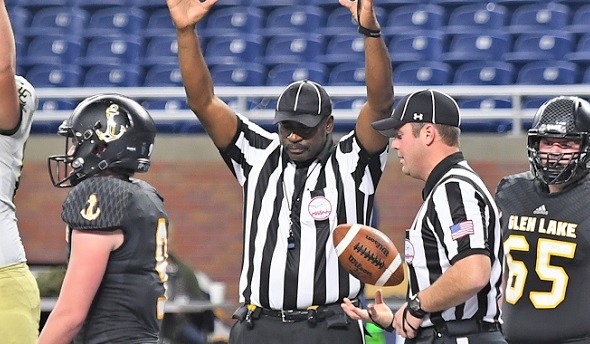
PHOTO: Official Willie Watson signals a touchdown during the 2016 MHSAA Division 6 Final at Ford Field.