

Preview: Classic Clashes and Broken Records Expected
By
Geoff Kimmerly
MHSAA.com senior editor
June 5, 2021
The attention that will be paid to one of the Lower Peninsula Boys Track & Field Finals on Saturday will go past usual interest in just a local school or single division.
Many eyes will be turned to the Division 1 meet, featuring among many Ann Arbor Skyline senior Hobbs Kessler, who has made national news over the last few weeks by setting the national high school record in the 1,500 (3:34.36) and qualifying for the Olympic Trials in the event.
But he’ll be facing some familiar competition in his distance races at East Kentwood – including Hartland junior Riley Hough, who edged Kessler by two seconds in the Division 1 cross country final this past fall.
Their matchup is just one of many stories worth tuning in for this weekend. Events at all four sites begin at 10 a.m. (EDT) and tickets to attend can be purchased online only at GoFan. The meets also will be broadcast on MHSAA.tv and viewable with subscription. Click to watch each division: LPD1 | LPD2 | LPD3 | LPD4.
Below is a glance at team contenders and individuals to watch in all four divisions.
Division 1 at East Kentwood
Top Regional scores: Macomb Dakota 160, Traverse City West 145½, Northville 136, Novi 136.
Team forecast: East Kentwood won the last three championships before COVID, with Ann Arbor Pioneer finishing runner-up in both 2018 and 2019. Dakota is an interesting possibility this time with qualifiers throughout the meet. Fenton has top-three seeds in six events, and Zeeland West is another team with scoring opportunities in a variety of events.
Trey Gardette, Ann Arbor Huron: The senior sprint star has taken amazing strides over the last two years and may be on the verge of an unforgettable finish to his high school career. Gardette’s top-seed 10.5 in the 100 is a blink faster than the LPD1 Finals record of 10.53, and he’s second-seeded in the 200 and also will run on the 400 relay.
Riley Hough, Hartland: The I-96 corridor has been the center of distance running this school year, and Hough hopes to follow his Division 1 cross country championship in the fall with titles in the 1,600 and 3,200. He’s seeded first in the former with a 4:13.93.
Hobbs Kessler, Ann Arbor Skyline: He’s slated to run the 800, 1,600 and 3,200 and on the top-seeded 3,200 relay (7:53.30) Saturday. He won all three of those open races at his Regional, and so while he isn’t top-seeded in any that likely means little as he could drop major time.
Tamaal Myers II, Detroit Cass Tech: The Technicians standout junior has the top 110 hurdles seed time (14.06) by nearly a second and is tied for the top seed time in the 300 (39.32). He’ll also run the 400 and on the 1,600 relay.
Brandon Miller, Fenton: He finished fifth in the 200 as a sophomore in 2019, but he can take a massive leap Saturday as his top seed time in that race (21.25) is five hundredths of a second off the meet record. He’s also the second seed in the 100 with a seed time of 10.60 that is seven hundredths of a second off that meet record. And he’ll also run on contending 400 and 800 relays.
Division 2 at Zeeland
Top Regional scores: Orchard Lake St. Mary’s 216½, Dearborn Divine Child 186, Frankenmuth 164.
Team forecast: Four teams have won this championship over the last four seasons. Flint Powers Catholic is a possibility to make it five as it runs for its first team title led by sprint standouts and relays. Frankenmuth with top qualifiers in the sprints, relays and field events is another to watch in what lines up to be a low-scoring team race. A total of 10 schools won championships in this division over the previous 11 seasons before 2020 was canceled.
Ryan Brenner, Frankenmuth: The senior Eagles hurdler is the top seed in the 300 with a time of 40.1 and also will run on the top-seeded 1,600 relay (3:28.44) and high jump.
Jamal Hailey, Berrien Springs: The standout junior sprinter has the top seed time in the 100 (11.04) and the third-fastest in the 200, and he’ll also run on the second-seeded 400 relay.
Austin Hamlin, Flint Powers Catholic: The Chargers sophomore would play a major role in any team title pursuit, entering with the top seed in the 200 (22.5), third-fastest in the 100 and as part of the top-seeded 400 relay (43.3) and fourth-seeded 800 relay. That 400 relay time is a second off the meet record.
Alex Mansfield, Monroe Jefferson: The junior thrower is another who has made a major move over the last two years. He enters Saturday with the top seed in the shot put (56-3) by two feet and the top seed in the discus (163-11) by nearly 10.
Luke Stowasser, Edwardsburg: The junior Eddies jumper also is top-seeded in both of his events, with a 22-6½ in the long jump and 6-10 in the high jump. That high jump is six inches better than the field and two off the meet record. He was the high jump runner-up as a freshman.
Division 3 at Jenison
Top Regional scores: Grass Lake 132, Caro 129, Pewamo-Westphalia 126 1/3.
Team forecast: Grass Lake will be pursuing its first team title since 1970 and has six top-four seeds leading the way. Figuring the next few contenders is difficult with points looking to be spread among a number of teams.
Brennan Bargesser, Grass Lake: A drive for the team championship would include significant points from Bargesser, who is seeded first in the 200 (21.98) and 400 (49.34) and second in the 100 for his final high school meet. He’ll also run on the top-seeded 400 relay (44.14) – that seed time is one second off the meet record.
Hunter Jones, Benzie Central: The sophomore standout has two Division 3 cross country championships to his credit and will make his Track Finals debut as the top seed in the 3,200 (9:37.42) and a likely contender in the 1,600 and 800 as well.
Josh Jones, Harrison: He’ll close his high school career running the 800, 1,600 and 3,200, with his 1,600 seed time (4:19.84) topping that event list.
Brenden Quackenbush, Chesaning: He’s set to establish himself in both throws at this level Saturday, with the top seed in the discus (143-0) by nearly two feet and the third seed in the shot put.
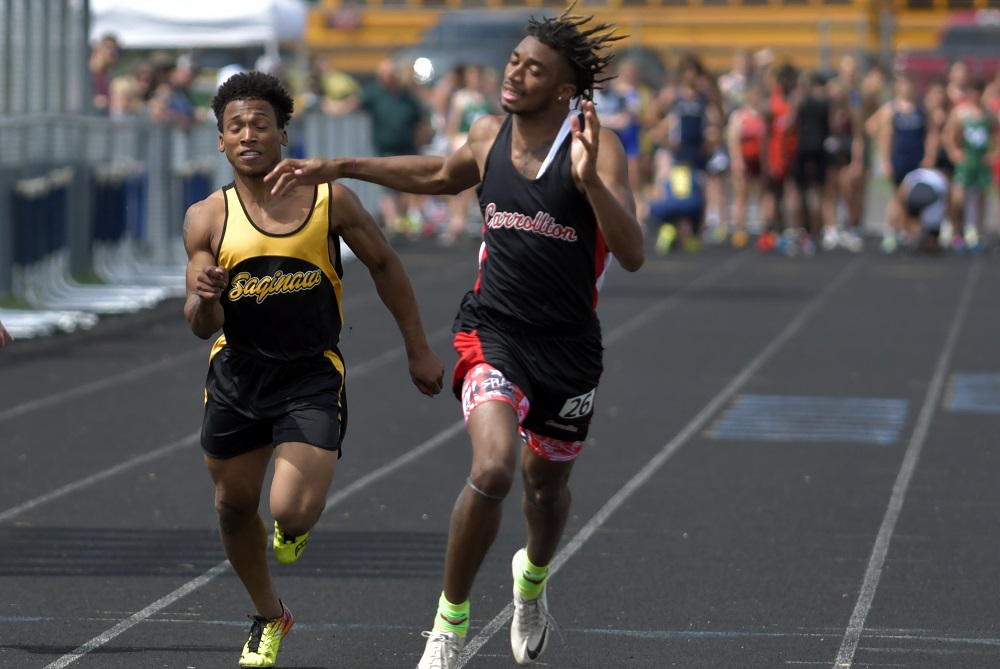
Derrick Voltz, Carrollton: A qualifier in the 100 as a freshman in 2019, he could cap his junior season as a two-event champion. He’s seeded first in the long jump (23-2) by nearly a foot with that leap only five inches off the meet record. He’s also the top seed in the 100 (11.11) just ahead of Bargesser.
Division 4 at Hudsonville
Top Regional scores: Lutheran Westland 171, Reading 170, Carson City-Crystal 147.
Team forecast: Kalamazoo Hackett Catholic Prep was the back-to-back champion before COVID, and Saugatuck was the Division 3 runner-up in 2019 but is back in Division 4. Saugatuck won’t run a relay this weekend but has favorites in the hurdles and distance events, and Breckenridge’s strengths in the sprints and relays should make it a team title contender as well as it seeks its first championship.
Coleman Clark, Carson City-Crystal: The lone returning champion in this division won the 3,200 as a sophomore in 2019 and will run that race along with the 800 and 1,600 and as part of the top-seeded 3,200 relay (8:19.40).
Benny Diaz, Saugatuck: The junior sprint/hurdles standout could make a run at four individual titles Saturday or next season. He’s the top seed in both hurdles races this time (15.01 in the 110 and 40.59 in the 300), and the fourth seed in the 200 and seventh in the 100. He was third in Division 3 in the 300 as a freshman.
Zane Forist, Carson City-Crystal: He was the runner-up in the discus and eighth in the shot put as a freshman two years ago, and he’s aiming for much more this time. His top-seed throws of 196-8 and 64-4, respectively, would both set LPD4 championship meet records – both by roughly six feet.
Nik Pettinga, Saugatuck: A top distance runner in cross country the last few seasons, he is looking to finish as a champion in his last high school meet and enters as the top seed in the 1,600 (4:26.99) and second seed (to junior teammate Max Sharnas) in the 3,200.
Charlie Steinhaus, Breckenridge: The speedy senior would help lead any charge for a team championship, entering as the top seed in the 100 (11.01) and second in the 200. He’ll also run on the top-seeded 400 relay (44.51) and second-seeded 800 relay.
PHOTO: Carrollton’s Derrick Voltz, right, breaks across the finish line during the 100-meter preliminaries at his Division 3 Regional at Shepherd last month. (Click for more from High School Sports Scene.)
Major Goal Accomplished as Three Rivers Racers Continue to Accelerate
By
Scott Hassinger
Special for MHSAA.com
October 8, 2024
THREE RIVERS – Sulley Zietlow and his teammates on the Three Rivers boys cross country team discussed their goals for the 2024 season prior to starting an early-evening workout back in June.
 With several experienced returners, coach Jason Muckel and his Wildcats set the bar high for success this Fall.
One of Three Rivers' preseason goals was to end Otsego's lengthy Wolverine Conference dual-meet winning streak.
The Wildcats quickly circled Tuesday, Sept. 17, as an important date on this fall’s schedule.
"Before the season began, we knew we were going to be running Otsego on our home course. We built our training plan around that race and made sure that our kids were ready to go," Muckel said.
Competing on its hilly home course at Meyer-Broadway Park, Three Rivers edged Otsego 24-31 thus ending the Bulldogs' 68-meet winning streak dating back to 2014.
Otsego, the 2021 Lower Peninsula Division 2 champion, has long been a state power under longtime head coach Steve Long. The Bulldogs have produced several talented runners, including 2018 individual Finals champion Alex Comerford, who went on to run at Syracuse University.
"I give Otsego a lot of credit for what they've done. Steve has built an incredible program. I have a lot of respect for him and his runners,” Muckel said. “He's helped me a lot here and there over the last few years, and I've learned a great deal from him."
Three Rivers, Plainwell and Otsego are currently tied for first in the league at 4-1 with two league duals plus next week's Wolverine Conference Meet in Otsego remaining. The Wildcats will need to win the league meet to earn an outright league title.
Zietlow, a three-time Finals qualifier, holds down Three Rivers' No. 1 spot and is also the top runner in the conference. The Wildcats qualified for the Finals as a team at the end of his freshman and junior seasons. He also qualified his sophomore year as an individual. As a junior he placed 52nd in LPD2 with a time of 16:18.9.
"Sulley is the top runner in our league and is beating the field by 30 or 40 seconds. He's gritty, hardworking, does whatever I ask of him and is the most committed runner I've ever had. He crushes everything he does," Muckel said.
Zietlow, who plans to continue his education and running career at Cornerstone University, ran a lifetime personal-best time of 15:52.4 in late August at the Under the Lights Invitational at Grand Rapids South Christian. He bested the field in the home victories over Otsego and Edwardsburg with a time of 16:12, his fastest on Three Rivers' home course.
"That (Otsego) win was very exciting and memorable,” Zietlow said. “This is the best team we've had here in a while. Our depth is good, and we want our pack time to be within a minute by season's end. I think we could take Top 10 in the state if reach our potential. The commitment, drive and positivity of our team is improved over last year."
 Winning a conference title and qualifying again for the Finals are both reachable goals for he and his teammates.
"I've ran for the last 493 days, and I've worked extremely hard to get where I am at this point. Our team is in good shape," Zietlow said.
Junior Charlie Brauer is Three Rivers' No. 2 runner.
"Charlie has made huge strides after fighting injuries the past couple years,” Muckel noted. “His CrossFit training and commitment to running a lot of miles over the summer have helped him make big gains. He's solidified himself as our number two runner and has a shot to finish among the top five or six in our conference."
Brauer clocked a personal-best of 16:35.03 at the Otsego Invitational, where Three Rivers took fourth.
"I'm kind of surprised to be our No. 2 runner,” Brauer said. “I do CrossFit training and that's helped me improve my kick along with my overall fitness. The last mile is the best part of my race."
Juniors Reece Howes (17:12) and Jonah Zietlow (17:18), Sulley's younger brother, have alternated as the Wildcats' Nos. 3 and 4 runners. Classmates Trey Hall (18:26) and Dontrel Taylor (18:26), along with freshman David Kore (17:48) round out Three Rivers' top seven.
"David is starting to race well against the older guys and can hold his own,” Muckel said. “If we're able to do some special things down the stretch here, a lot of that will depend on the performances of David, Reece and Jonah. Our sixth, seventh and eighth guys are working hard so they can step up if we incur an injury at some point."
Jonah Zietlow outlined his goals for the Wildcats the remainder of the season.
"It just depends what day it is and who steps up for us. We push one another to go faster,” he said. “If one of us isn't having the best race, we all work harder to make up for it.
“I'd like to solidify that No. 3 spot and get my time down under 17 minutes by the end of this season. I have a pretty strong kick, so that's a big key for me."
In the dual against Otsego, Zietlow played a key role by earning fourth overall while outpacing the Bulldogs' No. 2 and No. 3 runners after catching them with about 600 meters remaining.
He noted the team’s level of dedication is the highest he's seen since joining the program as a freshman. The top five runners for Three Rivers all logged more than 500 miles during the summer.
Muckel is pleased with the times his runners are posting, especially now since the Wildcats have started competing on some different kinds of courses and terrain.
"Up until the last week or two our times weren't quite as good on paper as we wanted them,” Muckel said. “That's because we were running some more difficult courses. Now as we get into running some flatter courses, our guys are excited to be able to show off their speed a little.
"In practice we do a workout called core sections, which is designed to split our course into sections and attack one of them at a time. We've done some very intentional workouts to prepare for races like our home course. I always talk to our kids about getting a good mileage base in the summer. Then we enter racing mode as the season starts. Now we're in championship gear, where we try to perfect our craft."
Three Rivers won its own Hill Climb Invitational followed by runner-up finishes at the Under The Lights and Battle Creek Lakeview invitationals, a third place at the Southwest Michigan Robuster Invite and a fourth-place finish at the Otsego Invite.
"My philosophy as a coach is to take our team to those difficult meets. We might take our licks early in the season, but it prepares us for the races that matter the most later on and builds character," Muckel said.
 Three Rivers frequently splits its boys practices up into two sessions.
"Each of our kids are committed,” said Muckel, who is in his third season coaching both the boys and girls Three Rivers teams. “As a coach I don't like to do an eight or nine-mile workout. Instead, we have our boys come in for a morning run and return in the afternoon for a five or six-mile practice. By breaking up those workouts, it’s easier on the body and keeps us healthier throughout the season.
"When I took over the program, there were some bad habits we had to break out of that first year. I basically have the boys run seven days a week now, which is something they weren't willing to do in the beginning.”
An individual goal-setting strategy has become a fun motivator.
“I ordered little mini records, and each kid is required to set goal-times and write them down. When they break that time during the season they get to break that record in half,” Muckel said. “These kinds of things have really helped the kids buy into our program and take ownership of it.”
***
After graduating nine seniors last year, Muckel is rebuilding his girls squad. His top two runners Brynn Copenhaver and Lillie Kerr are only sophomores.
"We have a young core of runners in our top of the pack who are learning to race. It's a talented group, and I believe we'll see a lot of cool things out of them in the next few seasons," Muckel said.
He noted several activities his boys and girls teams enjoy together as part of building a memorable all-around experience in the sport. Among those is the program’s summer camp involving both teams, which included four days this past offseason at Warner Camp in South Haven.
“Bringing our boys and girls teams together has also been really beneficial,” Muckel said. “While we are (at camp) we participate in a high ropes course, water ball and other activities and we get our workouts in as well. We use that time to solidify the team culture and do team-building tasks.”
 Scott Hassinger is a contributing sportswriter for Leader Publications and previously served as the sports editor for the Three Rivers Commercial-News from 1994-2022. He can be reached at [email protected] with story ideas for Berrien, Cass, St. Joseph and Branch counties.
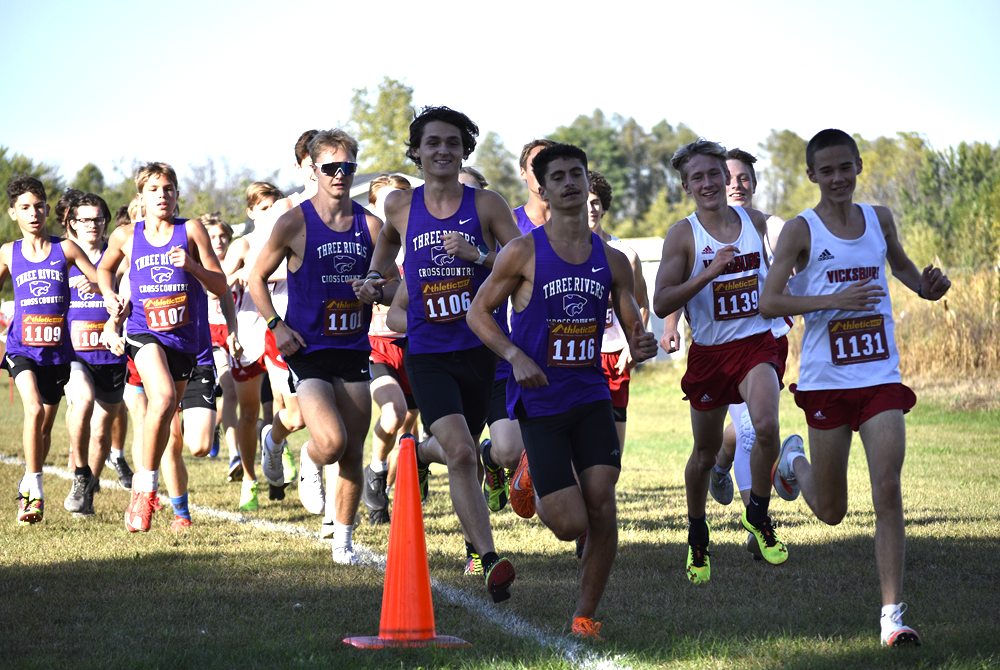
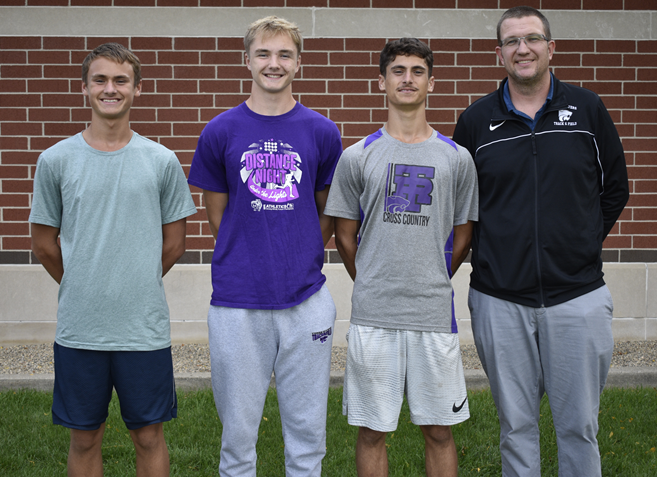
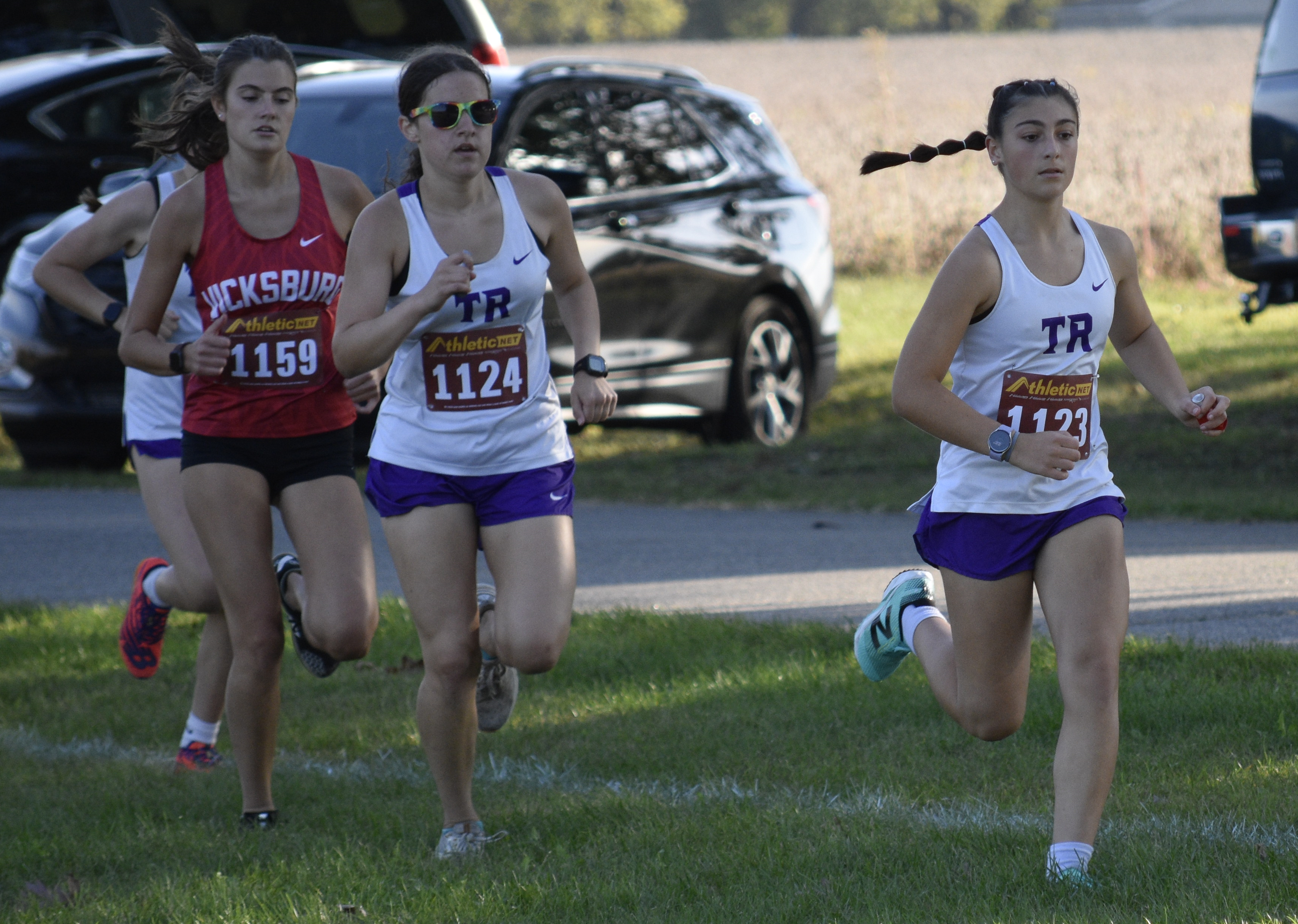
PHOTOS (Top) Three Rivers and Vicksburg runners take off at the start of the boys race last week at Indian Lake Nazarene Camp. (Middle) Pictured from left are Three Rivers juniors Jonah Zietlow and Charlie Brauer, senior Sulley Zietlow and Three Rivers head cross country coach Jason Muckel. (Below) Lillie Kerr, right, and teammate Gabby Kilbourn lead Three Rivers in the girls race against Vicksburg last week. (Photos by Scott Hassinger.)