

Preview: Classic Clashes and Broken Records Expected
By
Geoff Kimmerly
MHSAA.com senior editor
June 5, 2021
The attention that will be paid to one of the Lower Peninsula Boys Track & Field Finals on Saturday will go past usual interest in just a local school or single division.
Many eyes will be turned to the Division 1 meet, featuring among many Ann Arbor Skyline senior Hobbs Kessler, who has made national news over the last few weeks by setting the national high school record in the 1,500 (3:34.36) and qualifying for the Olympic Trials in the event.
But he’ll be facing some familiar competition in his distance races at East Kentwood – including Hartland junior Riley Hough, who edged Kessler by two seconds in the Division 1 cross country final this past fall.
Their matchup is just one of many stories worth tuning in for this weekend. Events at all four sites begin at 10 a.m. (EDT) and tickets to attend can be purchased online only at GoFan. The meets also will be broadcast on MHSAA.tv and viewable with subscription. Click to watch each division: LPD1 | LPD2 | LPD3 | LPD4.
Below is a glance at team contenders and individuals to watch in all four divisions.
Division 1 at East Kentwood
Top Regional scores: Macomb Dakota 160, Traverse City West 145½, Northville 136, Novi 136.
Team forecast: East Kentwood won the last three championships before COVID, with Ann Arbor Pioneer finishing runner-up in both 2018 and 2019. Dakota is an interesting possibility this time with qualifiers throughout the meet. Fenton has top-three seeds in six events, and Zeeland West is another team with scoring opportunities in a variety of events.
Trey Gardette, Ann Arbor Huron: The senior sprint star has taken amazing strides over the last two years and may be on the verge of an unforgettable finish to his high school career. Gardette’s top-seed 10.5 in the 100 is a blink faster than the LPD1 Finals record of 10.53, and he’s second-seeded in the 200 and also will run on the 400 relay.
Riley Hough, Hartland: The I-96 corridor has been the center of distance running this school year, and Hough hopes to follow his Division 1 cross country championship in the fall with titles in the 1,600 and 3,200. He’s seeded first in the former with a 4:13.93.
Hobbs Kessler, Ann Arbor Skyline: He’s slated to run the 800, 1,600 and 3,200 and on the top-seeded 3,200 relay (7:53.30) Saturday. He won all three of those open races at his Regional, and so while he isn’t top-seeded in any that likely means little as he could drop major time.
Tamaal Myers II, Detroit Cass Tech: The Technicians standout junior has the top 110 hurdles seed time (14.06) by nearly a second and is tied for the top seed time in the 300 (39.32). He’ll also run the 400 and on the 1,600 relay.
Brandon Miller, Fenton: He finished fifth in the 200 as a sophomore in 2019, but he can take a massive leap Saturday as his top seed time in that race (21.25) is five hundredths of a second off the meet record. He’s also the second seed in the 100 with a seed time of 10.60 that is seven hundredths of a second off that meet record. And he’ll also run on contending 400 and 800 relays.
Division 2 at Zeeland
Top Regional scores: Orchard Lake St. Mary’s 216½, Dearborn Divine Child 186, Frankenmuth 164.
Team forecast: Four teams have won this championship over the last four seasons. Flint Powers Catholic is a possibility to make it five as it runs for its first team title led by sprint standouts and relays. Frankenmuth with top qualifiers in the sprints, relays and field events is another to watch in what lines up to be a low-scoring team race. A total of 10 schools won championships in this division over the previous 11 seasons before 2020 was canceled.
Ryan Brenner, Frankenmuth: The senior Eagles hurdler is the top seed in the 300 with a time of 40.1 and also will run on the top-seeded 1,600 relay (3:28.44) and high jump.
Jamal Hailey, Berrien Springs: The standout junior sprinter has the top seed time in the 100 (11.04) and the third-fastest in the 200, and he’ll also run on the second-seeded 400 relay.
Austin Hamlin, Flint Powers Catholic: The Chargers sophomore would play a major role in any team title pursuit, entering with the top seed in the 200 (22.5), third-fastest in the 100 and as part of the top-seeded 400 relay (43.3) and fourth-seeded 800 relay. That 400 relay time is a second off the meet record.
Alex Mansfield, Monroe Jefferson: The junior thrower is another who has made a major move over the last two years. He enters Saturday with the top seed in the shot put (56-3) by two feet and the top seed in the discus (163-11) by nearly 10.
Luke Stowasser, Edwardsburg: The junior Eddies jumper also is top-seeded in both of his events, with a 22-6½ in the long jump and 6-10 in the high jump. That high jump is six inches better than the field and two off the meet record. He was the high jump runner-up as a freshman.
Division 3 at Jenison
Top Regional scores: Grass Lake 132, Caro 129, Pewamo-Westphalia 126 1/3.
Team forecast: Grass Lake will be pursuing its first team title since 1970 and has six top-four seeds leading the way. Figuring the next few contenders is difficult with points looking to be spread among a number of teams.
Brennan Bargesser, Grass Lake: A drive for the team championship would include significant points from Bargesser, who is seeded first in the 200 (21.98) and 400 (49.34) and second in the 100 for his final high school meet. He’ll also run on the top-seeded 400 relay (44.14) – that seed time is one second off the meet record.
Hunter Jones, Benzie Central: The sophomore standout has two Division 3 cross country championships to his credit and will make his Track Finals debut as the top seed in the 3,200 (9:37.42) and a likely contender in the 1,600 and 800 as well.
Josh Jones, Harrison: He’ll close his high school career running the 800, 1,600 and 3,200, with his 1,600 seed time (4:19.84) topping that event list.
Brenden Quackenbush, Chesaning: He’s set to establish himself in both throws at this level Saturday, with the top seed in the discus (143-0) by nearly two feet and the third seed in the shot put.
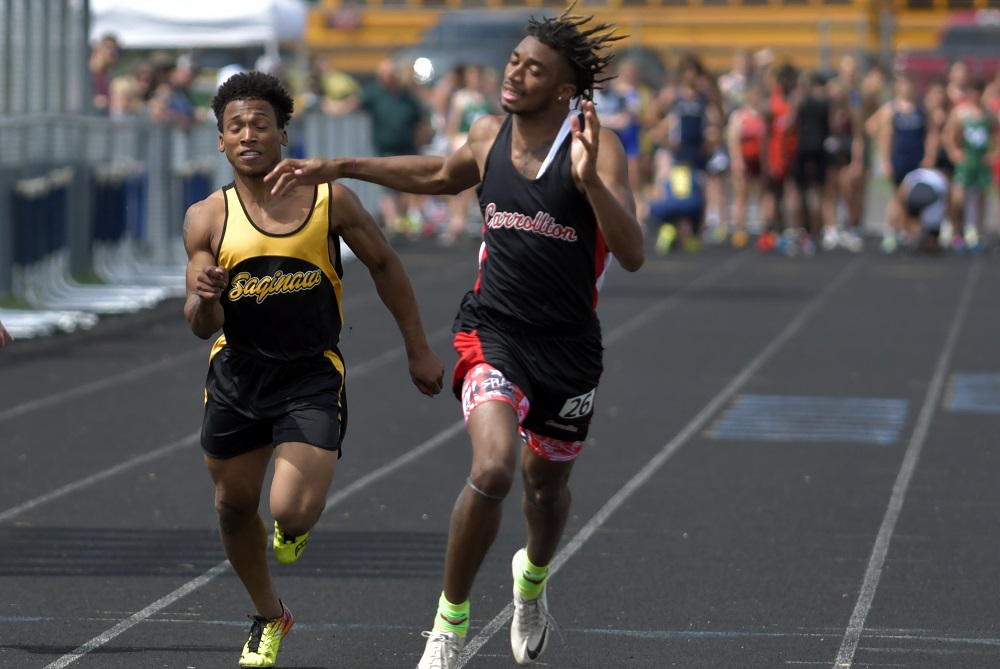
Derrick Voltz, Carrollton: A qualifier in the 100 as a freshman in 2019, he could cap his junior season as a two-event champion. He’s seeded first in the long jump (23-2) by nearly a foot with that leap only five inches off the meet record. He’s also the top seed in the 100 (11.11) just ahead of Bargesser.
Division 4 at Hudsonville
Top Regional scores: Lutheran Westland 171, Reading 170, Carson City-Crystal 147.
Team forecast: Kalamazoo Hackett Catholic Prep was the back-to-back champion before COVID, and Saugatuck was the Division 3 runner-up in 2019 but is back in Division 4. Saugatuck won’t run a relay this weekend but has favorites in the hurdles and distance events, and Breckenridge’s strengths in the sprints and relays should make it a team title contender as well as it seeks its first championship.
Coleman Clark, Carson City-Crystal: The lone returning champion in this division won the 3,200 as a sophomore in 2019 and will run that race along with the 800 and 1,600 and as part of the top-seeded 3,200 relay (8:19.40).
Benny Diaz, Saugatuck: The junior sprint/hurdles standout could make a run at four individual titles Saturday or next season. He’s the top seed in both hurdles races this time (15.01 in the 110 and 40.59 in the 300), and the fourth seed in the 200 and seventh in the 100. He was third in Division 3 in the 300 as a freshman.
Zane Forist, Carson City-Crystal: He was the runner-up in the discus and eighth in the shot put as a freshman two years ago, and he’s aiming for much more this time. His top-seed throws of 196-8 and 64-4, respectively, would both set LPD4 championship meet records – both by roughly six feet.
Nik Pettinga, Saugatuck: A top distance runner in cross country the last few seasons, he is looking to finish as a champion in his last high school meet and enters as the top seed in the 1,600 (4:26.99) and second seed (to junior teammate Max Sharnas) in the 3,200.
Charlie Steinhaus, Breckenridge: The speedy senior would help lead any charge for a team championship, entering as the top seed in the 100 (11.01) and second in the 200. He’ll also run on the top-seeded 400 relay (44.51) and second-seeded 800 relay.
PHOTO: Carrollton’s Derrick Voltz, right, breaks across the finish line during the 100-meter preliminaries at his Division 3 Regional at Shepherd last month. (Click for more from High School Sports Scene.)
Retired NHL-er Back on Ice to Answer Call - By Making Them
By
Rob Kaminski
MHSAA benchmarks editor
March 16, 2023
The most accomplished skater on the ice during Friday’s triple-overtime MHSAA Division 1 Semifinal hockey thriller between Hartland and Brighton was not wearing the school colors of either team.
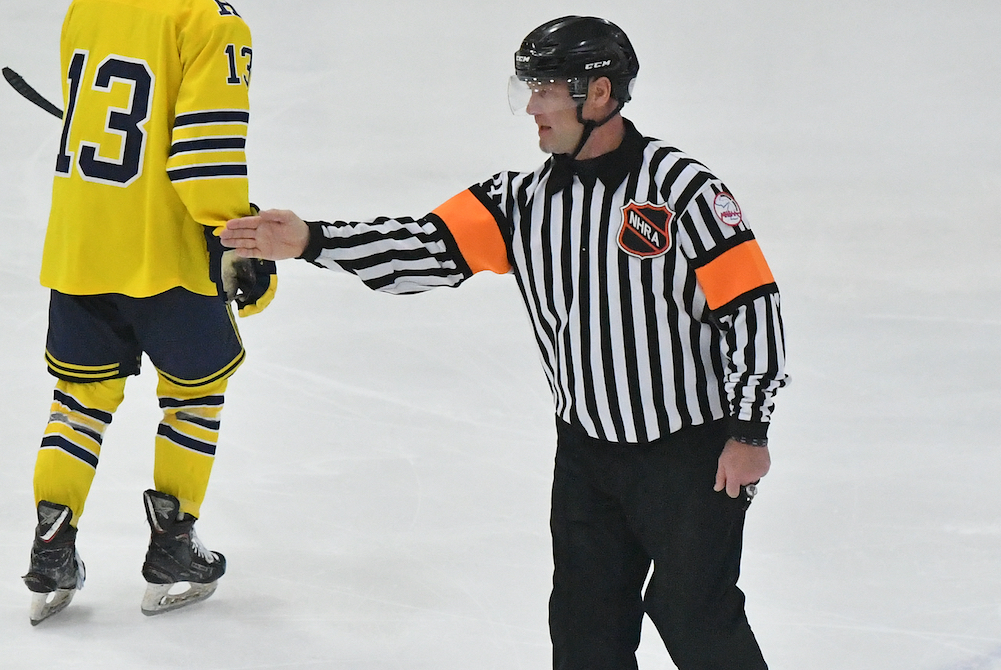
In front of a packed house at Plymouth’s USA Hockey Arena, referee Bryan Smolinski was in stripes, just like the rest of his officiating crew.
In his former life, he pulled on plenty of sweaters before lacing up the skates. That happens when one logs more than 1,000 games, tallies nearly 300 goals (274) and close to 400 assists (377) with eight teams spanning a 15-year playing career in the National Hockey League.
So, how did the 52-year-old former star player find himself on the ice last weekend as one of the referees for the pinnacle weekend of this high school season? Good question, even for the man known as “Smoke” during his playing days.
“I was working in youth development programs a few years back and reached out to some Michigan guys I had connections with about other ways to help the game,” Smolinski said. “I called Kevin May just to chat and asked, ‘Hey, how’s your reffing going?’ He said, ‘You know, we’re down a little bit,’ then said, ‘Why don’t you do it?’ I said, ‘Not a chance,’” Smolinski laughed.
Never Say Never
May persisted, imploring his friend to skate with him during a Fall league at Cranbrook in Bloomfield Hills. After eight weeks, once a week, Smolinski had a revelation.
“I’m like, ‘I’m kind of diggin’ this,’” Smolinski said “So, I did all the testing, and the educational part of it, and I really enjoyed it. I got with Danny (DiCristofaro) and his group, and he put me in as much as he could, and I really started to get my feet wet.”
 DiCristofaro is the assigner and referee-in-chief for the MHSAA’s Northeast Hockey Referees Association, and he has seen Smolinski’s growth first-hand.
“Obviously he’s got great instincts and a feel for the game, along with a wealth of experience, all of which has allowed him to climb the ladder quickly,” said DiCristofaro. “It’s been a joy to watch his growth as an official.”
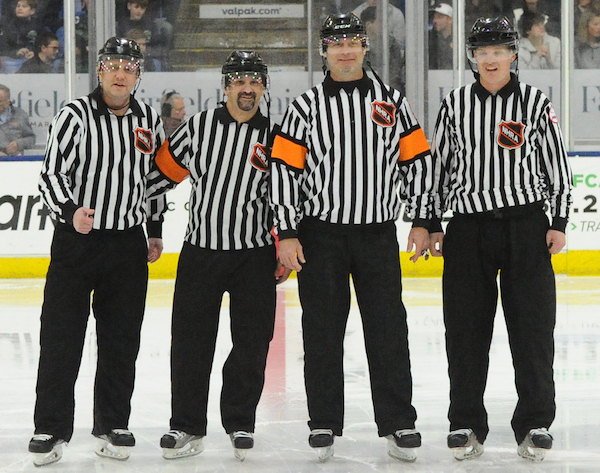
Fast forward to last Friday, and there were Smolinski and May sharing duties as referees during the MHSAA Semifinal with linesmen Michael Andrews and Thomas Robbins.
In between, there has been a learning curve that still continues, but the jump to officiating was not quite as daunting as his introduction to the NHL.
“I was scared to death. My first game was against Mario Lemieux. I’m in the old Boston Garden and now I’m playing against these guys and it’s their job, and they’re out there trying to make a living,” Smolinski recalled.
The emotions were not running nearly as frenzied for his first game as an MHSAA official, obviously, yet respect came in a different form.
“I couldn’t pick the puck up, I was breathing heavily; it was Kevin and me doing a two-man game in Brighton,” Smolinski recalled. “There were a few high-end kids playing, and I’m thinking, ‘I’m dying here.’ You know, there’s no training for that first time.”
What that experience did, however, was revitalize Smolinski in a new way. His playing career is well documented, not only in the NHL, but around Michigan. He enjoyed an honor-laden career at Michigan State University from 1989-93 before joining the Boston Bruins (who had drafted him three years earlier) at the end of the ’93 NHL campaign. Even after his final season, with Montreal in 2007-08, he stayed in the game via men’s leagues, or coaching his son, Max.
Smolinski and his wife, Julie, have three daughters: Ashtyn (22), Jojo (16) and Rylen (12), along with Max, whom dad coached for seven years including during a national championship run with a Little Caesars U15 team in 2019. Max, 19, is now playing collegiately at Rensselaer Polytechnic Institute.
So, for Smolinski, officiating offers a new chapter.
“Reffing brought back ... I wouldn’t say love of the game, because that’s always been there; it’s a different side of enjoying the game now. I have no horse in the race, my son’s off to college, my daughters are doing their thing; I wanted to find something new in the game,” Smolinski said. “I’ve coached, and I don’t want to do that. I found this, and I’ve stuck with it.”
Old College Ties
One of the great benefits of athletics at any level are the friendships made. For two kids who met in their first years on the MSU campus and forged a bond that lasts to this day, it’s amazing how their careers reached the pinnacle and have now come full circle.
Wes McCauley, an MSU teammate, is one of Smolinski’s best friends. After numerous years in the minor leagues, McCauley, like his friend, made it to the NHL. But McCauley made it as an official, working his first NHL game in 2003, when Smolinski was nearing the end of his playing career.
 Their games lined up on just a few occasions in the NHL, and the two lobbied hard to have McCauley work Smolinski’s 1,000th career game in his final season with the Canadiens in 2007-08. The request, sadly, was denied by the league.
On the rare occasions when the friends did share the same ice, less than a handful by Smolinski’s count, it was McCauley who was forced to rebuff any attempts at fraternization. It’s just part of an official’s edict.
“For both of us, it was amazing; it was just great,” Smolinski said. “I’d say, ‘Hey man what’s up?’ and he says, ‘Can’t talk.’ I’m like, ‘What do you mean, we talk all the time.’ Again, he’s like, ‘Can’t talk, get away from me.’ You know, it was just business.”
McCauley then reached the 1,000-game plateau himself in 2018 and is still going strong as a regular selection for playoff duties with nine Stanley Cup Finals assignments, including last year.
So, it should have been natural for Smolinski to go to his old friend immediately for officiating pointers once he joined the ranks, right? Well, maybe not immediately.
“I talk to Wes all the time, but I actually hid it from him right out of the gate because I didn’t want to take his razzing. Eventually it got out, and he was loving it. He started sending me whistles and visors and pants,” Smolinski said, grinning. “And none of it fit, you know, because I’m older and fatter, and he’s so damn skinny. So, I still had to go out and get all new gear.”
Both Sides Now
Having been to the top of his profession, now moving to the other side of that same mountain that his friend McCauley scaled, the respect has grown for those blowing the whistle.
“The preparation for officiating is much more mental,” Smolinski said. “Way more rules oriented. You’re always trying to get away with things that you can as a player; now you have to police that.”
Smolinski has a distinct advantage.
“I know everything they’re trying to do because I’ve done it. I know where you’re going with the puck, I know what kind of breakout you’re trying to do,” Smolinski said. “I have all the instincts, now I just try to stay out of the way and not ruin their game. The most fun is watching the game develop and the ups and downs. For me to be out there and enjoy it with them, that’s the fun part.”
 Those who have played hockey at any level have a built-in advantage should they consider the officiating avocation: the ability to skate. Unlike officiating in any other sport, skating is a prerequisite. This makes the pool limited, and almost solely composed of former players. Smolinski offers this advice.
“I prefer sticking with high school because I think there’s more decorum, more administrative structure. Kids are playing for their schools, there’s loyalty there,” said Smolinski. “And there is more accountability. People need report to athletic directors and supervisors. Other levels can be more loosely governed, or a bit more maverick in nature. Moms and dads get involved more, coaches maybe know a little less,” said Smolinski.
He has, in fact, worked a handful of non-school games, and there’s a stark difference.
“I wanted to see what was going on, and I see it first-hand,” Smolinski said. “There are some crazy people and parents out there, and these guys are getting absolutely tortured. I’ve been tortured. There has to be a level of respect for what officials do. I think schools can rein that in a little more. All the guys I’ve met give up a lot of time and work hard because they love to do it and love the game.”
All sports need an assist from school administration and from those who once played the games to keep the officials recruitment moving in the right direction. People like Smolinski can help.
“He clearly doesn’t need to do this, and that’s what makes it so fantastic,” DiCristofaro said. “We need more people who have played – at any level – to do what he’s done and stay in the game as officials.”
Smolinski continues to promote the game in other ways as well. Currently, he is involved in the NHL’s Learn To Play initiative, which aims to inspire youth and welcome more families into the hockey community.
“We work hand-in-hand with the NHL Players Association for player development and industry growth,” Smolinski said. “Ages 5 to 9 are introduced to hockey, get head-to-toe gear and instruction, and meet some former players.”
The idea is to have fun first, which can translate into years and maybe even a lifetime in the sport. It’s a lifetime that has given Smolinski so much and continues to do so as he watches it unfold for others from his new vantage point.
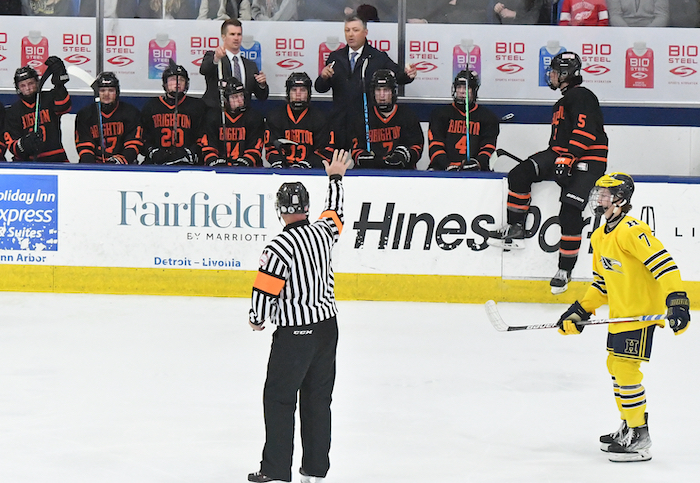
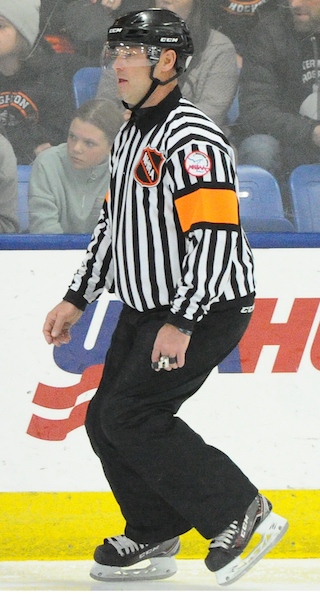
PHOTOS (Top) MHSAA official Bryan Smolinski signals during Friday's Division 1 Semifinal between Brighton and Hartland. (2) Smolinski, a retired NHL standout, communicates with the Bulldogs' bench. (3) Smolinski keeps watch during game play. (4) Smolinski, third from left, with his crew: Michael Andrews, Kevin May and Thomas Robbins.