

Preview: Classic Clashes and Broken Records Expected
By
Geoff Kimmerly
MHSAA.com senior editor
June 5, 2021
The attention that will be paid to one of the Lower Peninsula Boys Track & Field Finals on Saturday will go past usual interest in just a local school or single division.
Many eyes will be turned to the Division 1 meet, featuring among many Ann Arbor Skyline senior Hobbs Kessler, who has made national news over the last few weeks by setting the national high school record in the 1,500 (3:34.36) and qualifying for the Olympic Trials in the event.
But he’ll be facing some familiar competition in his distance races at East Kentwood – including Hartland junior Riley Hough, who edged Kessler by two seconds in the Division 1 cross country final this past fall.
Their matchup is just one of many stories worth tuning in for this weekend. Events at all four sites begin at 10 a.m. (EDT) and tickets to attend can be purchased online only at GoFan. The meets also will be broadcast on MHSAA.tv and viewable with subscription. Click to watch each division: LPD1 | LPD2 | LPD3 | LPD4.
Below is a glance at team contenders and individuals to watch in all four divisions.
Division 1 at East Kentwood
Top Regional scores: Macomb Dakota 160, Traverse City West 145½, Northville 136, Novi 136.
Team forecast: East Kentwood won the last three championships before COVID, with Ann Arbor Pioneer finishing runner-up in both 2018 and 2019. Dakota is an interesting possibility this time with qualifiers throughout the meet. Fenton has top-three seeds in six events, and Zeeland West is another team with scoring opportunities in a variety of events.
Trey Gardette, Ann Arbor Huron: The senior sprint star has taken amazing strides over the last two years and may be on the verge of an unforgettable finish to his high school career. Gardette’s top-seed 10.5 in the 100 is a blink faster than the LPD1 Finals record of 10.53, and he’s second-seeded in the 200 and also will run on the 400 relay.
Riley Hough, Hartland: The I-96 corridor has been the center of distance running this school year, and Hough hopes to follow his Division 1 cross country championship in the fall with titles in the 1,600 and 3,200. He’s seeded first in the former with a 4:13.93.
Hobbs Kessler, Ann Arbor Skyline: He’s slated to run the 800, 1,600 and 3,200 and on the top-seeded 3,200 relay (7:53.30) Saturday. He won all three of those open races at his Regional, and so while he isn’t top-seeded in any that likely means little as he could drop major time.
Tamaal Myers II, Detroit Cass Tech: The Technicians standout junior has the top 110 hurdles seed time (14.06) by nearly a second and is tied for the top seed time in the 300 (39.32). He’ll also run the 400 and on the 1,600 relay.
Brandon Miller, Fenton: He finished fifth in the 200 as a sophomore in 2019, but he can take a massive leap Saturday as his top seed time in that race (21.25) is five hundredths of a second off the meet record. He’s also the second seed in the 100 with a seed time of 10.60 that is seven hundredths of a second off that meet record. And he’ll also run on contending 400 and 800 relays.
Division 2 at Zeeland
Top Regional scores: Orchard Lake St. Mary’s 216½, Dearborn Divine Child 186, Frankenmuth 164.
Team forecast: Four teams have won this championship over the last four seasons. Flint Powers Catholic is a possibility to make it five as it runs for its first team title led by sprint standouts and relays. Frankenmuth with top qualifiers in the sprints, relays and field events is another to watch in what lines up to be a low-scoring team race. A total of 10 schools won championships in this division over the previous 11 seasons before 2020 was canceled.
Ryan Brenner, Frankenmuth: The senior Eagles hurdler is the top seed in the 300 with a time of 40.1 and also will run on the top-seeded 1,600 relay (3:28.44) and high jump.
Jamal Hailey, Berrien Springs: The standout junior sprinter has the top seed time in the 100 (11.04) and the third-fastest in the 200, and he’ll also run on the second-seeded 400 relay.
Austin Hamlin, Flint Powers Catholic: The Chargers sophomore would play a major role in any team title pursuit, entering with the top seed in the 200 (22.5), third-fastest in the 100 and as part of the top-seeded 400 relay (43.3) and fourth-seeded 800 relay. That 400 relay time is a second off the meet record.
Alex Mansfield, Monroe Jefferson: The junior thrower is another who has made a major move over the last two years. He enters Saturday with the top seed in the shot put (56-3) by two feet and the top seed in the discus (163-11) by nearly 10.
Luke Stowasser, Edwardsburg: The junior Eddies jumper also is top-seeded in both of his events, with a 22-6½ in the long jump and 6-10 in the high jump. That high jump is six inches better than the field and two off the meet record. He was the high jump runner-up as a freshman.
Division 3 at Jenison
Top Regional scores: Grass Lake 132, Caro 129, Pewamo-Westphalia 126 1/3.
Team forecast: Grass Lake will be pursuing its first team title since 1970 and has six top-four seeds leading the way. Figuring the next few contenders is difficult with points looking to be spread among a number of teams.
Brennan Bargesser, Grass Lake: A drive for the team championship would include significant points from Bargesser, who is seeded first in the 200 (21.98) and 400 (49.34) and second in the 100 for his final high school meet. He’ll also run on the top-seeded 400 relay (44.14) – that seed time is one second off the meet record.
Hunter Jones, Benzie Central: The sophomore standout has two Division 3 cross country championships to his credit and will make his Track Finals debut as the top seed in the 3,200 (9:37.42) and a likely contender in the 1,600 and 800 as well.
Josh Jones, Harrison: He’ll close his high school career running the 800, 1,600 and 3,200, with his 1,600 seed time (4:19.84) topping that event list.
Brenden Quackenbush, Chesaning: He’s set to establish himself in both throws at this level Saturday, with the top seed in the discus (143-0) by nearly two feet and the third seed in the shot put.
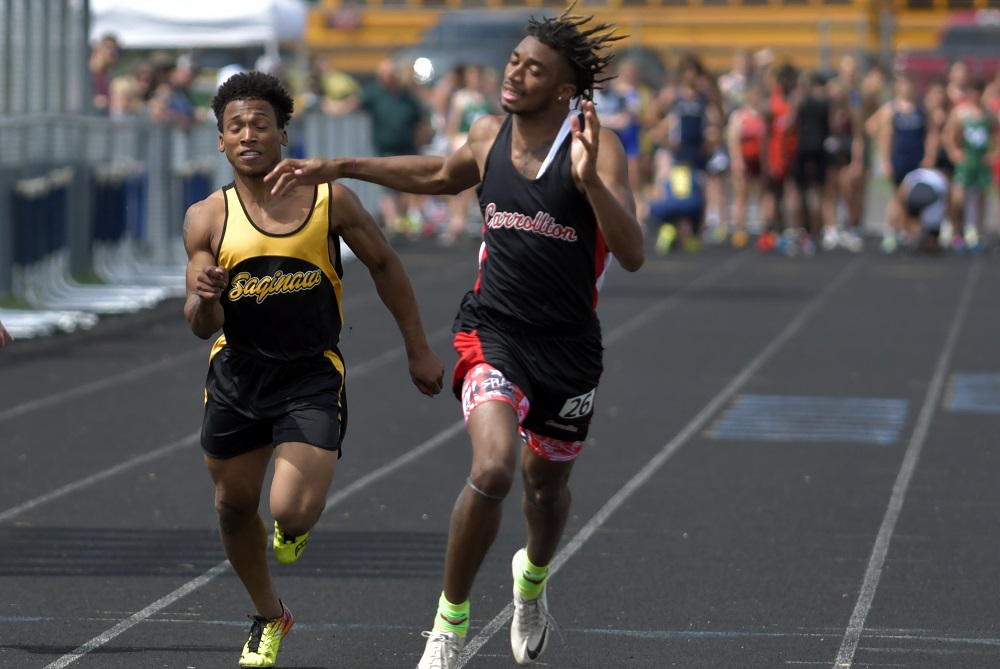
Derrick Voltz, Carrollton: A qualifier in the 100 as a freshman in 2019, he could cap his junior season as a two-event champion. He’s seeded first in the long jump (23-2) by nearly a foot with that leap only five inches off the meet record. He’s also the top seed in the 100 (11.11) just ahead of Bargesser.
Division 4 at Hudsonville
Top Regional scores: Lutheran Westland 171, Reading 170, Carson City-Crystal 147.
Team forecast: Kalamazoo Hackett Catholic Prep was the back-to-back champion before COVID, and Saugatuck was the Division 3 runner-up in 2019 but is back in Division 4. Saugatuck won’t run a relay this weekend but has favorites in the hurdles and distance events, and Breckenridge’s strengths in the sprints and relays should make it a team title contender as well as it seeks its first championship.
Coleman Clark, Carson City-Crystal: The lone returning champion in this division won the 3,200 as a sophomore in 2019 and will run that race along with the 800 and 1,600 and as part of the top-seeded 3,200 relay (8:19.40).
Benny Diaz, Saugatuck: The junior sprint/hurdles standout could make a run at four individual titles Saturday or next season. He’s the top seed in both hurdles races this time (15.01 in the 110 and 40.59 in the 300), and the fourth seed in the 200 and seventh in the 100. He was third in Division 3 in the 300 as a freshman.
Zane Forist, Carson City-Crystal: He was the runner-up in the discus and eighth in the shot put as a freshman two years ago, and he’s aiming for much more this time. His top-seed throws of 196-8 and 64-4, respectively, would both set LPD4 championship meet records – both by roughly six feet.
Nik Pettinga, Saugatuck: A top distance runner in cross country the last few seasons, he is looking to finish as a champion in his last high school meet and enters as the top seed in the 1,600 (4:26.99) and second seed (to junior teammate Max Sharnas) in the 3,200.
Charlie Steinhaus, Breckenridge: The speedy senior would help lead any charge for a team championship, entering as the top seed in the 100 (11.01) and second in the 200. He’ll also run on the top-seeded 400 relay (44.51) and second-seeded 800 relay.
PHOTO: Carrollton’s Derrick Voltz, right, breaks across the finish line during the 100-meter preliminaries at his Division 3 Regional at Shepherd last month. (Click for more from High School Sports Scene.)
The Official View: The Crossroad We Face
By
Brent Rice
MHSAA Assistant Director
December 20, 2021
It’s time to call it what it is … a major crossroad and tipping point.
For more than a decade, the numbers of registered MHSAA officials have steadily declined from a high of about 13,000 to, today, around 7,700. While the COVID pandemic has certainly exacerbated those figures over the last two seasons, two of the top reasons officials give for leaving the avocation remains adult spectators and coach behavior.
School sports and traditional recreational programs have been supplemented, and in some cases, supplanted, by travel and club programs that, more often than not, do not share the same values and standards expected in education-based athletics. Many of these non-school programs require parents to spend exorbitant amounts in registrations fees, travel, lodging and meals with the implicit suggestion that this is the gateway to Division I college and professional sports. The result is that the criticisms hurled at the officials are more than an overzealous parent wanting a fair-called game – it is stakeholders defending their investments.
While we are often disturbed by some of the events documented during these club and travel contests, the real concern is that this permitted conduct has begun to seep into the school sports world. The result is that officials are simply walking away, leaving increasingly more games being moved or cancelled due to the lack of officials. The games that are being played are often staffed with smaller crews – perhaps two officials instead of three. Officials are in place to provide athletes with safe and fair opportunities to play sports, and shorthanded crews may reduce the ability for officials to see and call plays and fouls. These potential missed calls incite more disparaging comments from spectators, thus pushing more officials away from sports. This cycle cannot be sustainable much longer.
So, what are the solutions, and who do they come from?
The first is spectators. We refer to this as the difference between the whistle and the airhorn. When spectators just feel compelled to be vocally critical, they should make certain that their criticisms are infrequent, brief and not personal. Spectators should be the whistle and not the airhorn. Other spectators have a responsibility to set a good example and call out those who are going overboard.
School administrators also play a critical role in ensuring that officials are able to do their job in a safe and secure setting. Administrators should look for escalating situations in the stands and diffuse them before they become abusive. No one wants to remove parents and other spectators from events; but frankly, more of that needs to be done to show that inappropriate conduct and behavior will not be tolerated.
Finally, MHSAA officials need to be the first line of defense against unsportsmanlike behavior. This should be penalized when observed from coaches or players, without concern to the consequences that student or coach will later face. In short, bad behavior cannot be tolerated. Conduct found in the MHSAA Personal Attack Policy should result in an immediate ejection/disqualification, and similar conduct that occurs after the game should be handled as provided in the Post-Contest Ejection Policy. Unaddressed bad behavior by coaches and players encourages the same from spectators.
MHSAA game officials should focus their attention to the competition on the playing surface. This means that most comments from the stands should be ignored, and an official should never engage with critical spectators. This is not to say that officials must take abuse from spectators. If the language or behavior becomes a distraction to the contest, or personal and vulgar language is directed at the officials, the officials have the authority to have spectators removed from the facility (and should do so). No need for a big spectacle, ejection mechanic or yelling into the stands to engage fans. They should simply stop the contest and have the administrator on site remove the unruly spectator from the game.
There are a number of other factors contributing to the decline of officials that also need to be addressed. Low game fees, substandard locker room accommodations, unmanageable game times, and assigner and association politics all play a part. Those all pale in comparison to the main reason cited: Misbehavior by adults. MHSAA officials will inevitably continue to miss calls. That’s the nature of what they do. However, without them the games cannot be played, which means opportunities for Michigan students will also decline. We all have a responsibility to see that school sports remain closely tied to the values of educational athletics and maintain scope and perspective. We all must do better; otherwise, the crossroads of the officials shortage will only get worse.
It’s Official!
Postseason Assignments: Winter sport officials need to pay close attention to the changes for postseason consideration in effect this school year. Officials in most sports must opt into tournament consideration. This means officials this season for basketball, competitive cheer, gymnastics, ice hockey and wrestling must submit their availability on the MHSAA website – otherwise, the default is that they are unavailable. This is in addition to other postseason requirements such as completion of the rules meeting, the tournament exam and submission of the official’s regular-season schedule through the MHSAA website. These requirements are due by Dec. 15 for wrestling, Jan. 5 for basketball, Jan. 12 for competitive cheer and ice hockey, Jan. 19 for gymnastics and Jan. 26 for boys swimming & diving.
Seeking Committee Members: We are reconvening an ad hoc committee of educators/officials to assist with the development of curriculum that can be utilized by school districts for officiating classes in conjunction with the MHSAA Legacy Officials Program.
If you’re interested in serving on this committee (some in-person, but mostly virtual) and have a background as an educator, please reach out to [email protected].
Know Your Rules
BASKETBALL As Team A is preparing to make a throw-in from the end line, Team A players #15, #20 and #3 stand shoulder-to-shoulder next to each other immediately in front of the thrower. Team B player #11 requests to stand between two of the A players before the throw-in.
RULING Within three feet on the court from the throw-in, Team B players will be permitted to stand between the Team A players, if requested. If the Team A players were positioned more than three feet from the throw-in, this request would be denied.
It’s Your Call
REVIEW The play from the last It’s Your Call (found here) involved ball-handling by a back row volleyball player. Following a good dig by her teammate, the back row player appears to make contact with her left hand then right hand with her overhead pass. Since this is not the first contact on her side, the contact with the ball must be simultaneous with both hands. This is a multiple contact and a loss of point against white.
WRESTLING For the first time, the MHSAA will introduce a Girls Division into this year’s Individual Wrestling Finals. The following “It’s Your Call” takes place in a girls match but is applicable to the sport as a whole. Review the brief clip and let us know your thoughts. What’s the call?