

Preview: Classic Clashes and Broken Records Expected
By
Geoff Kimmerly
MHSAA.com senior editor
June 5, 2021
The attention that will be paid to one of the Lower Peninsula Boys Track & Field Finals on Saturday will go past usual interest in just a local school or single division.
Many eyes will be turned to the Division 1 meet, featuring among many Ann Arbor Skyline senior Hobbs Kessler, who has made national news over the last few weeks by setting the national high school record in the 1,500 (3:34.36) and qualifying for the Olympic Trials in the event.
But he’ll be facing some familiar competition in his distance races at East Kentwood – including Hartland junior Riley Hough, who edged Kessler by two seconds in the Division 1 cross country final this past fall.
Their matchup is just one of many stories worth tuning in for this weekend. Events at all four sites begin at 10 a.m. (EDT) and tickets to attend can be purchased online only at GoFan. The meets also will be broadcast on MHSAA.tv and viewable with subscription. Click to watch each division: LPD1 | LPD2 | LPD3 | LPD4.
Below is a glance at team contenders and individuals to watch in all four divisions.
Division 1 at East Kentwood
Top Regional scores: Macomb Dakota 160, Traverse City West 145½, Northville 136, Novi 136.
Team forecast: East Kentwood won the last three championships before COVID, with Ann Arbor Pioneer finishing runner-up in both 2018 and 2019. Dakota is an interesting possibility this time with qualifiers throughout the meet. Fenton has top-three seeds in six events, and Zeeland West is another team with scoring opportunities in a variety of events.
Trey Gardette, Ann Arbor Huron: The senior sprint star has taken amazing strides over the last two years and may be on the verge of an unforgettable finish to his high school career. Gardette’s top-seed 10.5 in the 100 is a blink faster than the LPD1 Finals record of 10.53, and he’s second-seeded in the 200 and also will run on the 400 relay.
Riley Hough, Hartland: The I-96 corridor has been the center of distance running this school year, and Hough hopes to follow his Division 1 cross country championship in the fall with titles in the 1,600 and 3,200. He’s seeded first in the former with a 4:13.93.
Hobbs Kessler, Ann Arbor Skyline: He’s slated to run the 800, 1,600 and 3,200 and on the top-seeded 3,200 relay (7:53.30) Saturday. He won all three of those open races at his Regional, and so while he isn’t top-seeded in any that likely means little as he could drop major time.
Tamaal Myers II, Detroit Cass Tech: The Technicians standout junior has the top 110 hurdles seed time (14.06) by nearly a second and is tied for the top seed time in the 300 (39.32). He’ll also run the 400 and on the 1,600 relay.
Brandon Miller, Fenton: He finished fifth in the 200 as a sophomore in 2019, but he can take a massive leap Saturday as his top seed time in that race (21.25) is five hundredths of a second off the meet record. He’s also the second seed in the 100 with a seed time of 10.60 that is seven hundredths of a second off that meet record. And he’ll also run on contending 400 and 800 relays.
Division 2 at Zeeland
Top Regional scores: Orchard Lake St. Mary’s 216½, Dearborn Divine Child 186, Frankenmuth 164.
Team forecast: Four teams have won this championship over the last four seasons. Flint Powers Catholic is a possibility to make it five as it runs for its first team title led by sprint standouts and relays. Frankenmuth with top qualifiers in the sprints, relays and field events is another to watch in what lines up to be a low-scoring team race. A total of 10 schools won championships in this division over the previous 11 seasons before 2020 was canceled.
Ryan Brenner, Frankenmuth: The senior Eagles hurdler is the top seed in the 300 with a time of 40.1 and also will run on the top-seeded 1,600 relay (3:28.44) and high jump.
Jamal Hailey, Berrien Springs: The standout junior sprinter has the top seed time in the 100 (11.04) and the third-fastest in the 200, and he’ll also run on the second-seeded 400 relay.
Austin Hamlin, Flint Powers Catholic: The Chargers sophomore would play a major role in any team title pursuit, entering with the top seed in the 200 (22.5), third-fastest in the 100 and as part of the top-seeded 400 relay (43.3) and fourth-seeded 800 relay. That 400 relay time is a second off the meet record.
Alex Mansfield, Monroe Jefferson: The junior thrower is another who has made a major move over the last two years. He enters Saturday with the top seed in the shot put (56-3) by two feet and the top seed in the discus (163-11) by nearly 10.
Luke Stowasser, Edwardsburg: The junior Eddies jumper also is top-seeded in both of his events, with a 22-6½ in the long jump and 6-10 in the high jump. That high jump is six inches better than the field and two off the meet record. He was the high jump runner-up as a freshman.
Division 3 at Jenison
Top Regional scores: Grass Lake 132, Caro 129, Pewamo-Westphalia 126 1/3.
Team forecast: Grass Lake will be pursuing its first team title since 1970 and has six top-four seeds leading the way. Figuring the next few contenders is difficult with points looking to be spread among a number of teams.
Brennan Bargesser, Grass Lake: A drive for the team championship would include significant points from Bargesser, who is seeded first in the 200 (21.98) and 400 (49.34) and second in the 100 for his final high school meet. He’ll also run on the top-seeded 400 relay (44.14) – that seed time is one second off the meet record.
Hunter Jones, Benzie Central: The sophomore standout has two Division 3 cross country championships to his credit and will make his Track Finals debut as the top seed in the 3,200 (9:37.42) and a likely contender in the 1,600 and 800 as well.
Josh Jones, Harrison: He’ll close his high school career running the 800, 1,600 and 3,200, with his 1,600 seed time (4:19.84) topping that event list.
Brenden Quackenbush, Chesaning: He’s set to establish himself in both throws at this level Saturday, with the top seed in the discus (143-0) by nearly two feet and the third seed in the shot put.
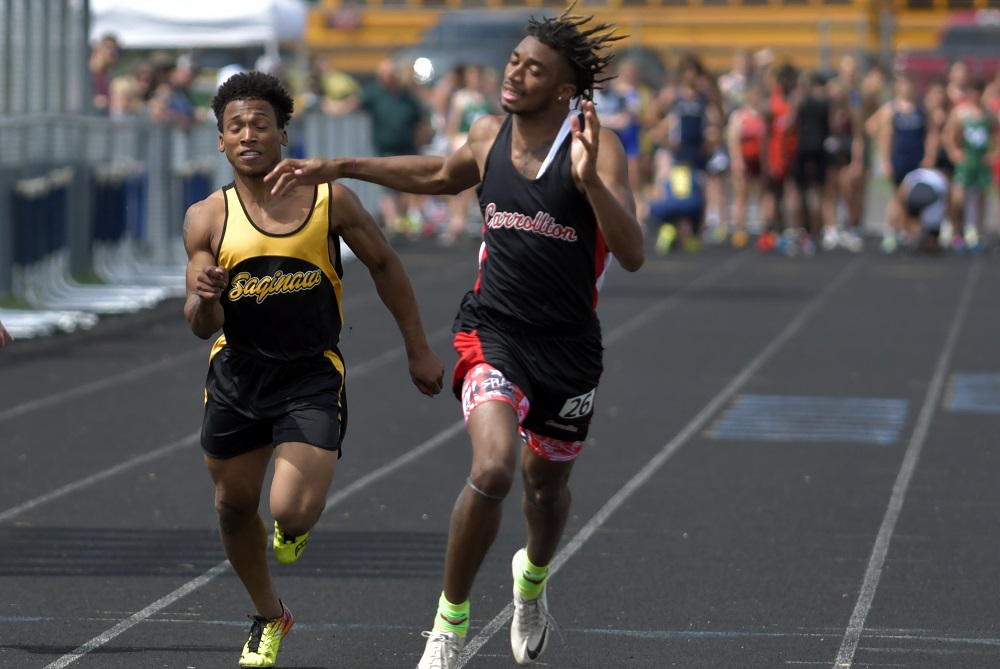
Derrick Voltz, Carrollton: A qualifier in the 100 as a freshman in 2019, he could cap his junior season as a two-event champion. He’s seeded first in the long jump (23-2) by nearly a foot with that leap only five inches off the meet record. He’s also the top seed in the 100 (11.11) just ahead of Bargesser.
Division 4 at Hudsonville
Top Regional scores: Lutheran Westland 171, Reading 170, Carson City-Crystal 147.
Team forecast: Kalamazoo Hackett Catholic Prep was the back-to-back champion before COVID, and Saugatuck was the Division 3 runner-up in 2019 but is back in Division 4. Saugatuck won’t run a relay this weekend but has favorites in the hurdles and distance events, and Breckenridge’s strengths in the sprints and relays should make it a team title contender as well as it seeks its first championship.
Coleman Clark, Carson City-Crystal: The lone returning champion in this division won the 3,200 as a sophomore in 2019 and will run that race along with the 800 and 1,600 and as part of the top-seeded 3,200 relay (8:19.40).
Benny Diaz, Saugatuck: The junior sprint/hurdles standout could make a run at four individual titles Saturday or next season. He’s the top seed in both hurdles races this time (15.01 in the 110 and 40.59 in the 300), and the fourth seed in the 200 and seventh in the 100. He was third in Division 3 in the 300 as a freshman.
Zane Forist, Carson City-Crystal: He was the runner-up in the discus and eighth in the shot put as a freshman two years ago, and he’s aiming for much more this time. His top-seed throws of 196-8 and 64-4, respectively, would both set LPD4 championship meet records – both by roughly six feet.
Nik Pettinga, Saugatuck: A top distance runner in cross country the last few seasons, he is looking to finish as a champion in his last high school meet and enters as the top seed in the 1,600 (4:26.99) and second seed (to junior teammate Max Sharnas) in the 3,200.
Charlie Steinhaus, Breckenridge: The speedy senior would help lead any charge for a team championship, entering as the top seed in the 100 (11.01) and second in the 200. He’ll also run on the top-seeded 400 relay (44.51) and second-seeded 800 relay.
PHOTO: Carrollton’s Derrick Voltz, right, breaks across the finish line during the 100-meter preliminaries at his Division 3 Regional at Shepherd last month. (Click for more from High School Sports Scene.)
The Official View: Title IX – Door Opens for Female Officials
By
Brent Rice
MHSAA Assistant Director
October 29, 2021
In the 50 years since Congress passed Title IX legislation in order to create equal educational opportunities, huge strides have been made for female students to participate in athletics.
But the advancement of opportunities wasn’t just for the athletes. It also opened a door which ushered in a generation of female sports officials.
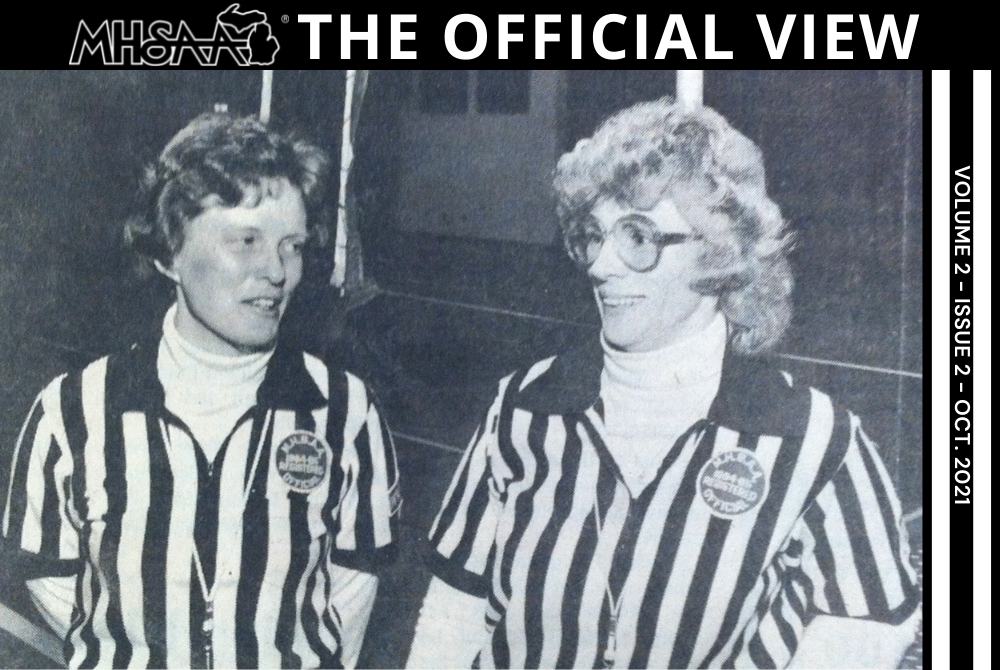
Betty Near is one of those officials whose long and distinguished career as a high school and collegiate volleyball official is a direct result of the opportunities provided through Title IX. Unlike many today who entered officiating after having played the sport, Betty didn’t have those opportunities before first climbing the ladder (literally) in 1971. She was encouraged to take up the sport by Macia Tiesenga (a nationally-ranked collegiate official) who told Betty – who had been involved in athletics recreationally – that athletes make the best officials because of their understanding of competition.
“I’m frequently asked whether I got into officiating because I played volleyball. I tell them I didn’t play because girls volleyball didn’t exist when I was in school," Near said. "I try to share the story of Title IX every chance I get, to show them that they now have opportunities to both play and officiate because of those that came before them.”
Near has spent more than 45 years as a registered MHSAA official and is still going strong. That run has included six appearances as a Finals official. She recalls how at one of those Finals, an injury to her knee created a change in mechanics for the entire state.
“When I first began officiating in the 70s, the MHSAA had the umpires (R2s today) kneel underneath the net to look at blockers," she said. "This was quite dangerous and pretty ineffective.
"Officiating at the collegiate level, I had been trained to stand at the pole and look down the net. With this background, and seeing as my knee was still hurting from an earlier injury, I decided to use this mechanic.”
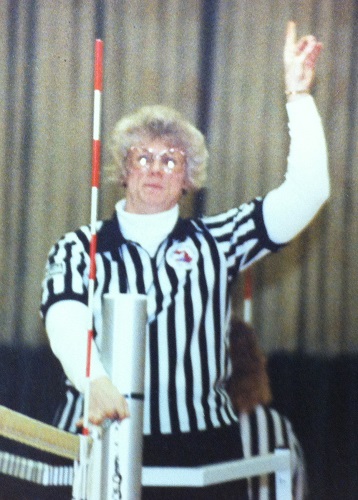 Sue Martin, the MHSAA director for volleyball at the time, approached Betty following her match. Near was certain that she was going to receive an earful. Instead, Martin asked the justification for using the mechanic, and they discussed the pros and cons of each. It was ultimately decided moving forward the umpire would take a position standing at the pole.
Mechanics changes aren’t the only effect Near has had on the sport. She was instrumental in the start of the West Michigan Volleyball Officials Association in 1984 and continues to help lead and grow that organization (now with more than 125 members). This has allowed her to work with the community, raising nearly $125,000 for scholarships for graduating high school seniors. And one of her biggest contributions remains her role in recruiting and mentoring new officials – especially helping to develop the next generation of female officials.
“Mentoring is a gratifying thing,” said Near, “especially when I receive emails or calls thanking me for helping them understand specific rules or situations and improving their skill sets. Watching someone I have mentored over 20 years work her way up to officiate multiple state tournaments (pleases me).”
Now officiating primarily at the college level, Betty still reserves Thursdays during the season to officiate MHSAA contests. She does this for the purpose of staying connected to high school students and officials and to build on the growth of female registered officials, though she also recognizes that challenges remain for female officials advancing through the system.
One of the natural barriers that apply to women more often than men is that women who begin families sometimes find difficulties continuing to officiate with their other responsibilities. While home lives can be difficult to navigate (for both women and men), officiating school sports provides a flexible alternative to stay active, remain involved in athletics, give back to the community, develop camaraderie and earn some extra cash.
Another hurdle that Near identifies for female officials, unfortunately, is a continuation of the “good ol' boy network.” She is reminded of a not-so-distant-past example when she and another female official had been selected to officiate the Regional round of the MHSAA Tournament; and even though both were well-established collegiate officials the host athletic director insisted that less-experienced male officials work as the R1 and R2 and the women work as line judges because the men would have better control of the tough matchup.
Of course, that kind of mindset isn’t based in fact, and many of the MHSAA’s best officials in all sports are women. Especially in girls sports, it is important that the student athletes see officials who represent them; but the MHSAA seeks female officials in all sports, including those dominated by male participants. This year will once again include a female officiating in the MHSAA Football Finals. Female officials also have worked Finals in baseball, boys basketball, ice hockey and wrestling.
The door that was opened for women and girls with the passing of Title IX a half-century ago only provides the opportunity. Capitalizing still requires stepping through the door to take full advantage of the opportunities provided. Near wants to encourage anyone to join the avocation of officiating, but especially young women.
“My hook is that the officiating is fun, and it is an activity that can be an avocation that can pay (in many ways) throughout their lifetimes," she said.
It’s Official!
Postseason Assignments: Officials assignments for fall sports tournaments have been released. Congratulations to all selected to officiate this year.
Speaking of tournament assignments, a change will be made this year that allows basketball officials to submit their availability to work together as a crew. Crews can be set for the boys and girls tournaments separately. The hope is that this will encourage more officials to seek postseason consideration, knowing they can choose with whom they will officiate. Eligible individuals not included with a crew will be assigned a crew by MHSAA staff.
For all winter sports officials, make sure to complete all requirements for postseason consideration. Please remember that officials in basketball, competitive cheer, gymnastics, ice hockey and wrestling must opt-in to the tournament by indicating their tournament availability dates HERE. All additional requirements such as completion of tournament exams and submission of regular-season schedule also remain in place.
Officials Review Committee: The Officials Review Committee, consisting of school administrators, officials and assigners from around the state, convened in early October to discuss issues and concerns involving officiating. A number of proposals were made to the MHSAA Representative Council. You can find these and other discussion items by reviewing the minutes HERE.
Know Your Rules
SOCCER A player (#7) is injured and must leave the field. His team elects to play short-handed. If #7 heals up, when can he return to the field? What if they wish to replace him with #12?
RULING If #7 comes back into the game, he only needs to wait until the next stoppage of play. If he will be replaced by #12 though, #12 can enter the game only at the next legal substitution opportunity.
It’s Your Call
REVIEW Last month’s play involved a suspect block by a defensive player (found here). The block by B17 is correctly flagged for an illegal block below the waist. While not widely known by spectators, blocks below the waist (except for linemen immediately at the snap) are illegal for players on both sides of the ball. In this case, since the block was by the defense, the penalty is enforced 15 yards from the end of the run.
VOLLEYBALL Officiating ball handling is the topic of this month’s "It’s Your Call." This rally ends following the pass of a back-row player. What’s the call?