

Preview: Classic Clashes and Broken Records Expected
By
Geoff Kimmerly
MHSAA.com senior editor
June 5, 2021
The attention that will be paid to one of the Lower Peninsula Boys Track & Field Finals on Saturday will go past usual interest in just a local school or single division.
Many eyes will be turned to the Division 1 meet, featuring among many Ann Arbor Skyline senior Hobbs Kessler, who has made national news over the last few weeks by setting the national high school record in the 1,500 (3:34.36) and qualifying for the Olympic Trials in the event.
But he’ll be facing some familiar competition in his distance races at East Kentwood – including Hartland junior Riley Hough, who edged Kessler by two seconds in the Division 1 cross country final this past fall.
Their matchup is just one of many stories worth tuning in for this weekend. Events at all four sites begin at 10 a.m. (EDT) and tickets to attend can be purchased online only at GoFan. The meets also will be broadcast on MHSAA.tv and viewable with subscription. Click to watch each division: LPD1 | LPD2 | LPD3 | LPD4.
Below is a glance at team contenders and individuals to watch in all four divisions.
Division 1 at East Kentwood
Top Regional scores: Macomb Dakota 160, Traverse City West 145½, Northville 136, Novi 136.
Team forecast: East Kentwood won the last three championships before COVID, with Ann Arbor Pioneer finishing runner-up in both 2018 and 2019. Dakota is an interesting possibility this time with qualifiers throughout the meet. Fenton has top-three seeds in six events, and Zeeland West is another team with scoring opportunities in a variety of events.
Trey Gardette, Ann Arbor Huron: The senior sprint star has taken amazing strides over the last two years and may be on the verge of an unforgettable finish to his high school career. Gardette’s top-seed 10.5 in the 100 is a blink faster than the LPD1 Finals record of 10.53, and he’s second-seeded in the 200 and also will run on the 400 relay.
Riley Hough, Hartland: The I-96 corridor has been the center of distance running this school year, and Hough hopes to follow his Division 1 cross country championship in the fall with titles in the 1,600 and 3,200. He’s seeded first in the former with a 4:13.93.
Hobbs Kessler, Ann Arbor Skyline: He’s slated to run the 800, 1,600 and 3,200 and on the top-seeded 3,200 relay (7:53.30) Saturday. He won all three of those open races at his Regional, and so while he isn’t top-seeded in any that likely means little as he could drop major time.
Tamaal Myers II, Detroit Cass Tech: The Technicians standout junior has the top 110 hurdles seed time (14.06) by nearly a second and is tied for the top seed time in the 300 (39.32). He’ll also run the 400 and on the 1,600 relay.
Brandon Miller, Fenton: He finished fifth in the 200 as a sophomore in 2019, but he can take a massive leap Saturday as his top seed time in that race (21.25) is five hundredths of a second off the meet record. He’s also the second seed in the 100 with a seed time of 10.60 that is seven hundredths of a second off that meet record. And he’ll also run on contending 400 and 800 relays.
Division 2 at Zeeland
Top Regional scores: Orchard Lake St. Mary’s 216½, Dearborn Divine Child 186, Frankenmuth 164.
Team forecast: Four teams have won this championship over the last four seasons. Flint Powers Catholic is a possibility to make it five as it runs for its first team title led by sprint standouts and relays. Frankenmuth with top qualifiers in the sprints, relays and field events is another to watch in what lines up to be a low-scoring team race. A total of 10 schools won championships in this division over the previous 11 seasons before 2020 was canceled.
Ryan Brenner, Frankenmuth: The senior Eagles hurdler is the top seed in the 300 with a time of 40.1 and also will run on the top-seeded 1,600 relay (3:28.44) and high jump.
Jamal Hailey, Berrien Springs: The standout junior sprinter has the top seed time in the 100 (11.04) and the third-fastest in the 200, and he’ll also run on the second-seeded 400 relay.
Austin Hamlin, Flint Powers Catholic: The Chargers sophomore would play a major role in any team title pursuit, entering with the top seed in the 200 (22.5), third-fastest in the 100 and as part of the top-seeded 400 relay (43.3) and fourth-seeded 800 relay. That 400 relay time is a second off the meet record.
Alex Mansfield, Monroe Jefferson: The junior thrower is another who has made a major move over the last two years. He enters Saturday with the top seed in the shot put (56-3) by two feet and the top seed in the discus (163-11) by nearly 10.
Luke Stowasser, Edwardsburg: The junior Eddies jumper also is top-seeded in both of his events, with a 22-6½ in the long jump and 6-10 in the high jump. That high jump is six inches better than the field and two off the meet record. He was the high jump runner-up as a freshman.
Division 3 at Jenison
Top Regional scores: Grass Lake 132, Caro 129, Pewamo-Westphalia 126 1/3.
Team forecast: Grass Lake will be pursuing its first team title since 1970 and has six top-four seeds leading the way. Figuring the next few contenders is difficult with points looking to be spread among a number of teams.
Brennan Bargesser, Grass Lake: A drive for the team championship would include significant points from Bargesser, who is seeded first in the 200 (21.98) and 400 (49.34) and second in the 100 for his final high school meet. He’ll also run on the top-seeded 400 relay (44.14) – that seed time is one second off the meet record.
Hunter Jones, Benzie Central: The sophomore standout has two Division 3 cross country championships to his credit and will make his Track Finals debut as the top seed in the 3,200 (9:37.42) and a likely contender in the 1,600 and 800 as well.
Josh Jones, Harrison: He’ll close his high school career running the 800, 1,600 and 3,200, with his 1,600 seed time (4:19.84) topping that event list.
Brenden Quackenbush, Chesaning: He’s set to establish himself in both throws at this level Saturday, with the top seed in the discus (143-0) by nearly two feet and the third seed in the shot put.
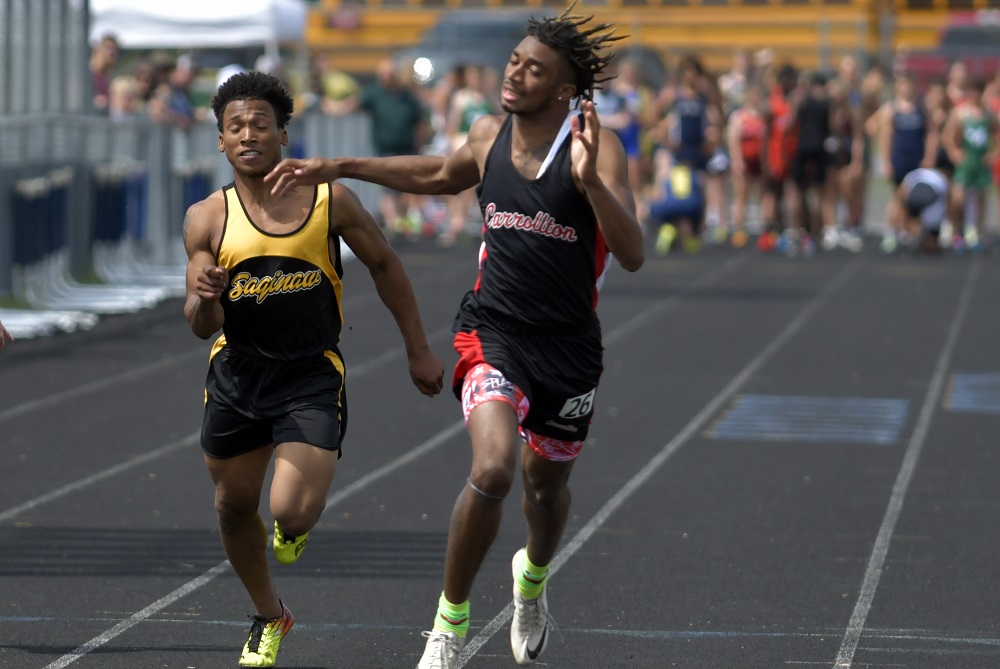
Derrick Voltz, Carrollton: A qualifier in the 100 as a freshman in 2019, he could cap his junior season as a two-event champion. He’s seeded first in the long jump (23-2) by nearly a foot with that leap only five inches off the meet record. He’s also the top seed in the 100 (11.11) just ahead of Bargesser.
Division 4 at Hudsonville
Top Regional scores: Lutheran Westland 171, Reading 170, Carson City-Crystal 147.
Team forecast: Kalamazoo Hackett Catholic Prep was the back-to-back champion before COVID, and Saugatuck was the Division 3 runner-up in 2019 but is back in Division 4. Saugatuck won’t run a relay this weekend but has favorites in the hurdles and distance events, and Breckenridge’s strengths in the sprints and relays should make it a team title contender as well as it seeks its first championship.
Coleman Clark, Carson City-Crystal: The lone returning champion in this division won the 3,200 as a sophomore in 2019 and will run that race along with the 800 and 1,600 and as part of the top-seeded 3,200 relay (8:19.40).
Benny Diaz, Saugatuck: The junior sprint/hurdles standout could make a run at four individual titles Saturday or next season. He’s the top seed in both hurdles races this time (15.01 in the 110 and 40.59 in the 300), and the fourth seed in the 200 and seventh in the 100. He was third in Division 3 in the 300 as a freshman.
Zane Forist, Carson City-Crystal: He was the runner-up in the discus and eighth in the shot put as a freshman two years ago, and he’s aiming for much more this time. His top-seed throws of 196-8 and 64-4, respectively, would both set LPD4 championship meet records – both by roughly six feet.
Nik Pettinga, Saugatuck: A top distance runner in cross country the last few seasons, he is looking to finish as a champion in his last high school meet and enters as the top seed in the 1,600 (4:26.99) and second seed (to junior teammate Max Sharnas) in the 3,200.
Charlie Steinhaus, Breckenridge: The speedy senior would help lead any charge for a team championship, entering as the top seed in the 100 (11.01) and second in the 200. He’ll also run on the top-seeded 400 relay (44.51) and second-seeded 800 relay.
PHOTO: Carrollton’s Derrick Voltz, right, breaks across the finish line during the 100-meter preliminaries at his Division 3 Regional at Shepherd last month. (Click for more from High School Sports Scene.)
Rep Council Wrap-up: Spring 2020
May 8, 2020
By Geoff Kimmerly
Second Half editor
The addition of seeding at the Regional level in ice hockey and adjustments to provide byes for top-seeded teams in basketball and soccer were among the most notable actions taken by the Representative Council of the Michigan High School Athletic Association during its annual Spring Meeting on May 4.
The Spring Meeting of the 19-member legislative body of the Association’s more than 1,500 member schools is generally the busiest of its three sessions each year. The Council considered 32 committee proposals and dealt with a variety of eligibility rule, postseason tournament and operational issues. As with the Council’s Winter Meeting in March, the Spring Meeting was conducted remotely to keep with social distancing required by the COVID-19 pandemic.
Beginning with the 2020-21 school year, ice hockey will employ a seeding process to place the top two teams in every Regional on opposite sides of that bracket, guaranteeing those two teams could not play each other before the Regional championship game. The two teams are to be seeded in each Regional using the Michigan Power Rating computer formula based on regular-season results against other MHSAA Tournament-eligible teams and opponents’ strength of schedule, the same system used in basketball and soccer and as one of multiple methods to seed in boys lacrosse. (Games against out-of-state or non-MHSAA opponents do not count in the MPR formula.) The MHSAA will draw all ice hockey brackets 15 days before the start of Regional play. The addition of hockey seeding was proposed by the MHSAA Hockey Committee.
The Council also adopted a change to seeding to take affect for hockey, basketball and soccer to provide any existing byes to the #1, and then #2 seed, in that order, if multiple byes are part of a bracket. The draw process then will continue to place the remaining teams on the bracket based on a randomly-selected order determined earlier in the season.
Similar rules changes in football and basketball approved by the Council and recommended by the MHSAA committees for those respective sports aim to create more opportunities, especially for programs struggling to field teams at multiple levels. In football, while an athlete may still play only four quarters in one day, that athlete may play in up to five quarters per week. In basketball, an athlete may compete in up to five quarters per day, during no more than three dates per week and 20 dates per team or individual. Both changes will allow athletes to contribute to both varsity and subvarsity teams simultaneously, potentially bolstering numbers and opportunities to retain those squads.
The Council also took action on a number of MHSAA Handbook regulations requiring adjustment because of the COVID-19 pandemic and disruption it has caused to Michigan high school athletics. Notably, the Council voted to waive the 2020-21 pre-participation physical exam requirement for athletes who received one during the 2019-20 school year, although they are still required to fill out and sign the MHSAA Annual Sports Health Questionnaire. The Council also authorized schools to make decisions on multiple summer matters, including an opportunity for athletic directors to request a waiver from the MHSAA to wear school competition uniforms during events that are school-sponsored and designed to recognize graduating 12th-graders. Additionally, the Council voted to give schools the opportunity to waive the annually-required week-long period of no summer activity, if they choose to do so.
Here is a summary of other notable actions taken by the Representative Council at the Spring Meeting, which will take effect during the 2020-21 school year unless noted. Additionally, three sport changes were approved by the Council during its Winter meeting in March and not yet publicized; those too are noted below.
Regulations
• The Council approved a change allowing teams in sports governed by MHSAA summer competition limits – basketball, football, ice hockey, lacrosse, soccer and girls volleyball – to participate against all opponents present at out-of-state summer events. MHSAA member schools must continue to abide by the MHSAA travel limit – traveling only to events that are hosted either in bordering states/provinces (Illinois, Indiana, Ohio, Ontario and Wisconsin) or within 300 miles one way. MHSAA member schools now may participate at those events against out-of-state teams that exceed the travel limit by traveling more than 300 miles to the event site.
Sport Matters
• In baseball, the Council approved a Baseball Committee recommendation to adopt a suspended-game policy stating that any game called before it reaches regulation, or when the score is tied, is suspended with play to pick up at a later time from that point. However, if both schools agree, a game called prior to regulation may be replayed in its entirety.
• Also in baseball, during its Winter meeting, the Council approved a Baseball Committee recommendation renaming the “Super Regional” level of the MHSAA Tournament as the “Quarterfinal” level – with trophies and medals to be presented to both Regional champions after the day’s Regional Finals are completed and before the day’s Quarterfinal matching up those two teams. The Council also adopted at the Winter meeting a tournament schedule that during even-numbered years will see Semifinals for Divisions 2 and 4 played on Thursday and Divisions 1 and 3 on Friday. The Semifinal schedule will flip during odd-numbered years.
• The Council approved a series of Girls Competitive Cheer Committee recommendations. High school athletes now are allowed to transition to stunts or loads from the flatback position. Also at the high school level, bases will be allowed to rotate or move while a flyer is in the inverted position (in a static inversion), and to provide for the allowance of additional flairs at the point of static inversion.
• Also in cheer, the Council approved a Committee recommendation requiring three safety judges (instead of two) and five panel judges at MHSAA Regional events.
• In football, the Council approved a Football Committee recommendation extending the running clock when a team leads its opponent by 50 points to both the first and second halves of a game; the 50-point running clock stops only for player injuries and previously was employed only during the second half. The 35-point running clock employed during the second half, with stoppages also for penalty enforcement, scoring plays and called timeouts, will remain in effect if the differential dips below 50 and until it reaches 50 points again.
• Also in football, the Council approved a Committee recommendation allowing schools 15 summer dates of non-mandatory contact with an unlimited number of players (wearing helmets only). Schools may use these dates as they see fit, but of these 15 only seven dates may be used for 7-on-7 competition against other teams. This also eliminates the previous allowance for a camp.
• The Council approved another change in hockey to improve safety, adopting a Hockey Committee recommendation requiring all members of a coaching staff to wear HECC-certified helmets while on the ice for practices or games.
• In alpine skiing, the Council approved a Ski Committee recommendation that will allow athletes who qualify for an MHSAA Final in one discipline (giant slalom or slalom) during Regional racing to compete in both disciplines at the Finals level.
• In soccer, the Council approved a recommendation from the Soccer Committee to allow girls soccer athletes to compete in scrimmages at a maximum of two college ID camps during the spring girls soccer season, when these ID events generally take place.
• A pair of changes were adopted for swimming & diving, one affecting each group of athletes. The Council approved a Swimming & Diving Committee recommendation allowing swimmers to wear caps reading “State Team” during both regular-season and postseason competition. For diving, the Council approved a Committee recommendation to designate the number of qualifiers from each Lower Peninsula Regional to be in proportion to the number of entries at those respective Regionals in each division. This will allow Regionals with larger numbers of participants to contribute more Finals qualifiers, while eliminating the possibility that a Regional could send all entrants to the Finals regardless of performance because only 12 participate at that site. Each division will continue to advance 36 divers total to the MHSAA Finals.
• In tennis, the Council approved a Tennis Committee recommendation to play the MHSAA Final two-day tournament on Friday and Saturday unless there is a conflict with the host facility. In that case, that specific Final would be scheduled for Thursday and Friday.
• During its Winter meeting, the Council approved a Classification Committee recommendation that adds girls and boys tennis to the group of sports that schools may play as cooperative programs – with Executive Committee approval – if their combined enrollments do not exceed 3,500 students. The Council will reexamine this allowance after its first two years.
Junior High/Middle Schools
• The Council approved a Junior High/Middle School Committee recommendation to conduct MHSAA-sponsored cross country Regional meets for junior high/middle school athletes at eight sites across the state, based on “zones” currently designated by the MHSAA. These Regional meets will begin with the 2021-22 school year.
• The Council also approved a Girls Competitive Cheer Committee recommendation to allow junior high/middle school teams to participate in three competitions per week (instead of two) as long as one of the three is conducted on a non-school day or a day not followed by school.
Officials
• The Council approved a series of recommendations from the Officials Review Committee. Of particular note, coaches and athletes ejected from competition now are required to complete an online sportsmanship course from the National Federation of State High School Associations (NFHS) before returning to competition.
The Council also discussed various other topics, including possibilities for presentation during this fall’s Update Meeting statewide tour, and took action to clarify Handbook language regarding a few eligibility scenarios. The Association’s $11.5 million budget for the 2020-21 school year also was approved.
The Representative Council is the 19-member legislative body of the MHSAA. All but five are elected by member schools. Four members are appointed by the Council to facilitate representation of females and minorities, and the 19th position is occupied by the Superintendent of Public Instruction or designee.
The MHSAA is a private, not-for-profit corporation of voluntary membership by more than 1,500 public and private senior high schools and junior high/middle schools which exists to develop common rules for athletic eligibility and competition. No government funds or tax dollars support the MHSAA, which was the first such association nationally to not accept membership dues or tournament entry fees from schools. Member schools which enforce these rules are permitted to participate in MHSAA tournaments, which attract more than 1.4 million spectators each year.