

Preview: Classic Clashes and Broken Records Expected
By
Geoff Kimmerly
MHSAA.com senior editor
June 5, 2021
The attention that will be paid to one of the Lower Peninsula Boys Track & Field Finals on Saturday will go past usual interest in just a local school or single division.
Many eyes will be turned to the Division 1 meet, featuring among many Ann Arbor Skyline senior Hobbs Kessler, who has made national news over the last few weeks by setting the national high school record in the 1,500 (3:34.36) and qualifying for the Olympic Trials in the event.
But he’ll be facing some familiar competition in his distance races at East Kentwood – including Hartland junior Riley Hough, who edged Kessler by two seconds in the Division 1 cross country final this past fall.
Their matchup is just one of many stories worth tuning in for this weekend. Events at all four sites begin at 10 a.m. (EDT) and tickets to attend can be purchased online only at GoFan. The meets also will be broadcast on MHSAA.tv and viewable with subscription. Click to watch each division: LPD1 | LPD2 | LPD3 | LPD4.
Below is a glance at team contenders and individuals to watch in all four divisions.
Division 1 at East Kentwood
Top Regional scores: Macomb Dakota 160, Traverse City West 145½, Northville 136, Novi 136.
Team forecast: East Kentwood won the last three championships before COVID, with Ann Arbor Pioneer finishing runner-up in both 2018 and 2019. Dakota is an interesting possibility this time with qualifiers throughout the meet. Fenton has top-three seeds in six events, and Zeeland West is another team with scoring opportunities in a variety of events.
Trey Gardette, Ann Arbor Huron: The senior sprint star has taken amazing strides over the last two years and may be on the verge of an unforgettable finish to his high school career. Gardette’s top-seed 10.5 in the 100 is a blink faster than the LPD1 Finals record of 10.53, and he’s second-seeded in the 200 and also will run on the 400 relay.
Riley Hough, Hartland: The I-96 corridor has been the center of distance running this school year, and Hough hopes to follow his Division 1 cross country championship in the fall with titles in the 1,600 and 3,200. He’s seeded first in the former with a 4:13.93.
Hobbs Kessler, Ann Arbor Skyline: He’s slated to run the 800, 1,600 and 3,200 and on the top-seeded 3,200 relay (7:53.30) Saturday. He won all three of those open races at his Regional, and so while he isn’t top-seeded in any that likely means little as he could drop major time.
Tamaal Myers II, Detroit Cass Tech: The Technicians standout junior has the top 110 hurdles seed time (14.06) by nearly a second and is tied for the top seed time in the 300 (39.32). He’ll also run the 400 and on the 1,600 relay.
Brandon Miller, Fenton: He finished fifth in the 200 as a sophomore in 2019, but he can take a massive leap Saturday as his top seed time in that race (21.25) is five hundredths of a second off the meet record. He’s also the second seed in the 100 with a seed time of 10.60 that is seven hundredths of a second off that meet record. And he’ll also run on contending 400 and 800 relays.
Division 2 at Zeeland
Top Regional scores: Orchard Lake St. Mary’s 216½, Dearborn Divine Child 186, Frankenmuth 164.
Team forecast: Four teams have won this championship over the last four seasons. Flint Powers Catholic is a possibility to make it five as it runs for its first team title led by sprint standouts and relays. Frankenmuth with top qualifiers in the sprints, relays and field events is another to watch in what lines up to be a low-scoring team race. A total of 10 schools won championships in this division over the previous 11 seasons before 2020 was canceled.
Ryan Brenner, Frankenmuth: The senior Eagles hurdler is the top seed in the 300 with a time of 40.1 and also will run on the top-seeded 1,600 relay (3:28.44) and high jump.
Jamal Hailey, Berrien Springs: The standout junior sprinter has the top seed time in the 100 (11.04) and the third-fastest in the 200, and he’ll also run on the second-seeded 400 relay.
Austin Hamlin, Flint Powers Catholic: The Chargers sophomore would play a major role in any team title pursuit, entering with the top seed in the 200 (22.5), third-fastest in the 100 and as part of the top-seeded 400 relay (43.3) and fourth-seeded 800 relay. That 400 relay time is a second off the meet record.
Alex Mansfield, Monroe Jefferson: The junior thrower is another who has made a major move over the last two years. He enters Saturday with the top seed in the shot put (56-3) by two feet and the top seed in the discus (163-11) by nearly 10.
Luke Stowasser, Edwardsburg: The junior Eddies jumper also is top-seeded in both of his events, with a 22-6½ in the long jump and 6-10 in the high jump. That high jump is six inches better than the field and two off the meet record. He was the high jump runner-up as a freshman.
Division 3 at Jenison
Top Regional scores: Grass Lake 132, Caro 129, Pewamo-Westphalia 126 1/3.
Team forecast: Grass Lake will be pursuing its first team title since 1970 and has six top-four seeds leading the way. Figuring the next few contenders is difficult with points looking to be spread among a number of teams.
Brennan Bargesser, Grass Lake: A drive for the team championship would include significant points from Bargesser, who is seeded first in the 200 (21.98) and 400 (49.34) and second in the 100 for his final high school meet. He’ll also run on the top-seeded 400 relay (44.14) – that seed time is one second off the meet record.
Hunter Jones, Benzie Central: The sophomore standout has two Division 3 cross country championships to his credit and will make his Track Finals debut as the top seed in the 3,200 (9:37.42) and a likely contender in the 1,600 and 800 as well.
Josh Jones, Harrison: He’ll close his high school career running the 800, 1,600 and 3,200, with his 1,600 seed time (4:19.84) topping that event list.
Brenden Quackenbush, Chesaning: He’s set to establish himself in both throws at this level Saturday, with the top seed in the discus (143-0) by nearly two feet and the third seed in the shot put.
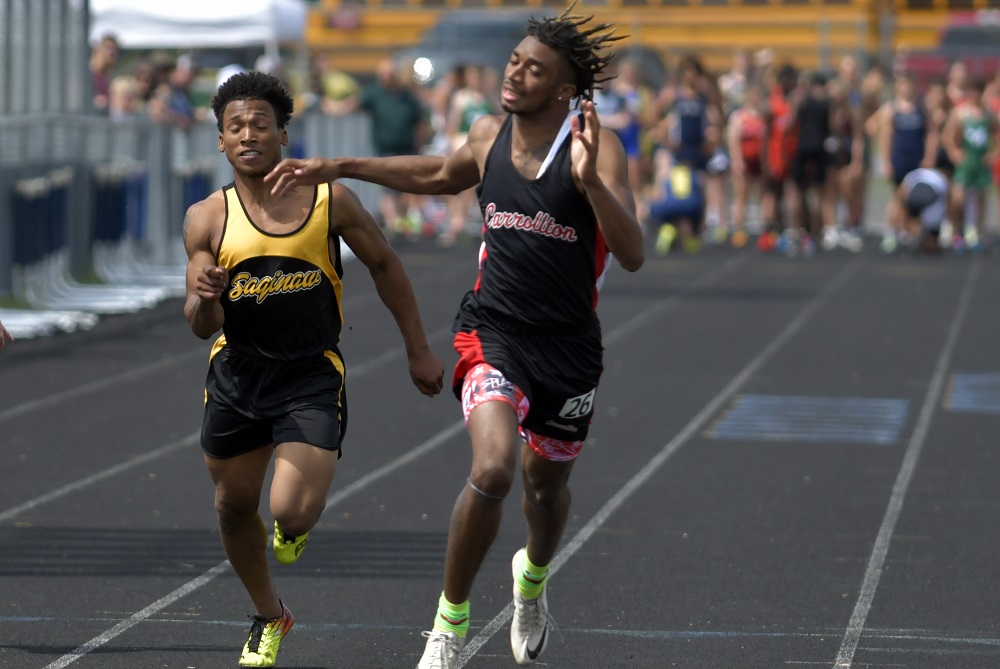
Derrick Voltz, Carrollton: A qualifier in the 100 as a freshman in 2019, he could cap his junior season as a two-event champion. He’s seeded first in the long jump (23-2) by nearly a foot with that leap only five inches off the meet record. He’s also the top seed in the 100 (11.11) just ahead of Bargesser.
Division 4 at Hudsonville
Top Regional scores: Lutheran Westland 171, Reading 170, Carson City-Crystal 147.
Team forecast: Kalamazoo Hackett Catholic Prep was the back-to-back champion before COVID, and Saugatuck was the Division 3 runner-up in 2019 but is back in Division 4. Saugatuck won’t run a relay this weekend but has favorites in the hurdles and distance events, and Breckenridge’s strengths in the sprints and relays should make it a team title contender as well as it seeks its first championship.
Coleman Clark, Carson City-Crystal: The lone returning champion in this division won the 3,200 as a sophomore in 2019 and will run that race along with the 800 and 1,600 and as part of the top-seeded 3,200 relay (8:19.40).
Benny Diaz, Saugatuck: The junior sprint/hurdles standout could make a run at four individual titles Saturday or next season. He’s the top seed in both hurdles races this time (15.01 in the 110 and 40.59 in the 300), and the fourth seed in the 200 and seventh in the 100. He was third in Division 3 in the 300 as a freshman.
Zane Forist, Carson City-Crystal: He was the runner-up in the discus and eighth in the shot put as a freshman two years ago, and he’s aiming for much more this time. His top-seed throws of 196-8 and 64-4, respectively, would both set LPD4 championship meet records – both by roughly six feet.
Nik Pettinga, Saugatuck: A top distance runner in cross country the last few seasons, he is looking to finish as a champion in his last high school meet and enters as the top seed in the 1,600 (4:26.99) and second seed (to junior teammate Max Sharnas) in the 3,200.
Charlie Steinhaus, Breckenridge: The speedy senior would help lead any charge for a team championship, entering as the top seed in the 100 (11.01) and second in the 200. He’ll also run on the top-seeded 400 relay (44.51) and second-seeded 800 relay.
PHOTO: Carrollton’s Derrick Voltz, right, breaks across the finish line during the 100-meter preliminaries at his Division 3 Regional at Shepherd last month. (Click for more from High School Sports Scene.)
Speakers Bureau Helps Generate Conversation
December 30, 2019
By Rob Kaminski
MHSAA benchmarks editor
As student mental health climbs the list of health and safety concerns, the MHSAA and state associations across the country are taking measures to provide resources and guidance aimed to keep school sports an enjoyable and valuable experience.
In sports, coaches and athletes learn to expect the unexpected. It’s the nature of competition; constructing gameplans tailored to utilize team strengths and expose opponents’ weaknesses. Often times this entails doing things that opponents won’t expect. Participants then learn and prepare for the next time; it’s one of the ways athletics prepares participants for life, as educational leaders often preach.
Today’s ever-changing culture recently threw such a curveball at the young people who populate our hallways and playing surfaces, calling for statewide associations and organizations to shift focuses and prepare for a new opponent while attempting to keep school sports one of the best means to a healthy adolescent lifestyle.
“I was at the NCAA summer meeting in 2017, discussing health and safety issues and the topic of concussions came up, as it often does. I assumed that concussions was the No. 1 health and safety issue,” said MHSAA Executive Director Mark Uyl. “I was quickly corrected that it’s student mental health; that knocked me back.”
It would not be an uncommon reaction, given the amount of information, media coverage and programs designed to recognize and reduce concussion incidents in recent years.
All the while, anxiety, depression and stress had been creeping into the picture beneath the surface. Such disorders are much more difficult to detect, as there are few visible symptoms when compared to sprains, fatigue, head injuries and other physical ailments.
“I became interested and began to research the topic. The more I read, the more concerned I became,” Uyl said. “The MHSAA, with a great deal of help and cooperation from our school leaders, has done a tremendous job educating and providing resources for health-related issues such as heat management, concussion reporting and practice policies, and now we have a new challenge.”
Fortunately, as has often been the case, there are knowledgeable and qualified people throughout Michigan’s roster of educational leaders who are willing to assist.
As word spread regarding the student mental health initiative, the MHSAA was able to establish a Mental Health Speakers Bureau composed of several experienced individuals willing to assist (see below).
“Our speakers bureau really grew by word of mouth,” Uyl said. “A school would bring in a speaker, or a league would invite a speaker, and once we were connected with them, then those people would share names and it grew from there.”
The resources range from former professional athletes, to behavioral specialists, to current MHSAA coaches.
Dave Ingles, basketball coach at Kent City, is one such individual. His credibility comes from first-hand experience.
“I privately struggled with deep depression for six years,” Ingles said. “Be alert. Talk to your athletes and students and actually listen to what they are saying. I always used the phrase, ‘I’m fine;’ that is not an acceptable answer to me anymore when I hear it.”
The National Institute of Mental Health reveals that most mental health conditions begin around the time children are transitioning from middle school to high school. The more people trained to identify symptoms and behavior, the better the chance to reduce or reverse some of the following numbers:
• 50% of all lifetime cases of mental illness begin by age 14
• 37% of students with a mental health condition age 14 or older drop out of school
• 20% of students ages 13-18 live with a mental health condition
• 11% of youth have a mood disorder and 8% have an anxiety disorder
• Suicide is the third leading cause of death for ages 10-24
Non-visible ailments always have been most difficult to detect, and today’s proliferation of technology – from streaming to social media – can serve to further mask symptoms.
“The more kids spend time with their devices, staring at their screens, isolation can be quick to take hold,” Uyl said. “Everything is instant. It used to be if our friends didn’t invite us somewhere, we didn’t worry about it; we probably wouldn’t find out for a couple days and had already moved on. Today, in about 10 minutes, there’s a picture on Instagram or Snapchat and kids instantly know, ‘I’m not included.’ Isolation leads to depression and anxiety, and in the worst cases can even lead to suicide.”
That message might sound familiar. Segments of the 2019-20 MHSAA online rules meetings include Uyl emphasizing student mental health and a video clip produced by benice.org promoting a mental health action plan endorsed by four of the state’s most recognized collegiate coaches.
It’s all part of the plan to promote awareness and generate conversation surrounding this serious health and safety issue during 2019-20 and beyond.
“We’re not going to try to do this all by ourselves,” Uyl said. “There are plenty of experts in the field, and we’re going to utilize their knowledge. We’ll build relationships and align ourselves with these people to provide a foundation. We need to become a resource center for our membership.”
In addition to the rules meetings messages, the MHSAA also partnered with the Michigan Association of Secondary School Principals Student Mental Health Summit on Oct. 8 in Lansing. This event – sold out within weeks of posting – invited principals, counselors, student leadership advisers and student leaders to come together to discuss and seek solutions for student mental health concerns impacting schools. The MHSAA lined up Eric Hipple, one of its speaker bureau members, who delivered a keynote, “Depression and Suicidal Awareness.”
Student mental health was among topics during the MHSAA Update and AD In-Service tour around the state this fall as well. The meeting at Comstock Park on Sept. 30 included a presentation from the Mental Health Foundation of West Michigan to introduce the be nice® action plan and encourage schools to take advantage of that and other resources the group has to offer.
The rise of mental health as one of the more prominent medical concerns nationally has occurred, as Ingles sees it, “because more people are talking about it now.”
Leaders like Ingles and those in numerous organizations have begun to assist the MHSAA in identifying and treating cases in our schools.
MHSAA Mental Health Speakers Bureau
Below is a list of individuals and organizations partnering with the MHSAA to assist in promoting mental well-being for students around the state. The MHSAA encourages school personnel to reach out to any of these experienced leaders in the field for programming in your buildings and districts.
• Christy Buck, Executive Director – Mental Health Foundation of West Michigan - be nice.® [email protected]
• Brooke Buys, Mental & Behavioral Health Specialist – BLND Health [email protected]
• Eric Hipple, former Detroit Lions quarterback [email protected]
• Dave Ingles, Basketball Coach & Speaker – Kent City High School [email protected]
• Cat Lanting, Program Coordinator – Mental Health Foundation of West Michigan - be nice.® [email protected]
• Halle Wangler, former University of Michigan basketball player [email protected]
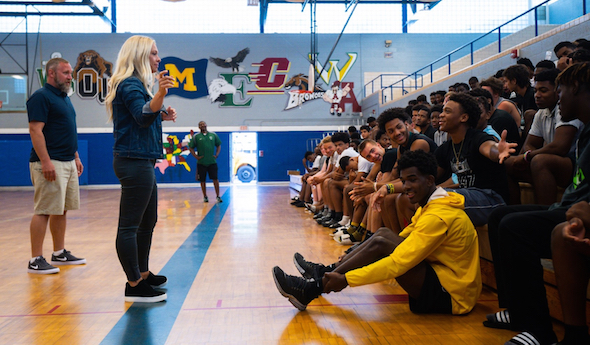
PHOTO: Brooke Buys, a mental and behavioral health specialist and founder of BLND Health, speaks with students. (Photo courtesy of BLND Health.)