

Preview: Classic Clashes and Broken Records Expected
By
Geoff Kimmerly
MHSAA.com senior editor
June 5, 2021
The attention that will be paid to one of the Lower Peninsula Boys Track & Field Finals on Saturday will go past usual interest in just a local school or single division.
Many eyes will be turned to the Division 1 meet, featuring among many Ann Arbor Skyline senior Hobbs Kessler, who has made national news over the last few weeks by setting the national high school record in the 1,500 (3:34.36) and qualifying for the Olympic Trials in the event.
But he’ll be facing some familiar competition in his distance races at East Kentwood – including Hartland junior Riley Hough, who edged Kessler by two seconds in the Division 1 cross country final this past fall.
Their matchup is just one of many stories worth tuning in for this weekend. Events at all four sites begin at 10 a.m. (EDT) and tickets to attend can be purchased online only at GoFan. The meets also will be broadcast on MHSAA.tv and viewable with subscription. Click to watch each division: LPD1 | LPD2 | LPD3 | LPD4.
Below is a glance at team contenders and individuals to watch in all four divisions.
Division 1 at East Kentwood
Top Regional scores: Macomb Dakota 160, Traverse City West 145½, Northville 136, Novi 136.
Team forecast: East Kentwood won the last three championships before COVID, with Ann Arbor Pioneer finishing runner-up in both 2018 and 2019. Dakota is an interesting possibility this time with qualifiers throughout the meet. Fenton has top-three seeds in six events, and Zeeland West is another team with scoring opportunities in a variety of events.
Trey Gardette, Ann Arbor Huron: The senior sprint star has taken amazing strides over the last two years and may be on the verge of an unforgettable finish to his high school career. Gardette’s top-seed 10.5 in the 100 is a blink faster than the LPD1 Finals record of 10.53, and he’s second-seeded in the 200 and also will run on the 400 relay.
Riley Hough, Hartland: The I-96 corridor has been the center of distance running this school year, and Hough hopes to follow his Division 1 cross country championship in the fall with titles in the 1,600 and 3,200. He’s seeded first in the former with a 4:13.93.
Hobbs Kessler, Ann Arbor Skyline: He’s slated to run the 800, 1,600 and 3,200 and on the top-seeded 3,200 relay (7:53.30) Saturday. He won all three of those open races at his Regional, and so while he isn’t top-seeded in any that likely means little as he could drop major time.
Tamaal Myers II, Detroit Cass Tech: The Technicians standout junior has the top 110 hurdles seed time (14.06) by nearly a second and is tied for the top seed time in the 300 (39.32). He’ll also run the 400 and on the 1,600 relay.
Brandon Miller, Fenton: He finished fifth in the 200 as a sophomore in 2019, but he can take a massive leap Saturday as his top seed time in that race (21.25) is five hundredths of a second off the meet record. He’s also the second seed in the 100 with a seed time of 10.60 that is seven hundredths of a second off that meet record. And he’ll also run on contending 400 and 800 relays.
Division 2 at Zeeland
Top Regional scores: Orchard Lake St. Mary’s 216½, Dearborn Divine Child 186, Frankenmuth 164.
Team forecast: Four teams have won this championship over the last four seasons. Flint Powers Catholic is a possibility to make it five as it runs for its first team title led by sprint standouts and relays. Frankenmuth with top qualifiers in the sprints, relays and field events is another to watch in what lines up to be a low-scoring team race. A total of 10 schools won championships in this division over the previous 11 seasons before 2020 was canceled.
Ryan Brenner, Frankenmuth: The senior Eagles hurdler is the top seed in the 300 with a time of 40.1 and also will run on the top-seeded 1,600 relay (3:28.44) and high jump.
Jamal Hailey, Berrien Springs: The standout junior sprinter has the top seed time in the 100 (11.04) and the third-fastest in the 200, and he’ll also run on the second-seeded 400 relay.
Austin Hamlin, Flint Powers Catholic: The Chargers sophomore would play a major role in any team title pursuit, entering with the top seed in the 200 (22.5), third-fastest in the 100 and as part of the top-seeded 400 relay (43.3) and fourth-seeded 800 relay. That 400 relay time is a second off the meet record.
Alex Mansfield, Monroe Jefferson: The junior thrower is another who has made a major move over the last two years. He enters Saturday with the top seed in the shot put (56-3) by two feet and the top seed in the discus (163-11) by nearly 10.
Luke Stowasser, Edwardsburg: The junior Eddies jumper also is top-seeded in both of his events, with a 22-6½ in the long jump and 6-10 in the high jump. That high jump is six inches better than the field and two off the meet record. He was the high jump runner-up as a freshman.
Division 3 at Jenison
Top Regional scores: Grass Lake 132, Caro 129, Pewamo-Westphalia 126 1/3.
Team forecast: Grass Lake will be pursuing its first team title since 1970 and has six top-four seeds leading the way. Figuring the next few contenders is difficult with points looking to be spread among a number of teams.
Brennan Bargesser, Grass Lake: A drive for the team championship would include significant points from Bargesser, who is seeded first in the 200 (21.98) and 400 (49.34) and second in the 100 for his final high school meet. He’ll also run on the top-seeded 400 relay (44.14) – that seed time is one second off the meet record.
Hunter Jones, Benzie Central: The sophomore standout has two Division 3 cross country championships to his credit and will make his Track Finals debut as the top seed in the 3,200 (9:37.42) and a likely contender in the 1,600 and 800 as well.
Josh Jones, Harrison: He’ll close his high school career running the 800, 1,600 and 3,200, with his 1,600 seed time (4:19.84) topping that event list.
Brenden Quackenbush, Chesaning: He’s set to establish himself in both throws at this level Saturday, with the top seed in the discus (143-0) by nearly two feet and the third seed in the shot put.
Derrick Voltz, Carrollton: A qualifier in the 100 as a freshman in 2019, he could cap his junior season as a two-event champion. He’s seeded first in the long jump (23-2) by nearly a foot with that leap only five inches off the meet record. He’s also the top seed in the 100 (11.11) just ahead of Bargesser.
Division 4 at Hudsonville
Top Regional scores: Lutheran Westland 171, Reading 170, Carson City-Crystal 147.
Team forecast: Kalamazoo Hackett Catholic Prep was the back-to-back champion before COVID, and Saugatuck was the Division 3 runner-up in 2019 but is back in Division 4. Saugatuck won’t run a relay this weekend but has favorites in the hurdles and distance events, and Breckenridge’s strengths in the sprints and relays should make it a team title contender as well as it seeks its first championship.
Coleman Clark, Carson City-Crystal: The lone returning champion in this division won the 3,200 as a sophomore in 2019 and will run that race along with the 800 and 1,600 and as part of the top-seeded 3,200 relay (8:19.40).
Benny Diaz, Saugatuck: The junior sprint/hurdles standout could make a run at four individual titles Saturday or next season. He’s the top seed in both hurdles races this time (15.01 in the 110 and 40.59 in the 300), and the fourth seed in the 200 and seventh in the 100. He was third in Division 3 in the 300 as a freshman.
Zane Forist, Carson City-Crystal: He was the runner-up in the discus and eighth in the shot put as a freshman two years ago, and he’s aiming for much more this time. His top-seed throws of 196-8 and 64-4, respectively, would both set LPD4 championship meet records – both by roughly six feet.
Nik Pettinga, Saugatuck: A top distance runner in cross country the last few seasons, he is looking to finish as a champion in his last high school meet and enters as the top seed in the 1,600 (4:26.99) and second seed (to junior teammate Max Sharnas) in the 3,200.
Charlie Steinhaus, Breckenridge: The speedy senior would help lead any charge for a team championship, entering as the top seed in the 100 (11.01) and second in the 200. He’ll also run on the top-seeded 400 relay (44.51) and second-seeded 800 relay.
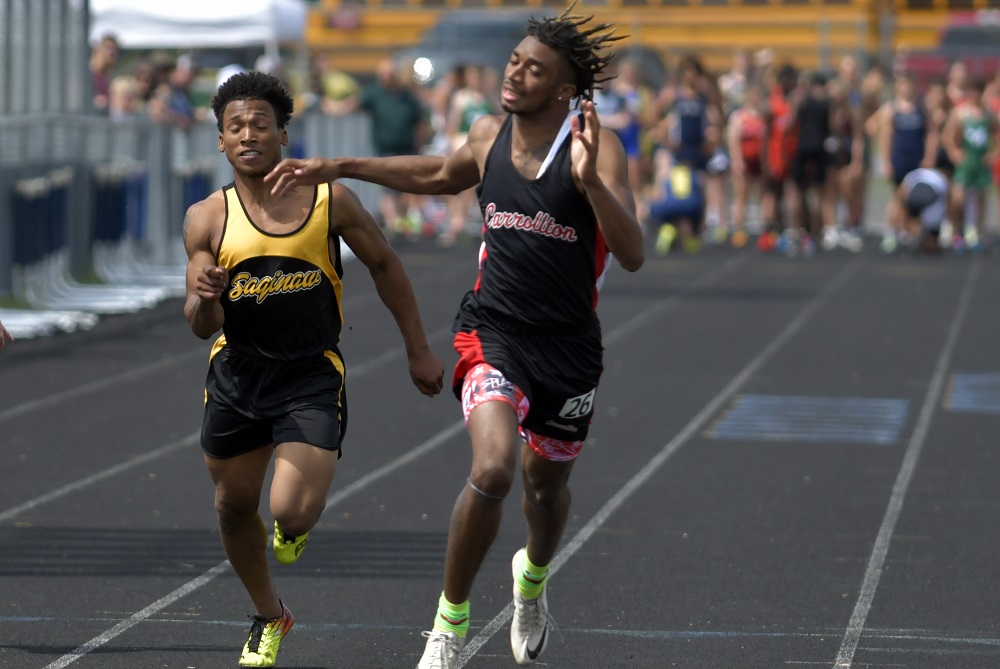
PHOTO: Carrollton’s Derrick Voltz, right, breaks across the finish line during the 100-meter preliminaries at his Division 3 Regional at Shepherd last month. (Click for more from High School Sports Scene.)

NFHS Voice: No HS Football Link to CTE
October 21, 2019
By Karissa Niehoff
NFHS Executive Director
When it comes to the long-term effects of concussions in sports, there is a wide range of information published – almost on a daily basis. Unfortunately, much of the media coverage as it relates to high school sports – and particularly the sport of football – is misleading.
Last week, the Concussion Legacy Foundation introduced its new public-service announcement that compared youth football dangers to smoking. As the pre-teen football players puff on cigarettes, the voiceover says, “Tackle football is like smoking, the younger I start, the longer I’m exposed to danger.”
The “Tackle Can Wait” campaign by the foundation is an attempt to steer children under the age of 14 into flag football. Although establishing a finite age may be difficult, reducing contact at youth levels is certainly a positive. USA Football is doing just that nationally through its Football Development Model. Likewise, the 51 member state associations of the National Federation of State High School Associations (NFHS) have enacted limitations on contact during preseason and practice sessions.
Our concern is the term “exposed to danger.” These types of messages continue to spread unwarranted fear to parents of high school student-athletes. The “danger” refers to reports that players who incur repeated concussions can develop chronic traumatic encephalopathy (CTE).
A 2017 study from the Journal of American Medical Association (JAMA) linked CTE in the brains of deceased National Football League players. Even if this report is accurate, these are individuals who endured repeated blows to the head for 20 to 25 years BEFORE any concussion protocols were in place.
Less publicized is a study by Dr. Munro Cullum and his colleagues at the Peter O’Donnell Jr. Brain Institute, which is a part of the University of Texas Southwestern Medical Center in Dallas. Cullum’s group studied 35 former NFL players age 50 and older who had sustained multiple concussions throughout their careers. The findings showed no significant association between the length of the individuals’ careers, the number of concussions and their cognitive function later in life.
Two studies, two different conclusions. Regardless of the outcome, however, they are not applicable to kids playing football before and during high school. There is absolutely no linkage to CTE at these levels, and the word “danger” should not be a part of the discussion.
A more applicable and significant study was also published in JAMA in 2017. In a study of about 4,000 men who graduated from Wisconsin high schools in 1957, there was no difference in cognitive function or decline between those who played football and those who did not as they reached 65 years of age. We would assume the majority of these individuals discontinued football after high school.
With more than one million boys – and girls – playing the contact sport of football each year, severe injuries do occur from time to time, but parents should know that efforts to lessen the risk of a catastrophic injury, including head injuries, have never been stronger than they are today.
In fact, new data from the National High School Sports-Related Injury Surveillance Study indicates some positive trends in concussion rates. The study, which was released in the American Academy of Pediatrics online issue of Pediatrics last week, indicated that concussion rates during football practices dropped from 5.47 to 4.44 concussions per 10,000 athletic exposures between the 2013-14 and 2017-18 seasons.
In addition, repeat concussion rates across all sports declined from 0.47 to 0.28 per 10,000 exposures during the same time period.
Concussion laws are in place in every state. All NFHS sports rules books have concussion management protocols. Helmet-to-helmet hits are not allowed in football. Limits on contact in preseason and practice in football are in place in every state.
After considering all the available research, we encourage parents to let their kids play their sport of choice in high school, but we would discourage moving away from football – or any contact sport – solely based on the fear of developing CTE later in life.
Dr. Karissa L. Niehoff is in her second year as executive director of the National Federation of State High School Associations (NFHS) in Indianapolis, Indiana. She is the first female to head the national leadership organization for high school athletics and performing arts activities and the sixth full-time executive director of the NFHS, which celebrated its 100th year of service during the 2018-19 school year. She previously was executive director of the Connecticut Association of Schools-Connecticut Interscholastic Athletic Conference for seven years.