

Preview: Classic Clashes and Broken Records Expected
By
Geoff Kimmerly
MHSAA.com senior editor
June 5, 2021
The attention that will be paid to one of the Lower Peninsula Boys Track & Field Finals on Saturday will go past usual interest in just a local school or single division.
Many eyes will be turned to the Division 1 meet, featuring among many Ann Arbor Skyline senior Hobbs Kessler, who has made national news over the last few weeks by setting the national high school record in the 1,500 (3:34.36) and qualifying for the Olympic Trials in the event.
But he’ll be facing some familiar competition in his distance races at East Kentwood – including Hartland junior Riley Hough, who edged Kessler by two seconds in the Division 1 cross country final this past fall.
Their matchup is just one of many stories worth tuning in for this weekend. Events at all four sites begin at 10 a.m. (EDT) and tickets to attend can be purchased online only at GoFan. The meets also will be broadcast on MHSAA.tv and viewable with subscription. Click to watch each division: LPD1 | LPD2 | LPD3 | LPD4.
Below is a glance at team contenders and individuals to watch in all four divisions.
Division 1 at East Kentwood
Top Regional scores: Macomb Dakota 160, Traverse City West 145½, Northville 136, Novi 136.
Team forecast: East Kentwood won the last three championships before COVID, with Ann Arbor Pioneer finishing runner-up in both 2018 and 2019. Dakota is an interesting possibility this time with qualifiers throughout the meet. Fenton has top-three seeds in six events, and Zeeland West is another team with scoring opportunities in a variety of events.
Trey Gardette, Ann Arbor Huron: The senior sprint star has taken amazing strides over the last two years and may be on the verge of an unforgettable finish to his high school career. Gardette’s top-seed 10.5 in the 100 is a blink faster than the LPD1 Finals record of 10.53, and he’s second-seeded in the 200 and also will run on the 400 relay.
Riley Hough, Hartland: The I-96 corridor has been the center of distance running this school year, and Hough hopes to follow his Division 1 cross country championship in the fall with titles in the 1,600 and 3,200. He’s seeded first in the former with a 4:13.93.
Hobbs Kessler, Ann Arbor Skyline: He’s slated to run the 800, 1,600 and 3,200 and on the top-seeded 3,200 relay (7:53.30) Saturday. He won all three of those open races at his Regional, and so while he isn’t top-seeded in any that likely means little as he could drop major time.
Tamaal Myers II, Detroit Cass Tech: The Technicians standout junior has the top 110 hurdles seed time (14.06) by nearly a second and is tied for the top seed time in the 300 (39.32). He’ll also run the 400 and on the 1,600 relay.
Brandon Miller, Fenton: He finished fifth in the 200 as a sophomore in 2019, but he can take a massive leap Saturday as his top seed time in that race (21.25) is five hundredths of a second off the meet record. He’s also the second seed in the 100 with a seed time of 10.60 that is seven hundredths of a second off that meet record. And he’ll also run on contending 400 and 800 relays.
Division 2 at Zeeland
Top Regional scores: Orchard Lake St. Mary’s 216½, Dearborn Divine Child 186, Frankenmuth 164.
Team forecast: Four teams have won this championship over the last four seasons. Flint Powers Catholic is a possibility to make it five as it runs for its first team title led by sprint standouts and relays. Frankenmuth with top qualifiers in the sprints, relays and field events is another to watch in what lines up to be a low-scoring team race. A total of 10 schools won championships in this division over the previous 11 seasons before 2020 was canceled.
Ryan Brenner, Frankenmuth: The senior Eagles hurdler is the top seed in the 300 with a time of 40.1 and also will run on the top-seeded 1,600 relay (3:28.44) and high jump.
Jamal Hailey, Berrien Springs: The standout junior sprinter has the top seed time in the 100 (11.04) and the third-fastest in the 200, and he’ll also run on the second-seeded 400 relay.
Austin Hamlin, Flint Powers Catholic: The Chargers sophomore would play a major role in any team title pursuit, entering with the top seed in the 200 (22.5), third-fastest in the 100 and as part of the top-seeded 400 relay (43.3) and fourth-seeded 800 relay. That 400 relay time is a second off the meet record.
Alex Mansfield, Monroe Jefferson: The junior thrower is another who has made a major move over the last two years. He enters Saturday with the top seed in the shot put (56-3) by two feet and the top seed in the discus (163-11) by nearly 10.
Luke Stowasser, Edwardsburg: The junior Eddies jumper also is top-seeded in both of his events, with a 22-6½ in the long jump and 6-10 in the high jump. That high jump is six inches better than the field and two off the meet record. He was the high jump runner-up as a freshman.
Division 3 at Jenison
Top Regional scores: Grass Lake 132, Caro 129, Pewamo-Westphalia 126 1/3.
Team forecast: Grass Lake will be pursuing its first team title since 1970 and has six top-four seeds leading the way. Figuring the next few contenders is difficult with points looking to be spread among a number of teams.
Brennan Bargesser, Grass Lake: A drive for the team championship would include significant points from Bargesser, who is seeded first in the 200 (21.98) and 400 (49.34) and second in the 100 for his final high school meet. He’ll also run on the top-seeded 400 relay (44.14) – that seed time is one second off the meet record.
Hunter Jones, Benzie Central: The sophomore standout has two Division 3 cross country championships to his credit and will make his Track Finals debut as the top seed in the 3,200 (9:37.42) and a likely contender in the 1,600 and 800 as well.
Josh Jones, Harrison: He’ll close his high school career running the 800, 1,600 and 3,200, with his 1,600 seed time (4:19.84) topping that event list.
Brenden Quackenbush, Chesaning: He’s set to establish himself in both throws at this level Saturday, with the top seed in the discus (143-0) by nearly two feet and the third seed in the shot put.
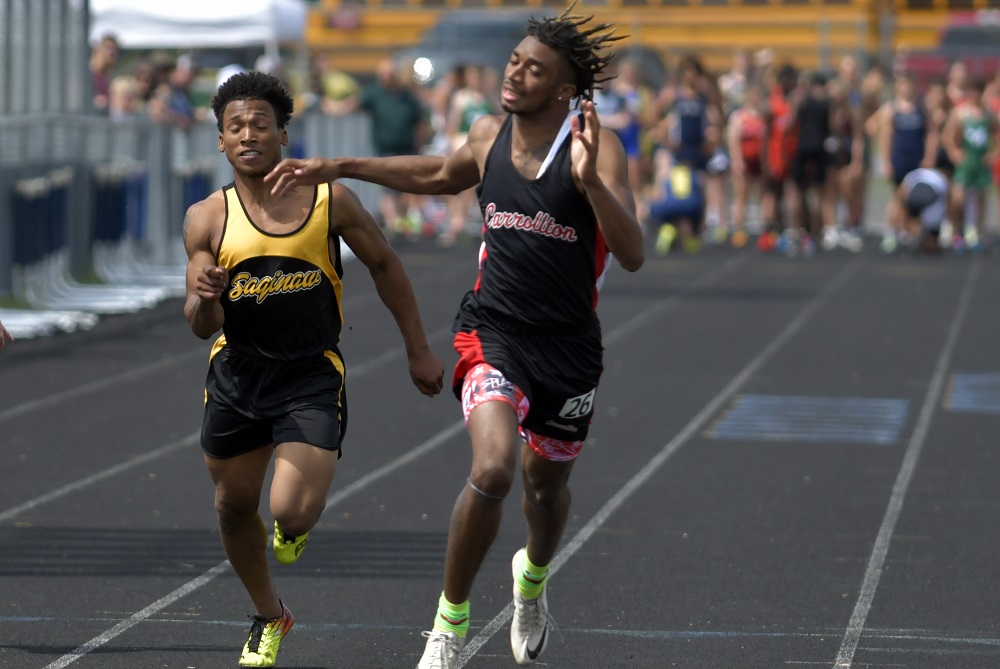
Derrick Voltz, Carrollton: A qualifier in the 100 as a freshman in 2019, he could cap his junior season as a two-event champion. He’s seeded first in the long jump (23-2) by nearly a foot with that leap only five inches off the meet record. He’s also the top seed in the 100 (11.11) just ahead of Bargesser.
Division 4 at Hudsonville
Top Regional scores: Lutheran Westland 171, Reading 170, Carson City-Crystal 147.
Team forecast: Kalamazoo Hackett Catholic Prep was the back-to-back champion before COVID, and Saugatuck was the Division 3 runner-up in 2019 but is back in Division 4. Saugatuck won’t run a relay this weekend but has favorites in the hurdles and distance events, and Breckenridge’s strengths in the sprints and relays should make it a team title contender as well as it seeks its first championship.
Coleman Clark, Carson City-Crystal: The lone returning champion in this division won the 3,200 as a sophomore in 2019 and will run that race along with the 800 and 1,600 and as part of the top-seeded 3,200 relay (8:19.40).
Benny Diaz, Saugatuck: The junior sprint/hurdles standout could make a run at four individual titles Saturday or next season. He’s the top seed in both hurdles races this time (15.01 in the 110 and 40.59 in the 300), and the fourth seed in the 200 and seventh in the 100. He was third in Division 3 in the 300 as a freshman.
Zane Forist, Carson City-Crystal: He was the runner-up in the discus and eighth in the shot put as a freshman two years ago, and he’s aiming for much more this time. His top-seed throws of 196-8 and 64-4, respectively, would both set LPD4 championship meet records – both by roughly six feet.
Nik Pettinga, Saugatuck: A top distance runner in cross country the last few seasons, he is looking to finish as a champion in his last high school meet and enters as the top seed in the 1,600 (4:26.99) and second seed (to junior teammate Max Sharnas) in the 3,200.
Charlie Steinhaus, Breckenridge: The speedy senior would help lead any charge for a team championship, entering as the top seed in the 100 (11.01) and second in the 200. He’ll also run on the top-seeded 400 relay (44.51) and second-seeded 800 relay.
PHOTO: Carrollton’s Derrick Voltz, right, breaks across the finish line during the 100-meter preliminaries at his Division 3 Regional at Shepherd last month. (Click for more from High School Sports Scene.)
School Sports Reflection: Play to Learn
December 7, 2018
By Christopher Mundy
Special for benchmarks
Christopher Mundy is a graduate of Manton High School and Michigan State University and the principal of Mundy Advisors Group in Chicago. This commentary previously was published this summer in the Traverse City Record-Eagle.
What are sports really about today? And are today's parents missing the point? Time, money, effort and energy. All for what? Trophies, medals, first place, a college scholarship or that top-five draft pick and that multi-million dollar contract that come with it. Fortune and fame?
Why does American society have such an obsession with sports, and are the true values of the games being lost in the “new” modern era of sports?
What if the games kids played were for the pure values of competition, hard work, camaraderie, trust, respect, discipline, communication and relationship building? Even just expressing these words and phrases seems healthier than the win-at-all-cost, everyone-gets-a-trophy, playing for the “end game” society we currently live in.
What messages are we instilling/infusing in our future leaders? It has become a strong and consistent message across all fronts – the arms race to be the best and win at all costs.
Families sacrificing their most precious resources, time and money, for what? For the golden child, the chosen child ... that special one. A glimmer of hope that becomes a burning obsession (for the parent). Are parents attempting to right their wrongs of their playing days or relive their youth through their child? It is an easy and complex trap.
I don’t have children, but I have played sports for nearly 40 years. I have coached, officiated, watched and listened closely at all levels. A spectator with an intense passion for the lessons to learn and a strong curiosity of why and how. I guess at 45 I am old ... or maybe just old-school.
Being raised on an isolated farm in Northern Michigan with a dirt driveway and a makeshift basketball hoop created the love affair with sports. Games of pig, horse or around-the-world with my father are some of my fondest memories. He has since passed. He would always shoot with his off-hand or easy bunny shots to finish me off. And Dad always told me, if you want to play in the fourth quarter, be a 90-percent free-throw shooter and the coach has to put you in.
Baseball would entail games of rain on the roof by myself and a homemade batting tee to hit home runs into the pasture. Football was either offense-defense (three-person football, with my father as quarterback) against my older sister or breakaway running plays against my aggressive dogs; a stiff-arm was my best defense. No video games or cable television on our farm, maybe this fueled my fire or forced my hand. It sure did not make friends want to come over for sleepovers.
Small town America was a great place to be raised. I am biased in that regard. I do think it takes a village to raise a child. Sports was and is the fiber of these communities; it was reality TV before reality TV, and what Friday Night Lights was based on. Kids playing a game for a common goal. It could not be more simple or pure. They are called “games” for a reason. When did we start taking it so seriously? Where did we go wrong?
In high school, we were pretty good. You put kids together since kindergarten and they kind of know and trust each other, they know each other’s strengths and weaknesses. They know more than this. They know each other’s families. And extended families. They pretty much know everything about each other. Which family is broken and which one may have a little more love at their dinner table. Good or bad, this is the reality of being raised in a small town.
Our basketball team was so good we received a top-five ranking, and legendary Detroit Free Press writer Mick McCabe compared us to Hickory, Indiana, in the movie “Hoosiers.” No Hollywood ending for Manton in 1991 though.
This is where the lessons of sports become real; the harsh reality of your childhood fantasies begin to fade, and fade quickly. The hours spent in that driveway will lead to no state championships. The early morning trips to the gym to play against your adult coaches would lead to no college scholarships. And the thousands of hours in the weight room lifting, jumping rope and wearing ankle weights would lead to no multi-million dollar contract. Devastating. Crushing. The end?
No. This is just the beginning.
This is the beginning of life’s toughest lessons being learned. This is where the sweat of your youth meets the tears of maturity, leading to a wisdom that is worth more than any trophy. Maturity is processing these challenging life lessons, learning from them and moving on. If you do not let go of these failures, the burdens can lead you to a life of regret or maybe becoming that aggressive parent trying correct his or her shortcomings through a son or daughter. You know these parents from your kid's games, and I hope you are not one of them.
It has often been stated more is learned from losing than winning. The lessons from failure burn deep, etched into our soul, this pain more powerful than the glory of victory. These lessons and scenarios easily translate to our personal relationships and work life. Memorable. Powerful anecdotes that become part of us. Part of or history. Part of our story. Erase these chapters from our lives, and what are we left with? A shell of a person. A half-written book. A journey half-walked. Perspective with no depth.
These kinds of lessons can’t be learned in a textbook, cannot be explained by a parent or modeled by a teacher in a classroom. The field, the court, the rink is where these lessons are learned. Where family values are refined. Manners are taught. And respect is earned.
Or is it?
This is the crossroads we are at as a society. I cannot think of any other vehicle that offers so much potential and opportunity for the building of character. It starts with the family. And where does it go from there? School, church, a job. The military. A fraternity. Volunteering? An internship or apprenticeship? A civic organization?
Nope. Sports.
Sports is the most dynamic and able tool to build character. The kind of character we need right now as a country and society. Polished. Refined. Character with a sharp edge. An edge called courage. But the reality is sports has become about money, power and control. Are these qualities desirable? Have they corrupted the innocence of sports? Do we worship false idols? Is this generation entitled? Have we given them too much? Made it to easy?
Are the kids having fun? What do the kids want? Do kids have and show a genuine passion for a sport? Have we dared to ask them? Have we prepped them with the appropriate answer? Or do we answer for them? Do we hear them OR do we listen to them? To clarify, listening is an active process of hearing and then processing. Coach Tom Izzo starts each basketball camp with, “Learn to listen ... and listen to learn.” It is that simple.
I do think communication is vital to this process. Communication between all parties: athletic directors, coaches, parents and players. Governing bodies. All stakeholders. A real and raw dialogue on what we collectively want out of sports. Because somehow we have gotten lost, and the many headlines and feature stories confirm the crossroads where we’ve arrived.
Do we as leaders, adults, parents care enough to look into the mirror and ask the tough questions? Or is it just easier to proceed as is? If you believe sports has a larger impact than trophies, medals and ribbons, a larger value than money, then I encourage you to start the conversation with those around you. Our communities’ futures depend on these conversations.
We may soon reach a point of no return, and this would be a catastrophic failure for our generation. When playing for the “love of the game” is just a marketing tagline and not a real opportunity for our kids. For our children’s sake, I hope this is not the case. I know I am a better athlete, better professional and better human from all the losses in my life.
Play hard. Play to compete. Play with passion. Play to learn.