

Preview: Classic Clashes and Broken Records Expected
By
Geoff Kimmerly
MHSAA.com senior editor
June 5, 2021
The attention that will be paid to one of the Lower Peninsula Boys Track & Field Finals on Saturday will go past usual interest in just a local school or single division.
Many eyes will be turned to the Division 1 meet, featuring among many Ann Arbor Skyline senior Hobbs Kessler, who has made national news over the last few weeks by setting the national high school record in the 1,500 (3:34.36) and qualifying for the Olympic Trials in the event.
But he’ll be facing some familiar competition in his distance races at East Kentwood – including Hartland junior Riley Hough, who edged Kessler by two seconds in the Division 1 cross country final this past fall.
Their matchup is just one of many stories worth tuning in for this weekend. Events at all four sites begin at 10 a.m. (EDT) and tickets to attend can be purchased online only at GoFan. The meets also will be broadcast on MHSAA.tv and viewable with subscription. Click to watch each division: LPD1 | LPD2 | LPD3 | LPD4.
Below is a glance at team contenders and individuals to watch in all four divisions.
Division 1 at East Kentwood
Top Regional scores: Macomb Dakota 160, Traverse City West 145½, Northville 136, Novi 136.
Team forecast: East Kentwood won the last three championships before COVID, with Ann Arbor Pioneer finishing runner-up in both 2018 and 2019. Dakota is an interesting possibility this time with qualifiers throughout the meet. Fenton has top-three seeds in six events, and Zeeland West is another team with scoring opportunities in a variety of events.
Trey Gardette, Ann Arbor Huron: The senior sprint star has taken amazing strides over the last two years and may be on the verge of an unforgettable finish to his high school career. Gardette’s top-seed 10.5 in the 100 is a blink faster than the LPD1 Finals record of 10.53, and he’s second-seeded in the 200 and also will run on the 400 relay.
Riley Hough, Hartland: The I-96 corridor has been the center of distance running this school year, and Hough hopes to follow his Division 1 cross country championship in the fall with titles in the 1,600 and 3,200. He’s seeded first in the former with a 4:13.93.
Hobbs Kessler, Ann Arbor Skyline: He’s slated to run the 800, 1,600 and 3,200 and on the top-seeded 3,200 relay (7:53.30) Saturday. He won all three of those open races at his Regional, and so while he isn’t top-seeded in any that likely means little as he could drop major time.
Tamaal Myers II, Detroit Cass Tech: The Technicians standout junior has the top 110 hurdles seed time (14.06) by nearly a second and is tied for the top seed time in the 300 (39.32). He’ll also run the 400 and on the 1,600 relay.
Brandon Miller, Fenton: He finished fifth in the 200 as a sophomore in 2019, but he can take a massive leap Saturday as his top seed time in that race (21.25) is five hundredths of a second off the meet record. He’s also the second seed in the 100 with a seed time of 10.60 that is seven hundredths of a second off that meet record. And he’ll also run on contending 400 and 800 relays.
Division 2 at Zeeland
Top Regional scores: Orchard Lake St. Mary’s 216½, Dearborn Divine Child 186, Frankenmuth 164.
Team forecast: Four teams have won this championship over the last four seasons. Flint Powers Catholic is a possibility to make it five as it runs for its first team title led by sprint standouts and relays. Frankenmuth with top qualifiers in the sprints, relays and field events is another to watch in what lines up to be a low-scoring team race. A total of 10 schools won championships in this division over the previous 11 seasons before 2020 was canceled.
Ryan Brenner, Frankenmuth: The senior Eagles hurdler is the top seed in the 300 with a time of 40.1 and also will run on the top-seeded 1,600 relay (3:28.44) and high jump.
Jamal Hailey, Berrien Springs: The standout junior sprinter has the top seed time in the 100 (11.04) and the third-fastest in the 200, and he’ll also run on the second-seeded 400 relay.
Austin Hamlin, Flint Powers Catholic: The Chargers sophomore would play a major role in any team title pursuit, entering with the top seed in the 200 (22.5), third-fastest in the 100 and as part of the top-seeded 400 relay (43.3) and fourth-seeded 800 relay. That 400 relay time is a second off the meet record.
Alex Mansfield, Monroe Jefferson: The junior thrower is another who has made a major move over the last two years. He enters Saturday with the top seed in the shot put (56-3) by two feet and the top seed in the discus (163-11) by nearly 10.
Luke Stowasser, Edwardsburg: The junior Eddies jumper also is top-seeded in both of his events, with a 22-6½ in the long jump and 6-10 in the high jump. That high jump is six inches better than the field and two off the meet record. He was the high jump runner-up as a freshman.
Division 3 at Jenison
Top Regional scores: Grass Lake 132, Caro 129, Pewamo-Westphalia 126 1/3.
Team forecast: Grass Lake will be pursuing its first team title since 1970 and has six top-four seeds leading the way. Figuring the next few contenders is difficult with points looking to be spread among a number of teams.
Brennan Bargesser, Grass Lake: A drive for the team championship would include significant points from Bargesser, who is seeded first in the 200 (21.98) and 400 (49.34) and second in the 100 for his final high school meet. He’ll also run on the top-seeded 400 relay (44.14) – that seed time is one second off the meet record.
Hunter Jones, Benzie Central: The sophomore standout has two Division 3 cross country championships to his credit and will make his Track Finals debut as the top seed in the 3,200 (9:37.42) and a likely contender in the 1,600 and 800 as well.
Josh Jones, Harrison: He’ll close his high school career running the 800, 1,600 and 3,200, with his 1,600 seed time (4:19.84) topping that event list.
Brenden Quackenbush, Chesaning: He’s set to establish himself in both throws at this level Saturday, with the top seed in the discus (143-0) by nearly two feet and the third seed in the shot put.
Derrick Voltz, Carrollton: A qualifier in the 100 as a freshman in 2019, he could cap his junior season as a two-event champion. He’s seeded first in the long jump (23-2) by nearly a foot with that leap only five inches off the meet record. He’s also the top seed in the 100 (11.11) just ahead of Bargesser.
Division 4 at Hudsonville
Top Regional scores: Lutheran Westland 171, Reading 170, Carson City-Crystal 147.
Team forecast: Kalamazoo Hackett Catholic Prep was the back-to-back champion before COVID, and Saugatuck was the Division 3 runner-up in 2019 but is back in Division 4. Saugatuck won’t run a relay this weekend but has favorites in the hurdles and distance events, and Breckenridge’s strengths in the sprints and relays should make it a team title contender as well as it seeks its first championship.
Coleman Clark, Carson City-Crystal: The lone returning champion in this division won the 3,200 as a sophomore in 2019 and will run that race along with the 800 and 1,600 and as part of the top-seeded 3,200 relay (8:19.40).
Benny Diaz, Saugatuck: The junior sprint/hurdles standout could make a run at four individual titles Saturday or next season. He’s the top seed in both hurdles races this time (15.01 in the 110 and 40.59 in the 300), and the fourth seed in the 200 and seventh in the 100. He was third in Division 3 in the 300 as a freshman.
Zane Forist, Carson City-Crystal: He was the runner-up in the discus and eighth in the shot put as a freshman two years ago, and he’s aiming for much more this time. His top-seed throws of 196-8 and 64-4, respectively, would both set LPD4 championship meet records – both by roughly six feet.
Nik Pettinga, Saugatuck: A top distance runner in cross country the last few seasons, he is looking to finish as a champion in his last high school meet and enters as the top seed in the 1,600 (4:26.99) and second seed (to junior teammate Max Sharnas) in the 3,200.
Charlie Steinhaus, Breckenridge: The speedy senior would help lead any charge for a team championship, entering as the top seed in the 100 (11.01) and second in the 200. He’ll also run on the top-seeded 400 relay (44.51) and second-seeded 800 relay.
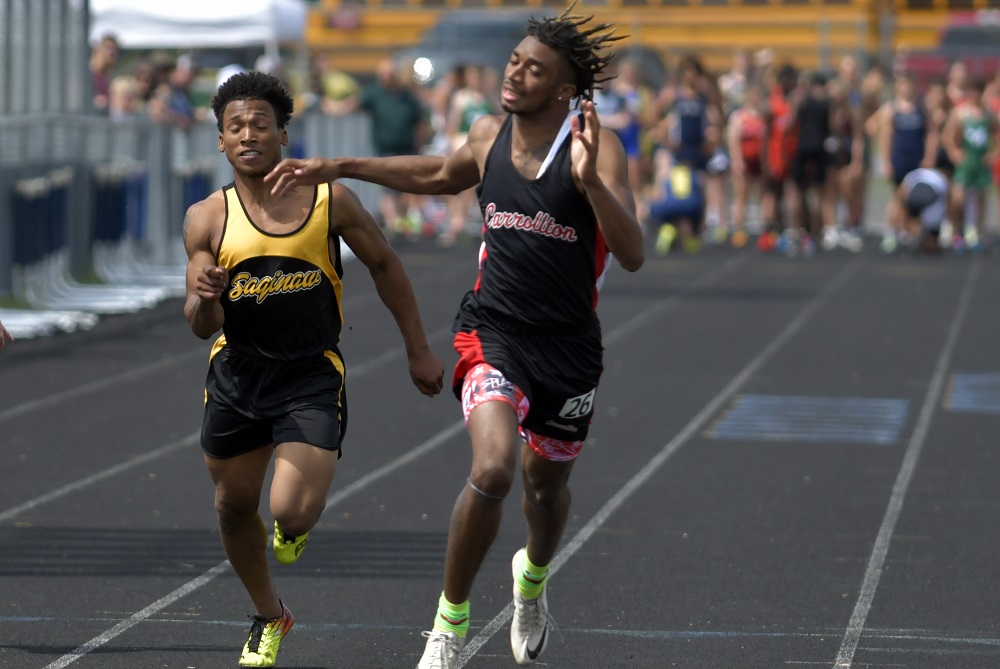
PHOTO: Carrollton’s Derrick Voltz, right, breaks across the finish line during the 100-meter preliminaries at his Division 3 Regional at Shepherd last month. (Click for more from High School Sports Scene.)
2017-18 Report Shows Fewer Concussions
August 8, 2018
By Geoff Kimmerly
Second Half editor
Concussions are down, according to data compiled by the Michigan High School Athletic Association during its third year of collecting head injury reports from member high schools.
The work is not done – but this year’s data reinforces trends that emerged during the first two years of reporting and will assist the MHSAA as it explores solutions to continue reducing the incidence of head injuries in school sports.
The 2017-18 concussion report found a 9.6-percent decrease in the number of confirmed concussions from the previous year. Student-athletes at MHSAA member high schools encountered during 2017-18 a total of 3,580 head injuries – or 4.8 per member school, compared to the 2016-17 average of 5.2. Total participation in MHSAA sports for 2017-18 was 284,920 – with students counted once for each sport he or she played – and only 1.3 percent of participants experienced a head injury, down from 1.4 in 2016-17 and 1.6 percent the first year of the study.
As first mandated in 2015-16, member schools are required to report head injuries to the MHSAA identifying the sport that each student-athlete was participating in and whether the injury was sustained during practice or competition. Schools also are required to designate at which level – varsity, junior varsity or freshman – the injury occurred.
The full report of all head injuries experienced during 2017-18 by student-athletes at MHSAA member high schools – including percentages by sport (per 1,000 participants), gender and team level, as well as data tracking when athletes returned to play – is available by clicking here.
Consistent with the first two years of the study, the MHSAA received data from more than 99 percent of its member high schools after the fall, winter and spring seasons and continued to track each injury report through its conclusion this summer. Member junior high and middle schools also were allowed, although not mandated, to report their potential head injuries; and those findings are not part of the published report.
The decrease in overall head injury reports collected for 2017-18 follows a similar reduction from 2015-16 to 2016-17 – and brings the total decrease to 19.6 percent fewer reports since the first year of the study.
MHSAA Executive Director John E. “Jack” Roberts noted that the decreases in reports, both year to year and since the first year of the survey, likely have some relation to year-to-year fluctuation, refinement of the follow-up reporting process and a better understanding by schools of what is not to be included for the survey – including head injuries not diagnosed as concussions and head injuries that did not take place during MHSAA-sponsored activities.
However, the findings of this year’s study – and their similarities to the findings from the first two surveys – has begun to clarify the identification and understanding of trends. Continuing to emerge perhaps most prominently is the higher incidence of concussion reports from girls sports – and pertinent questions about physiological and social causes behind those results.
“With three years of reporting by virtually 100 percent of our high schools, what we’re learning is no longer anecdotal; the results are beginning to identify valid trends and genuine issues that need to be addressed,” Roberts said. “For example, it’s even clearer than before that girls are reporting three times the number of concussions as boys when comparing similar sports – soccer, basketball and baseball versus softball. As a result, we’ve already begun to incorporate these gender differences into our coaches education, and the writers of high school playing rules are obligated to focus on these gender differences as well.”
Although the total number of confirmed concussions was significantly lower again in 2017-18, a number of findings detailing those injuries fell in line with results of the first two surveys.
Boys experienced 2,373– or 66 percent – of those injuries, the same ratio as 2016-17, and not surprisingly as boys have a much higher participation in contact sports. More than half of head injuries – 56 percent – were experienced by varsity athletes, which for the second year also fell within a percent difference of the previous year’s findings.
A total of 2,330 head injuries – or 65 percent – came in competition as opposed to practice. More than half took place during either the middle of practice or middle of competition as opposed to the start or end, and 52 percent of injuries were a result of person-to-person contact. The MHSAA also asked schools to report the number of days between the head injury and the athlete’s return to activity – and the two largest groups, both at 24 percent, returned to activity after either 6 to 10 days of rest or 11 to 15. All of these findings were within 1-3 percent of those discovered from the 2016-17 data.
Contact sports again revealed the most head injuries. Ranking first was football, 11 and 8-player combined, with 41 head injuries per 1,000 participants – a decrease for the second straight year, this time from 44 head injuries per 1,000 participants in 2016-17 and down from 49 head injuries per 1,000 football participants shown by the first study in 2015-16.
Ice hockey repeated with the second-most injuries per 1,000, with 32 (down from 36 injuries per 1,000 from 2016-17 and 38 per 1,000 in 2015-16), and girls soccer and wrestling tied for third with 25 head injuries per 1,000 participants – girls soccer down from 28 head injuries per 1,000 participants and wrestling down from 26 per 1,000 in 2016-17.
Also consistent with 2016-17, the next five sports (after football and hockey) to show the highest incidences of head injuries were girls sports – girls soccer followed by girls basketball (22 per 1,000), girls competitive cheer (20) and girls lacrosse (20). Boys lacrosse (17), girls gymnastics (16) and boys soccer (12) were the only other sports to show double-digit head injuries per 1,000 participants.
Females again reported significantly more concussions than males playing the same or similar sports – soccer, basketball and baseball/softball. Female soccer players reported more than double the concussions per 1,000 participants as male soccer players (25 to 12), while female basketball players also reported more than double the number of concussions per 1,000 participants (22 to 9). Softball players reported seven concussions per 1,000 participants, and baseball players reported three per 1,000. Although the percentage differences vary from year to year, the results of all three comparisons remained consistent with what the survey found in 2015-16 and 2016-17.
The MHSAA in 2018-19 is directing its sport committees to focus on a pair of questions – how to increase participation and how to make their specific sports safer – the latter aiming to put some of what has been learned from concussion reporting into practice. The MHSAA also is continuing to invite Michigan’s universities, health care systems and the National Federation of State High School Associations (NFHS) to take part in analyzing the data and resulting questions that have arisen during the past three years.
“Regrettably, I do not see a nationwide head injury reporting effort likely,” Roberts said. “First, it’s hard to coordinate 50 states’ efforts. And second, if left to medical professionals, the survey tool might become so cumbersome that schools would be reluctant to participate – and certainly, it would not get the 99.9 percent cooperation that we’ve enjoyed from schools over these three years.”
Schools report possible concussions online via the MHSAA Website. Reports are then examined by members of the MHSAA staff, who follow up with school administrators as those student-athletes continue to receive care and eventually return to play. Student privacy is protected.
The reporting of possible concussions is part of a three-pronged advance by the MHSAA in concussion care begun during the 2015-16 school year. The MHSAA completed in spring 2017 the largest-ever state high school association sideline concussion testing pilot program, with a sample of schools from across the state over two years using one of two screening tests designed to detect concussions. The MHSAA also was the first state association to provide all participants at every member high school and junior high/middle school with insurance intended to pay accident medical expense benefits – covering deductibles and co-pays left unpaid by other policies – resulting from head injuries sustained during school practices or competitions and at no cost to either schools or families.
Previously, the MHSAA also was among the first state associations to adopt a return-to-play protocol that keeps an athlete out of activity until at least the next day after a suspected concussion, and allows that athlete to return to play only after he or she has been cleared unconditionally for activity by a doctor (M.D. or D.O.), physician’s assistant or nurse practitioner.
In addition, the MHSAA’s Coaches Advancement Program – which includes courses that must be completed by all varsity head coaches hired for the first time at a member school – provides substantial instruction on concussion care. Separately, rules meetings that are required viewing for high school varsity and subvarsity head and assistant coaches at the start of each season include detailed training on caring for athletes with possible head injuries.