

Preview: Classic Clashes and Broken Records Expected
By
Geoff Kimmerly
MHSAA.com senior editor
June 5, 2021
The attention that will be paid to one of the Lower Peninsula Boys Track & Field Finals on Saturday will go past usual interest in just a local school or single division.
Many eyes will be turned to the Division 1 meet, featuring among many Ann Arbor Skyline senior Hobbs Kessler, who has made national news over the last few weeks by setting the national high school record in the 1,500 (3:34.36) and qualifying for the Olympic Trials in the event.
But he’ll be facing some familiar competition in his distance races at East Kentwood – including Hartland junior Riley Hough, who edged Kessler by two seconds in the Division 1 cross country final this past fall.
Their matchup is just one of many stories worth tuning in for this weekend. Events at all four sites begin at 10 a.m. (EDT) and tickets to attend can be purchased online only at GoFan. The meets also will be broadcast on MHSAA.tv and viewable with subscription. Click to watch each division: LPD1 | LPD2 | LPD3 | LPD4.
Below is a glance at team contenders and individuals to watch in all four divisions.
Division 1 at East Kentwood
Top Regional scores: Macomb Dakota 160, Traverse City West 145½, Northville 136, Novi 136.
Team forecast: East Kentwood won the last three championships before COVID, with Ann Arbor Pioneer finishing runner-up in both 2018 and 2019. Dakota is an interesting possibility this time with qualifiers throughout the meet. Fenton has top-three seeds in six events, and Zeeland West is another team with scoring opportunities in a variety of events.
Trey Gardette, Ann Arbor Huron: The senior sprint star has taken amazing strides over the last two years and may be on the verge of an unforgettable finish to his high school career. Gardette’s top-seed 10.5 in the 100 is a blink faster than the LPD1 Finals record of 10.53, and he’s second-seeded in the 200 and also will run on the 400 relay.
Riley Hough, Hartland: The I-96 corridor has been the center of distance running this school year, and Hough hopes to follow his Division 1 cross country championship in the fall with titles in the 1,600 and 3,200. He’s seeded first in the former with a 4:13.93.
Hobbs Kessler, Ann Arbor Skyline: He’s slated to run the 800, 1,600 and 3,200 and on the top-seeded 3,200 relay (7:53.30) Saturday. He won all three of those open races at his Regional, and so while he isn’t top-seeded in any that likely means little as he could drop major time.
Tamaal Myers II, Detroit Cass Tech: The Technicians standout junior has the top 110 hurdles seed time (14.06) by nearly a second and is tied for the top seed time in the 300 (39.32). He’ll also run the 400 and on the 1,600 relay.
Brandon Miller, Fenton: He finished fifth in the 200 as a sophomore in 2019, but he can take a massive leap Saturday as his top seed time in that race (21.25) is five hundredths of a second off the meet record. He’s also the second seed in the 100 with a seed time of 10.60 that is seven hundredths of a second off that meet record. And he’ll also run on contending 400 and 800 relays.
Division 2 at Zeeland
Top Regional scores: Orchard Lake St. Mary’s 216½, Dearborn Divine Child 186, Frankenmuth 164.
Team forecast: Four teams have won this championship over the last four seasons. Flint Powers Catholic is a possibility to make it five as it runs for its first team title led by sprint standouts and relays. Frankenmuth with top qualifiers in the sprints, relays and field events is another to watch in what lines up to be a low-scoring team race. A total of 10 schools won championships in this division over the previous 11 seasons before 2020 was canceled.
Ryan Brenner, Frankenmuth: The senior Eagles hurdler is the top seed in the 300 with a time of 40.1 and also will run on the top-seeded 1,600 relay (3:28.44) and high jump.
Jamal Hailey, Berrien Springs: The standout junior sprinter has the top seed time in the 100 (11.04) and the third-fastest in the 200, and he’ll also run on the second-seeded 400 relay.
Austin Hamlin, Flint Powers Catholic: The Chargers sophomore would play a major role in any team title pursuit, entering with the top seed in the 200 (22.5), third-fastest in the 100 and as part of the top-seeded 400 relay (43.3) and fourth-seeded 800 relay. That 400 relay time is a second off the meet record.
Alex Mansfield, Monroe Jefferson: The junior thrower is another who has made a major move over the last two years. He enters Saturday with the top seed in the shot put (56-3) by two feet and the top seed in the discus (163-11) by nearly 10.
Luke Stowasser, Edwardsburg: The junior Eddies jumper also is top-seeded in both of his events, with a 22-6½ in the long jump and 6-10 in the high jump. That high jump is six inches better than the field and two off the meet record. He was the high jump runner-up as a freshman.
Division 3 at Jenison
Top Regional scores: Grass Lake 132, Caro 129, Pewamo-Westphalia 126 1/3.
Team forecast: Grass Lake will be pursuing its first team title since 1970 and has six top-four seeds leading the way. Figuring the next few contenders is difficult with points looking to be spread among a number of teams.
Brennan Bargesser, Grass Lake: A drive for the team championship would include significant points from Bargesser, who is seeded first in the 200 (21.98) and 400 (49.34) and second in the 100 for his final high school meet. He’ll also run on the top-seeded 400 relay (44.14) – that seed time is one second off the meet record.
Hunter Jones, Benzie Central: The sophomore standout has two Division 3 cross country championships to his credit and will make his Track Finals debut as the top seed in the 3,200 (9:37.42) and a likely contender in the 1,600 and 800 as well.
Josh Jones, Harrison: He’ll close his high school career running the 800, 1,600 and 3,200, with his 1,600 seed time (4:19.84) topping that event list.
Brenden Quackenbush, Chesaning: He’s set to establish himself in both throws at this level Saturday, with the top seed in the discus (143-0) by nearly two feet and the third seed in the shot put.
Derrick Voltz, Carrollton: A qualifier in the 100 as a freshman in 2019, he could cap his junior season as a two-event champion. He’s seeded first in the long jump (23-2) by nearly a foot with that leap only five inches off the meet record. He’s also the top seed in the 100 (11.11) just ahead of Bargesser.
Division 4 at Hudsonville
Top Regional scores: Lutheran Westland 171, Reading 170, Carson City-Crystal 147.
Team forecast: Kalamazoo Hackett Catholic Prep was the back-to-back champion before COVID, and Saugatuck was the Division 3 runner-up in 2019 but is back in Division 4. Saugatuck won’t run a relay this weekend but has favorites in the hurdles and distance events, and Breckenridge’s strengths in the sprints and relays should make it a team title contender as well as it seeks its first championship.
Coleman Clark, Carson City-Crystal: The lone returning champion in this division won the 3,200 as a sophomore in 2019 and will run that race along with the 800 and 1,600 and as part of the top-seeded 3,200 relay (8:19.40).
Benny Diaz, Saugatuck: The junior sprint/hurdles standout could make a run at four individual titles Saturday or next season. He’s the top seed in both hurdles races this time (15.01 in the 110 and 40.59 in the 300), and the fourth seed in the 200 and seventh in the 100. He was third in Division 3 in the 300 as a freshman.
Zane Forist, Carson City-Crystal: He was the runner-up in the discus and eighth in the shot put as a freshman two years ago, and he’s aiming for much more this time. His top-seed throws of 196-8 and 64-4, respectively, would both set LPD4 championship meet records – both by roughly six feet.
Nik Pettinga, Saugatuck: A top distance runner in cross country the last few seasons, he is looking to finish as a champion in his last high school meet and enters as the top seed in the 1,600 (4:26.99) and second seed (to junior teammate Max Sharnas) in the 3,200.
Charlie Steinhaus, Breckenridge: The speedy senior would help lead any charge for a team championship, entering as the top seed in the 100 (11.01) and second in the 200. He’ll also run on the top-seeded 400 relay (44.51) and second-seeded 800 relay.
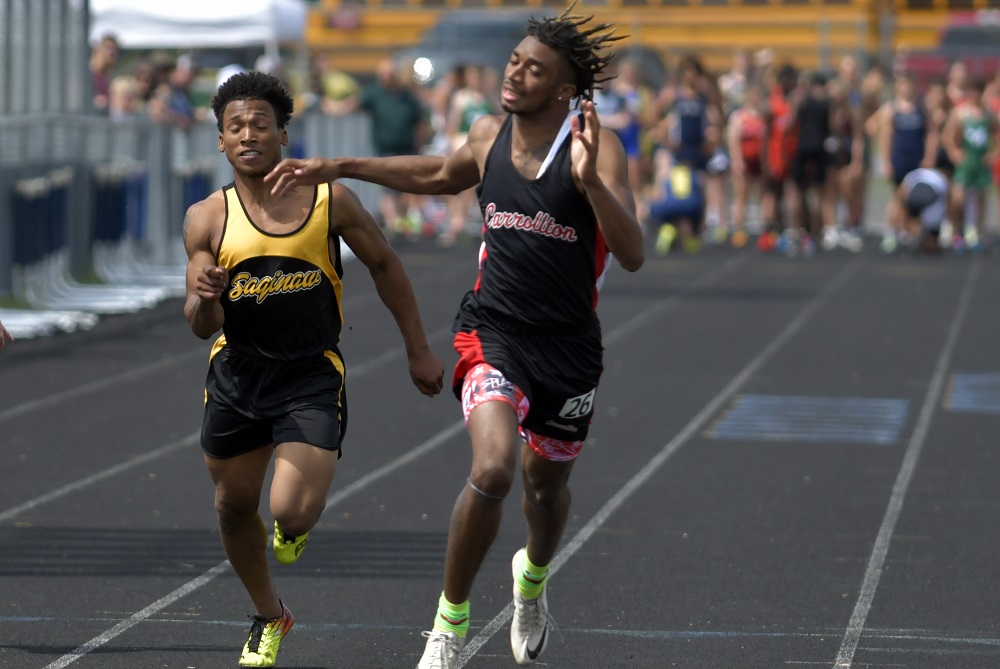
PHOTO: Carrollton’s Derrick Voltz, right, breaks across the finish line during the 100-meter preliminaries at his Division 3 Regional at Shepherd last month. (Click for more from High School Sports Scene.)

The Past, Present and Future of Golf
June 19, 2018
The game of golf can and does reveal both the good and bad sides of people. Think you might want to hire a person for a job? Then take that person golfing. Observe. If that person can’t count all his or her strokes on a golf course, you can’t count on that person in life.
Golf claims to need and nurture integrity like no other sport. It does not prescribe or require a contest official to observe every action but is designed to be a game where each competitor plays the ball as it is found and counts every attempt to hit it. The rules of golf are without leniency for a player who records an incorrect score yet depend on that player, and no one else, to count all strokes and assess any penalties that add to the score.
As a youngster, I played regularly with my parents. My mother was the club rules chairperson for many years. I was told in no uncertain terms to “play my ball as it lies and tell no lies about my play.”
Golf certainly has its detractors ... for example, its pace is slow and its price is high. But over years, and with enlightenment that arrived too slowly, golf has addressed its worst blind spots and opened its choicest courses and its most chauvinistic hearts to females and minorities. Its recent outreach to youth is marvelous; its ongoing support of charities is magnificent.
A recent controversy over scores posted by a small group of players at a Michigan High School Athletic Association Regional Golf Tournament has caused some local tarnish on this illustrious worldwide game and brought embarrassment to some players and their schools as well as some criticism of the MHSAA. It was alleged that players from more than one team who were assigned to the same competitive groupings colluded to post lower scores than they actually earned. Neither their coaches nor administrators discovered a crack in the players’ stories, or in their solidarity, in spite of repeated questioning. There was no evidence of acts of cheating, but a suspicious anomaly in the players’ scores caused concern at the Regional meet and since.
If there was a conspiracy of cheating, it was the players who are at fault, which must be shared by the adults in their lives who may have been unable to nurture character to the same degree they developed skills.
If the only solution to questions of players’ shaving strokes is adult supervision of every grouping at every Regional of all four Divisions, then the soul of the game and much of what it is supposed to teach is lost, and the time spent on the sport may be unjustifiable. At least that’s what our state golf coaches association argued a decade ago when coaches were granted relief from being assigned to accompany groupings and “observe” players. They said they wanted to coach their own kids and not be required to count the strokes of other players.
Studies in other states have demonstrated that golf is the school sport which, on a per-participant basis, causes students to lose more classroom instructional time than any other sport. It’s played off school grounds and very often with non-faculty coaches. It generates no revenue to offset expenses. Add in dissatisfaction with the court-ordered change of seasons for MHSAA Lower Peninsula golf tournaments 10 years ago — and this recent ugly and, for some, unsettled incident — and one is left with more reasons than not for the MHSAA to discontinue tournament sponsorship of golf.
But I love the sport! I grew up playing golf with my parents and spent hundreds more hours with them than my siblings who did not play the game. I had a few great rounds when I was a youngster and eventually settled on the goal of being among the 10 percent of all golfers who break 90. I love the colors and contours of challenging courses, which in my prime I preferred to play at their full length, from the toughest tees and with no “gimmies” on the greens. I now watch more golf on television than any other sport.
I’ve been thinking a lot about golf over the past decade, but have found little traction when talking about changing traditions of high school golf in Michigan ... for example, in favor of a Ryder Cup style team tournament — perhaps even coed — conducted in both Spring and Fall where schools (or their leagues) choose the season that fits their needs best. While the NCAA still conducts a Spring championship, it has “modernized” its tournament with match play, and television ratings reveal broader public appeal for the team format that professional players seem to relish. Might we make some changes to modernize high school competition in this state?
This tradition-soaked sport needs to be energized, not eliminated at the high school level. Most of all, it needs to be introduced earlier in rural and urban junior high/middle schools to create the interest and cultivate the skill that will lead to larger and more stable high school golf programs.