

Preview: Classic Clashes and Broken Records Expected
By
Geoff Kimmerly
MHSAA.com senior editor
June 5, 2021
The attention that will be paid to one of the Lower Peninsula Boys Track & Field Finals on Saturday will go past usual interest in just a local school or single division.
Many eyes will be turned to the Division 1 meet, featuring among many Ann Arbor Skyline senior Hobbs Kessler, who has made national news over the last few weeks by setting the national high school record in the 1,500 (3:34.36) and qualifying for the Olympic Trials in the event.
But he’ll be facing some familiar competition in his distance races at East Kentwood – including Hartland junior Riley Hough, who edged Kessler by two seconds in the Division 1 cross country final this past fall.
Their matchup is just one of many stories worth tuning in for this weekend. Events at all four sites begin at 10 a.m. (EDT) and tickets to attend can be purchased online only at GoFan. The meets also will be broadcast on MHSAA.tv and viewable with subscription. Click to watch each division: LPD1 | LPD2 | LPD3 | LPD4.
Below is a glance at team contenders and individuals to watch in all four divisions.
Division 1 at East Kentwood
Top Regional scores: Macomb Dakota 160, Traverse City West 145½, Northville 136, Novi 136.
Team forecast: East Kentwood won the last three championships before COVID, with Ann Arbor Pioneer finishing runner-up in both 2018 and 2019. Dakota is an interesting possibility this time with qualifiers throughout the meet. Fenton has top-three seeds in six events, and Zeeland West is another team with scoring opportunities in a variety of events.
Trey Gardette, Ann Arbor Huron: The senior sprint star has taken amazing strides over the last two years and may be on the verge of an unforgettable finish to his high school career. Gardette’s top-seed 10.5 in the 100 is a blink faster than the LPD1 Finals record of 10.53, and he’s second-seeded in the 200 and also will run on the 400 relay.
Riley Hough, Hartland: The I-96 corridor has been the center of distance running this school year, and Hough hopes to follow his Division 1 cross country championship in the fall with titles in the 1,600 and 3,200. He’s seeded first in the former with a 4:13.93.
Hobbs Kessler, Ann Arbor Skyline: He’s slated to run the 800, 1,600 and 3,200 and on the top-seeded 3,200 relay (7:53.30) Saturday. He won all three of those open races at his Regional, and so while he isn’t top-seeded in any that likely means little as he could drop major time.
Tamaal Myers II, Detroit Cass Tech: The Technicians standout junior has the top 110 hurdles seed time (14.06) by nearly a second and is tied for the top seed time in the 300 (39.32). He’ll also run the 400 and on the 1,600 relay.
Brandon Miller, Fenton: He finished fifth in the 200 as a sophomore in 2019, but he can take a massive leap Saturday as his top seed time in that race (21.25) is five hundredths of a second off the meet record. He’s also the second seed in the 100 with a seed time of 10.60 that is seven hundredths of a second off that meet record. And he’ll also run on contending 400 and 800 relays.
Division 2 at Zeeland
Top Regional scores: Orchard Lake St. Mary’s 216½, Dearborn Divine Child 186, Frankenmuth 164.
Team forecast: Four teams have won this championship over the last four seasons. Flint Powers Catholic is a possibility to make it five as it runs for its first team title led by sprint standouts and relays. Frankenmuth with top qualifiers in the sprints, relays and field events is another to watch in what lines up to be a low-scoring team race. A total of 10 schools won championships in this division over the previous 11 seasons before 2020 was canceled.
Ryan Brenner, Frankenmuth: The senior Eagles hurdler is the top seed in the 300 with a time of 40.1 and also will run on the top-seeded 1,600 relay (3:28.44) and high jump.
Jamal Hailey, Berrien Springs: The standout junior sprinter has the top seed time in the 100 (11.04) and the third-fastest in the 200, and he’ll also run on the second-seeded 400 relay.
Austin Hamlin, Flint Powers Catholic: The Chargers sophomore would play a major role in any team title pursuit, entering with the top seed in the 200 (22.5), third-fastest in the 100 and as part of the top-seeded 400 relay (43.3) and fourth-seeded 800 relay. That 400 relay time is a second off the meet record.
Alex Mansfield, Monroe Jefferson: The junior thrower is another who has made a major move over the last two years. He enters Saturday with the top seed in the shot put (56-3) by two feet and the top seed in the discus (163-11) by nearly 10.
Luke Stowasser, Edwardsburg: The junior Eddies jumper also is top-seeded in both of his events, with a 22-6½ in the long jump and 6-10 in the high jump. That high jump is six inches better than the field and two off the meet record. He was the high jump runner-up as a freshman.
Division 3 at Jenison
Top Regional scores: Grass Lake 132, Caro 129, Pewamo-Westphalia 126 1/3.
Team forecast: Grass Lake will be pursuing its first team title since 1970 and has six top-four seeds leading the way. Figuring the next few contenders is difficult with points looking to be spread among a number of teams.
Brennan Bargesser, Grass Lake: A drive for the team championship would include significant points from Bargesser, who is seeded first in the 200 (21.98) and 400 (49.34) and second in the 100 for his final high school meet. He’ll also run on the top-seeded 400 relay (44.14) – that seed time is one second off the meet record.
Hunter Jones, Benzie Central: The sophomore standout has two Division 3 cross country championships to his credit and will make his Track Finals debut as the top seed in the 3,200 (9:37.42) and a likely contender in the 1,600 and 800 as well.
Josh Jones, Harrison: He’ll close his high school career running the 800, 1,600 and 3,200, with his 1,600 seed time (4:19.84) topping that event list.
Brenden Quackenbush, Chesaning: He’s set to establish himself in both throws at this level Saturday, with the top seed in the discus (143-0) by nearly two feet and the third seed in the shot put.
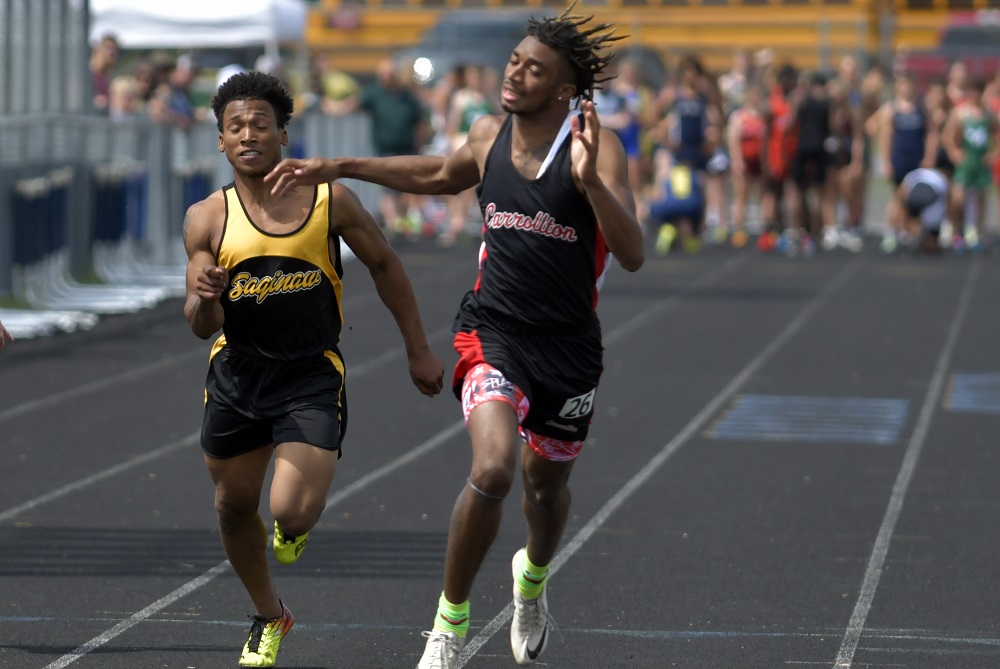
Derrick Voltz, Carrollton: A qualifier in the 100 as a freshman in 2019, he could cap his junior season as a two-event champion. He’s seeded first in the long jump (23-2) by nearly a foot with that leap only five inches off the meet record. He’s also the top seed in the 100 (11.11) just ahead of Bargesser.
Division 4 at Hudsonville
Top Regional scores: Lutheran Westland 171, Reading 170, Carson City-Crystal 147.
Team forecast: Kalamazoo Hackett Catholic Prep was the back-to-back champion before COVID, and Saugatuck was the Division 3 runner-up in 2019 but is back in Division 4. Saugatuck won’t run a relay this weekend but has favorites in the hurdles and distance events, and Breckenridge’s strengths in the sprints and relays should make it a team title contender as well as it seeks its first championship.
Coleman Clark, Carson City-Crystal: The lone returning champion in this division won the 3,200 as a sophomore in 2019 and will run that race along with the 800 and 1,600 and as part of the top-seeded 3,200 relay (8:19.40).
Benny Diaz, Saugatuck: The junior sprint/hurdles standout could make a run at four individual titles Saturday or next season. He’s the top seed in both hurdles races this time (15.01 in the 110 and 40.59 in the 300), and the fourth seed in the 200 and seventh in the 100. He was third in Division 3 in the 300 as a freshman.
Zane Forist, Carson City-Crystal: He was the runner-up in the discus and eighth in the shot put as a freshman two years ago, and he’s aiming for much more this time. His top-seed throws of 196-8 and 64-4, respectively, would both set LPD4 championship meet records – both by roughly six feet.
Nik Pettinga, Saugatuck: A top distance runner in cross country the last few seasons, he is looking to finish as a champion in his last high school meet and enters as the top seed in the 1,600 (4:26.99) and second seed (to junior teammate Max Sharnas) in the 3,200.
Charlie Steinhaus, Breckenridge: The speedy senior would help lead any charge for a team championship, entering as the top seed in the 100 (11.01) and second in the 200. He’ll also run on the top-seeded 400 relay (44.51) and second-seeded 800 relay.
PHOTO: Carrollton’s Derrick Voltz, right, breaks across the finish line during the 100-meter preliminaries at his Division 3 Regional at Shepherd last month. (Click for more from High School Sports Scene.)
Rep Council Wrap-Up: Spring 2018
By
Geoff Kimmerly
MHSAA.com senior editor
May 14, 2018
The adoption of major changes to the Michigan High School Athletic Association transfer regulation was among notable actions taken by the Representative Council during its annual Spring Meeting, May 6-7, in Gaylord, in addition to the selection of the Association’s next executive director announced in a previous release May 8.
The Spring Meeting of the 19-member legislative body of the Association’s more than 1,400 member schools is generally the busiest of its three sessions each year. The Council considered 29 committee proposals and dealt with a variety of eligibility rule, postseason tournament and operational issues.
The revised transfer regulation will go into effect for the 2019-20 school year, based on a student-athlete’s sports participation during 2018-19. The new transfer rule will make transferring student-athletes ineligible for one year in any sport played during the previous year at the previous school – unless that student-athlete’s situation fits one of the current 15 exceptions that allow for immediate eligibility. However, the revised transfer regulation also allows that transferring student-athlete immediate eligibility in any other MHSAA-sponsored sport not participated in during that previous year at the previous school.
The additions to the transfer rule received vast support from member schools in surveys leading up to the Council’s vote.
“We are hopeful this ‘sport-specific’ transfer rule will be easier to understand, and therefore, more consistently enforced,” MHSAA Executive Director John E. “Jack” Roberts said. “This rule better addresses the changing landscape of transfers, hopefully dissuading those considering moving for athletic reasons while still allowing a full range of sports for those who do switch. It may seem like a punishment to some, but the new rule is actually more permissive for many transfer students, and we saw growing support for these changes from our schools since we began discussing this proposal a year ago.”
A number of significant actions at the Spring Meeting will affect the junior high/middle school levels, as the Council continued growing its impact among those who represent the future of educational athletics.
The Council approved Junior High/Middle School Committee recommendations to increase the number of contests and days of competition in three sports, beginning in 2018-19. Softball teams will have 12 days of competition over 13 weeks, with doubleheaders counting as one of those 12 days. Basketball teams may play 12 games over 13 weeks with one game a day allowed, except that two games may be played on a day not followed by a school day up to four times a season; each of those doubleheader days will count as one of the 12 games. Soccer teams may play 12 games over 13 weeks with one game a day allowed, except that two games may be played on a day not followed by a school day up to two times a season; each of those doubleheader days also will count as one of the 12 games.
Another committee recommendation approved by the Council will allow a middle school student-athlete to compete in two non-school events during the school season in team sports except football – making the rule for team sports at the junior high/middle school level the same as the individual sport model currently enforced.
The Council also approved of continuing to develop and expand opportunities for the MHSAA to act as a “presenting sponsor” of already-existing junior high/middle school meets, invitationals and tournaments conducted by leagues, conferences and schools around Michigan. Staff was authorized to approach MHSAA sport committees and sport coaches association to explore possible junior high/middle school area or sectional competitions in cross country, track & field, wrestling, swimming & diving and potentially other sports.
“The Representative Council continued to consider ways to better serve the youngest student-athletes in our membership – the junior high/middle school participants who are the future of high school sports,” Roberts said. “While these actions may not gain as much attention as changes at the high school level, they are just as important if not more critical to the status of educational athletics moving forward. Nurturing this youngest level must continue to be a focus in the years to come as we work to strengthen and provide more opportunities at all levels.”
The Council approved a number of recommendations by respective sport committees that will alter the tournament setup beginning this fall. In ice hockey, the Pre-Regional system of tournament assignments has been eliminated; all teams will instead be organized into traditional Regionals, 24 total with no more than eight teams assigned to each. In boys lacrosse, a game will end when an 18-goal margin is reached any time after the completion of the third quarter; the 12-goal differential that starts a running clock during the second half will continue. In soccer, beginning with the 2019 season, the first round of District games will be required to be played the week before the current District week on that Wednesday, Thursday or Friday. District Semifinals and Finals will be scheduled for the following week – but Saturday games can be used only as a weather backup during the District round.
To better assist with scheduling and provide transportation relief, the Council approved a number of adjustments to the non-traditional draw policies for District and Regional tournaments; non-traditional draws do not require all contests be played as a designated host site, assisting primarily teams that might be located far from their tournament host but closer to their opponent(s). For the 2018-19 MHSAA Basketball and Volleyball Tournaments, non-traditional draws will be mandated for Districts made up of (a) all Upper Peninsula teams, (b) a combination of Upper and Lower Peninsula teams, or (c) seven or eight-team District grouping in any location of the state. In Districts with circumstances (a) and (b), a traditional draw may be conducted if all participating teams agree to that format. At the Regional level, any that include more than one District located in the Upper Peninsula will require geographic neutral sites be used. The Council also authorized a work group to review all aspects of non-traditional draws and all affected sports and report at the Council’s Fall meeting this Nov. 30.
Additionally, the Council approved a Classification Committee recommendation to move the “opt-up” deadline for fall sports from April 15 to May 1, while keeping the dates for winter (Aug. 15) and spring sports (Oct. 15) the same.
Here is a summary of other actions taken by the Representative Council at the Spring Meeting, which will take effect during the 2018-19 school year unless noted:
Sport Matters
• In baseball, the Council approved a committee recommendation altering tournament trophies to match the tournament format previously approved to begin with the 2019 season. Starting that spring, baseball teams will play what previously were Quarterfinals as the final game of a “Super Regional” tournament, and trophies awarded to those 16 winners will read “Super Regional Champion.” Trophies awarded to losing teams in that round will read “Regional Champion” as they still will have won the Regional level of the tournament.
• In basketball, the Council approved a committee recommendation to adopt the 28-foot coaching box for competition allowed under National Federation of State High School Associations (NFHS) rules. Previously, the MHSAA allowed for a 14-foot coaches box in front of the team’s bench.
• In competitive cheer, the Council approved four committee recommendations. The first allows junior high/middle school athletes to perform an inverted exit-cradle to back walkover out only. At the high school level, any catch that originates from shoulder level or below and transitions from a vertical body position to a horizontal body position now will require only three catchers, while four catchers are still required for any catch that exceeds shoulder level. The two other recommendations affect scoring: the first will allow at the high school level a mountain climber to an unbraced OLE to receive the OLE choreography bonus, while the second will allow for all levels (grades 7-12) four difficulty points to be awarded for a ground-up to an elevator.
• In cross country and track & field, the Council approved a Committee recommendation to adopt a recommendation from the state coaches and officials associations to use a one-turn stagger for the 3,200-meter relay and open 800, 1,600 and 3,200 meter runs. This stagger will begin to be used in 2020. The Council also approved a Committee recommendation to alter the junior high/middle school meet order to closely align with the high school order; eight events will switch so that relays and similar sprints and distance runs are ordered in the same way.
• In football, the Council approved a Football Committee recommendation that the MHSAA continue for the third year to experiment with a 40-second clock for use between plays. Teams taking part in the experiment will have 40 seconds from the end of the previous play to snap the ball to begin the next, unless there is an administrative stoppage (for penalty, measurement, etc.). MHSAA schools began experimenting with the 40-second clock during the 2016 season.
• In boys lacrosse, the Council approved a Committee recommendation to allow contests with out-of-state schools from states that do not sponsor a statewide boys lacrosse tournament only as long as those opponents follow comparable regulations of other spring sport teams in that state – including practice and contest limits, use of NFHS playing rules and prohibitions on undue influence and recruiting. Member schools must receive pre-approval from the MHSAA to play these opponents.
• In skiing, the Council approved a Committee recommendation to increase the maximum number of contests from 15 to 17 while reducing the number of scrimmages allowed from four to two.
• In soccer, the Council approved a Committee recommendation to allow at the high school level, as a part of the multi-team tournament rule, teams to play two full games on a non-school day and have those two count as one of the 18 regular-season contests. Teams still have the option to play 180 minutes under the current multi-team tournament rule. The only overtime allowed would be a shootout if part of a bracket tournament.
The Council also discussed a number of topics that will require action as quickly as its Nov. 30 meeting. The Council considered options for the Girls and Boys Basketball Tournaments for the 2019-20 season; one option follows the current format of playing tournaments with a one week offset and Finals at separate sites, and a second option would have the tournaments conducted simultaneously over three weeks with Semifinals at sites around the state and all eight championship games (four for girls, four for boys) at the same arena during the same weekend.
The possible scheduling by the MHSAA of regular-season games for 8-player football teams also was discussed and may be voted upon Nov. 30.
Make-up of the MHSAA’s sport committees is an emerging topic, and the Council considered suggestions for making them more effective. The committee appointment procedure originally was adopted by the Council in 1987 and modified in 2007.
The Council also reviewed reports on membership, with 751 senior high schools and 752 junior high/middle schools in 2017-18 plus 42 elementary schools with 6th-grader participation; eligibility advancement applications, which totaled six for this school year; the use of Educational Transfer Forms, which fell eight percent this year; out-of-state practice requests, school violations, attendance at athletic director in-service workshops and Coaches Advancement Program sessions, officials’ registrations, rules meetings attendance and officials reports submitted for the past three sports seasons. The Association’s $11.6 million budget for the 2018-19 school year also was approved.
The Representative Council is the 19-member legislative body of the MHSAA. All but five are elected by member schools. Four members are appointed by the Council to facilitate representation of females and minorities, and the 19th position is occupied by the Superintendent of Public Instruction or designee.
The MHSAA is a private, not-for-profit corporation of voluntary membership by more than 1,500 public and private senior high schools and junior high/middle schools which exists to develop common rules for athletic eligibility and competition. No government funds or tax dollars support the MHSAA, which was the first such association nationally to not accept membership dues or tournament entry fees from schools. Member schools which enforce these rules are permitted to participate in MHSAA tournaments, which attract more than 1.4 million spectators each year.