

Preview: Classic Clashes and Broken Records Expected
By
Geoff Kimmerly
MHSAA.com senior editor
June 5, 2021
The attention that will be paid to one of the Lower Peninsula Boys Track & Field Finals on Saturday will go past usual interest in just a local school or single division.
Many eyes will be turned to the Division 1 meet, featuring among many Ann Arbor Skyline senior Hobbs Kessler, who has made national news over the last few weeks by setting the national high school record in the 1,500 (3:34.36) and qualifying for the Olympic Trials in the event.
But he’ll be facing some familiar competition in his distance races at East Kentwood – including Hartland junior Riley Hough, who edged Kessler by two seconds in the Division 1 cross country final this past fall.
Their matchup is just one of many stories worth tuning in for this weekend. Events at all four sites begin at 10 a.m. (EDT) and tickets to attend can be purchased online only at GoFan. The meets also will be broadcast on MHSAA.tv and viewable with subscription. Click to watch each division: LPD1 | LPD2 | LPD3 | LPD4.
Below is a glance at team contenders and individuals to watch in all four divisions.
Division 1 at East Kentwood
Top Regional scores: Macomb Dakota 160, Traverse City West 145½, Northville 136, Novi 136.
Team forecast: East Kentwood won the last three championships before COVID, with Ann Arbor Pioneer finishing runner-up in both 2018 and 2019. Dakota is an interesting possibility this time with qualifiers throughout the meet. Fenton has top-three seeds in six events, and Zeeland West is another team with scoring opportunities in a variety of events.
Trey Gardette, Ann Arbor Huron: The senior sprint star has taken amazing strides over the last two years and may be on the verge of an unforgettable finish to his high school career. Gardette’s top-seed 10.5 in the 100 is a blink faster than the LPD1 Finals record of 10.53, and he’s second-seeded in the 200 and also will run on the 400 relay.
Riley Hough, Hartland: The I-96 corridor has been the center of distance running this school year, and Hough hopes to follow his Division 1 cross country championship in the fall with titles in the 1,600 and 3,200. He’s seeded first in the former with a 4:13.93.
Hobbs Kessler, Ann Arbor Skyline: He’s slated to run the 800, 1,600 and 3,200 and on the top-seeded 3,200 relay (7:53.30) Saturday. He won all three of those open races at his Regional, and so while he isn’t top-seeded in any that likely means little as he could drop major time.
Tamaal Myers II, Detroit Cass Tech: The Technicians standout junior has the top 110 hurdles seed time (14.06) by nearly a second and is tied for the top seed time in the 300 (39.32). He’ll also run the 400 and on the 1,600 relay.
Brandon Miller, Fenton: He finished fifth in the 200 as a sophomore in 2019, but he can take a massive leap Saturday as his top seed time in that race (21.25) is five hundredths of a second off the meet record. He’s also the second seed in the 100 with a seed time of 10.60 that is seven hundredths of a second off that meet record. And he’ll also run on contending 400 and 800 relays.
Division 2 at Zeeland
Top Regional scores: Orchard Lake St. Mary’s 216½, Dearborn Divine Child 186, Frankenmuth 164.
Team forecast: Four teams have won this championship over the last four seasons. Flint Powers Catholic is a possibility to make it five as it runs for its first team title led by sprint standouts and relays. Frankenmuth with top qualifiers in the sprints, relays and field events is another to watch in what lines up to be a low-scoring team race. A total of 10 schools won championships in this division over the previous 11 seasons before 2020 was canceled.
Ryan Brenner, Frankenmuth: The senior Eagles hurdler is the top seed in the 300 with a time of 40.1 and also will run on the top-seeded 1,600 relay (3:28.44) and high jump.
Jamal Hailey, Berrien Springs: The standout junior sprinter has the top seed time in the 100 (11.04) and the third-fastest in the 200, and he’ll also run on the second-seeded 400 relay.
Austin Hamlin, Flint Powers Catholic: The Chargers sophomore would play a major role in any team title pursuit, entering with the top seed in the 200 (22.5), third-fastest in the 100 and as part of the top-seeded 400 relay (43.3) and fourth-seeded 800 relay. That 400 relay time is a second off the meet record.
Alex Mansfield, Monroe Jefferson: The junior thrower is another who has made a major move over the last two years. He enters Saturday with the top seed in the shot put (56-3) by two feet and the top seed in the discus (163-11) by nearly 10.
Luke Stowasser, Edwardsburg: The junior Eddies jumper also is top-seeded in both of his events, with a 22-6½ in the long jump and 6-10 in the high jump. That high jump is six inches better than the field and two off the meet record. He was the high jump runner-up as a freshman.
Division 3 at Jenison
Top Regional scores: Grass Lake 132, Caro 129, Pewamo-Westphalia 126 1/3.
Team forecast: Grass Lake will be pursuing its first team title since 1970 and has six top-four seeds leading the way. Figuring the next few contenders is difficult with points looking to be spread among a number of teams.
Brennan Bargesser, Grass Lake: A drive for the team championship would include significant points from Bargesser, who is seeded first in the 200 (21.98) and 400 (49.34) and second in the 100 for his final high school meet. He’ll also run on the top-seeded 400 relay (44.14) – that seed time is one second off the meet record.
Hunter Jones, Benzie Central: The sophomore standout has two Division 3 cross country championships to his credit and will make his Track Finals debut as the top seed in the 3,200 (9:37.42) and a likely contender in the 1,600 and 800 as well.
Josh Jones, Harrison: He’ll close his high school career running the 800, 1,600 and 3,200, with his 1,600 seed time (4:19.84) topping that event list.
Brenden Quackenbush, Chesaning: He’s set to establish himself in both throws at this level Saturday, with the top seed in the discus (143-0) by nearly two feet and the third seed in the shot put.
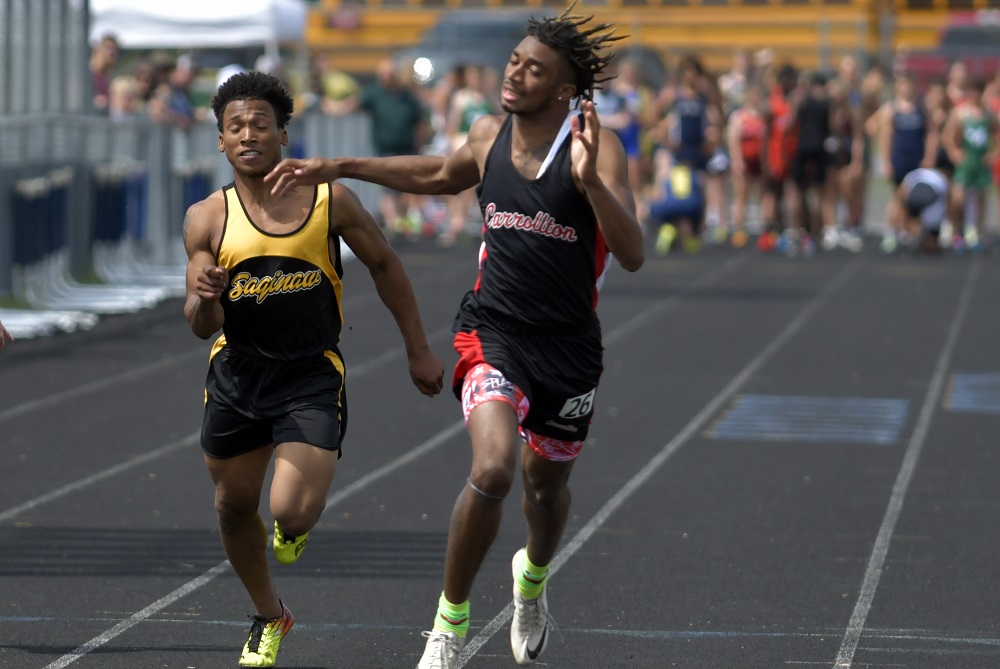
Derrick Voltz, Carrollton: A qualifier in the 100 as a freshman in 2019, he could cap his junior season as a two-event champion. He’s seeded first in the long jump (23-2) by nearly a foot with that leap only five inches off the meet record. He’s also the top seed in the 100 (11.11) just ahead of Bargesser.
Division 4 at Hudsonville
Top Regional scores: Lutheran Westland 171, Reading 170, Carson City-Crystal 147.
Team forecast: Kalamazoo Hackett Catholic Prep was the back-to-back champion before COVID, and Saugatuck was the Division 3 runner-up in 2019 but is back in Division 4. Saugatuck won’t run a relay this weekend but has favorites in the hurdles and distance events, and Breckenridge’s strengths in the sprints and relays should make it a team title contender as well as it seeks its first championship.
Coleman Clark, Carson City-Crystal: The lone returning champion in this division won the 3,200 as a sophomore in 2019 and will run that race along with the 800 and 1,600 and as part of the top-seeded 3,200 relay (8:19.40).
Benny Diaz, Saugatuck: The junior sprint/hurdles standout could make a run at four individual titles Saturday or next season. He’s the top seed in both hurdles races this time (15.01 in the 110 and 40.59 in the 300), and the fourth seed in the 200 and seventh in the 100. He was third in Division 3 in the 300 as a freshman.
Zane Forist, Carson City-Crystal: He was the runner-up in the discus and eighth in the shot put as a freshman two years ago, and he’s aiming for much more this time. His top-seed throws of 196-8 and 64-4, respectively, would both set LPD4 championship meet records – both by roughly six feet.
Nik Pettinga, Saugatuck: A top distance runner in cross country the last few seasons, he is looking to finish as a champion in his last high school meet and enters as the top seed in the 1,600 (4:26.99) and second seed (to junior teammate Max Sharnas) in the 3,200.
Charlie Steinhaus, Breckenridge: The speedy senior would help lead any charge for a team championship, entering as the top seed in the 100 (11.01) and second in the 200. He’ll also run on the top-seeded 400 relay (44.51) and second-seeded 800 relay.
PHOTO: Carrollton’s Derrick Voltz, right, breaks across the finish line during the 100-meter preliminaries at his Division 3 Regional at Shepherd last month. (Click for more from High School Sports Scene.)

MHSAA's Roberts to Retire in August
By
Geoff Kimmerly
MHSAA.com senior editor
April 24, 2018
For 32 years, Jack Roberts has served as much more than a caretaker of the Michigan High School Athletic Association.
In announcing his retirement Tuesday, he called working for 1,500 schools and hundreds of thousands of student-athletes over three decades his "purpose."
John E. “Jack” Roberts, who has served as executive director of the MHSAA since the fall of 1986, will retire in August.
Roberts will conclude his tenure as the second-longest serving full-time executive director during the MHSAA’s 94-year history. He is the fourth person to serve that leadership role full time, following Charles E. Forsythe (1931-42, 1945-68), Allen W. Bush (1968-78) and Vern L. Norris (1978-86). Roberts currently is also the nation’s longest-serving executive director of a state high school athletic association.
The MHSAA has enjoyed continued growth under Roberts’ guidance, particularly in the number of Michigan high school students participating in athletics and in the number of MHSAA-sponsored tournament sports available to them.
The Association also has made unprecedented advances in providing for the health and safety of athletes and promoting sportsmanship and the values of educational athletics and while working to preserve competitive equity for its more than 1,500 member high school and junior high/middle schools.
“I don’t think anybody could have been luckier than I to enjoy their work so much and to enjoy the people he worked with so much,” Roberts said. “It has been a blessing to be able to bring my passions to work every day and be able to act on my convictions. I don’t think anybody could ever feel more called to a job than I did."
Under Roberts’ leadership, overall participation in high school athletics in Michigan has increased 10 percent, and the MHSAA has added more than 200 schools in increasing its membership by more than 15 percent at the high school and junior high/middle school levels combined. Most recently, in 2016, 6th-graders were allowed to compete for member schools for the first time as a push was made to increase junior high/middle school membership and serve the state’s students earlier in their athletic careers.
His tenure has seen the addition of girls competitive cheer (1994), girls & boys bowling (2004) and girls & boys lacrosse (2005) to the tournament sport lineup, the creation of separate wrestling tournament to determine champions by team format (1988) and 8-player football (2010, first playoffs 2011) as many small schools across the state began having trouble fielding 11-player teams because of enrollment and population decreases. Meanwhile, also under his leadership, the 11-player Football Playoffs expanded, doubling to 256 teams in 1999.
A number of key rules changes came under Roberts’ watch and direction, including the addition of opportunities for multiple schools to create cooperative teams in sports where participation is lagging, as well as the creation of down time and dead periods (2006) to ease pressure for year-round activity. A comprehensive sportsmanship package enacted in 1996 set a statewide tone for appropriate behavior and perspective that continues to make an impact today.
But the most significant and arguably lasting work influenced by Roberts came on topics not related to specific sports or competition. The MHSAA has led nationally in concussion care with its first programming in 2000 and return-to-play protocols enacted in 2010, and with concussion pilot testing, mandated reporting and insurance for those who suffer head injuries rolled out in 2015.
A heat management policy and CPR requirements for coaches were introduced in 2013. The first program for coaches education was launched in 1987 and evolved into the Coaches Advancement Program that is now required for all newly-hired varsity head coaches, and all coaches (head or assistant) at all high school levels (varsity and subvarsity) are now required to take annual rules/health meetings.
The Women in Sports Leadership Conference was created in 1989 and remains the first, largest and longest-running program of its type in the country, regularly drawing upwards of 500 participants. The first of now-annual statewide Athletic Director In-Service Programs was conducted in 1992, and the MHSAA’s website – MHSAA.com – was launched in 1997. That same year the first of the now-annual Sportsmanship Summits was held, and Michigan remains a national leader in student services thanks to a variety of programs that have been introduced over the last three decades.
 “We have accomplished a great deal over 32 years, but there is very much more to do – and it will always be that way,” Roberts said. “People ask me if I have any regrets, and I don’t have many. But two come to mind right now.
“I regret that I didn’t spend more time writing notes to the folks I’ve been serving at the local level who work so hard delivering the program every day, every week, every season, every year to the young people that we serve. I wish I’d done more of that – that encouraging word to people in the trenches doing the work.
“And I suppose the second regret is that in spite of everything that we’ve done, there’s still a lot more to do to keep school sports as safe, sane and sportsmanlike as it ought to be – as it must be for schools to continue to sponsor these programs. You see, school sports done right brings help and hope to parents and to schools who are trying as hard as they can to raise up and educate kids in very, very scary times. School sports helps parents and helps schools bring stability and engagement into young people’s lives that can provide them life lessons and turn some good athletes into great citizens down the road.”
Roberts privately made the decision to retire during May 2017. But even as he has prepared for his retirement this summer, he’s catalyzed a Multi-Sport Participation Task Force charged with promoting the benefits of playing more than one sport and led the facilitating of statewide discussion on a sport-based transfer rule proposal that will come before the MHSAA's Representative Council in May.
In addition to his work specifically in Michigan, Roberts has carried significant influence at the national level. With his retirement, he also will be leaving the National Federation of State High School Associations (NFHS) Board of Directors. He led the creation of the NFHS Network for video productions in 2012 and is finishing an extended term as that board’s chairperson. He also has served on the board of directors of the National Association of Sports Officials (NASO).
Roberts previously served as an assistant director for the National Federation from 1973-80. He came to the MHSAA in 1986 from the Fellowship of Christian Athletes, which he served as executive vice president. During the last 45 years, Roberts has spoken to education, business and civic groups in nearly every state and five Canadian provinces and continues to be hailed as one of the nation’s most articulate advocates for educational athletics.
"We have always felt that we had the best executive director in the United States. What he's done for interscholastic athletics in Michigan is incredible," said MHSAA Representative Council President Scott Grimes, who serves as assistant superintendent of human services for Grand Haven Area Public Schools.
"Jack has always had student-athletes' best interests in mind when making all decisions, and he's had tough decisions to make. We certainly will miss his leadership in our state."
In addition to his MHSAA work, Roberts has served as board president for the Refugee Development Center in Lansing for nine years and this year is the chair of the board of trustees for the Capital Regional Community Foundation. He is a 1970 graduate of Dartmouth College and taught English and coached football at high schools in Milwaukee and Denver before joining the NFHS staff. He and his wife Peggy reside in East Lansing, and his late father, John Roberts, served as the executive director of the Wisconsin Interscholastic Athletic Association (WIAA) from 1957-86.
The MHSAA is a private, not-for-profit corporation of voluntary membership by more than 1,500 public and private senior high schools and junior high/middle schools which exists to develop common rules for athletic eligibility and competition. No government funds or tax dollars support the MHSAA, which was the first such association nationally to not accept membership dues or tournament entry fees from schools. Member schools which enforce these rules are permitted to participate in MHSAA tournaments, which attract more than 1.4 million spectators each year.
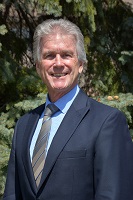
PHOTOS: From left, Jack Roberts during an interview in 1986, at Ford Field in 2005 and during a Representative Council meeting in 2014.