

Preview: Classic Clashes and Broken Records Expected
By
Geoff Kimmerly
MHSAA.com senior editor
June 5, 2021
The attention that will be paid to one of the Lower Peninsula Boys Track & Field Finals on Saturday will go past usual interest in just a local school or single division.
Many eyes will be turned to the Division 1 meet, featuring among many Ann Arbor Skyline senior Hobbs Kessler, who has made national news over the last few weeks by setting the national high school record in the 1,500 (3:34.36) and qualifying for the Olympic Trials in the event.
But he’ll be facing some familiar competition in his distance races at East Kentwood – including Hartland junior Riley Hough, who edged Kessler by two seconds in the Division 1 cross country final this past fall.
Their matchup is just one of many stories worth tuning in for this weekend. Events at all four sites begin at 10 a.m. (EDT) and tickets to attend can be purchased online only at GoFan. The meets also will be broadcast on MHSAA.tv and viewable with subscription. Click to watch each division: LPD1 | LPD2 | LPD3 | LPD4.
Below is a glance at team contenders and individuals to watch in all four divisions.
Division 1 at East Kentwood
Top Regional scores: Macomb Dakota 160, Traverse City West 145½, Northville 136, Novi 136.
Team forecast: East Kentwood won the last three championships before COVID, with Ann Arbor Pioneer finishing runner-up in both 2018 and 2019. Dakota is an interesting possibility this time with qualifiers throughout the meet. Fenton has top-three seeds in six events, and Zeeland West is another team with scoring opportunities in a variety of events.
Trey Gardette, Ann Arbor Huron: The senior sprint star has taken amazing strides over the last two years and may be on the verge of an unforgettable finish to his high school career. Gardette’s top-seed 10.5 in the 100 is a blink faster than the LPD1 Finals record of 10.53, and he’s second-seeded in the 200 and also will run on the 400 relay.
Riley Hough, Hartland: The I-96 corridor has been the center of distance running this school year, and Hough hopes to follow his Division 1 cross country championship in the fall with titles in the 1,600 and 3,200. He’s seeded first in the former with a 4:13.93.
Hobbs Kessler, Ann Arbor Skyline: He’s slated to run the 800, 1,600 and 3,200 and on the top-seeded 3,200 relay (7:53.30) Saturday. He won all three of those open races at his Regional, and so while he isn’t top-seeded in any that likely means little as he could drop major time.
Tamaal Myers II, Detroit Cass Tech: The Technicians standout junior has the top 110 hurdles seed time (14.06) by nearly a second and is tied for the top seed time in the 300 (39.32). He’ll also run the 400 and on the 1,600 relay.
Brandon Miller, Fenton: He finished fifth in the 200 as a sophomore in 2019, but he can take a massive leap Saturday as his top seed time in that race (21.25) is five hundredths of a second off the meet record. He’s also the second seed in the 100 with a seed time of 10.60 that is seven hundredths of a second off that meet record. And he’ll also run on contending 400 and 800 relays.
Division 2 at Zeeland
Top Regional scores: Orchard Lake St. Mary’s 216½, Dearborn Divine Child 186, Frankenmuth 164.
Team forecast: Four teams have won this championship over the last four seasons. Flint Powers Catholic is a possibility to make it five as it runs for its first team title led by sprint standouts and relays. Frankenmuth with top qualifiers in the sprints, relays and field events is another to watch in what lines up to be a low-scoring team race. A total of 10 schools won championships in this division over the previous 11 seasons before 2020 was canceled.
Ryan Brenner, Frankenmuth: The senior Eagles hurdler is the top seed in the 300 with a time of 40.1 and also will run on the top-seeded 1,600 relay (3:28.44) and high jump.
Jamal Hailey, Berrien Springs: The standout junior sprinter has the top seed time in the 100 (11.04) and the third-fastest in the 200, and he’ll also run on the second-seeded 400 relay.
Austin Hamlin, Flint Powers Catholic: The Chargers sophomore would play a major role in any team title pursuit, entering with the top seed in the 200 (22.5), third-fastest in the 100 and as part of the top-seeded 400 relay (43.3) and fourth-seeded 800 relay. That 400 relay time is a second off the meet record.
Alex Mansfield, Monroe Jefferson: The junior thrower is another who has made a major move over the last two years. He enters Saturday with the top seed in the shot put (56-3) by two feet and the top seed in the discus (163-11) by nearly 10.
Luke Stowasser, Edwardsburg: The junior Eddies jumper also is top-seeded in both of his events, with a 22-6½ in the long jump and 6-10 in the high jump. That high jump is six inches better than the field and two off the meet record. He was the high jump runner-up as a freshman.
Division 3 at Jenison
Top Regional scores: Grass Lake 132, Caro 129, Pewamo-Westphalia 126 1/3.
Team forecast: Grass Lake will be pursuing its first team title since 1970 and has six top-four seeds leading the way. Figuring the next few contenders is difficult with points looking to be spread among a number of teams.
Brennan Bargesser, Grass Lake: A drive for the team championship would include significant points from Bargesser, who is seeded first in the 200 (21.98) and 400 (49.34) and second in the 100 for his final high school meet. He’ll also run on the top-seeded 400 relay (44.14) – that seed time is one second off the meet record.
Hunter Jones, Benzie Central: The sophomore standout has two Division 3 cross country championships to his credit and will make his Track Finals debut as the top seed in the 3,200 (9:37.42) and a likely contender in the 1,600 and 800 as well.
Josh Jones, Harrison: He’ll close his high school career running the 800, 1,600 and 3,200, with his 1,600 seed time (4:19.84) topping that event list.
Brenden Quackenbush, Chesaning: He’s set to establish himself in both throws at this level Saturday, with the top seed in the discus (143-0) by nearly two feet and the third seed in the shot put.
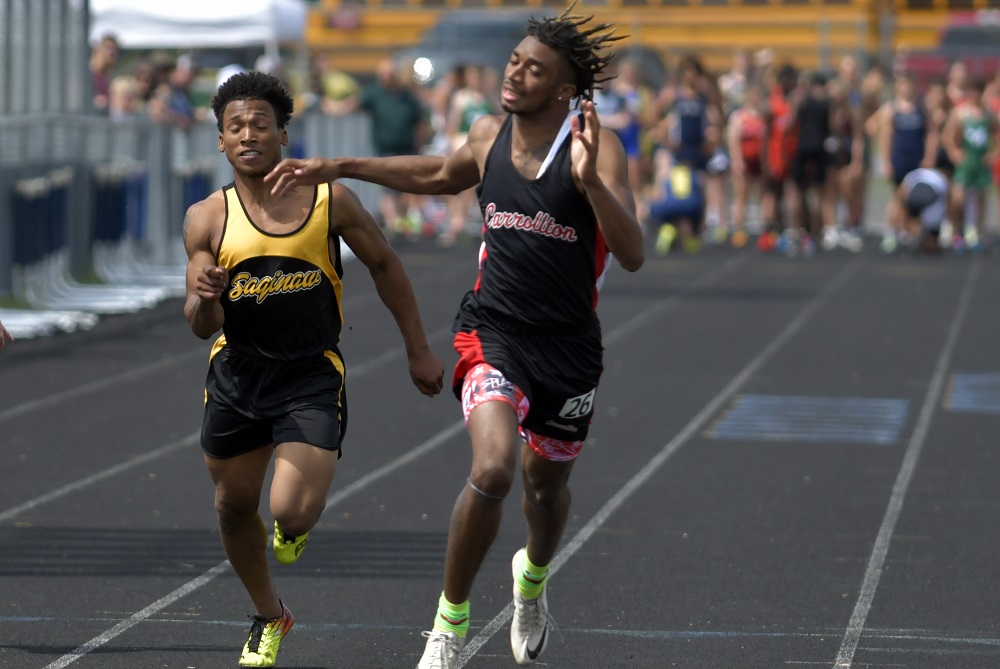
Derrick Voltz, Carrollton: A qualifier in the 100 as a freshman in 2019, he could cap his junior season as a two-event champion. He’s seeded first in the long jump (23-2) by nearly a foot with that leap only five inches off the meet record. He’s also the top seed in the 100 (11.11) just ahead of Bargesser.
Division 4 at Hudsonville
Top Regional scores: Lutheran Westland 171, Reading 170, Carson City-Crystal 147.
Team forecast: Kalamazoo Hackett Catholic Prep was the back-to-back champion before COVID, and Saugatuck was the Division 3 runner-up in 2019 but is back in Division 4. Saugatuck won’t run a relay this weekend but has favorites in the hurdles and distance events, and Breckenridge’s strengths in the sprints and relays should make it a team title contender as well as it seeks its first championship.
Coleman Clark, Carson City-Crystal: The lone returning champion in this division won the 3,200 as a sophomore in 2019 and will run that race along with the 800 and 1,600 and as part of the top-seeded 3,200 relay (8:19.40).
Benny Diaz, Saugatuck: The junior sprint/hurdles standout could make a run at four individual titles Saturday or next season. He’s the top seed in both hurdles races this time (15.01 in the 110 and 40.59 in the 300), and the fourth seed in the 200 and seventh in the 100. He was third in Division 3 in the 300 as a freshman.
Zane Forist, Carson City-Crystal: He was the runner-up in the discus and eighth in the shot put as a freshman two years ago, and he’s aiming for much more this time. His top-seed throws of 196-8 and 64-4, respectively, would both set LPD4 championship meet records – both by roughly six feet.
Nik Pettinga, Saugatuck: A top distance runner in cross country the last few seasons, he is looking to finish as a champion in his last high school meet and enters as the top seed in the 1,600 (4:26.99) and second seed (to junior teammate Max Sharnas) in the 3,200.
Charlie Steinhaus, Breckenridge: The speedy senior would help lead any charge for a team championship, entering as the top seed in the 100 (11.01) and second in the 200. He’ll also run on the top-seeded 400 relay (44.51) and second-seeded 800 relay.
PHOTO: Carrollton’s Derrick Voltz, right, breaks across the finish line during the 100-meter preliminaries at his Division 3 Regional at Shepherd last month. (Click for more from High School Sports Scene.)
1st Miss Basketball Recalls Marvelous Rise
January 31, 2018
By Ron Pesch
Special for Second Half
In the eyes of Julie Swanson, she lived an idyllic childhood.
She grew up in Leland. Her family lived on a small lake, a mere half mile from Lake Michigan. “I was a tomboy,” said Swanson recently from her home in Charlottesville, Va.
Today, the mother of three, Swanson excitedly reminisced about those early days when she was known as Julie Polakowski. As a kid, she saw herself without borders. She could become an artist, or a writer, or a woodworker. As time passed and her interests grew, she thought she might become an engineer or a teacher.
Then basketball arrived in her life, and life changed. She added coach to the list of possibilities.
“Our school was little, and we had a really small class,” remembered Swanson. “In seventh grade, school sports were offered for the first time; basketball for the boys, and cheerleading for the girls. I was shy and unassertive and didn't want to have to make waves to be allowed to play on the boys' team, but being a cheerleader just wasn’t me. And luckily I didn't have to make waves.”
The 1977 Leland yearbook lists 15 students in Polakowski’s seventh grade class – seven boys and eight girls.
“Not all of the boys wanted to play basketball. But I wanted to be on the team,” she said. “So I went out with my classmate, Cindy Moore. I think everyone was aware of Title IX. I don’t recall really any resistance. Besides, they kind of needed us. What would happen if someone got sick, or couldn’t play? Everyone wanted sixth and seventh team members.
“You could see it was more of a weird thing for the other team,” she continued, describing the restlessness in the opponents’ huddle as the game was about to begin. “No one wanted to be the one who had to guard the girl. Sometimes they would be afraid of contact. Sometimes, they would play harder, because they were afraid that they might have a girl score on them. Either way, it made you a better player.”
Simultaneously, changes occurred at Leland that would alter the path of a number of girls from the little town in Leelanau County.
***
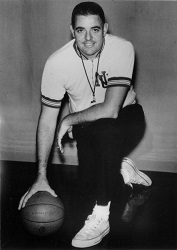
Larry Glass grew up in Beavercreek, Ohio, and graduated from the local high school in 1953. A four-sport star, he excelled in baseball and helped pitch the Beavers to the Class B state baseball championship as a junior and senior.
Glass earned a baseball scholarship to Miami of Ohio University, an hour from home. There he also played basketball, where he was a dependable sixth man. In 1956, he gave up a year of college eligibility to sign with the Cleveland Indians, and kicked around their minor league affiliates for a couple seasons before an arm injury ended his playing days.
 Following college and baseball, he taught a half year at Beavercreek, then taught English and coached a variety of sports for two years at Columbus Grove High School in Ohio.
In 1957, his old college basketball coach, William Rohr, became head basketball coach at Northwestern University. In 1960, Glass was asked to join the staff at the Big Ten school, first as freshman basketball coach, then as a varsity assistant. When Rohr left to become athletic director at Ohio University, the 28-year-old Glass was named Northwestern’s new varsity coach. He remained at the helm for six campaigns. In 1967, Glass earned National Coach of the Year votes, departing from the college coaching ranks following the 1968-69 season.
“There are people who are motivated by an intolerance to losing,” Glass told the Chicago Tribune. “It`s not so much they have to win, it`s that they can`t stand to lose. I don`t say that with any pride. It`s the way I operate. I hate to lose. When I got my big break, I got it at a place where you kind of have to get used to it. I couldn’t, and couldn’t see any way out of it. Ultimately, it got to the point where I didn`t have fun going to practice. The game simply wasn’t any fun anymore.”
He moved his family to northern Michigan, purchased the former Stier Motel on the west shore of upper Lake Leelanau, renamed it the “Glass House Motel” and then returned to the classroom, teaching seventh grade English at Leland. Life again changed when he was asked by his youngest daughters, Laurie and Rebecca, to take over the girls basketball program in 1977.
Traverse City Record-Eagle sports editor Dennis Chase recalled the story in 2012: “When the girls coach, Nancy Boynton Fisher, became pregnant, Glass felt some serious pressure to take over.” Larry and Dee Glass had three daughters and a son. When Dee asked her husband what he would do if his son had made the request for him to coach the boys team, Larry Glass, still running the motel, conceded, and took control of the girls team.
“OK,” he told his bride, “but I want you to understand, if I'm going to try to do this thing right, I'm not going to be home a lot." Glass would hook Polakowski and a host of girls at Leland on the game.
“Credit (for what came next) goes to our amazing coach, Mr. Glass,” said Swanson, admiringly. “He was our inspiration. “
The feeling, you could say, was mutual.
 “I find in my experiences that when you explain something to girls they listen,” said Glass to Detroit Free Press sports writer Mick McCabe in 1981. “There were always a few boys who were like Ford – they had a better idea. I guess some day it may get like that for girls, too.”
Girls basketball was played in the fall in Michigan at the time. Leland’s Comets went 13-6 in 1977 under Glass’ direction, then 18-3 in daughter Laurie’s senior year, falling in the District tournament to Maple City Glen Lake. The team finished with a 19-2 record the following year, also falling to Glen Lake in the postseason.
“They were our rival” recalled Swanson. “You know rivalries. You hate them. They’re the enemy.”
“In Polakowski’s first two years, Leland didn’t do much in the state tournament,” wrote McCabe, “mostly because of (Glen Lake’s) Laura Wiesen.” Another thorn was Kim Kaiser.
“We couldn't beat Glen Lake for three years,” Glass told Chase. “We finally beat them the fourth year when we started our run. We felt back then that the winner of the Leelanau District would be the state champion. We felt we were basically playing championship games at the District level. Glen Lake won one (state) title and should have won a second in that three-year span (1977-79).”
The Leland girls won the first of three consecutive MHSAA Class D titles in December of 1980 when Glass’ daughter Rebecca, his youngest, was a senior. It was Polakowski’s junior year.
In September of 1981, Coach Glass discussed the team’s success with McCabe, and explained why he returned to coach the girls after Rebecca had graduated.
“… I don’t feel I ought to leave the girls we have back for this team,” he said. “Julie averaged three hours a day practicing basketball this summer, and I like that kind of dedication.”
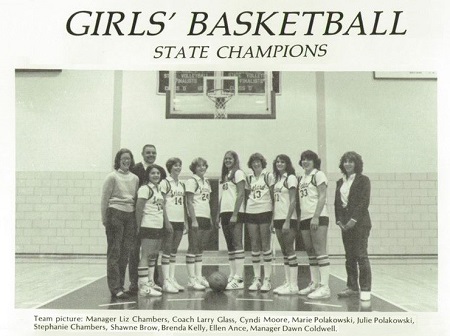
Leland's 1981 team posted a 28-0 record en route to the second consecutive MHSAA Class D title.
Polakowski finished her senior season with 812 points, a new single-season scoring mark, topping the 804 points scored by Evelyn Johnson of Lansing Everett in the fall of 1978. Polakowski’s career total of 2,109 points ranked second in Michigan history behind the 2,227 scored by Jackson’s Regina Pierce.
In late December, Polakowski and 19 others were named by the Detroit Free Press as first-team all-state selections. Glass, who would guide Leland to a third consecutive title in 1982, was honored as the state’s Coach of the Year. “Perhaps the best player in the state can be found among the Class D All Staters,” wrote McCabe alluding to the presence of both Polakowski and Wiesen on the honor team.
***
In the spring of 1981, the Michigan High School Basketball Coaches Association had presented Sam Vincent of Lansing Eastern with the first Hal Schram Mr. Basketball Award.
Similar honors were tradition in Indiana, California and other states. Now Michigan had one, to be presented to the state’s top senior male high school basketball player. Sponsored by the Detroit Free Press, the award was named after the highly-respected sports writer who had covered interscholastic athletics for the paper since 1945.
 In February 1982, two months after the announcement of the girls all-state teams, the Coaches Association announced the creation of a Miss Basketball Award to be presented to the state’s top senior female high school basketball player from the recently completed season.
Sponsored by the Lansing State Journal, it was styled after the Schram award. The winner of the honor would be announced in early April. Presentation of the award would come at the Coaches Association’s third annual All-Star Festival, hosted at Michigan State University’s Jenison Fieldhouse in late June.
Besides Polakowski, five other players from around the state were nominated for the honor. It was a talented bunch. Each would play in the first Girls East-West All-Star game, hosted by the Coaches Association.
• Lori Vettes of Addison, a 5-foot-7 guard named Class C first team all-state by the Free Press.
• Allison Geatches, an all-around sports star at Harper Woods Regina. A fourth team Parade All-American, she later played college ball at the University of Detroit before heading overseas to play a year of professional basketball in Belgium. Later, she spent a season with the Colorado Silver Bullets, an all-female baseball team that barnstormed the United States during the mid-1990s, squaring off against male counterparts. She went on to coach softball at Macomb Community College.
• Sal DeGraw, a four-year starter, three-time team Most Valuable Player and a Class B all-state selection at Marshall. DeGraw later starred as a softball player at Alma College. Marshall fell short of an MHSAA basketball title in DeGraw’s senior year, but in 2000, now as Sal Konkle, she took the reins of the girls basketball program at her old high school. In 2016, Konkle guided Marshall to an MHSAA championship game for the first time since 1981. This time, with her daughter on the team, Marshall emerged victorious.
• Denise Basford, a 5-foot-9 guard from Farmington Our Lady of Mercy, and honorary captain of the Free Press Class A all-state squad. She would go on to play at Notre Dame. A leader on the court, today she’s a lawyer and the mother of two college volleyball players.
• Kelly Belanger, a 5-foot-10 guard and forward at East Kentwood who earned Class A all-state honors. Following graduation, she would join Polakowski on the basketball court at Michigan State University. Today, she’s a professor of English at Valparaiso University and the author of Invisible Seasons – Title IX and the Fight for Equity in College Sports.
At least today, the absence of Wiesen from the ballot was surprising.
“Really?” said Swanson, 35 years later. “Laura was their best player. She was a better athlete than me. I thought she was great.
“Every year, Glen Lake’s boys coach Don Miller would host the Leelanau County basketball clinic,” remembered Swanson. “It had always been hosted at Glen Lake, but one year he had it come over to Leland, and then it alternated. Anyway, there we got to know each other, we got to befriend them. I got to know her, and I really liked her.”
“She was a very good player,” recalled Belanger. Wiesen went on to play at Northwestern, and then returned to Glen Lake, serving as assistant to her high school coach, Ted Swierad.
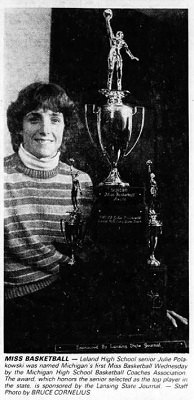 In early April, Polakowski was named the winner of the first Miss Basketball honor, but, unlike today, no vote totals were announced.
“It was a nice surprise for me,” she recalled.
In June 1982, a team of all-stars separated into squads representing the East and West sides of the state. For the first time, the All-Star Festival included a game for the girls. Before the contest, Polakowski was honored with the Miss Basketball Award.
“My jersey number was 1,” remembered Swanson. “It was kind of embarrassing.”
The West, made up of primarily Class C and D players, won 81-62, with Polakowski and Wiesen sharing the backcourt. The girls also shared top scoring honors with 17 points each. Wiesen was awarded the MVP award for the game.
Marveling at the list of candidates and recalling the all-star game, former Grand Rapids West Catholic and Aquinas College girls basketball coach – and spokesperson for the Coaches Association at the time of the first award – Patti Tibaldi spoke glowingly about the era and the efforts to honor the girls.
“I’m nostalgic for the time. Wow. It was a time of all kinds of change – wonderful, challenging times,” Tibaldi said. “These girls (from the era) were so grateful for the chance to play, so passionate. They would have run through a wall for their coaches.”
“I think I learned I was nominated from my high school coach at Regina, Diane Laffey,” said Geatches, who now lives in Florida. “I remember the (all-star) game at the fieldhouse at MSU and being in awe. We were treated very well. My mom was there. I can’t tell you how I did in the game, but I recall being really happy about getting a new pair of tennis shoes for the game. I came from a family of seven, so that was kind of a big deal.”
“I guess I learned of the award, but I don’t recall when,” said Belanger, trying to remember the event. “I did play in the all-star game. I remember we stayed in the dorms at MSU. It was a different time. Girls basketball wasn’t as celebrated as it is today, but it was fun. I remember wishing there was more. At least, I wanted more. I don’t think there was as much year-around play. There were some camps for those who could afford them.”
“The girls today have no idea what these women went through,” added Tibaldi. “And that’s a good thing. They shouldn’t have to think about being given the same opportunities. Do you know what I mean?”
Swanson graduated from MSU, then taught math and coached girls varsity basketball in Iowa. These were the days when high school teams in Iowa began the switch from 6-on-6 basketball, once the norm across the nation for girls, to the five-player game. Following her marriage to husband Steve, who has served as head coach of the University of Virginia women’s soccer team for the past 17 years, and the birth of their first child, Swanson became a stay-at-home mom and pursued life as a writer.
Today she is the author of middle grade and young adult novels, including Going for the Record.
“I might not have been the most athletic,” added Swanson, “or the best player in the state. But basketball was everything to me.
“I doubt anyone could have been more obsessed with, maybe even unbalanced by, the game than I was.”
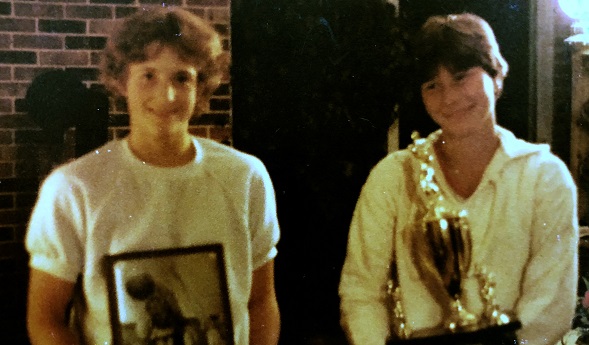
PHOTOS: (Top) Julie Polakowski (left with Miss Basketball plaque) and Laura Wiesen (right with her MVP trophy) following the Coaches Association All-Star game. (Top middle) Larry Glass, who coached the Northwestern University men’s basketball team and later the Leland girls basketball team. (Middle) The Glass House Motel, purchased and renamed by the Glass family after its move to northern Michigan. (Bottom middle) Leland’s 1981 team finished 28-0 in winning a second straight Class D title. (Below) Polakowski, with the Miss Basketball trophy. (Photos provided by Ron Pesch.)