

Preview: Classic Clashes and Broken Records Expected
By
Geoff Kimmerly
MHSAA.com senior editor
June 5, 2021
The attention that will be paid to one of the Lower Peninsula Boys Track & Field Finals on Saturday will go past usual interest in just a local school or single division.
Many eyes will be turned to the Division 1 meet, featuring among many Ann Arbor Skyline senior Hobbs Kessler, who has made national news over the last few weeks by setting the national high school record in the 1,500 (3:34.36) and qualifying for the Olympic Trials in the event.
But he’ll be facing some familiar competition in his distance races at East Kentwood – including Hartland junior Riley Hough, who edged Kessler by two seconds in the Division 1 cross country final this past fall.
Their matchup is just one of many stories worth tuning in for this weekend. Events at all four sites begin at 10 a.m. (EDT) and tickets to attend can be purchased online only at GoFan. The meets also will be broadcast on MHSAA.tv and viewable with subscription. Click to watch each division: LPD1 | LPD2 | LPD3 | LPD4.
Below is a glance at team contenders and individuals to watch in all four divisions.
Division 1 at East Kentwood
Top Regional scores: Macomb Dakota 160, Traverse City West 145½, Northville 136, Novi 136.
Team forecast: East Kentwood won the last three championships before COVID, with Ann Arbor Pioneer finishing runner-up in both 2018 and 2019. Dakota is an interesting possibility this time with qualifiers throughout the meet. Fenton has top-three seeds in six events, and Zeeland West is another team with scoring opportunities in a variety of events.
Trey Gardette, Ann Arbor Huron: The senior sprint star has taken amazing strides over the last two years and may be on the verge of an unforgettable finish to his high school career. Gardette’s top-seed 10.5 in the 100 is a blink faster than the LPD1 Finals record of 10.53, and he’s second-seeded in the 200 and also will run on the 400 relay.
Riley Hough, Hartland: The I-96 corridor has been the center of distance running this school year, and Hough hopes to follow his Division 1 cross country championship in the fall with titles in the 1,600 and 3,200. He’s seeded first in the former with a 4:13.93.
Hobbs Kessler, Ann Arbor Skyline: He’s slated to run the 800, 1,600 and 3,200 and on the top-seeded 3,200 relay (7:53.30) Saturday. He won all three of those open races at his Regional, and so while he isn’t top-seeded in any that likely means little as he could drop major time.
Tamaal Myers II, Detroit Cass Tech: The Technicians standout junior has the top 110 hurdles seed time (14.06) by nearly a second and is tied for the top seed time in the 300 (39.32). He’ll also run the 400 and on the 1,600 relay.
Brandon Miller, Fenton: He finished fifth in the 200 as a sophomore in 2019, but he can take a massive leap Saturday as his top seed time in that race (21.25) is five hundredths of a second off the meet record. He’s also the second seed in the 100 with a seed time of 10.60 that is seven hundredths of a second off that meet record. And he’ll also run on contending 400 and 800 relays.
Division 2 at Zeeland
Top Regional scores: Orchard Lake St. Mary’s 216½, Dearborn Divine Child 186, Frankenmuth 164.
Team forecast: Four teams have won this championship over the last four seasons. Flint Powers Catholic is a possibility to make it five as it runs for its first team title led by sprint standouts and relays. Frankenmuth with top qualifiers in the sprints, relays and field events is another to watch in what lines up to be a low-scoring team race. A total of 10 schools won championships in this division over the previous 11 seasons before 2020 was canceled.
Ryan Brenner, Frankenmuth: The senior Eagles hurdler is the top seed in the 300 with a time of 40.1 and also will run on the top-seeded 1,600 relay (3:28.44) and high jump.
Jamal Hailey, Berrien Springs: The standout junior sprinter has the top seed time in the 100 (11.04) and the third-fastest in the 200, and he’ll also run on the second-seeded 400 relay.
Austin Hamlin, Flint Powers Catholic: The Chargers sophomore would play a major role in any team title pursuit, entering with the top seed in the 200 (22.5), third-fastest in the 100 and as part of the top-seeded 400 relay (43.3) and fourth-seeded 800 relay. That 400 relay time is a second off the meet record.
Alex Mansfield, Monroe Jefferson: The junior thrower is another who has made a major move over the last two years. He enters Saturday with the top seed in the shot put (56-3) by two feet and the top seed in the discus (163-11) by nearly 10.
Luke Stowasser, Edwardsburg: The junior Eddies jumper also is top-seeded in both of his events, with a 22-6½ in the long jump and 6-10 in the high jump. That high jump is six inches better than the field and two off the meet record. He was the high jump runner-up as a freshman.
Division 3 at Jenison
Top Regional scores: Grass Lake 132, Caro 129, Pewamo-Westphalia 126 1/3.
Team forecast: Grass Lake will be pursuing its first team title since 1970 and has six top-four seeds leading the way. Figuring the next few contenders is difficult with points looking to be spread among a number of teams.
Brennan Bargesser, Grass Lake: A drive for the team championship would include significant points from Bargesser, who is seeded first in the 200 (21.98) and 400 (49.34) and second in the 100 for his final high school meet. He’ll also run on the top-seeded 400 relay (44.14) – that seed time is one second off the meet record.
Hunter Jones, Benzie Central: The sophomore standout has two Division 3 cross country championships to his credit and will make his Track Finals debut as the top seed in the 3,200 (9:37.42) and a likely contender in the 1,600 and 800 as well.
Josh Jones, Harrison: He’ll close his high school career running the 800, 1,600 and 3,200, with his 1,600 seed time (4:19.84) topping that event list.
Brenden Quackenbush, Chesaning: He’s set to establish himself in both throws at this level Saturday, with the top seed in the discus (143-0) by nearly two feet and the third seed in the shot put.
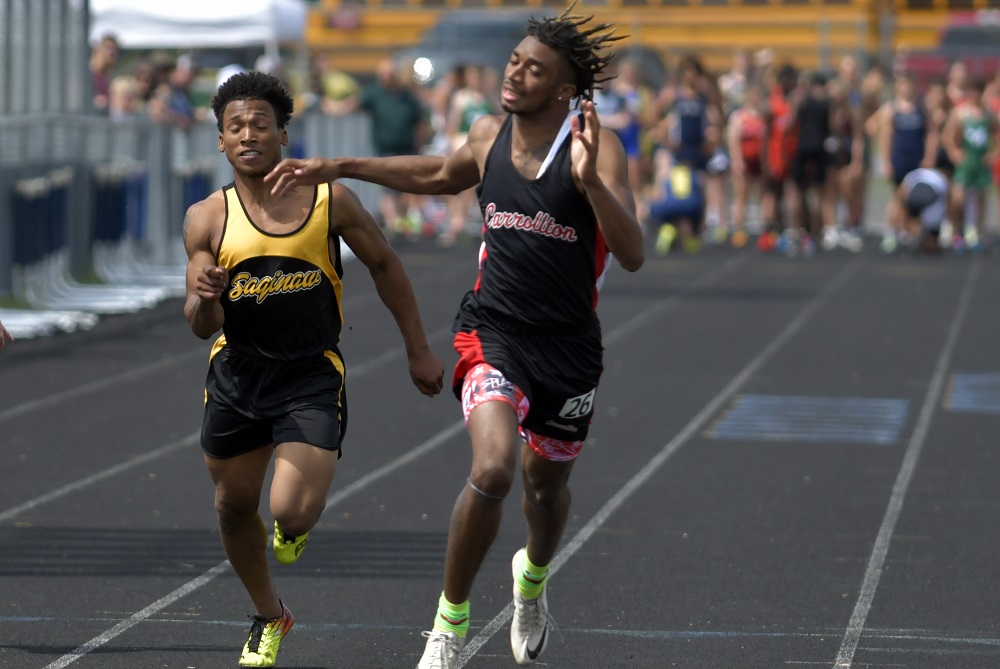
Derrick Voltz, Carrollton: A qualifier in the 100 as a freshman in 2019, he could cap his junior season as a two-event champion. He’s seeded first in the long jump (23-2) by nearly a foot with that leap only five inches off the meet record. He’s also the top seed in the 100 (11.11) just ahead of Bargesser.
Division 4 at Hudsonville
Top Regional scores: Lutheran Westland 171, Reading 170, Carson City-Crystal 147.
Team forecast: Kalamazoo Hackett Catholic Prep was the back-to-back champion before COVID, and Saugatuck was the Division 3 runner-up in 2019 but is back in Division 4. Saugatuck won’t run a relay this weekend but has favorites in the hurdles and distance events, and Breckenridge’s strengths in the sprints and relays should make it a team title contender as well as it seeks its first championship.
Coleman Clark, Carson City-Crystal: The lone returning champion in this division won the 3,200 as a sophomore in 2019 and will run that race along with the 800 and 1,600 and as part of the top-seeded 3,200 relay (8:19.40).
Benny Diaz, Saugatuck: The junior sprint/hurdles standout could make a run at four individual titles Saturday or next season. He’s the top seed in both hurdles races this time (15.01 in the 110 and 40.59 in the 300), and the fourth seed in the 200 and seventh in the 100. He was third in Division 3 in the 300 as a freshman.
Zane Forist, Carson City-Crystal: He was the runner-up in the discus and eighth in the shot put as a freshman two years ago, and he’s aiming for much more this time. His top-seed throws of 196-8 and 64-4, respectively, would both set LPD4 championship meet records – both by roughly six feet.
Nik Pettinga, Saugatuck: A top distance runner in cross country the last few seasons, he is looking to finish as a champion in his last high school meet and enters as the top seed in the 1,600 (4:26.99) and second seed (to junior teammate Max Sharnas) in the 3,200.
Charlie Steinhaus, Breckenridge: The speedy senior would help lead any charge for a team championship, entering as the top seed in the 100 (11.01) and second in the 200. He’ll also run on the top-seeded 400 relay (44.51) and second-seeded 800 relay.
PHOTO: Carrollton’s Derrick Voltz, right, breaks across the finish line during the 100-meter preliminaries at his Division 3 Regional at Shepherd last month. (Click for more from High School Sports Scene.)
Farewell Silverdome; Our Memories Live On
By
Ron Pesch
MHSAA historian
November 28, 2017
Farewell Pontiac Silverdome.
In early December, more than 15 years after the Detroit Lions played their last game beneath its air-supported Teflon-paneled roof, the “Dome” will take a last breath and then depart.
Finally.
The last few years have been cruel to the stadium that was once a gem and the home of dreams.
The Lions arrived at the newly opened “Pontiac Metropolitan Stadium” (or “Ponmet” as it was called by enthusiasts of the new structure) in August 1975. It was renamed “Pontiac Stadium” later in the year by the city council, and in October of 1976 the Pontiac council again re-christened the building as the “Pontiac Silverdome.”
“We feel the new name better conveys the image of our facility,” said Charles McSwigan, Jr., stadium executive director, at the time. “It certainly lets everyone around the country know we have a modern year-round domed stadium.”
The move was primarily marketing motivated. “The other three giants, Super, Astro and King, get all the publicity,” added McSwigan, further explaining the change. “Promoters call them, but they don’t even come near us.”
Launched in 1975, the MHSAA football championship games were played outdoors at college stadiums that first year on the Saturday before Thanksgiving. While deemed a success, the games were played at two different sites. That had presented challenges.
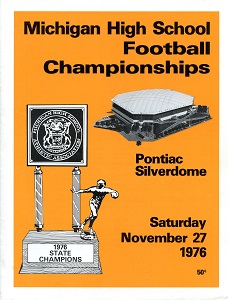 Following that first year, consideration was given to the new structure in Pontiac.
“There are some problems,” remarked Al Bush, MHSAA executive director, explaining the logistics of a possible move to the NFL stadium. “For instance, it would be difficult to play four games on the same day. We would have to start early in the morning, and the last game would have to start late at night.”
Competition for attendance with various events, including deer hunting season, and college football – especially the televised University of Michigan-Ohio State game – were factors to be considered. The high school football playoffs were still a new product without a tradition. Finances also were an area of worry. It was estimated that a crowd of between 20,000 and 25,000 would be needed to make the jump economically feasible.
So, it was with great caution and trepidation that the move was made indoors to Pontiac. Initially, the contract was for a single year. The games would be played on the Saturday following Thanksgiving. By all measures, to the delight of all involved, the 1976 championships were a huge success.
“The four state championship games, which were played in the Silverdome in two sessions on Saturday, drew a paid attendance of 29,423 fans,” said Associated Press writer Harry Atkins in a follow-up piece following the games, “bringing smiles of relief and joy to MHSAA Executive Director Al Bush and his assistant, Vern Norris. The attendance figure was almost double the number of fans who turned out last year in ice box-like weather at two sites – Western Michigan University and Central Michigan University.”
With that, a new contract was signed, and for 29 years the city of Pontiac served as home to the MHSAA 11-player football championships. “Goin’ to the Dome” soon became the goal of every high school in Michigan that offered the sport.
Following a 15-10 victory over the Dallas Cowboys in early January 2002, the Lions departed the Silverdome for Ford Field, located in downtown Detroit. The high school Finals stayed put for three more years before moving to Ford Field.
Twelve seasons after following the Lions from Pontiac to Detroit, countless memories and several MHSAA championship game records still stand from those years under the Dome.
Four championship games were played at the Silverdome to close each season from 1976-90. In 1991, the playoffs were expanded to eight classifications and the Finals expanded to eight games over a two-day showcase.
For many across Michigan, those 176 high school state title games were their first live exposure to the building many had only seen on television. For football fans, the MHSAA Finals provided an affordable and unique chance to visit the stadium and watch the game between the 20-yard-lines at ground level. An NFL game, concert, or in later years a Pistons basketball game at the Silverdome was far from an intimate experience for most. Seating 80,311, it was the largest stadium in the NFL until 1997.
For thousands of athletes and coaches, the playing surface was their first exposure to artificial turf. It was an honor to set foot on the field. After all, who didn’t want to run on the same canvas on which Lions legend Barry Sanders painted?
 Who can forget the Mill Colemen-led comeback drive to title glory in the final minutes as Farmington Hills Harrison downed DeWitt for the Class B title in 1989, or “The Catch” by Muskegon Reeths-Puffer’s Stacy Starr that broke the hearts of Walled Lake Western players and fans in the final seconds in Class A in 1992? Who remembers the wild 91 points (and 883 yards in total offense) posted in Belding’s 50-41 victory over Detroit Country Day in Class B in 1994, when Belding trailed by 19 points at the half? The combined final score remains the record for most points tallied in a title game by two teams.
Farmington Hills Harrison and coach John Herrington won five consecutive finals in Pontiac (1997, 1998, 1999, 2000, 2001), and 12 of their 13 MHSAA Finals titles at the Silverdome. A total of 12 of Detroit Catholic Central’s 17 trips to the Finals meant a bus ride to Pontiac.
One record performance set in the opening game of the 1976 championships still stands in the MHSAA championship record book. With the evolution of the game, it may never fall.
Despite the climate-controlled environment afforded by moving indoors, Crystal Falls Forest Park threw only three passes against Flint Holy Rosary in the Class D title game, completing one for a net -3 yards. By default, that total established a record for pass defense in a title game. It remains the zenith.
Forest Park had little need for the pass that day. The Trojans rolled up 234 rushing yards on 48 carries, including a 74-yard touchdown run off left tackle by all-state running back Marty Ball with 4:36 to play in the first quarter. Less than two minutes later, a fumble recovery by Forest Park’s Charlie Davis was returned 25 yards for a score, and the Trojans led, 14-0. Holy Rosary passed for 204 yards including an 18-yard pass from Ron Fray to Dan Lehoux in the second quarter, but couldn’t overcome that first quarter deficit, falling 14-6. A crowd of 14,879 attended the day’s first session, comprised of the Class D and Class A games.
Other long-standing record performances at the Dome still can be spotted in the record book.
Josh Wuerfel’s 46-yard field goal in the second quarter gave Traverse City a 10-0 halftime lead and aided the second-ranked Trojans’ 24-14 defeat of top-ranked Detroit Catholic Central in the 1988 Class A contest. The kick stood for 28 years as the title game record before finally being exceeded (twice!) at the 2016 championships played at Ford Field. Liam Putz of Grand Rapids West Catholic shattered the mark with a 47-yarder against Menominee in the Division 5 title game, before Ben Fee of Orchard Lake St. Mary’s topped the kick in the eighth game of the weekend. Fee’s 49-yard field goal late in the fourth quarter helped St. Mary’s down Muskegon 29-28 in the Division 3 thriller. The boot was his third field goal of the game. Combined with two extra points, he finished as the Eaglets’ top scorer.
Paul Gross of Jackson Lumen Christi established a new mark for extra points against Livonia Clarenceville in the 2001 Division 5 game, connecting accurately on all seven of his attempts. The record has been matched twice since the move to downtown Detroit.
Nick Williams’ 90-yard touchdown dash on Farmington Hills Harrison’s first play from scrimmage in the 1994 Class A game, a 17-13 victory over Grand Rapids Forest Hills Central, still tops the record book category for longest run play in a title game. An 89-yard TD run by Constantine’s Jim Schragg sits directly behind the Williams’ mark. Schragg rolled up 307 yards in a 34-13 win over Suttons Bay in the 2004 Division 6 game, during the final year at the Silverdome. His total established the pinnacle for rushing yards in a game.
Ravenna’s Benny Clark carried the ball 49 times (including 29 rushes in the second half) for 212 yards as the Bulldogs topped Morenci 30-14 in the 1996 Class C contest. The total, which exceeded the previous mark of 40 set by Dan Lato of Crystal Falls Forest Park in 1977, has yet to be matched or exceeded.
The fastest championship game passing touchdown came 15 seconds into the 2003 Division 5 Final, when Jackson Lumen Christi‘s Tyler Aldridge found wide-open Matt Russell on a reverse pass on the second play from scrimmage. The Titans defeated Muskegon Oakridge 23-0 for the title.
 Quarterback Tony Koshar tossed a short pass to Jim Steinman, “who shed a tackler and managed to stay in bounds as he took off for the end zone on a 96-yard scoring play,” as Gobles grabbed a 31-22 upset victory over top-ranked Crystal Falls Forest Park in the 1984 Class D title game. The reception for the longest pass play lasted 24 years before it was finally topped in 2008.
Kirk Williams’ 15 pass receptions for DeWitt against East Grand Rapids in the 2002 Division 3 contest still stand the test of time, as does Brad Johnson’s 87-yard punt return for a touchdown for Schoolcraft against Frankfort in the 1988 Class D championship game.
The 1991 title games saw two defensive marks set, both on the same day. On Saturday, November 30, Rick Marcotte of Lake Linden-Hubbell scooped up a fumble and dashed 79 yards for a touchdown and a new Finals record versus Mendon in Class DD. Less than 16 hours earlier Nate Cierlak of Muskegon Catholic Central had set the mark with a 56-yard return for a TD against Harbor Beach. In that year’s Class CC Final against Negaunee, Jason Livengood of Battle Creek Pennfield set the one mark that statistically can never be topped when he returned a pick-six for 100 yards.
Eight punts by Muskegon’s Jason Crago in the Big Reds’ 16-13 victory over Detroit Martin Luther King in the 1989 Class A title game was unmatched until 2007, when Aaron Hudson of Blissfield equaled the total. On Saturday, Clarkston’s Jermaine Roemer also tied the record in the Division 1 Final.
Between 1976 and 2004, more than 1.5 million fans attended the games in Pontiac, with a peak of attendance of 71,156 in 1995.
Soon the site will be cleared, with plans for redevelopment. Not far down the road, The Palace of Auburn Hills, once home to the MHSAA Basketball Finals and longtime home to the MHSAA Individual Wrestling Finals, will be scrubbed from the earth. Along with them, the structural evidence of the home of countless accomplishments will disappear.
Change is constant, and time moves on. Still those achievements, and several others, live on in the pages of the MHSAA record book, in the memories of those who competed and the recollections of those who played witness.
 Ron Pesch has taken an active role in researching the history of MHSAA events since 1985 and began writing for MHSAA Finals programs in 1986, adding additional features and "flashbacks" in 1992. He inherited the title of MHSAA historian from the late Dick Kishpaugh following the 1993-94 school year, and resides in Muskegon. Contact him at [email protected] with ideas for historical articles.
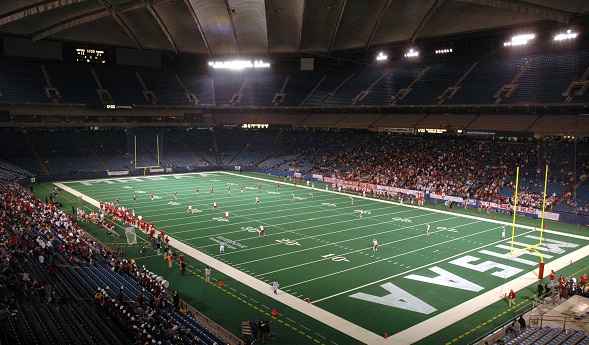
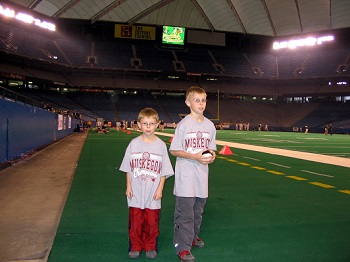
PHOTOS: (Top) Constantine and Suttons Bay played in the Division 6 Final at the Silverdome as part of the last weekend of MHSAA games in the building in 2004. (Top middle) The 1976 program welcomed Finals fans to the Dome for the first time. (Bottom middle) The author's children during a trip to the Silverdome before the Finals moved to Ford Field. (Below) The 1986 Finals ticket got fans into two games at the Silverdome for $4. (Photos courtesy of Ron Pesch and MHSAA files.)