

Tales of Teams, Trophies & Trinkets - Vol 2
By
Ron Pesch
MHSAA historian
February 9, 2017
A picture may be worth a thousand words – but often, we can learn as much from a traveling trophy, game ticket, and even an old megaphone.
Michigan’s high school sports history is more than a century old and filled with legends passed on of games, teams and athletes and the roles they played as our communities rolled forward toward present day. Following up last year’s “Tales of Teams, Trophies & Trinkets,” we present a second chapter highlighting artifacts that tell some of those stories.
|
1909 |
Saginaw vs. Saginaw Arthur Hill |
Football Trophy |
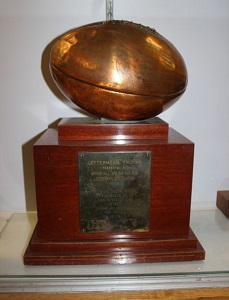 This bronzed football was the original used in the 1909 Thanksgiving Day contest played between Saginaw High and Saginaw Arthur Hill, and won by Saginaw, 5-0 at Burkart Park. In 1948, the ball was stylized into a trophy by the Letterman’s Associations of the rival schools, designed to travel between schools as the reward for winning the annual contest. When the Lumberjacks of Arthur Hill ripped off 24 straight victories beginning in 1971 (the teams played twice in 1974), ownership of the trophy was mostly forgotten. When talk of closing Saginaw High School mounted, the trophy was placed on display at Saginaw’s Castle Museum, then donated to the Saginaw County Sports Hall of Fame.
According to Jeffrey Cottrell, the multi-media specialist at the Historical Society of Saginaw County, when plans to close Saginaw High did not materialize, “it was decided amongst the Saginaw County Sports Hall of Fame and the Arthur Hill Letterwinners Association that it was time to put it back into use. This past fall, the Sports Hall of Fame awarded the trophy to Saginaw High when they beat Arthur Hill 40-0.”
Going forward, the Letterman's Trophy will continue to be presented to the winner of the football game between the Trojans and the Lumberjacks.
|
1921 |
Detroit Cass Tech vs. Flint Central |
Football Program |
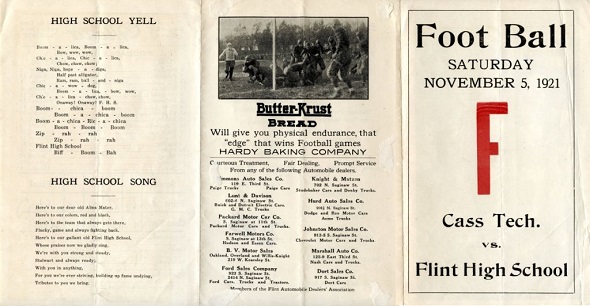
A crowd of 2,500 was on hand for this contest as Detroit Cass Tech downed Flint Central, 34-20, in an aerial battle between the squads. The Detroit Free Press arraigned for a special interurban run, with special railcars earmarked for Cass Tech students interested in attending the Saturday game at Flint. Between 200 to 300 made the trip to cheer their team to victory.
Flint Central completed 14 of 34 passes for 176 yards, but was intercepted on six occasions. Cass Tech arms were accurate on only 7 of 24 attempts for 160 yards, with four interceptions, but two completions went for touchdowns of 18 yards and 50 yards. A third pass of 35 yards helped set up the visitor’s first score. Bruno Murkobred, Cass Tech’s speedy quarterback, was the star of the contest, scoring three of his team’s five touchdowns.
|
1939 |
Kalamazoo Central vs. Battle Creek Central |
Basketball Program |
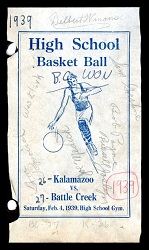 This tattered memento, from a scrapbook kept by historian Dick Kishpaugh, illustrates the modest design of a high school basketball program back in 1939. Likely created by the high school print shop, this single sheet, printed specifically for distribution at the game, features autographs gathered by its owner. Wes Clark, one of the names captured on the cover, led Battle Creek Central with 10 points, including a pair of buckets in the final minute to secure a 27-26 win by the Bearcats.
Newspaper reports from the time indicate that halftime of the contest would feature “a table tennis exhibition between Helen Van Dyke of Flint, four-time state champion, and Floyd Painter, Battle Creek champion.” Miss Van Dyke was a sophomore at Olivet College at the time.
|
1940 |
Lansing Eastern vs. Lansing Central |
Football Program |
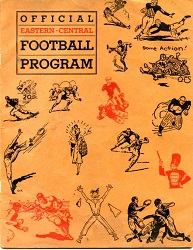 This is the program cover from the 13th annual Football Classic between the Quakers of Eastern and the Big Reds of Central. Fans were requested to “refrain from making unnecessary noise as they drive away from the stadium … due to the nearness of Sparrow Hospital.”
At the time of the 1940 contest, Lansing Central led the series with six wins against five defeats. The series featured a single tie, a 6-6 result in 1935.
Eastern’s 1940 squad, coached by Walter Graff, was able to knot the series at six wins apiece with a thrilling 7- 6 victory over the crosstown rivals, coached by Al Bovard.
The 16-page document was hand set and printed by the Eastern and Central High School Vocational Printing Classes, and included rosters, messages from the two school principals and athletic directors, as well as comments from each member of the coaching staffs, team captains, student council presidents and numerous team members from each school with their views on the game. Of course there is a photograph of each high school football team, but also photos of each band, their directors, and a list of the band members for both Eastern and Central. Finally, there are photos of the Eastern and Central Yell Leaders, nine for the Quakers and six for the Big Reds.
It is a true work of art.
|
1950 |
Central Michigan College Relays |
Track Medal |
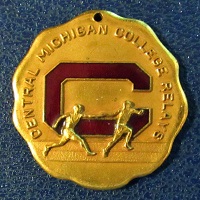 More than 2,300 athletes from 97 high schools descended upon Mt. Pleasant for the Tenth Annual Central Michigan Relays. Ecorse in Class B and Flint School for the Deaf in Class D earned team titles on Friday, May 5th while on Saturday, the 6th, Flint Northern and Milan won Class A and Class C, respectively. Six event records fell during the two-day event, three in the broad jump.
This medal, honoring a member of the winning Class C sprint relay team, was awarded at the event. The winning team, and therefore, the name of the individual awarded the medal, remain a mystery.
|
1962 |
Saginaw Sacred Heart |
Megaphone |
 As at the majority of schools across the state at the time, athletic competition against other schools was not an option for Gloria Groll and her female classmates during her days as a student at Saginaw Holy Rosary High School. So, from the fall of 1959 until her graduation with 27 other students in the spring of 1962, she was a cheerleader for the Greyhounds. This beautiful megaphone, donated by Groll to the Saginaw County Sports Hall of Fame, is a memento from those times.
Holy Rosary was one of nine Catholic high schools operating in the Saginaw area in the 1950s and 1960s. Population shifts from the cities to the suburbs over the coming years would impact enrollment figures at schools nationally. In Saginaw, the opening of the Buena Vista School District in 1956 directly impacted Holy Rosary. In 1970 the school closed. A year later only three schools – SS Peter and Paul, St. Mary and Saginaw St. Stephen – remained. In 1984, those schools were consolidated to form Saginaw Nouvel Catholic Central.
|
1963 & 1930 |
Grosse Pointe St. Paul |
League Trophies |
 On the left, we find the trophy awarded to Grosse Pointe St. Paul's after winning the 1963 city championship. Bob Martin, a 6-foot-6 junior who earned first division all-Catholic honors, scored 14 of his 22 points in the fourth quarter to lead the Lakers to a 55-46 upset-victory over Detroit Pershing. The game was played at University of Detroit Memorial before 6,979 spectators. It was the first time since 1958 that the Catholic League won the annual matchup with the champions of the Public School League.
To the right is the trophy awarded to St. Paul for winning the first golf tournament of the South Michigan Catholic High School League. The school's four golfers shot 710 over 36 holes on the day, 69 fewer strokes than second-place Detroit St. Rose. Played at Clinton Valley, the event saw Bill Beaupre win individual honors with a total of 158, including 76 in the morning. His cousin and teammate, Harold Beaupre, finished second with 169, while Peter Bononis of Detroit Holy Name was third with 171 strokes.
|
1965 |
Fennville vs. Kalamazoo Hackett |
Ticket Stub |
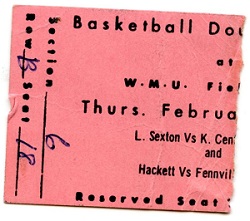 This ticket stub from a doubleheader hosted at Western Michigan University’s Read Fieldhouse on February 18, 1965 was the first chance for many to witness lightning in a bottle. A capacity-plus crowd of 9,100 fans slid through the gate to watch a rumor.
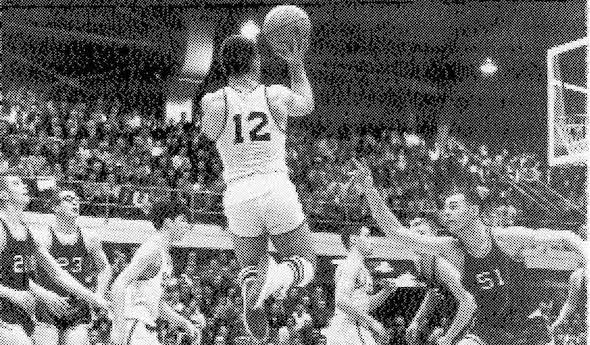
The antics of 5-foot-7½ guard Richie Jordan had been talked about around the Kalamazoo area, but few had actually seen him play. His skills were on full display on this Thursday night, as he netted a fieldhouse scoring record with 49 points in a come-from-behind 76-72 win over a much taller team from Kalamazoo Hackett. Jordan’s output during the evening’s second game eclipsed the 45 points Manny Newsome scored for Western Michigan University against Toledo, just over a year before.
The evening hadn’t started well. According to the Kalamazoo Gazette, “Jordan hit only six of his 13 field shots in the first half and threw the ball away eight times. Trailing Hackett by 17 points, 50-33, with two minutes to play in the third quarter, the Blackhawks were able to cut the deficit to 13, 60-47 as the teams entered the final frame.
Quickly, everyone in the fieldhouse knew who was getting the ball during the comeback attempt. Jordan grabbed control; with his drives for layups and “softly-arched” jump shots against intense pressure, he hit seven of nine field goals, wowing the crowd. With 2:36 to play, Jordan nailed a pair of free throws to tie the game at 72 all. Then, with 57 seconds left, the “Fennville Flash” nailed the go-ahead basket, followed by two insurance free throws to seal the win. For many, his 24 points in the fourth quarter sealed his journey from rumor to legend and, no doubt, inspired the single-sentence first paragraph of the next morning’s coverage in the Gazette.
“Yes, there is a Richie Jordan!”
(P.S. – Kalamazoo Central upset eighth-ranked Lansing Sexton, 67-57, in the evening’s opening contest).
 Ron Pesch has taken an active role in researching the history of MHSAA events since 1985 and began writing for MHSAA Finals programs in 1986, adding additional features and "flashbacks" in 1992. He inherited the title of MHSAA historian from the late Dick Kishpaugh following the 1993-94 school year, and resides in Muskegon. Contact him at [email protected] with ideas for historical articles.
PHOTO: Fennville's Richie Jordan pulls up for a jumper, showing off the form that's become iconic when recalling the high school phenom. (Photos of Letterman's Trophy and Megaphone were provided by Jeffery Cottrell, and photo of Grosse Pointe trophies was provided by Bill Roose.)

Jackson's Imprint on MHSAA Stretches 45 Years, Across 4 Executive Directors
By
Geoff Kimmerly
MHSAA.com senior editor
October 5, 2022
First impressions can be significant, as many a saying goes. And Karen Brown unknowingly provided one in 1978 that helped affect the course of athletics in this state over the next 40-plus years.
A Michigan State University student named Karen Leinaar had shown up at the Michigan High School Athletic Association for a meeting about a 5K road race she was planning that was unrelated to the MHSAA except that the building provided a good meeting place – and Brown, just a year out of high school, was the first person to greet her at the old Trowbridge Road headquarters.
Seeing someone her age immediately made Leinaar more comfortable. She ended up returning to that office several times over the years, registering as an MHSAA game official while still an MSU student and then starting a career in 1982 that has included nearly 40 years as a high school athletic director and two decades of shaping policy as part of the MHSAA Representative Council.
That’s the kind of impact that’s emanated from Karen Jackson, formerly Brown, and over the last 45 years as assistant to four of the five executive directors during the MHSAA’s 98-year history. Jackson finished that run with her retirement Friday.
“She was always one that would welcome you, and whether you walked into the office or called on the phone, she always had an answer that would calm you down or provide you with the information you needed,” said Leinaar, who currently is serving as interim athletic director at Frankfort High School in addition to her duties as executive director of the Michigan Interscholastic Athletic Administrators Association.
“I remember initially calling and needing something from Mr. Norris – it was always Mr. Norris – and she could answer the question,” Leinaar added, referring to retired MHSAA executive director Vern Norris, who served in that role from 1978-86. “You didn’t want to talk to scary Mr. Norris – Vern was a wonderful man, but he was like the superintendent or principal. Karen always had the answer. … It was always that smile that made you feel like you were more than welcomed, wanted in the office, and everything is going to be OK.”
 Jackson began at the MHSAA in June 1977, two days before her graduation from long ago-closed Harry Hill High School in Lansing.
Her high school sports career amounted to about half a season on the Hill varsity volleyball team as a sophomore before she had to switch gears to begin working for the Lansing Regional Chamber of Commerce as part of a school co-op program.
Jackson graduated as a co-valedictorian of Hill’s Class of 1977. Despite her academic standing, she hadn’t received much guidance at school on the possibility of college. But she had a job offer from the Chamber – and also had heard from grade-school friend Deborah Norris (Vern’s daughter) about an opening at the MHSAA.
The MHSAA was offering more money, and Jackson was hoping to buy a car – and so at 18, she became the secretary for executive director Allen W. Bush.
The title has changed over the years, from secretary to the executive director, to executive assistant, to senior executive assistant. The MHSAA’s administrative processes obviously have changed, mostly because of technology, from everything done on paper and through the mail to just about everything conducted digitally over the internet.
But many of Jackson’s most important duties at the end of her tenure resembled those she was hired to carry out nearly half a century ago.
Setting Exemplary Expectations
Bush retired a year after Jackson began, and she then assisted Norris for his eight as executive director. She served with Jack Roberts through his 32 years as executive director from 1986-2018 and then for these first 3½ under current director Mark Uyl.
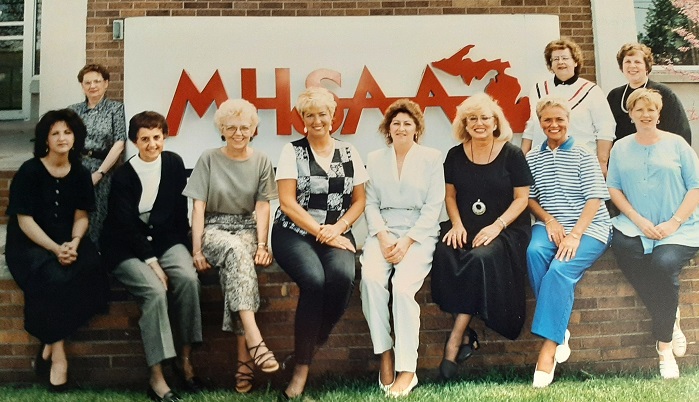
She was considered the “baby” of the MHSAA staff during her first 12 years, until she turned 30 and her support staff teammates declared she wasn’t the baby anymore during a Christmas party serenade. Just about 33 years later, she’s leaving as one of two people left who worked in the old offices before the MHSAA moved to another East Lansing headquarters at Ramblewood Drive in 1996.
School sports happen thanks to a Karen Jackson or two in every community -- people who provide the unseen support that makes these programs possible every day.
For the last 45 years, she’s provided a consistent anchor for service to 1,500 schools and millions of student-athletes across Michigan.
 “She’s shaped so much of what we’ve done,” said MHSAA assistant director Kathy Vruggink Westdorp, who joined the staff during the 2003-04 school year after more than two decades working for Grand Rapids-area schools. “Her service to schools was imperative to what she was doing, and it was a valuable part for our membership. Hers was such a dedicated service, such an exemplary service – finding solutions, to do what’s needed.”
There are file cabinets and libraries and hard drives at the MHSAA office, the contents of which are known by only a handful of people on Earth – and Jackson perhaps the most as she did most of the sorting and maintaining of those files over the years.
For a 1996 Lansing State Journal feature on the MHSAA’s support staff, Jackson (then Yonkers) explained “there are always new challenges, new issues and controversies. It never gets boring. In the past 19 years, we’ve slowly shifted from dealing with athletic administrators, principals and superintendents to dealing with legislators, attorneys and courts.”
The last 25 years has seen much of the work swing back to providing service directly to schools. And Jackson’s mind has become part MHSAA library and part card catalog of where to find those few snippets she might not recall immediately from the last half century.
“I guess what I’m proud of is being able to find things, to know where to find things and how to find things that other people don’t,” Jackson said. “Yes, the technology has changed everything. … We used to have more schools – they used to have 40-some Detroit public schools – and there was a whole era of (litigation), but it’s calmed down now.
“I liked what I did, and it kept me on my toes – that’s for sure.”
The MHSAA is rooted in its responsibilities as a championship and eligibility rules maker, and Jackson was involved in just about every communication in those areas during her time. Tournament changes are made at Representative Council meetings, and she’s reported the minutes for at least 150 of those, including piles of special sessions as the MHSAA managed sports through the COVID-19 pandemic. Eligibility waivers are requested at Executive Committee meetings, and she’s prepared somewhere north of 505 sets of minutes for those monthly sessions even as those agendas have grown in content substantially over the years.
Then there’s all of the correspondence from those four executive directors – all with the initials “kb” or “kj” to go with “AWB” or “VLN” or “JER” and “MU.” She also was in charge of MHSAA election ballots for 35 years, served as the lead organizer of cooperative programs, helped with football tickets for a time and briefly was part of the program-selling crew at early Football Finals at the Pontiac Silverdome.
“I think I’m pretty lucky, being on the Council and Executive Committee, that I’ve been able to work with her a lot. And most athletic directors, they may not even know who she is because they may not have contact with her or do anything with her – but she’s obviously been the unsung hero of that office,” said Vic Michaels, who serves as director of physical education & athletics for the Archdiocese of Detroit and has served on the Representative Council since 2003.
“She just does so much that you don’t really know about, especially with the Council. Whenever I need anything, Karen’s the one I call. She is the history, really. She’s the keeper of that.”
Unprecedented & 'Never to be Replicated'
A longtime co-worker of Jackson, Shirley Hytinen, retired in 1998 after just a few months more than 43 years. She too had worked for four executive directors, as she began in 1955 during the Charles E. Forsythe era.
Jackson surpassed Hytinen’s tenure a few years into Uyl’s, and can readily recall some of what stood out from all four directors she’s assisted.
Bush was “really stern” – he had served in the U.S. Marines – and she said he didn’t smile much until the day he announced his retirement, when it was “like a switch turned. He was smiling and happy and joking around.”
Norris was “the sweetest guy in the world.” Jackson had bought her first house in her mid-20s and was preparing to move in with only her dad and his motor home to assist, when Norris showed up to help at 7:30 a.m. that morning to provide another set of hands.
Roberts is known by Michigan administrators and national colleagues for his writing, and Jackson said jokingly she still “cringes” when she sees a yellow legal pad. She was an important proofreader and spent the majority of her career serving with her desk just a few paces away from that of the recent National Federation Hall of Fame selection, and she attended his induction this past summer and San Antonio.
 Roberts pointed out that during the 1980s, the MHSAA would conduct nine Executive Committee meetings, each averaging fewer than 10 requests for waivers. By the end of his 32 years, there were 11 Executive Committee meetings annually – with approximately 50 waiver requests presented on average. Still, he and Jackson were able to process the meeting minutes and continue to distribute those decisions within 24 hours.
“Over the more than three decades that Karen and I worked together at the MHSAA, the work became increasingly more voluminous and complicated – and Karen kept finding ways to increase our efficiency and maximize our output,” Roberts said.
Like Norris when Bush was executive director, Uyl had been part of the MHSAA staff under Roberts since 2004 before eventually moving into the corner office. After those first 15 years together, Uyl knew what a valuable person he had just a few yards away to assist in his transition, and “he just says to do this” and allows his staff to run with it, which Jackson enjoyed.
Her duties have been shifted confidently, mostly to Jamie VanDerMoere, another longtime administrative assistant who is best-known to Michigan school sports people for her leadership with the annual wrestling championship tournaments.
Jackson recently was married to Jim Jackson, and they have plans as they close in on their first anniversary – they’re hoping to travel to Italy at some point and also The Masters in Augusta, Ga., next spring. “I’m not going to miss coming to work every day, but the people,” Karen Jackson said.
And many in school sports across Michigan, although they may not realize it, will miss the contributions Jackson has made to their community over the decades including the context she’s provided as thousands of decisions have been made.
“Not only her understanding of our regulations and the processes of our regulations, but understanding why we have those things in place – when someone does something 45 years, you get a lot of historical context,” Uyl said. “What’s made her so effective is understanding the why – and that to me is something that’s almost impossible to replace.
“When an organization has been around 98 years with only five directors, it says something to have worked for four out of the five. That will never be replicated again.”
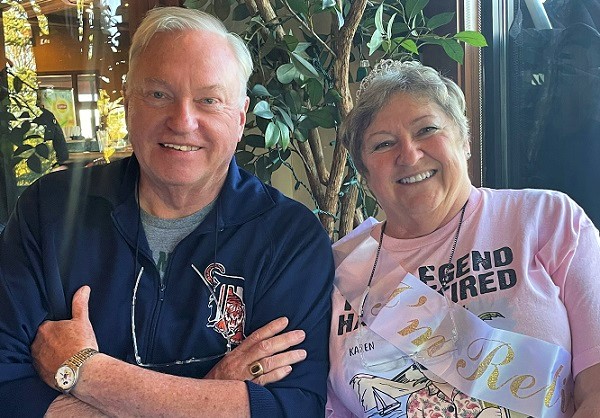
PHOTOS (Top) From top left, Karen Jackson has been a mainstay of the MHSAA for decades – serving membership, working with administrators like Randy Allen and Gina Mazzolini or serving as assistant to executive directors like Jack Roberts (right) and Vern Norris. (Middle) Jackson, sitting fourth from left, was the “baby” of the MHSAA staff after joining when she was 18. (Below) Jackson and husband Jim have plans to travel in retirement. (MHSAA archives.)