

Tales of Teams, Trophies & Trinkets - Vol 2
By
Ron Pesch
MHSAA historian
February 9, 2017
A picture may be worth a thousand words – but often, we can learn as much from a traveling trophy, game ticket, and even an old megaphone.
Michigan’s high school sports history is more than a century old and filled with legends passed on of games, teams and athletes and the roles they played as our communities rolled forward toward present day. Following up last year’s “Tales of Teams, Trophies & Trinkets,” we present a second chapter highlighting artifacts that tell some of those stories.
|
1909 |
Saginaw vs. Saginaw Arthur Hill |
Football Trophy |
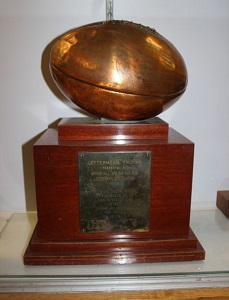 This bronzed football was the original used in the 1909 Thanksgiving Day contest played between Saginaw High and Saginaw Arthur Hill, and won by Saginaw, 5-0 at Burkart Park. In 1948, the ball was stylized into a trophy by the Letterman’s Associations of the rival schools, designed to travel between schools as the reward for winning the annual contest. When the Lumberjacks of Arthur Hill ripped off 24 straight victories beginning in 1971 (the teams played twice in 1974), ownership of the trophy was mostly forgotten. When talk of closing Saginaw High School mounted, the trophy was placed on display at Saginaw’s Castle Museum, then donated to the Saginaw County Sports Hall of Fame.
According to Jeffrey Cottrell, the multi-media specialist at the Historical Society of Saginaw County, when plans to close Saginaw High did not materialize, “it was decided amongst the Saginaw County Sports Hall of Fame and the Arthur Hill Letterwinners Association that it was time to put it back into use. This past fall, the Sports Hall of Fame awarded the trophy to Saginaw High when they beat Arthur Hill 40-0.”
Going forward, the Letterman's Trophy will continue to be presented to the winner of the football game between the Trojans and the Lumberjacks.
|
1921 |
Detroit Cass Tech vs. Flint Central |
Football Program |
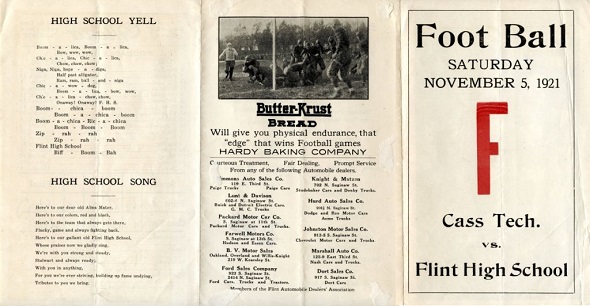
A crowd of 2,500 was on hand for this contest as Detroit Cass Tech downed Flint Central, 34-20, in an aerial battle between the squads. The Detroit Free Press arraigned for a special interurban run, with special railcars earmarked for Cass Tech students interested in attending the Saturday game at Flint. Between 200 to 300 made the trip to cheer their team to victory.
Flint Central completed 14 of 34 passes for 176 yards, but was intercepted on six occasions. Cass Tech arms were accurate on only 7 of 24 attempts for 160 yards, with four interceptions, but two completions went for touchdowns of 18 yards and 50 yards. A third pass of 35 yards helped set up the visitor’s first score. Bruno Murkobred, Cass Tech’s speedy quarterback, was the star of the contest, scoring three of his team’s five touchdowns.
|
1939 |
Kalamazoo Central vs. Battle Creek Central |
Basketball Program |
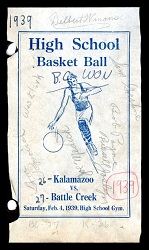 This tattered memento, from a scrapbook kept by historian Dick Kishpaugh, illustrates the modest design of a high school basketball program back in 1939. Likely created by the high school print shop, this single sheet, printed specifically for distribution at the game, features autographs gathered by its owner. Wes Clark, one of the names captured on the cover, led Battle Creek Central with 10 points, including a pair of buckets in the final minute to secure a 27-26 win by the Bearcats.
Newspaper reports from the time indicate that halftime of the contest would feature “a table tennis exhibition between Helen Van Dyke of Flint, four-time state champion, and Floyd Painter, Battle Creek champion.” Miss Van Dyke was a sophomore at Olivet College at the time.
|
1940 |
Lansing Eastern vs. Lansing Central |
Football Program |
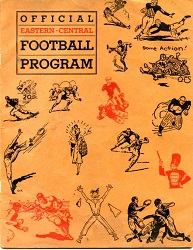 This is the program cover from the 13th annual Football Classic between the Quakers of Eastern and the Big Reds of Central. Fans were requested to “refrain from making unnecessary noise as they drive away from the stadium … due to the nearness of Sparrow Hospital.”
At the time of the 1940 contest, Lansing Central led the series with six wins against five defeats. The series featured a single tie, a 6-6 result in 1935.
Eastern’s 1940 squad, coached by Walter Graff, was able to knot the series at six wins apiece with a thrilling 7- 6 victory over the crosstown rivals, coached by Al Bovard.
The 16-page document was hand set and printed by the Eastern and Central High School Vocational Printing Classes, and included rosters, messages from the two school principals and athletic directors, as well as comments from each member of the coaching staffs, team captains, student council presidents and numerous team members from each school with their views on the game. Of course there is a photograph of each high school football team, but also photos of each band, their directors, and a list of the band members for both Eastern and Central. Finally, there are photos of the Eastern and Central Yell Leaders, nine for the Quakers and six for the Big Reds.
It is a true work of art.
|
1950 |
Central Michigan College Relays |
Track Medal |
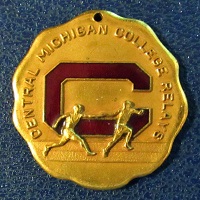 More than 2,300 athletes from 97 high schools descended upon Mt. Pleasant for the Tenth Annual Central Michigan Relays. Ecorse in Class B and Flint School for the Deaf in Class D earned team titles on Friday, May 5th while on Saturday, the 6th, Flint Northern and Milan won Class A and Class C, respectively. Six event records fell during the two-day event, three in the broad jump.
This medal, honoring a member of the winning Class C sprint relay team, was awarded at the event. The winning team, and therefore, the name of the individual awarded the medal, remain a mystery.
|
1962 |
Saginaw Sacred Heart |
Megaphone |
 As at the majority of schools across the state at the time, athletic competition against other schools was not an option for Gloria Groll and her female classmates during her days as a student at Saginaw Holy Rosary High School. So, from the fall of 1959 until her graduation with 27 other students in the spring of 1962, she was a cheerleader for the Greyhounds. This beautiful megaphone, donated by Groll to the Saginaw County Sports Hall of Fame, is a memento from those times.
Holy Rosary was one of nine Catholic high schools operating in the Saginaw area in the 1950s and 1960s. Population shifts from the cities to the suburbs over the coming years would impact enrollment figures at schools nationally. In Saginaw, the opening of the Buena Vista School District in 1956 directly impacted Holy Rosary. In 1970 the school closed. A year later only three schools – SS Peter and Paul, St. Mary and Saginaw St. Stephen – remained. In 1984, those schools were consolidated to form Saginaw Nouvel Catholic Central.
|
1963 & 1930 |
Grosse Pointe St. Paul |
League Trophies |
 On the left, we find the trophy awarded to Grosse Pointe St. Paul's after winning the 1963 city championship. Bob Martin, a 6-foot-6 junior who earned first division all-Catholic honors, scored 14 of his 22 points in the fourth quarter to lead the Lakers to a 55-46 upset-victory over Detroit Pershing. The game was played at University of Detroit Memorial before 6,979 spectators. It was the first time since 1958 that the Catholic League won the annual matchup with the champions of the Public School League.
To the right is the trophy awarded to St. Paul for winning the first golf tournament of the South Michigan Catholic High School League. The school's four golfers shot 710 over 36 holes on the day, 69 fewer strokes than second-place Detroit St. Rose. Played at Clinton Valley, the event saw Bill Beaupre win individual honors with a total of 158, including 76 in the morning. His cousin and teammate, Harold Beaupre, finished second with 169, while Peter Bononis of Detroit Holy Name was third with 171 strokes.
|
1965 |
Fennville vs. Kalamazoo Hackett |
Ticket Stub |
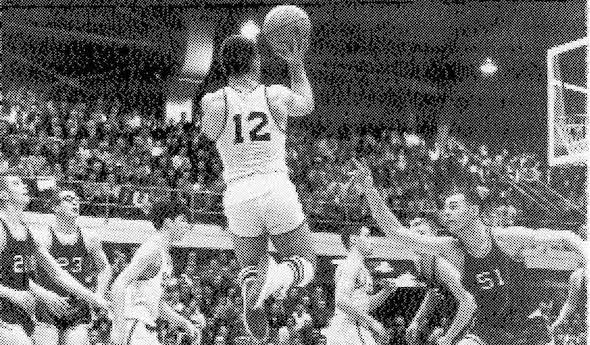
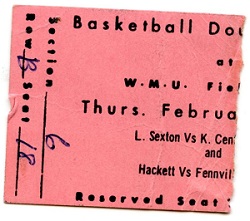 This ticket stub from a doubleheader hosted at Western Michigan University’s Read Fieldhouse on February 18, 1965 was the first chance for many to witness lightning in a bottle. A capacity-plus crowd of 9,100 fans slid through the gate to watch a rumor.
The antics of 5-foot-7½ guard Richie Jordan had been talked about around the Kalamazoo area, but few had actually seen him play. His skills were on full display on this Thursday night, as he netted a fieldhouse scoring record with 49 points in a come-from-behind 76-72 win over a much taller team from Kalamazoo Hackett. Jordan’s output during the evening’s second game eclipsed the 45 points Manny Newsome scored for Western Michigan University against Toledo, just over a year before.
The evening hadn’t started well. According to the Kalamazoo Gazette, “Jordan hit only six of his 13 field shots in the first half and threw the ball away eight times. Trailing Hackett by 17 points, 50-33, with two minutes to play in the third quarter, the Blackhawks were able to cut the deficit to 13, 60-47 as the teams entered the final frame.
Quickly, everyone in the fieldhouse knew who was getting the ball during the comeback attempt. Jordan grabbed control; with his drives for layups and “softly-arched” jump shots against intense pressure, he hit seven of nine field goals, wowing the crowd. With 2:36 to play, Jordan nailed a pair of free throws to tie the game at 72 all. Then, with 57 seconds left, the “Fennville Flash” nailed the go-ahead basket, followed by two insurance free throws to seal the win. For many, his 24 points in the fourth quarter sealed his journey from rumor to legend and, no doubt, inspired the single-sentence first paragraph of the next morning’s coverage in the Gazette.
“Yes, there is a Richie Jordan!”
(P.S. – Kalamazoo Central upset eighth-ranked Lansing Sexton, 67-57, in the evening’s opening contest).
 Ron Pesch has taken an active role in researching the history of MHSAA events since 1985 and began writing for MHSAA Finals programs in 1986, adding additional features and "flashbacks" in 1992. He inherited the title of MHSAA historian from the late Dick Kishpaugh following the 1993-94 school year, and resides in Muskegon. Contact him at [email protected] with ideas for historical articles.
PHOTO: Fennville's Richie Jordan pulls up for a jumper, showing off the form that's become iconic when recalling the high school phenom. (Photos of Letterman's Trophy and Megaphone were provided by Jeffery Cottrell, and photo of Grosse Pointe trophies was provided by Bill Roose.)
Self-Taught Lutzke Leaving Williamston with Decades of Memorable Lessons
By
Geoff Kimmerly
MHSAA.com senior editor
June 1, 2022
WILLIAMSTON – If it were possible to string together all of the moments that made Mitch Lutzke into a Hall of Fame high school track & field coach, the first half of the video would look like a one-man pentathlon.
 At most, the now-longtime Williamston leader brought into coaching a season of mostly-junior varsity cross country experience as a student at Albion High, and some additional knowledge gleaned from marrying a college All-American runner.
He also didn’t have the internet back then to speed up the learning curve. But he had books to show him technique, and coaching clinics where he’d learn more. The skills he was using as a morning radio news reporter surely helped him digest information and pass it on to his pupils. And he had an open track facility, where he’d go when no one else was around and try to teach himself all of the events so he could better serve as his wife Karen’s assistant as she was coaching middle school kids in Illinois before she herself would go on to lead college programs for most of the last three decades.
“I just wanted to make my wife happy and said, ‘I'll coach middle school track,’ which I didn't want to do. And I almost tried to quit. I'm like, I don't want to do this. I don't even know what I'm doing. And she's like, ‘No, you could just learn,’” Mitch Lutzke recalled last week.
“I tell people I’d do this, and they think I’m making this up. I’d stand there with a book and say, ‘OK,’ and I would go do it, and like, ‘OK, that’s how you do it right.’ So I decided, but nobody needs to know when they do it right – they need to know when they do it wrong. So I would take a book and look at discus. I said, ‘OK, I’m throwing it straight. How do I throw it left? So I’ve changed my feet. And if I step in a bucket, I’m going left. Or if I don’t block out, or if I do this … so I’d write down all these things to fix the kids. I did trial and error; what do I do if it goes too high in shot? OK, what did I do with my thumb? So I wrote a bunch of little notes down.”
His experiences, especially over the last 32 years leading the Hornets girls and now both the girls and boys programs, could fill a book – and he’s written a few of those too, on other subjects that have interested the also big-time sports fan and local historian.
Lutzke has begun the final week of a coaching career that’s seen him build upon one of the state’s most consistently-strong track & field programs and make it his own. Since taking over the Hornets girls team in 1993 and then adding the boys team in 2014, Lutzke has amassed 250 meet wins, 16 girls league championships and five conference titles with the boys, 12 Regional championships, eight top-10 MHSAA Finals finishes and nine Michigan Interscholastic Track Coaches Association team state titles. In 2020, he was named to the MITCA Hall of Fame.
 That’s a whale of a list for someone whose “gift for gab” had him headed initially down a path aspiring to be the next Dan Rather. He had earned accolades and opportunities to continue in broadcasting, but found himself instead taking a path back to school to become a teacher, into the classroom and onto the track and sideline, with his communication skills and knowledge no doubt pouring into the multiple books and other pieces he’s written on baseball and local history, the classes he’s taught as a popular social studies and television broadcast teacher at Williamston and the years serving most recently as the public address announcer at many Hornets events.
“The thing about Mitch is he’s not one dimensional, even in coaching – he can coach many different events. He has many different interests outside of track & field. And when he does something, he does it 100 percent,” Karen Lutzke said. “Even when he started coaching a long, long time ago with me … he just kept learning. He likes working with kids. He enjoys that and watching them get better, whether it’s a guy who’s a 30-foot shot putter or a 45-foot shot putter, or any event. It’s not how far they throw, it’s are they doing the best they can?
“He just likes the kids, and being around them. I think it’s going to be harder than he thinks, retiring – because the kids are what make coaching fun. Being around the kids and watching them have success, and he’s had a lot of success.”
‘Expectation of Excellence’
Williamston has had its fair share of MHSAA Finals individual placers over the years, with the best of those eight top-10 team finishes under Lutzke coming in 2007 when the girls placed fourth in Lower Peninsula Division 3.
The MHSAA Finals team championships are determined by the success of individuals who qualify from Regionals, which could be just a handful. Williamston has shined even brighter, however, at the MITCA Team Finals, where the competition pits full teams against each other and the Hornets’ talent and depth across all events frequently has stood out.
Longtime and similarly-legendary coach Paul Nilsson led both Williamston track & field programs from the 1970s into the 1990s. Lutzke joined him as an assistant for both in 1991 – following Karen after she’d been hired to coach women’s cross country and assist with track & field at Michigan State. In 1993, Lutzke took over the Hornets girls track & field program.
Known now for success in a variety of sports, Williamston during the first decade of the 2000s was most consistently revered for that MHSAA championship-caliber track & field success – and on the girls side, that superiority was rooted in part in the daily grind of January and February workouts often in the school’s hallways or later on an inside track that circles the gym.
 Lutzke’s “Winter Warriors” got a T-shirt if they trained a certain number of days during the offseason. But that was just a small bonus for showing up. The memorable pay offs came three and four months later in league titles, Regional successes, MITCA titles and MHSAA Finals achievements.
“I’ve never quite had another experience in my lifetime that demonstrated that as much to me. Now I know moving forward in my life that if I expect to be great at something, or I expect to achieve results, I have to put the work in myself,” said 2019 graduate Jessica Robach, who that spring helped Williamston finish 10th at the MHSAA LPD2 Final running on a championship relay and placing third in long jump and as part of another relay. “It’s really kind of a personal integrity and motivation thing that draws a direct parallel to my career in track and to when I really decided to push myself to be great – you put in the hours of work, and then it finally happens.
“That’s just something Mitch always reiterated to us: That you can have all the natural talent in the world, but a person who works hard is going to get to where they want to be.”
Robach began attending Williamston as a freshman, and didn’t feel entirely comfortable with her new school until track season came – when “everything fell together.”
That “expectation of excellence” wasn’t just about competing athletically, but striving to be a good person. The camaraderie he established, the way he made sure knowledge was passed down from the oldest athletes to the youngest, and again, the emphasis on work ethic overcoming talent, have continued to stick with Robach as she’s gone on to study at Western Michigan.
“Mitch does things the right way. He believes in fair play, hard work, and preparation. He keeps an even keel with athletes – he doesn't get overly hyped when the team is successful or overly critical when the team struggles,” said assistant Ray Herek, who has coached with Lutzke since 2002 and taught with him since 2000. “I have learned a ton from watching him coach. He does an excellent job of knowing how to approach each athlete – he reads people very well. He seems to know what makes each person tick, and finds the right words or coaching tips to help each athlete excel.”
A decade before Robach, Leanne Selinger was learning the same lessons. The team’s leadership award is named after her, and after running on two Finals-placing relays as a senior in 2010 she actually went on to serve as an assistant coach on Lutzke’s staff over the next four seasons while at college.
These days she’s working in supply chain management – a higher-pressure-than-usual field lately because of headline-making materials shortages in a number of industries. But what she learned from Lutzke about being flexible and prepared for the unexpected – in a track meet, maybe a scratch or an injury – while trying to lead people from different subgroups (sprinters, distance runners, jumpers, etc.) toward a common goal are among lessons she continues to keep front of mind.
“Even in my professional career now, I get a lot of feedback that I am not afraid to roll up my sleeves, get dirty,” Selinger said. “And I think that comes from some of my track history with Coach Lutzke and being able to go out, let’s go out and get the job done. If we have to do X-Y-Z, let’s go do it.”
Signing Off
After the couple moved from Illinois, Mitch Lutzke taught in Lansing for five years while coaching at Williamston, then came to Williamston to teach as well. He added coaching in basketball and cross country at the middle school and subvarsity levels, and immersed himself in the family’s new community. Karen Lutzke is now in her second tenure at Olivet College, coaching the women’s and men’s cross country and track & field teams, and the couple has sent three children through Williamston schools with two going on to run at the college level.
Mitch let the decision to retire sink in over this school year – he’s retiring from teaching as well – and eventually he had one more major objective to complete this spring. And he accomplished it.
Williamston track & field wasn’t alone trying to dodge the wrenches thrown its way by COVID-19. But the effects certainly were noticeable.
When the 2020 spring season was suspended (to be ultimately canceled) late that March, Williamston’s teams had practiced four days – with 125 students (nearly 20 percent of the entire student body) signed up and hopes high with lots of talent and experience returning. When spring sports returned a year ago, Williamston was down to 49 athletes in the program – including only 16 girls – with that missing year of older athletes recruiting and mentoring the younger ones striking a massive blow.
 This spring, numbers didn’t return all the way to pre-COVID levels. But 90 athletes came out to put the program on solid footing for this season and whoever comes next.
“I've been amazed this year how many coaches have approached Mitch with words of appreciation and admiration for the job he has done at Williamston,” Herek said. “Anybody that has coached track and field knows that it is so hard getting kids outside in the spring when it is 40 degrees outside. It is difficult to know how to coach all of the events. It is difficult to know how to reach each athlete – there are so many different types of students that go out for track. But Mitch is as good as it gets.”
He’ll pour his energies into other things. He’s going to do some announcing of Olivet College events. He wants to write more. He’d like to visit baseball spring training for the first time. “Whatever he’s involved, in he’s very passionate about and gets things done,” Karen Lutzke said. “Maybe we’ll have a very clean house (and) the lawn will look wonderful after this.”
Although Williamston’s boys team won’t send anyone to the MHSAA Finals this weekend for the first time in a number of seasons, Mitch Lutzke will bring five athletes to Saturday’s Lower Peninsula Division 2 championship meet at Ada Forest Hills Eastern. They will combine to run two relays, in two more individual races and participate in one field event.
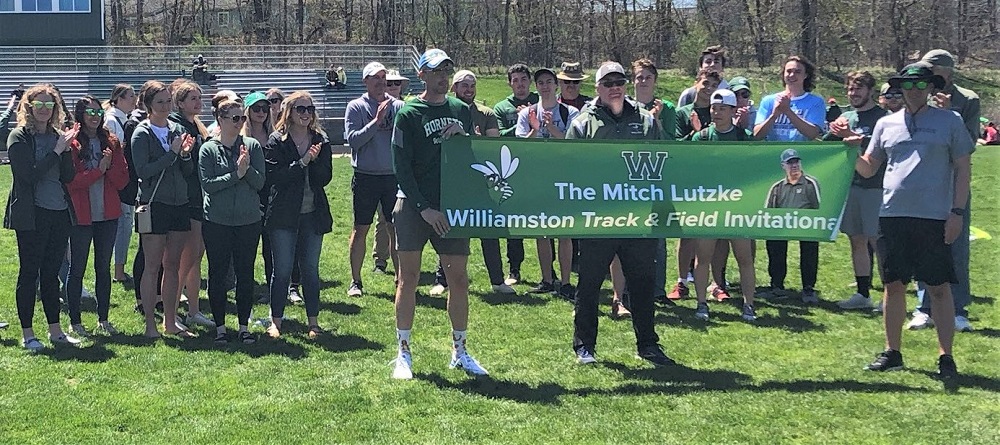
Next year, he’ll cheer from the stands, maybe help move hurdles or clerk a meet if needed. Williamston has renamed its annual meet the Mitch Lutzke Williamston Track & Field Invitational, after all, and the namesake can’t be a no show.
“I say at the end of every year, if you've got more negatives than positives in what you did in track this year, then don't come out (next year). Because we're not changing. This is what we do,” Lutzke said. “I always tell the kids, I want you to support the program of track & field in the community you grow up in or you move to, that you put your kids in track & field because you thought it was a positive experience because of what you went through here in the program, and you just give back.”
 Geoff Kimmerly joined the MHSAA as its Media & Content Coordinator in Sept. 2011 after 12 years as Prep Sports Editor of the Lansing State Journal. He has served as Editor of Second Half since its creation in January 2012, and MHSAA Communications Director since January 2021. Contact him at [email protected] with story ideas for the Barry, Eaton, Ingham, Livingston, Ionia, Clinton, Shiawassee, Gratiot, Isabella, Clare and Montcalm counties.
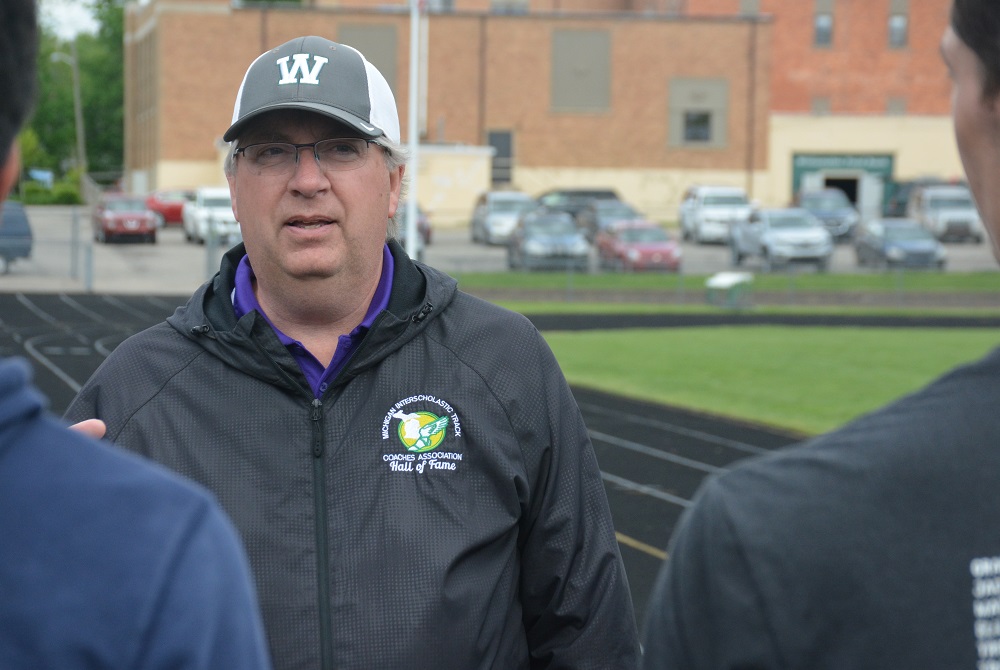
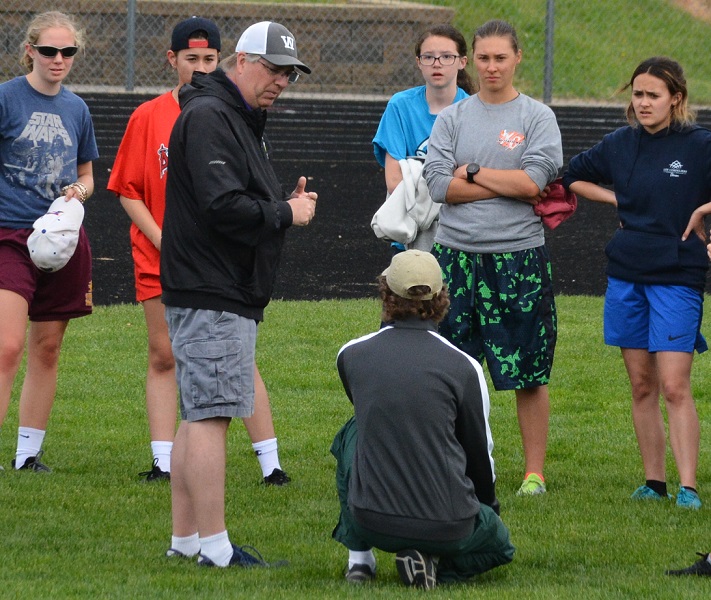
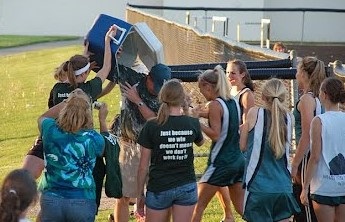
PHOTOS (Top) Williamston coach Mitch Lutzke talks things over with his boys team captains last week. (2) Lutzke stands with, from left, Diana Eidt, Cassidy Metzer, Mallory Metzer and Elizabeth Dutcher – who ran on school record-setting 400 and 800 relays in 2011. (3) Lutzke is recognized earlier this spring as Williamston’s annual meet is named after him. (4) Lutzke and assistant Ray Herek (kneeling) confer with their girls team. (5) The 2009 team dumps a cooler over Lutzke’s head to celebrate a Capital Area Activities Conference league meet championship. (Last week’s photos by Geoff Kimmerly; others courtesy of Williamston track & field and athletic department.)