

Tales of Teams, Trophies & Trinkets - Vol 2
By
Ron Pesch
MHSAA historian
February 9, 2017
A picture may be worth a thousand words – but often, we can learn as much from a traveling trophy, game ticket, and even an old megaphone.
Michigan’s high school sports history is more than a century old and filled with legends passed on of games, teams and athletes and the roles they played as our communities rolled forward toward present day. Following up last year’s “Tales of Teams, Trophies & Trinkets,” we present a second chapter highlighting artifacts that tell some of those stories.
|
1909 |
Saginaw vs. Saginaw Arthur Hill |
Football Trophy |
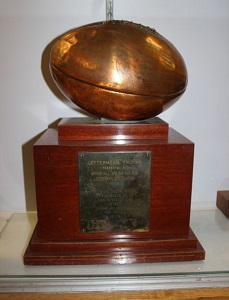 This bronzed football was the original used in the 1909 Thanksgiving Day contest played between Saginaw High and Saginaw Arthur Hill, and won by Saginaw, 5-0 at Burkart Park. In 1948, the ball was stylized into a trophy by the Letterman’s Associations of the rival schools, designed to travel between schools as the reward for winning the annual contest. When the Lumberjacks of Arthur Hill ripped off 24 straight victories beginning in 1971 (the teams played twice in 1974), ownership of the trophy was mostly forgotten. When talk of closing Saginaw High School mounted, the trophy was placed on display at Saginaw’s Castle Museum, then donated to the Saginaw County Sports Hall of Fame.
According to Jeffrey Cottrell, the multi-media specialist at the Historical Society of Saginaw County, when plans to close Saginaw High did not materialize, “it was decided amongst the Saginaw County Sports Hall of Fame and the Arthur Hill Letterwinners Association that it was time to put it back into use. This past fall, the Sports Hall of Fame awarded the trophy to Saginaw High when they beat Arthur Hill 40-0.”
Going forward, the Letterman's Trophy will continue to be presented to the winner of the football game between the Trojans and the Lumberjacks.
|
1921 |
Detroit Cass Tech vs. Flint Central |
Football Program |
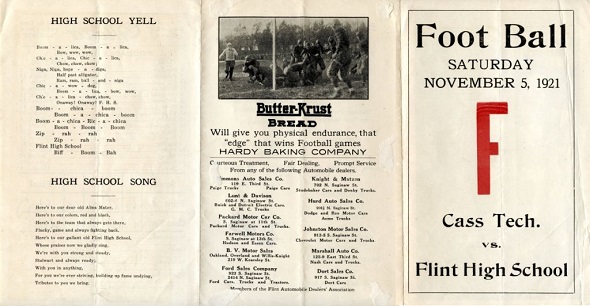
A crowd of 2,500 was on hand for this contest as Detroit Cass Tech downed Flint Central, 34-20, in an aerial battle between the squads. The Detroit Free Press arraigned for a special interurban run, with special railcars earmarked for Cass Tech students interested in attending the Saturday game at Flint. Between 200 to 300 made the trip to cheer their team to victory.
Flint Central completed 14 of 34 passes for 176 yards, but was intercepted on six occasions. Cass Tech arms were accurate on only 7 of 24 attempts for 160 yards, with four interceptions, but two completions went for touchdowns of 18 yards and 50 yards. A third pass of 35 yards helped set up the visitor’s first score. Bruno Murkobred, Cass Tech’s speedy quarterback, was the star of the contest, scoring three of his team’s five touchdowns.
|
1939 |
Kalamazoo Central vs. Battle Creek Central |
Basketball Program |
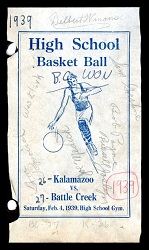 This tattered memento, from a scrapbook kept by historian Dick Kishpaugh, illustrates the modest design of a high school basketball program back in 1939. Likely created by the high school print shop, this single sheet, printed specifically for distribution at the game, features autographs gathered by its owner. Wes Clark, one of the names captured on the cover, led Battle Creek Central with 10 points, including a pair of buckets in the final minute to secure a 27-26 win by the Bearcats.
Newspaper reports from the time indicate that halftime of the contest would feature “a table tennis exhibition between Helen Van Dyke of Flint, four-time state champion, and Floyd Painter, Battle Creek champion.” Miss Van Dyke was a sophomore at Olivet College at the time.
|
1940 |
Lansing Eastern vs. Lansing Central |
Football Program |
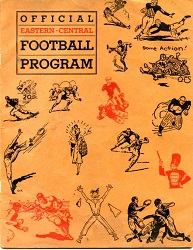 This is the program cover from the 13th annual Football Classic between the Quakers of Eastern and the Big Reds of Central. Fans were requested to “refrain from making unnecessary noise as they drive away from the stadium … due to the nearness of Sparrow Hospital.”
At the time of the 1940 contest, Lansing Central led the series with six wins against five defeats. The series featured a single tie, a 6-6 result in 1935.
Eastern’s 1940 squad, coached by Walter Graff, was able to knot the series at six wins apiece with a thrilling 7- 6 victory over the crosstown rivals, coached by Al Bovard.
The 16-page document was hand set and printed by the Eastern and Central High School Vocational Printing Classes, and included rosters, messages from the two school principals and athletic directors, as well as comments from each member of the coaching staffs, team captains, student council presidents and numerous team members from each school with their views on the game. Of course there is a photograph of each high school football team, but also photos of each band, their directors, and a list of the band members for both Eastern and Central. Finally, there are photos of the Eastern and Central Yell Leaders, nine for the Quakers and six for the Big Reds.
It is a true work of art.
|
1950 |
Central Michigan College Relays |
Track Medal |
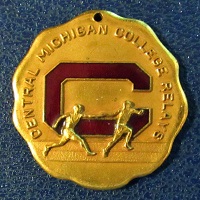 More than 2,300 athletes from 97 high schools descended upon Mt. Pleasant for the Tenth Annual Central Michigan Relays. Ecorse in Class B and Flint School for the Deaf in Class D earned team titles on Friday, May 5th while on Saturday, the 6th, Flint Northern and Milan won Class A and Class C, respectively. Six event records fell during the two-day event, three in the broad jump.
This medal, honoring a member of the winning Class C sprint relay team, was awarded at the event. The winning team, and therefore, the name of the individual awarded the medal, remain a mystery.
|
1962 |
Saginaw Sacred Heart |
Megaphone |
 As at the majority of schools across the state at the time, athletic competition against other schools was not an option for Gloria Groll and her female classmates during her days as a student at Saginaw Holy Rosary High School. So, from the fall of 1959 until her graduation with 27 other students in the spring of 1962, she was a cheerleader for the Greyhounds. This beautiful megaphone, donated by Groll to the Saginaw County Sports Hall of Fame, is a memento from those times.
Holy Rosary was one of nine Catholic high schools operating in the Saginaw area in the 1950s and 1960s. Population shifts from the cities to the suburbs over the coming years would impact enrollment figures at schools nationally. In Saginaw, the opening of the Buena Vista School District in 1956 directly impacted Holy Rosary. In 1970 the school closed. A year later only three schools – SS Peter and Paul, St. Mary and Saginaw St. Stephen – remained. In 1984, those schools were consolidated to form Saginaw Nouvel Catholic Central.
|
1963 & 1930 |
Grosse Pointe St. Paul |
League Trophies |
 On the left, we find the trophy awarded to Grosse Pointe St. Paul's after winning the 1963 city championship. Bob Martin, a 6-foot-6 junior who earned first division all-Catholic honors, scored 14 of his 22 points in the fourth quarter to lead the Lakers to a 55-46 upset-victory over Detroit Pershing. The game was played at University of Detroit Memorial before 6,979 spectators. It was the first time since 1958 that the Catholic League won the annual matchup with the champions of the Public School League.
To the right is the trophy awarded to St. Paul for winning the first golf tournament of the South Michigan Catholic High School League. The school's four golfers shot 710 over 36 holes on the day, 69 fewer strokes than second-place Detroit St. Rose. Played at Clinton Valley, the event saw Bill Beaupre win individual honors with a total of 158, including 76 in the morning. His cousin and teammate, Harold Beaupre, finished second with 169, while Peter Bononis of Detroit Holy Name was third with 171 strokes.
|
1965 |
Fennville vs. Kalamazoo Hackett |
Ticket Stub |
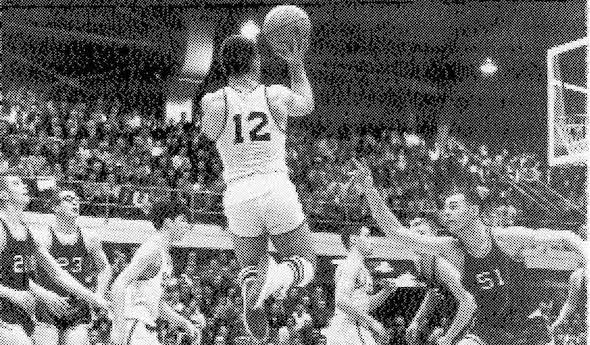
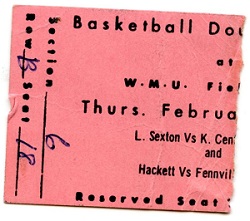 This ticket stub from a doubleheader hosted at Western Michigan University’s Read Fieldhouse on February 18, 1965 was the first chance for many to witness lightning in a bottle. A capacity-plus crowd of 9,100 fans slid through the gate to watch a rumor.
The antics of 5-foot-7½ guard Richie Jordan had been talked about around the Kalamazoo area, but few had actually seen him play. His skills were on full display on this Thursday night, as he netted a fieldhouse scoring record with 49 points in a come-from-behind 76-72 win over a much taller team from Kalamazoo Hackett. Jordan’s output during the evening’s second game eclipsed the 45 points Manny Newsome scored for Western Michigan University against Toledo, just over a year before.
The evening hadn’t started well. According to the Kalamazoo Gazette, “Jordan hit only six of his 13 field shots in the first half and threw the ball away eight times. Trailing Hackett by 17 points, 50-33, with two minutes to play in the third quarter, the Blackhawks were able to cut the deficit to 13, 60-47 as the teams entered the final frame.
Quickly, everyone in the fieldhouse knew who was getting the ball during the comeback attempt. Jordan grabbed control; with his drives for layups and “softly-arched” jump shots against intense pressure, he hit seven of nine field goals, wowing the crowd. With 2:36 to play, Jordan nailed a pair of free throws to tie the game at 72 all. Then, with 57 seconds left, the “Fennville Flash” nailed the go-ahead basket, followed by two insurance free throws to seal the win. For many, his 24 points in the fourth quarter sealed his journey from rumor to legend and, no doubt, inspired the single-sentence first paragraph of the next morning’s coverage in the Gazette.
“Yes, there is a Richie Jordan!”
(P.S. – Kalamazoo Central upset eighth-ranked Lansing Sexton, 67-57, in the evening’s opening contest).
 Ron Pesch has taken an active role in researching the history of MHSAA events since 1985 and began writing for MHSAA Finals programs in 1986, adding additional features and "flashbacks" in 1992. He inherited the title of MHSAA historian from the late Dick Kishpaugh following the 1993-94 school year, and resides in Muskegon. Contact him at [email protected] with ideas for historical articles.
PHOTO: Fennville's Richie Jordan pulls up for a jumper, showing off the form that's become iconic when recalling the high school phenom. (Photos of Letterman's Trophy and Megaphone were provided by Jeffery Cottrell, and photo of Grosse Pointe trophies was provided by Bill Roose.)
MHSAA Neck Guard Requirement Rooted in 1999 'Impossible to Forget' Injury
By
Ron Pesch
MHSAA historian
February 3, 2022
Dan DiCristofaro has made it a mission to remind schools, coaches, athletic directors, and other officials of the need to enforce an equipment rule, added to the MHSAA hockey rule book more than 20 years ago.
“Officials are not trying to give out misconduct penalties,” wrote DiCristofaro in a recent email, “but the avoidance by so many players to wear this piece of equipment as intended in its unaltered state or to even wear a neck guard at all has become almost the norm instead of the exception.”
“This is mandatory,” emphasized the long-time hockey official during a recent conversation. “It’s required, not recommended. Required.”
As a witness to an unforgettable occurrence during a game, DiCristofaro wants others to do what they can to reduce the odds of that moment happening again.
Rivals
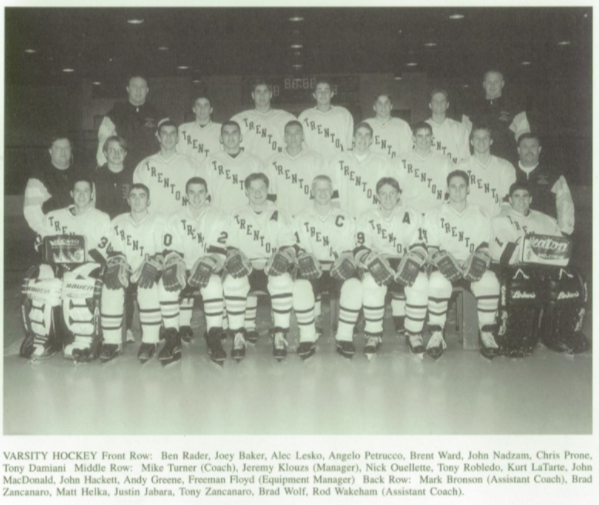
The Wednesday, Feb. 10, 1999, game between Trenton and Redford Catholic Central was a rematch – the second game of a home-and-home series that had been played for years. Two of the state’s hockey powerhouses, the foes were certainly familiar with each other.
“The rivalry between Trenton and Catholic Central has probably gone on since the 60s,” recalled Trenton coach Mike Turner.
 “They were usually two of the best teams in the state,” added Gordon St. John, Catholic’s coach at the time.
Both coaches were speaking in 2010, for REPLAY, a sports television series created by Gatorade, built around the re-staging of games between high school rivals. Fox Sports Net broadcast the game.
“If you go into our gymnasium, you will find 42 state banners,” noted Fr. Richard Ranalletti, principal at CC from 2000 to 2010. “Thirteen of them are in hockey” (1959, 1961, 1968, 1974, 1994, 1997, 1999, 2000, 2001, 2002, 2003, 2005, 2009). Founded in 1928, Detroit Catholic Central had moved to Redford Township 50 years later. (The campus moved again in 2005, this time to Novi.)
The city of Trenton was founded in 1834. A 1901 report in the Free Press speaks of architect Edward C. Leyen completing plans “for a high school building for the board of education of Trenton.”
“Since 1975, there’s 12 state championship banners (1976, 1979, 1980, 1982, 1986, 1991, 1996, 1998, 2003, 2004, 2008, 2009) hanging in our arena,” said Jerry Brown, Mayor of Trenton in his interview for the program.
Hank Minckiewicz, sports editor for the News-Herald in Trenton, summed it up: “Back in 1999, there was not a bigger rivalry in the state than Trenton and Catholic Central.”
Fifth-ranked Trenton had downed No. 1 CC, 1-0, at Redford Arena earlier in the 1999 season – the Shamrocks’ only loss at that point in the annual chase for a state title. The second game between the schools was played at Trenton’s Kennedy Recreation Center, then a single rink arena, before a full house. Catholic Central opened a 4-1 lead before the Trojans, dressed in their home white jerseys, stormed back to tie the game at 4-4 with about five minutes to play.
Nightmare Come to Life
The moment on the ice, caught on videotape, appears harmless enough.
“Late in the game, a Trenton player knocked a CC player off balance, sending his leg back into the air.” recounted Bill Roose in the Detroit Free Press, describing the freak accident that nearly took the life of Trojans senior Kurt LaTarte.
A 6-foot defenseman, LaTarte had been near the play and initially continued toward the puck, but then circled back and headed to the Trenton bench.
Lori Holcomb, a team trainer for Trenton, recalled the moment for REPLAY, documenting the night.
“Kurt was coming on to the bench, and he was kind of holding the side of his face and his neck and he said, ‘The kid’s boot hit me in the chin … I think my chin is cut.’
‘It was clean and straight,” she continued, “like surgical.”
It wouldn’t remain that way.
Guardian Angels
“The gash across the right side of his neck was four inches long and two inches wide,” wrote Roose in touching on the horror that quickly unfolded.
Chaos erupted on the Trenton bench as the color of LaTarte’s jersey changed from white to red.
“The game was so intense. … It was so jam-packed with people,” remembered DiCristofaro. “You couldn’t even hear yourself because it was so loud. We did not know that this had happened during the game until a linesman who happened to be standing next to the bench saw what was going on. … He’s the one who blew his whistle loud and kept blowing it for the play to actually stop.
“Once it all hit home and the play stopped … everybody went stone silent. Once everybody knew what was happening and everybody was informed, the players started kneeling, a lot of them were crying.”
The game was ended.
“Fortunately,” stated Roose, “(there were) a few guardian angels among the … spectators.”
Dr. David Wolf, nurse Leslie Zancanaro and firefighter Alec Lesko were all at the game because they had sons on Trenton’s team.
Wolf would accompany LaTarte to the hospital, “detailing his injuries to emergency room doctors” at Oakwood/Seaway Hospital in Trenton. Surgery that night repaired vein and muscle damage. On Friday, he was released from University of Michigan Hospitals in Ann Arbor. A week later, LaTarte was back in school.
In a follow-up article in the Free Press, the LaTarte Family thanked all involved with saving Kurt’s life.
DiCristofaro had officiated the game.
The Injury
Regrettably, this was far from the first time a hockey player had suffered such an injury. While certainly not common, and not always fatal, cuts like these are extremely serious. And for all involved – from spectator to player – impossible to forget.
Simply put, carotid arteries carry oxygenated blood to the head, face, and brain through the neck, while the jugular veins passing through the neck handle deoxygenated blood. Disruption to these vessels can quickly create major precarious problems instantly.
Few hockey fans can forget the horrific story of Clint Malarchuk, goalie for the Buffalo Sabres of the National Hockey League, nearly “bleeding to death on the ice when a skate severed his jugular vein,” in 1989. Many had forgotten that a similar injury to carotid arteries occurred to NHL player Jackie Leclair of the Montreal Canadians in 1954. (It would happen again in 2008, this time to Richard Zednick of the Florida Panthers). There have been various near misses and close calls in the NHL and professional hockey’s minor leagues.
Reports of cuts to the neck in Canada appeared in both U.S. and Canadian newspapers, including one causing the death of a 29-year-old father of two, Maurice Ayotte, who was playing amateur hockey in December 1973.
In another instance, a team trainer and a teammate were credited with saving the life of Kim Crouch of the Markham, Ontario Waxers in January 1975. An 18-year-old junior league goalie, he had been cut while making a save. The near tragedy inspired Kim’s father, Edward M. Crouch, to design a neck protector.
 “Maybe this neck guard will prevent other boys from going through what he did,” Edward told The Canadian Press. “It’s a combination of a baby’s bib and a turtleneck sweater.”
By the fall of 1976, the initial “Kim Crouch Safety Collar” – weighing 3½ ounces and made of Nylon Ballistic Material and closed-cell foam – was available in stores. Two years later, it was being worn by several NHL and minor league goalies, and within five years, other manufacturers had throat protectors on the market.
Yet, their existence didn’t ensure broad acceptance or use.
It would take a series of tragic episodes that occurred within a span of two years to alter equipment requirements for youth hockey above the border.
In December 1983, a Montreal, Quebec boy, James Lechman, who played for the Class BB Rosemont team, died. Down on the ice in a scramble in front of his team’s net, the Rosemont goalie’s skate accidentally clipped the 15-year-old’s neck while he tried to block a shot.
In October 1984, Henry Reimer of the Richmond, British Columbia Sockeyes, a 17-year-old “standout centre” in the B.C. Junior Hockey League, survived a throat slit suffered when a teammate fell prior to a game during warmups, and his skate clipped Reimer. Fifty stitches – “30 internal and 20 external” – were required to close the wound. “Only the swift action of trainers and ambulance attendants prevented a tragedy,” stated the Vancouver, B.C. Province.
“If it was millimetres, either way,” Sockeyes’ coach Vic LeMire would later say, “he would be a statistic.”
A month later, Stephane Saint-Aubin, an 18-year-old Repentigny Olympiques player in the Junior AA Quebec league, died due to a similar injury. It was his first game with the team.
CCM and Cooper released new or redesigned versions of protectors that covered the neck and upper chest in 1985. Following his injury, Reimer, who would play college hockey on scholarship for the University of Illinois, worked with a Michigan company to develop another design.
But in September 1985, misfortune struck again within the same B.C. Junior Hockey League. Abbotsford British Columbia Falcons forward Jeff Butler, another 18-year-old, died after being cut on the throat by the “freshly sharpened, razor-sharp” blade of a teammate’s skate, according to another Province report.
The exhibition game, played before a crowd of just 200, was called off after the incident, midway through the second period. Doctors had labored to save Butler’s life but were unsuccessful.
“There are not words to describe what happened,” said coach Larry Romanchych to the Vancouver Sun.
Romanchych, who had previously played with Chicago and Atlanta in the NHL, immediately went to work searching for neck protectors. After examining the various types available, he purchased Crouch Collars.
“After what happened Saturday. I will never let my own (12-year-old) son on the ice without one,” vowed Romanchych. “And I will never let anybody who plays for me go without one. (The players) will get used to them, the same way we got used to playing with helmets. It’s just a shame that something … has to happen before we do anything about it.”
New Requirement
Some leagues in Canada took action and began to require players and goalies to wear neck guards. Players complained, stating the guards were uncomfortable and/or too hot to wear, and the rules were not always enforced. Heartbreaking accidents continued to occur.
The Canadian Standards Association (CSA)/Bureau de Normalisation du Quebec (BNQ) began work to establish guidelines for protection to be met by manufacturers. The injury to Malarchuk (an Alberta, Canada native) would ensure the passage of a national directive.
Still, it took time.
Challenges arose for manufacturers to distribute products to Canada’s more than 400,000 players, especially to small cities. That presented some implementation delays, but as of Jan. 1, 1994, it was a requirement to wear a Canadian Standards Association-approved throat protector (sometimes referred to as a neck laceration guard) labeled or stamped with the initials BNQ for all participants across the Canada Amateur Hockey Association.
Another death, this time in Sweden in 1995, moved the country to require all hockey players to wear neck guards.
Back in Michigan
“Neck guards are mandatory for youth hockey players in Canada,” wrote Anjali J. Sekhar days after LaTarte’s injury in an article for the Port Huron Times-Herald. “And while they are not mandatory in the United States, many people believe it’s common sense to wear them.”
While recognizing that the piece of equipment did not guarantee tragedy would always be avoided, the MHSAA still responded promptly to what had happened in Trenton. In May 1999, the MHSAA’s Representative Council, following Canada’s lead, instituted a mandatory neck guard rule for scholastic athletes in 2000.
Like our northern neighbors, the equipment worn by players must bear a label from BNQ. Today, the MHSAA is one of only two high school governing bodies in the United States to require hockey neck guards.
REPLAY by Gatorade
In May 2010, Gatorade reunited former members of the 1999 game from both DCC and Trenton, including LaTarte, their teams’ original coaching staffs, and two of the three officials from the game for a full-check, regulation-length replay of the contest. (Ironically, only weeks before, both schools had won MHSAA hockey titles.)
“For Trenton hockey alumni, redemption has come after years of waiting as they defeated their Detroit Catholic Central counterparts by a score of 4-2,” stated a news release following the contest.
 “From the moment Compuware Arena's doors opened, to the ceremonial puck-drop by game day commissioner, ‘Mr. Hockey®’ Gordie Howe, to the final horn sounding, excitement filled the arena. The teams, which hit the ice in front of nearly 4,000 people, were joined by Detroit hockey legends Scotty Bowman and Brendan Shanahan who provided their expertise and guidance as honorary coaches to the Catholic Central and Trenton squads, respectively.”
Prior to the game, training for former players had lasted eight weeks.
“We’re thinking this game was going to be more fun and ceremonial and casual,” said DiCristofaro, laughing at the memory. “The first few minutes shocked us with the physicality. This was serious hockey.
“These guys are running at each other. They were 17 and 18 years old again. There were some serious body checks. We had to start intervening immediately before somebody got hurt.
“They really went all-out with training and practice and off-ice conditioning to get ready for this game.”
“I knew this was an awesome opportunity to get the teams together and close this chapter,” said LaTarte. “Seeing how this came together, it was definitely worth every ounce of sweat.”
Prompting the Memory
Sadly, these memories of the happy ending were prompted by another much more recent nightmare. This January, once again, the razor-blade sharpness of an unintended air-bound ice skate took a life, this time in Connecticut. The player was Teddy Balkind, a 16-year-old sophomore at St. Luke’s School in New Canaan. The contest was with Brunswick School, located in Greenwich. In a letter written by Mark Davis, St. Luke’s head of school, to school families and reported in the media, he clarified details of the accident, misreported by some of the media:
“Teddy did not fall and was not lying on the ice. He was skating upright and low. During the normal course of play, another player’s leg momentarily went into the air and, through no fault of anyone’s, or any lack of control, his skate cut Teddy.”
Recommend, but not Require
“’Commercially manufactured throat guards designed specifically for ice hockey are required for all players, including goaltenders during regular season and tournament play,’ Connecticut Interscholastic Athletic Conference rules state,” noted the Toronto Star in coverage. “St. Luke’s and Brunswick play in the Fairchester Athletic Association, which like most prep school conferences follows the policy of USA Hockey and the NCAA, which recommend rather than require neck guards.”
“Founded on Oct. 29, 1937, in New York City … the organization was known as the Amateur Hockey Association of the United States (AHAUS) and changed to its present name in June 1991. While youth hockey is a main focus, USA Hockey also has vibrant junior and adult hockey programs that provide opportunities for players of all ability levels. The organization also supports a growing disabled hockey program.”
The Player Safety and Health Information page on USA Hockey’s website, while recommending neck laceration protectors and expressing concern about such injuries, stated (as of Feb. 3, 2022), “There is sparse data on neck laceration prevalence, severity and neck laceration protector (neck guard) effectiveness.”
“USA Hockey recommends that all players wear a neck laceration protector, choosing a design that covers as much of the neck area as possible. Further research & improved standards testing will better determine the effectiveness of neck laceration protectors.”
Ron Pesch has taken an active role in researching the history of MHSAA events since 1985 and began writing for MHSAA Finals programs in 1986, adding additional features and "flashbacks" in 1992. He inherited the title of MHSAA historian from the late Dick Kishpaugh following the 1993-94 school year, and resides in Muskegon. Contact him at [email protected] with ideas for historical articles.
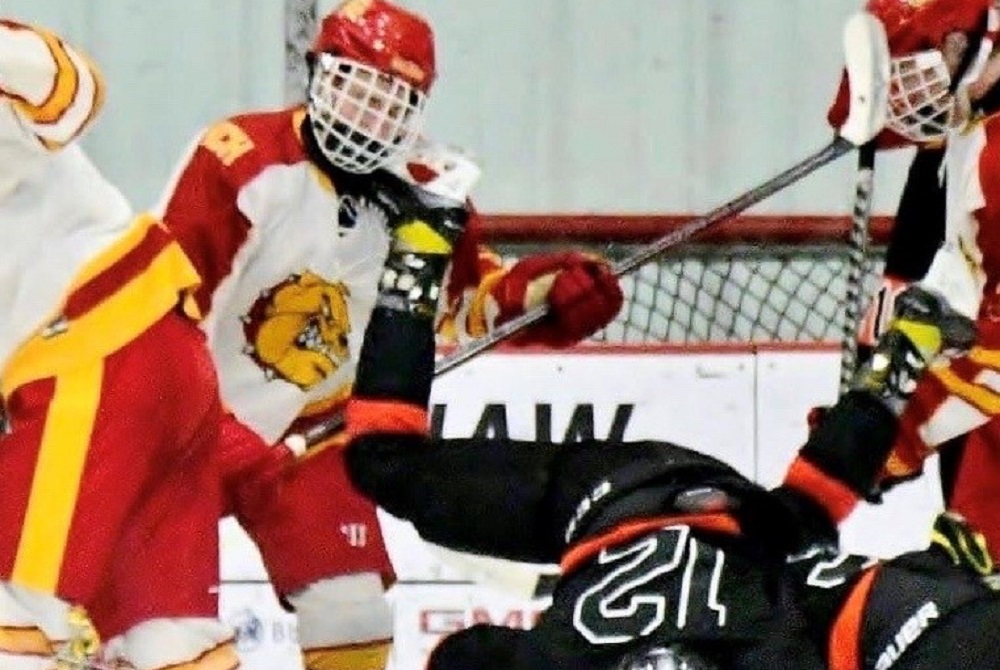
PHOTOS (Top) The neck guard worn by this player may have prevented injury as another skater toppled in front of the goal. (2) The 1999 Trenton hockey team. (3) The Kim Crouch Safety Collar was the first neck guard of its kind. (4) The 1999 Detroit Catholic Central hockey team. (Top photo by Judy Gill; other photos collected by Ron Pesch.)