

Tales of Teams, Trophies & Trinkets - Vol 2
By
Ron Pesch
MHSAA historian
February 9, 2017
A picture may be worth a thousand words – but often, we can learn as much from a traveling trophy, game ticket, and even an old megaphone.
Michigan’s high school sports history is more than a century old and filled with legends passed on of games, teams and athletes and the roles they played as our communities rolled forward toward present day. Following up last year’s “Tales of Teams, Trophies & Trinkets,” we present a second chapter highlighting artifacts that tell some of those stories.
|
1909 |
Saginaw vs. Saginaw Arthur Hill |
Football Trophy |
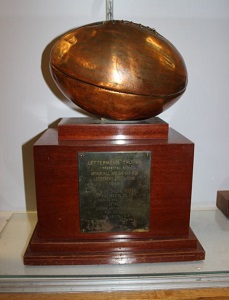 This bronzed football was the original used in the 1909 Thanksgiving Day contest played between Saginaw High and Saginaw Arthur Hill, and won by Saginaw, 5-0 at Burkart Park. In 1948, the ball was stylized into a trophy by the Letterman’s Associations of the rival schools, designed to travel between schools as the reward for winning the annual contest. When the Lumberjacks of Arthur Hill ripped off 24 straight victories beginning in 1971 (the teams played twice in 1974), ownership of the trophy was mostly forgotten. When talk of closing Saginaw High School mounted, the trophy was placed on display at Saginaw’s Castle Museum, then donated to the Saginaw County Sports Hall of Fame.
According to Jeffrey Cottrell, the multi-media specialist at the Historical Society of Saginaw County, when plans to close Saginaw High did not materialize, “it was decided amongst the Saginaw County Sports Hall of Fame and the Arthur Hill Letterwinners Association that it was time to put it back into use. This past fall, the Sports Hall of Fame awarded the trophy to Saginaw High when they beat Arthur Hill 40-0.”
Going forward, the Letterman's Trophy will continue to be presented to the winner of the football game between the Trojans and the Lumberjacks.
|
1921 |
Detroit Cass Tech vs. Flint Central |
Football Program |
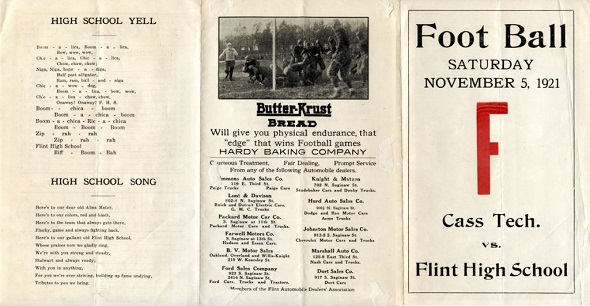
A crowd of 2,500 was on hand for this contest as Detroit Cass Tech downed Flint Central, 34-20, in an aerial battle between the squads. The Detroit Free Press arraigned for a special interurban run, with special railcars earmarked for Cass Tech students interested in attending the Saturday game at Flint. Between 200 to 300 made the trip to cheer their team to victory.
Flint Central completed 14 of 34 passes for 176 yards, but was intercepted on six occasions. Cass Tech arms were accurate on only 7 of 24 attempts for 160 yards, with four interceptions, but two completions went for touchdowns of 18 yards and 50 yards. A third pass of 35 yards helped set up the visitor’s first score. Bruno Murkobred, Cass Tech’s speedy quarterback, was the star of the contest, scoring three of his team’s five touchdowns.
|
1939 |
Kalamazoo Central vs. Battle Creek Central |
Basketball Program |
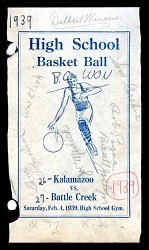 This tattered memento, from a scrapbook kept by historian Dick Kishpaugh, illustrates the modest design of a high school basketball program back in 1939. Likely created by the high school print shop, this single sheet, printed specifically for distribution at the game, features autographs gathered by its owner. Wes Clark, one of the names captured on the cover, led Battle Creek Central with 10 points, including a pair of buckets in the final minute to secure a 27-26 win by the Bearcats.
Newspaper reports from the time indicate that halftime of the contest would feature “a table tennis exhibition between Helen Van Dyke of Flint, four-time state champion, and Floyd Painter, Battle Creek champion.” Miss Van Dyke was a sophomore at Olivet College at the time.
|
1940 |
Lansing Eastern vs. Lansing Central |
Football Program |
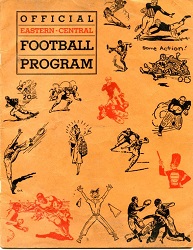 This is the program cover from the 13th annual Football Classic between the Quakers of Eastern and the Big Reds of Central. Fans were requested to “refrain from making unnecessary noise as they drive away from the stadium … due to the nearness of Sparrow Hospital.”
At the time of the 1940 contest, Lansing Central led the series with six wins against five defeats. The series featured a single tie, a 6-6 result in 1935.
Eastern’s 1940 squad, coached by Walter Graff, was able to knot the series at six wins apiece with a thrilling 7- 6 victory over the crosstown rivals, coached by Al Bovard.
The 16-page document was hand set and printed by the Eastern and Central High School Vocational Printing Classes, and included rosters, messages from the two school principals and athletic directors, as well as comments from each member of the coaching staffs, team captains, student council presidents and numerous team members from each school with their views on the game. Of course there is a photograph of each high school football team, but also photos of each band, their directors, and a list of the band members for both Eastern and Central. Finally, there are photos of the Eastern and Central Yell Leaders, nine for the Quakers and six for the Big Reds.
It is a true work of art.
|
1950 |
Central Michigan College Relays |
Track Medal |
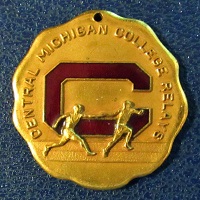 More than 2,300 athletes from 97 high schools descended upon Mt. Pleasant for the Tenth Annual Central Michigan Relays. Ecorse in Class B and Flint School for the Deaf in Class D earned team titles on Friday, May 5th while on Saturday, the 6th, Flint Northern and Milan won Class A and Class C, respectively. Six event records fell during the two-day event, three in the broad jump.
This medal, honoring a member of the winning Class C sprint relay team, was awarded at the event. The winning team, and therefore, the name of the individual awarded the medal, remain a mystery.
|
1962 |
Saginaw Sacred Heart |
Megaphone |
 As at the majority of schools across the state at the time, athletic competition against other schools was not an option for Gloria Groll and her female classmates during her days as a student at Saginaw Holy Rosary High School. So, from the fall of 1959 until her graduation with 27 other students in the spring of 1962, she was a cheerleader for the Greyhounds. This beautiful megaphone, donated by Groll to the Saginaw County Sports Hall of Fame, is a memento from those times.
Holy Rosary was one of nine Catholic high schools operating in the Saginaw area in the 1950s and 1960s. Population shifts from the cities to the suburbs over the coming years would impact enrollment figures at schools nationally. In Saginaw, the opening of the Buena Vista School District in 1956 directly impacted Holy Rosary. In 1970 the school closed. A year later only three schools – SS Peter and Paul, St. Mary and Saginaw St. Stephen – remained. In 1984, those schools were consolidated to form Saginaw Nouvel Catholic Central.
|
1963 & 1930 |
Grosse Pointe St. Paul |
League Trophies |
 On the left, we find the trophy awarded to Grosse Pointe St. Paul's after winning the 1963 city championship. Bob Martin, a 6-foot-6 junior who earned first division all-Catholic honors, scored 14 of his 22 points in the fourth quarter to lead the Lakers to a 55-46 upset-victory over Detroit Pershing. The game was played at University of Detroit Memorial before 6,979 spectators. It was the first time since 1958 that the Catholic League won the annual matchup with the champions of the Public School League.
To the right is the trophy awarded to St. Paul for winning the first golf tournament of the South Michigan Catholic High School League. The school's four golfers shot 710 over 36 holes on the day, 69 fewer strokes than second-place Detroit St. Rose. Played at Clinton Valley, the event saw Bill Beaupre win individual honors with a total of 158, including 76 in the morning. His cousin and teammate, Harold Beaupre, finished second with 169, while Peter Bononis of Detroit Holy Name was third with 171 strokes.
|
1965 |
Fennville vs. Kalamazoo Hackett |
Ticket Stub |
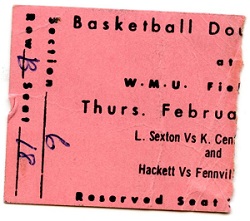 This ticket stub from a doubleheader hosted at Western Michigan University’s Read Fieldhouse on February 18, 1965 was the first chance for many to witness lightning in a bottle. A capacity-plus crowd of 9,100 fans slid through the gate to watch a rumor.
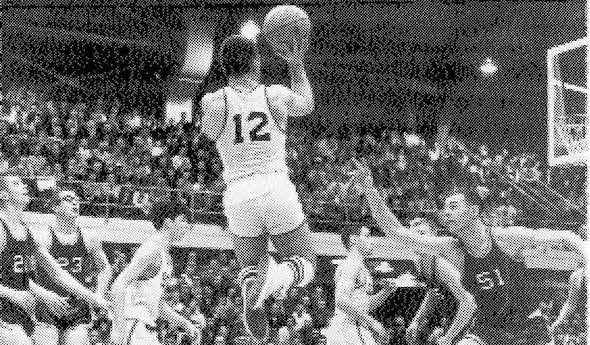
The antics of 5-foot-7½ guard Richie Jordan had been talked about around the Kalamazoo area, but few had actually seen him play. His skills were on full display on this Thursday night, as he netted a fieldhouse scoring record with 49 points in a come-from-behind 76-72 win over a much taller team from Kalamazoo Hackett. Jordan’s output during the evening’s second game eclipsed the 45 points Manny Newsome scored for Western Michigan University against Toledo, just over a year before.
The evening hadn’t started well. According to the Kalamazoo Gazette, “Jordan hit only six of his 13 field shots in the first half and threw the ball away eight times. Trailing Hackett by 17 points, 50-33, with two minutes to play in the third quarter, the Blackhawks were able to cut the deficit to 13, 60-47 as the teams entered the final frame.
Quickly, everyone in the fieldhouse knew who was getting the ball during the comeback attempt. Jordan grabbed control; with his drives for layups and “softly-arched” jump shots against intense pressure, he hit seven of nine field goals, wowing the crowd. With 2:36 to play, Jordan nailed a pair of free throws to tie the game at 72 all. Then, with 57 seconds left, the “Fennville Flash” nailed the go-ahead basket, followed by two insurance free throws to seal the win. For many, his 24 points in the fourth quarter sealed his journey from rumor to legend and, no doubt, inspired the single-sentence first paragraph of the next morning’s coverage in the Gazette.
“Yes, there is a Richie Jordan!”
(P.S. – Kalamazoo Central upset eighth-ranked Lansing Sexton, 67-57, in the evening’s opening contest).
 Ron Pesch has taken an active role in researching the history of MHSAA events since 1985 and began writing for MHSAA Finals programs in 1986, adding additional features and "flashbacks" in 1992. He inherited the title of MHSAA historian from the late Dick Kishpaugh following the 1993-94 school year, and resides in Muskegon. Contact him at [email protected] with ideas for historical articles.
PHOTO: Fennville's Richie Jordan pulls up for a jumper, showing off the form that's become iconic when recalling the high school phenom. (Photos of Letterman's Trophy and Megaphone were provided by Jeffery Cottrell, and photo of Grosse Pointe trophies was provided by Bill Roose.)
63-Pointer Stirs Memories of UP Legends
February 29, 2020
By Ron Pesch
Special for Second Half
For the first time since 1970 – 50 years ago – and for only the 10th time in Upper Peninsula boys basketball history, a player has scored 60 or more points in a single game.
And that Houghton showing has stoked memories of legendary U.P. scoring showcases going back more than a century.
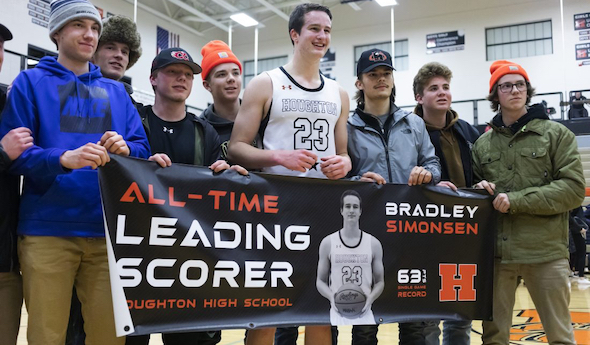
For the first time, the effort was for naught, at least from a win-loss standpoint, as Houghton dropped a nonconference road contest to Ishpeming 88-83 on Feb. 4. Brad Simonsen hit 23 of 45 field goal attempts, including 7 of 18 from beyond the 3-point arc, as Houghton pushed the play, hoping to narrow what had been a 10-point halftime margin. The 6-foot-6 senior, signed by Michigan Tech, was 10 of 13 from the free throw line and scored 24 points in the fourth quarter, ending the night with 63.
The performance topped Houghton’s school record of 60 points, set by Gary Lange in 1970. The total ranks 14th across the entire state for single game points in a contest, and tied Simonsen for sixth highest above the bridge. There, the mark equaled the top single-game output posted by Stephenson’s Mel Peterson, considered by many the greatest cager ever to come out of the Upper Peninsula.
“Marvelous Mel”
Peterson was the son of a minister and one of 10 children (and eight boys). His older brother, George, broke the U.P. scoring record in 1949 with 44 points in a game for Stephenson High School. The family moved away from the Upper Peninsula following George’s graduation, ultimately landing in southeastern Idaho.
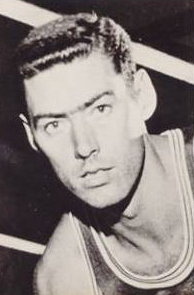 There, Mel emerged as an outstanding athlete for Idaho Falls High School. Standing 6-foot-4½, Peterson’s growth occurred mostly during his freshman year.
“I played quite a bit on the varsity my sophomore year,” recalled Peterson recently. “My junior year I started out very, very slow but ended up very good. (However,) I fractured my ankle with about a minute to go in the semifinals of the (1955) state tournament, which we won.”
Peterson led all scorers with 25 points and dominated the boards that night, but had to be helped from the floor, then didn’t play in the title contest. “We lost the state tournament by three points, (43-40 to Kellogg). I was a cheerleader. … It would have been fun to play in the final game.”
When his father received a call to serve the Mission Covenant Church in Wallace, Michigan, about seven miles south of Stephenson, the family returned to the Upper Peninsula for Peterson’s senior year.
“At that time, it was nothing like it is now, where you can find anything about anybody. Then, that wasn’t the case at all,” Peterson said. “So, when we came back, no one had any idea of where I lived before, if I played or not.”
Indeed, prior to football season, one newspaper report indicated Peterson had transferred in from North Dakota, while another listed him as coming from Illinois. Regardless, Peterson emerged as a solid football player at Stephenson High in the fall of 1955. But it was on the basketball court where his scoring and rebounding prowess quickly loomed. He opened the season with 33 points in a win over Gladstone, despite fouling out early in the fourth quarter.
By January, the media had taken to calling him “Marvelous Mel” as Peterson averaged 32.3 points in his first half-dozen games for the Eagles. He drove Stephenson to a 15-1 regular-season record, posting 11 games over 30 points and scoring more than 40 in six.
On Jan. 21, 1956, he poured in 63 points in an 89-44 win over Manistique, shattering his brother’s school record. Mel nailed 25 of 38 shots from the field and 13 of 16 from the free-throw line. At the time, the scoring total exceeded the previous known best in the U.P. of 60 points, scored by Norbert Purol in February 1952. (Purol, from Ironwood St. Ambrose, would later play two seasons of AAU ball in Chicago before matriculating at Kentucky Wesleyan, earning four letters between 1956 and 1959. Wesleyan ended the 1957 season as runner-up to Wheaton College in the inaugural NCAA Small College Tournament – now known as Division II.)
“I don’t remember a great deal about a lot of it. That was so long ago,” said Peterson, laughing. “I guess the thing I appreciate most about the game was that my coach (Duane “Gus” Lord), let me play the whole game, which didn’t happen real often. Probably the thing I remember most about the whole year is that we played a Catholic school, Lourdes, from Marinette, Wisconsin. The first game we played them we beat them 110 to 44. The second game we lost 68-66.”
Peterson’s regular-season total of 570 points also exceeded Purol’s U.P. record of 556 posted over 19 games in 1952. His regular-season average, which had climbed to 35.6, topped the previous best of 29.6, posted by Pete Kutches in 1952 for Escanaba St. Joseph. Then Peterson pushed the per-game-average even higher in the postseason.
Seeing more playing time in the playoffs, “Marvelous Mel,” notched more than 30 points in all seven postseason games (exceeding 40 in three of the contests and 50 once), leading Stephenson to the MHSAA Class B championship win against Detroit St. Andrews in sudden-death overtime, 73-71. There he scored the game-tying bucket with 17 seconds remaining in the three-minute extra frame, and then sunk the game winner 26 seconds into sudden death, where the first team to gain a two-point advantage was proclaimed the victor. That 1956 season saw three of the four basketball championships awarded to U.P. teams.
Peterson finished with 849 points on the year – at the time the best single-season performance in MHSAA history. He averaged 36.9 points across 23 contests – currently eighth in the MHSAA record book.
Following graduation, Peterson nearly signed to play at the University of Minnesota, but felt a better fit at Wheaton College, outside Chicago. There, he earned three All-American honors. As a freshman in 1957, he led Wheaton to victory in that first NCAA Small College Tournament championship game against Wesleyan, earning Most Outstanding Player honors along the way. Today, he remains Wheaton’s all-time leader in career points, points per game, field goals made and career rebounds, all accomplished “without the benefit of a 3-point line, which had yet to be implemented.”
Peterson, who helped the USA team win gold at the 1963 Pan American Games in Sao Paulo, Brazil, played two games for Baltimore in the National Basketball Association (NBA) before a heart condition sidetracked his career. Once the issue was repaired, he returned to play 134 games over three seasons in the American Basketball Association, earning an ABA league championship with the Oakland Oaks in 1969. In 2019, he was inducted into the Small College Basketball National Hall of Fame.
The High-Scoring Sixties
Roger Roell, a senior at Channing, topped Peterson’s U.P. single game record with a 67-point performance in early January 1960 by dropping 31 field goals and five free throws in a 105-55 win over Michigamme.
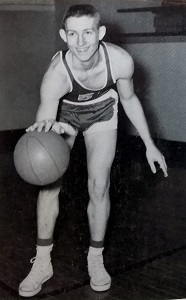 Just over seven weeks later, Jim Manning scored 69 for Trout Creek against Amasa in another lopsided affair, 140-47 (then, a U.P. record for highest team score. The team’s 44 points in the fourth quarter was also a U.P. mark at the time. Trout Creek’s coach, Bruce Warren began substituting in the second quarter).
Manning, a junior, finished the 1959-60 season as the first player in U.P. history to exceed 600 points in one regular season, totaling 608 over 18 games. He would later pitch in the Major Leagues.
Roell finished second with 569 points in 18 regular-season contests. Third on the regular-season scoring list was another junior, Erwin Scholtz of Hermansville, who tallied 505 across 18 games.
As a senior, the 6-foot-5 Scholtz would post 71 points against Channing, a new benchmark for points in a game in the Upper Peninsula.
Or was it?
The Master’s Thesis
Perhaps because of the media coverage of Scholtz’s accomplishment, in 1962 the Crystal Falls Diamond Drill ran an article detailing the recently unearthed exploits of Ed Burling some 50 years prior. Richard Mettlach, football and baseball coach at Crystal Falls, had uncovered the Burling story.
Mettlach, “in the process of preparing a history of local high school sports which he submitted as a part of the preparation for his master’s degree … discovered that the newspaper records of the early years of high school basketball tell of a match between Iron River and Crystal Falls (played during the 1910-11 season).”
Crystal Falls had downed Iron River, 107-27, according to Mettlach’s research, and Burling had scored all but 10 of Crystal Falls’ points.
“Basketball was different in those days,” said Burling when interviewed by the Diamond Drill in January 1962. Then 68 years old and working as the postmaster in Crystal Falls, he recalled, “when one man was hitting the basket well, the rest of the team fed him the ball and let him shoot. I couldn’t miss that night.”
According to the article, “Burling said as he recalled the game, he made 98 points that night. It appears that 97, however, reportedly verified in two newspaper accounts of the game, will have to be the figure used in the record book.”
Burling recalled that the majority of his shots were from in front of the basket and that rules of the day allowed the top shooter on the team to attempt the free throws.
“The 97 point scoring record would probably have never been uncovered if it had not been for Mettlach’s research,” added the Diamond Drill.
Three more U.P. additions
In 1966, Bob Gale of Trout Creek scored 60 against Mercer, Wisconsin. Gale would later play at Michigan State.
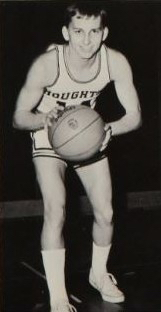 Houghton’s Lange scored his 60 as the Gremlins walloped Painsedale Jeffers, 134-62, on January 23, 1970. One week later, Larry Laitala dropped 65 as Champion crushed Felch, 114-71.
“We had a very good team that year. We had a lot of wings and normally, I wouldn’t play the whole game. My coach was Dominic Jacobetti (who played at Negaunee St. Paul, then Northern Michigan University) and he was a pretty prolific scorer in the U.P. It was one of those nights where the rim was real big,” recalled Laitala, chuckling.
Laitala finished second to Lange in regular-season scoring, 557 to 523, with each athlete playing 17 games.
“Houghton is possibly the best team in any class in the Upper Peninsula,” wrote Hal Schram in the Detroit Free Press, who predicted an MHSAA state title for the team noting that many felt Lange was the top player north of the bridge. The Gremlins, at 17-0, finished as the top-ranked team in Class C in the weekly press polls assembled by the Free Press, The Associated Press and United Press International.
But the season ended earlier than expected for both teams. Houghton fell to St. Ignace in a Regional Semifinal.
“We were beat by our archrival, Republic (61-55) in the first game of the (Class D) Districts, which was kind of an upset,” added Laitala.
Prior to Simonsen’s accomplishment, Lange and Laitala were the most recent players above the Straits of Mackinac to equal or exceed the 60-point minimum established in the MHSAA record book.
The Challenge of Traceability
With modern-day electronic archiving of a number of the state’s newspapers and the accessibility of newspapers on microfilm, an effort has been made to add dates to single-game records, where once only the season of accomplishment was listed. The work continues.
Today, more than 100 years later, the “two newspaper accounts” used back in the 1960s for verification of Burling’s scoring accomplishment have not resurfaced. Hence, neither the date of the game, nor details from period accounts are available for study. That, combined with knowledge that basketball games from the time were usually low-scoring affairs, means doubt is still cast on the mark.
 After investigation, the record was accepted by Crystal Falls historian Malcolm McNeil and U.P. sports archivist, Jim Trethewey, a former sports editor of the Marquette Mining Journal who travelled to Crystal Falls to interview Burling. MHSAA historian Dick Kishpaugh ultimately added the performance to the state record book. Questions about the legitimacy of Burling’s total began almost immediately and have resurfaced every 10 years or so. Todd Schulz, a former sports columnist at the Lansing State Journal, wrote extensively on the chase in 2012.
One of the individuals still working to help solve the mystery is Al Anderson of Crystal Falls.
The Diamond Drill was a weekly paper during Burling’s high school days, and newspapers of the time generally didn’t separate prep sporting news into sections. When reported upon, accounts of high school games were usually included in a ‘School Notes’ column.
The season was, without question, a success. “Winning eight out of ten games played, and having three challenges refused, the local basket ball team lay claim to the U.P. championship for the season of 1910-11,” stated the Diamond Drill in the March 25, 1911 edition.
Still, reports uncovered from the period publication continue to cast doubt on the plausibility of the feat occurring in a high school game. “… More basket ball and less indoor foot ball next time will look better to the audience,” noted the newspaper about a 17-10 victory over Niagara, Wis., in mid-December 1910.
“The basket ball game last night resulted in a dispute near the end of the last half with the score 13 to 12 in favor of Crystal Falls. Iron Mountain disputed a decision by the referee and withdrew from the floor,” was the account in the Feb. 18, 1911 edition of the paper.
“There’s an article that was cut out of the physical copy of the December 10, 1910 Diamond Drill,” reports Anderson, who’s been seeking confirmation in fits and starts for nearly a decade. “It looks like it could be the ‘School Notes.’ portion. It’s missing on microfiche copies as well. Perhaps that’s it.”
So the chase to verify continues.
2019-20 season brings sudden burst
Sophomore phenom Emoni Bates of Ypsilanti Lincoln is the latest prep player to etch his name in the MHSAA record book for scoring 63 points. He accomplished the feat in a 108-102 double-overtime win against Chelsea two weeks after Simonsen’s accomplishment. Statewide, that means 34 players have now scored 60 or more points in a game – 30 boys (10 in the U.P. and 20 in Lower Michigan) and four girls (one in the U.P and three in the Lower Peninsula).
Will the list be reduced by one? Time and additional research will tell.
Ron Pesch has taken an active role in researching the history of MHSAA events since 1985 and began writing for MHSAA Finals programs in 1986, adding additional features and "flashbacks" in 1992. He inherited the title of MHSAA historian from the late Dick Kishpaugh following the 1993-94 school year, and resides in Muskegon. Contact him at [email protected] with ideas for historical articles.
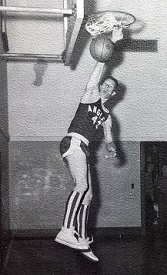
PHOTOS: (Top) Brad Simonsen celebrates becoming Houghton's all-time leading scorer Wednesday. (2) Stephenson's Mel Peterson. (3) Trout Creek's Jim Manning. (4) Houghton's Gary Lange. (5) Trout Creek's Bob Gale. (Top photo courtesy of Houghton Daily Mining Gazette. Peterson photo courtesy of Upper Peninsula Sports Hall of Fame. Houghton and Trout Creek photos courtesy of those schools' yearbook departments.)