

Tales of Teams, Trophies & Trinkets - Vol 2
By
Ron Pesch
MHSAA historian
February 9, 2017
A picture may be worth a thousand words – but often, we can learn as much from a traveling trophy, game ticket, and even an old megaphone.
Michigan’s high school sports history is more than a century old and filled with legends passed on of games, teams and athletes and the roles they played as our communities rolled forward toward present day. Following up last year’s “Tales of Teams, Trophies & Trinkets,” we present a second chapter highlighting artifacts that tell some of those stories.
|
1909 |
Saginaw vs. Saginaw Arthur Hill |
Football Trophy |
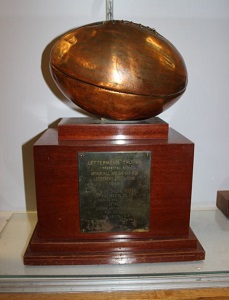 This bronzed football was the original used in the 1909 Thanksgiving Day contest played between Saginaw High and Saginaw Arthur Hill, and won by Saginaw, 5-0 at Burkart Park. In 1948, the ball was stylized into a trophy by the Letterman’s Associations of the rival schools, designed to travel between schools as the reward for winning the annual contest. When the Lumberjacks of Arthur Hill ripped off 24 straight victories beginning in 1971 (the teams played twice in 1974), ownership of the trophy was mostly forgotten. When talk of closing Saginaw High School mounted, the trophy was placed on display at Saginaw’s Castle Museum, then donated to the Saginaw County Sports Hall of Fame.
According to Jeffrey Cottrell, the multi-media specialist at the Historical Society of Saginaw County, when plans to close Saginaw High did not materialize, “it was decided amongst the Saginaw County Sports Hall of Fame and the Arthur Hill Letterwinners Association that it was time to put it back into use. This past fall, the Sports Hall of Fame awarded the trophy to Saginaw High when they beat Arthur Hill 40-0.”
Going forward, the Letterman's Trophy will continue to be presented to the winner of the football game between the Trojans and the Lumberjacks.
|
1921 |
Detroit Cass Tech vs. Flint Central |
Football Program |
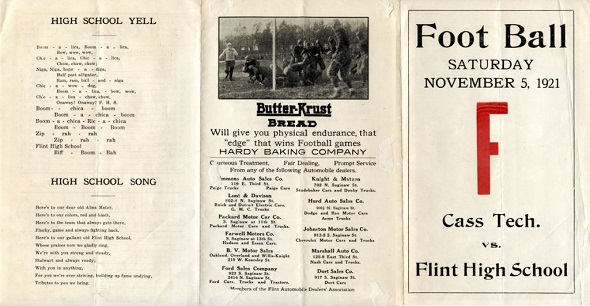
A crowd of 2,500 was on hand for this contest as Detroit Cass Tech downed Flint Central, 34-20, in an aerial battle between the squads. The Detroit Free Press arraigned for a special interurban run, with special railcars earmarked for Cass Tech students interested in attending the Saturday game at Flint. Between 200 to 300 made the trip to cheer their team to victory.
Flint Central completed 14 of 34 passes for 176 yards, but was intercepted on six occasions. Cass Tech arms were accurate on only 7 of 24 attempts for 160 yards, with four interceptions, but two completions went for touchdowns of 18 yards and 50 yards. A third pass of 35 yards helped set up the visitor’s first score. Bruno Murkobred, Cass Tech’s speedy quarterback, was the star of the contest, scoring three of his team’s five touchdowns.
|
1939 |
Kalamazoo Central vs. Battle Creek Central |
Basketball Program |
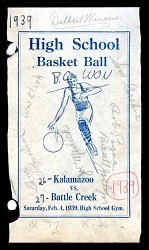 This tattered memento, from a scrapbook kept by historian Dick Kishpaugh, illustrates the modest design of a high school basketball program back in 1939. Likely created by the high school print shop, this single sheet, printed specifically for distribution at the game, features autographs gathered by its owner. Wes Clark, one of the names captured on the cover, led Battle Creek Central with 10 points, including a pair of buckets in the final minute to secure a 27-26 win by the Bearcats.
Newspaper reports from the time indicate that halftime of the contest would feature “a table tennis exhibition between Helen Van Dyke of Flint, four-time state champion, and Floyd Painter, Battle Creek champion.” Miss Van Dyke was a sophomore at Olivet College at the time.
|
1940 |
Lansing Eastern vs. Lansing Central |
Football Program |
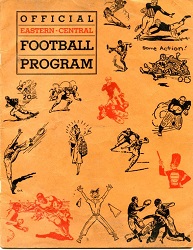 This is the program cover from the 13th annual Football Classic between the Quakers of Eastern and the Big Reds of Central. Fans were requested to “refrain from making unnecessary noise as they drive away from the stadium … due to the nearness of Sparrow Hospital.”
At the time of the 1940 contest, Lansing Central led the series with six wins against five defeats. The series featured a single tie, a 6-6 result in 1935.
Eastern’s 1940 squad, coached by Walter Graff, was able to knot the series at six wins apiece with a thrilling 7- 6 victory over the crosstown rivals, coached by Al Bovard.
The 16-page document was hand set and printed by the Eastern and Central High School Vocational Printing Classes, and included rosters, messages from the two school principals and athletic directors, as well as comments from each member of the coaching staffs, team captains, student council presidents and numerous team members from each school with their views on the game. Of course there is a photograph of each high school football team, but also photos of each band, their directors, and a list of the band members for both Eastern and Central. Finally, there are photos of the Eastern and Central Yell Leaders, nine for the Quakers and six for the Big Reds.
It is a true work of art.
|
1950 |
Central Michigan College Relays |
Track Medal |
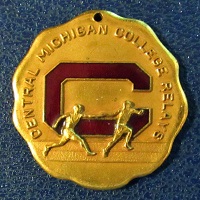 More than 2,300 athletes from 97 high schools descended upon Mt. Pleasant for the Tenth Annual Central Michigan Relays. Ecorse in Class B and Flint School for the Deaf in Class D earned team titles on Friday, May 5th while on Saturday, the 6th, Flint Northern and Milan won Class A and Class C, respectively. Six event records fell during the two-day event, three in the broad jump.
This medal, honoring a member of the winning Class C sprint relay team, was awarded at the event. The winning team, and therefore, the name of the individual awarded the medal, remain a mystery.
|
1962 |
Saginaw Sacred Heart |
Megaphone |
 As at the majority of schools across the state at the time, athletic competition against other schools was not an option for Gloria Groll and her female classmates during her days as a student at Saginaw Holy Rosary High School. So, from the fall of 1959 until her graduation with 27 other students in the spring of 1962, she was a cheerleader for the Greyhounds. This beautiful megaphone, donated by Groll to the Saginaw County Sports Hall of Fame, is a memento from those times.
Holy Rosary was one of nine Catholic high schools operating in the Saginaw area in the 1950s and 1960s. Population shifts from the cities to the suburbs over the coming years would impact enrollment figures at schools nationally. In Saginaw, the opening of the Buena Vista School District in 1956 directly impacted Holy Rosary. In 1970 the school closed. A year later only three schools – SS Peter and Paul, St. Mary and Saginaw St. Stephen – remained. In 1984, those schools were consolidated to form Saginaw Nouvel Catholic Central.
|
1963 & 1930 |
Grosse Pointe St. Paul |
League Trophies |
 On the left, we find the trophy awarded to Grosse Pointe St. Paul's after winning the 1963 city championship. Bob Martin, a 6-foot-6 junior who earned first division all-Catholic honors, scored 14 of his 22 points in the fourth quarter to lead the Lakers to a 55-46 upset-victory over Detroit Pershing. The game was played at University of Detroit Memorial before 6,979 spectators. It was the first time since 1958 that the Catholic League won the annual matchup with the champions of the Public School League.
To the right is the trophy awarded to St. Paul for winning the first golf tournament of the South Michigan Catholic High School League. The school's four golfers shot 710 over 36 holes on the day, 69 fewer strokes than second-place Detroit St. Rose. Played at Clinton Valley, the event saw Bill Beaupre win individual honors with a total of 158, including 76 in the morning. His cousin and teammate, Harold Beaupre, finished second with 169, while Peter Bononis of Detroit Holy Name was third with 171 strokes.
|
1965 |
Fennville vs. Kalamazoo Hackett |
Ticket Stub |
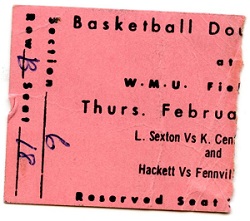 This ticket stub from a doubleheader hosted at Western Michigan University’s Read Fieldhouse on February 18, 1965 was the first chance for many to witness lightning in a bottle. A capacity-plus crowd of 9,100 fans slid through the gate to watch a rumor.
The antics of 5-foot-7½ guard Richie Jordan had been talked about around the Kalamazoo area, but few had actually seen him play. His skills were on full display on this Thursday night, as he netted a fieldhouse scoring record with 49 points in a come-from-behind 76-72 win over a much taller team from Kalamazoo Hackett. Jordan’s output during the evening’s second game eclipsed the 45 points Manny Newsome scored for Western Michigan University against Toledo, just over a year before.
The evening hadn’t started well. According to the Kalamazoo Gazette, “Jordan hit only six of his 13 field shots in the first half and threw the ball away eight times. Trailing Hackett by 17 points, 50-33, with two minutes to play in the third quarter, the Blackhawks were able to cut the deficit to 13, 60-47 as the teams entered the final frame.
Quickly, everyone in the fieldhouse knew who was getting the ball during the comeback attempt. Jordan grabbed control; with his drives for layups and “softly-arched” jump shots against intense pressure, he hit seven of nine field goals, wowing the crowd. With 2:36 to play, Jordan nailed a pair of free throws to tie the game at 72 all. Then, with 57 seconds left, the “Fennville Flash” nailed the go-ahead basket, followed by two insurance free throws to seal the win. For many, his 24 points in the fourth quarter sealed his journey from rumor to legend and, no doubt, inspired the single-sentence first paragraph of the next morning’s coverage in the Gazette.
“Yes, there is a Richie Jordan!”
(P.S. – Kalamazoo Central upset eighth-ranked Lansing Sexton, 67-57, in the evening’s opening contest).
 Ron Pesch has taken an active role in researching the history of MHSAA events since 1985 and began writing for MHSAA Finals programs in 1986, adding additional features and "flashbacks" in 1992. He inherited the title of MHSAA historian from the late Dick Kishpaugh following the 1993-94 school year, and resides in Muskegon. Contact him at [email protected] with ideas for historical articles.
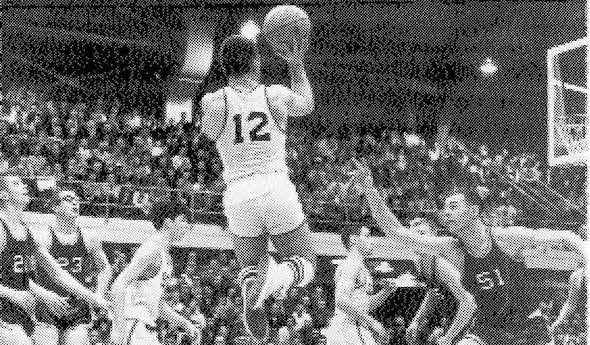
PHOTO: Fennville's Richie Jordan pulls up for a jumper, showing off the form that's become iconic when recalling the high school phenom. (Photos of Letterman's Trophy and Megaphone were provided by Jeffery Cottrell, and photo of Grosse Pointe trophies was provided by Bill Roose.)
Hoops Finds Annual Home During Holidays
December 27, 2019
By Ron Pesch
Special for Second Half
Nothing says the Holidays like a high school basketball tournament.
It started, like many things do, with a drip. Well, make that a dribble.
The Michigan High School Athletic Association has allowed Holiday basketball tournaments for years. When was the first? That’s hard to establish. No one really kept track of such. A 1934 Wakefield News article indicates that a “Christmas Tournament will be held for the (Gogebic) Range teams at Wakefield December 27 and at Ironwood December 28.” Hurley, Bessemer, Ironwood and Wakefield were entered in the “blind” tournament, with opponents drawn just before game time. It was a new idea, at least in the Upper Peninsula.
“Nothing of its kind has ever been attempted in the Peninsula before,” stated the Ironwood Daily Globe. The tournament, won by Hurley, was a financial success. After expenditures, including the purchase of trophies, profit equaled enough that $22.42 was distributed to each school competing in the tournament. Plans were announced to bring back the tournament in a larger format the following year. It did return the following December, with the same teams in the same format but with all games played in Wakefield. This time out, Ironwood topped Hurley 22-21 for the tournament title.
In the Lower Peninsula in 1935, an All-Berrien County Holiday tournament was held Dec. 26, 27 and 28, with Three Oaks winning the Class B-C division title, 15-13 in the final over Berrien Springs. St. Joseph Catholic emerged as the Class D victor with a surprising 27-26 win over the reigning MHSAA state champ from Stevensville. The 14-team competition was played at Niles High School. Attendance was “slim, very slim” for the opening day of the tourney. The event did not return in 1936.
A similar, but much smaller, event was staged in Berrien County in 1941 with the Bridgman Class C Invitational. The tournament featured seven teams with contests spread over three nights. It was a success.
“Some 450 paid admissions were checked in Wednesday night for the championship finals, which Bridgman won from Berrien Springs. … The total paid admission for the three night event was 1,420 fans with a gross gate of approximately $400.”
By the mid-1940s, the idea of playing prep basketball during the Christmas lull had begun to take off across the state.
In December 1946, before a crowd of 1,500 at the Flint IMA Auditorium, Holland, the reigning Class A champion, downed Flint Northern 51-48 behind a pair of late field goals by Ken ‘Fuzz’ Bauman in the first annual Motor City Invitational. In Jackson, Detroit Catholic Central won the Michigan Catholic Invitational, beating Kalamazoo St. Augustine, 42-40. Bridgman again snagged the title at the Sixth Annual Berrien Class C Christmas Holiday Tournament. It was the Bees’ third Christmas championship in four years. The Little Eight Conference Holiday Tournament was played across four school gymnasiums as the calendar transitioned from 1946 to 1947. Bangor downed Covert, 34-29, in the championship contest hosted at Watervliet High School on Saturday, Jan. 4.
“Holiday tournament basketball has really caught on in Michigan,” said Hal Schram in the Detroit Free Press in 1947. “There will be no Christmas-New Year’s rest for at least 60 Michigan high school squads which have jumped at the chance to sharpen their collective shooting eyes for the long season ahead. … At last count, tournaments will be played between Dec 17 and Jan 3 at Flint, Saginaw, Grand Rapids, Jackson, Lincoln Park, Fremont, Negaunee, Marquette, Benton Harbor and Detroit.”
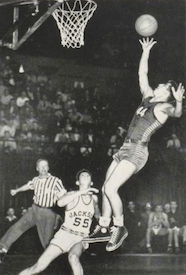 The same eight schools that played at the first Motor City tournament – Jackson, Grand Rapids Central, Holland, Muskegon Heights, Monroe, Midland, Flint Central and Flint Northern – were invited back for the second year. According to Schram, “Not a single participating school of a year ago wanted to be left out.”
Jackson downed Flint Northern in the title game, 39-34.
The Saginaw Invitational, hosted at Arthur Hill High School, boasted six Class A schools as well as Alma and Mount Pleasant, both Class B schools. Mount Pleasant surprised the field, winning the tournament with a 40-25 triumph over Dearborn Fordson in the championship game.
A year later in December, Schram wrote, “The Michigan High School Athletic Association wasn’t caught unaware when the tournament bug started to bite every sector of the state.”
“Never did we expect such a wave of tournament play as we will see during the next three weeks,” said Charles Forsythe, state director for the MHSAA, noting 34 Christmas vacation tournaments were scheduled between December 15 and January 8 during the 1948-49 basketball season. “Perhaps we’re lucky at that. The Oklahoma association has had to sanction 123 tournaments.”
Forsythe and Schram explained the reasons for the wave of popularity. Of particular interest was the fact that, at the time, a school sponsoring both football and basketball could play a total of no more than 24 games, combined, in the two sports. However, MHSAA rules allowed a basketball team the chance to play as many as three games during a Holiday tournament and be charged with only one of its allotted combination of 24 contests. (The MHSAA rules changed prior to 1972-73 to allow basketball teams a maximum of 20 games.)
Coaches could keep their squads sharp during the two-week layoff with games rather than just mandatory practices. And, as a bonus to all because tournaments were financed through gate admissions, invitations to larger tournaments meant teams got to “stay and eat at the best hostelries, go on sightseeing tours when not playing and play non-conference opponents from other sections of the state.“
Add in the chance to play before larger-than-normal crowds, and the formula for a successful tournament was cast.
Beginning with the 1950-51 season, the football-basketball rule was altered to count play in mid-season invitational tournaments as two contests. With the change, according to the Detroit Times, “the number of such meets dropped sharply.”
Only nine Holiday tournaments, involving 50-plus teams, were recorded by the MHSAA during the 1951-52 season: the 5th annual Flint Parochial Invitational, the Alpena Catholic Invitational (involving 16 teams), the 5th Annual Greater Lansing Invitational, the Albion College Invitational, the Twin-Five Conference Christmas Tournament (a 10-team replacement for the disbanded Little Eight Conference’s tournament), the Otisville Invitational, the Columbiaville Invitational and the 1st Annual Portland St. Patrick Christmas Invitational.
But by the 1960s, Holiday Tournaments were again regaining popularity, with more now focused on teams from a specific community or section of the state, especially among smaller schools.
The St. Patrick tournament was still going strong in 1966 – its 15th year – with an eight-team, four-day design. Williamston downed a Cinderella squad from Carson City, 64-44, before 1,100 fans at Portland to earn the championship. Other Mid-Michigan holiday tournaments played out in Chelsea and Swartz Creek at the same time.
The Flint Parochial League Tournament was a mainstay of the Holiday season until the breakup of the league in the early 1970s.
“Basketball tournaments have become popular around the state and nation in recent years,” wrote Wendy Foltz, longtime Battle Creek Enquirer sports editor, before the kickoff of the inaugural Battle Creek Central Holiday Cage Tournament in 1968. In a twist that harkened back to earlier days, the eight-team event represented nearly every section of lower Michigan. “Battle Creek never has been a rabid basketball town like some around the state,” added a hesitant Foltz, noting a hope that the event could at least break even.
Hosted at the Cereal City’s historic Fieldhouse, built in 1928, that first tournament was won by host Battle Creek Central, which downed Traverse City 71-53 before a crowd of 2,000. Phil Todd led the Bearcats with 29 points, including 21 in the first half, while 6-foot-8 Tom Kozelko paced TC with 24. Muskegon Heights won the consolation game, holding off a late Ypsilanti Willow Run rally, 78-77. Other schools competing were Battle Creek Lakeview, Grand Blanc, Romulus and recently-opened Jackson Lumen Christi.
Chuck Turner, Central’s head coach, and junior varsity coach Jack Schils had contacted 60 schools during the summer of 1967 to organize the 12-game schedule.
“The response was terrific,” said Schils, who added, “Many schools could not accept because of schedule commitments but want to enter a year hence.”
The Battle Creek tournament was back in 1969, again hosting teams from near and far. Schils noted that cost ran high when teams were brought in from long distances: “However, this type of tournament is highly desirable so we hope fans will support it.”
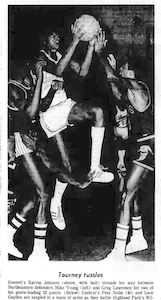
 But the event was discontinued following the 1970-71 season when the “eight team format became too unwieldy,” according to the Enquirer “… and both crowd and the quality of play declined.”
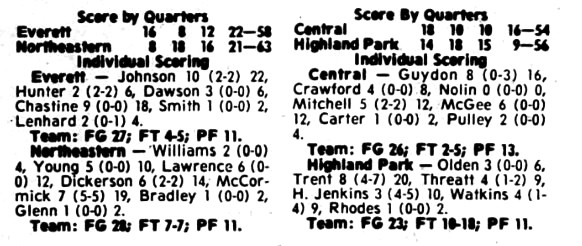
Pared down to a four-team format, it returned in a big way in December 1975. The tournament saw standing-room-only crowds of more than 3,000 for games between Battle Creek Central, Detroit Northeastern, Class A quarterfinalist Lansing Everett and reigning Class A champion Highland Park.
Detroit Northeastern downed Lansing Everett, 63-58 for the Cereal City championship trophy. Everett junior Earvin Johnson scored 22 points and, with teammate Reggie Chastine, was named to the all-tournament team along with Northwestern’s Wilbert McCormick, the tourney MVP, and his teammate Greg Lawrence. Highland Park’s William Trent and Battle Creek Central’s Leon Guydon also were named to the team.
By the 1980s, it seemed that the Christmas break nearly mimicked March in Michigan.
“I think a Christmas tournament really helps your program,” said Turner in 1980 to the Enquirer. He had taken over the head coaching position at Battle Creek in the fall of 1967 after a successful stint at Willow Run. “I don’t understand basketball teams having a preseason, playing three or four games, then taking two weeks off. When you get back, it’s like starting over.”
Besides Turner’s squad, the 1980 field included Detroit Western, Detroit Murray Wright and eventual winner Kalamazoo Central. The event would ultimately be re-christened the Battle Creek Central Chuck Turner Holiday Classic.
“The late Chuck Turner started bringing big games to the city over the holidays when he first started at the school in the 1960s,” wrote Bill Broderick in the Enquirer in 2018.
“Chuck started this because he wanted to give people the chance to come back home for the holidays and see everyone play. It’s been like a family reunion over the years,” Fred Jones told Broderick. Jones was a longtime assistant to Turner. “That we can keep it going in his name is great and hopefully we can keep if going for another 50 years.”
The girls are now part of the action. All five Battle Creek city schools – Central, Pennfield, Harper Creek, Lakeview, and St. Philip – were part of the event in 2018.
This year the Chuck Turner Central Field House Holiday Classic will again span two days – December 27 and 28 – and will again see all five city schools play on the historic floor.
Other Holiday tournaments scheduled this year include:
Petoskey Invitational – December 13-14
Raider Shootout – December 21
18th Annual Muskegon Area Sports Hall of Fame Classic – December 27
Earl McKee Classic – December 27-28
North Farmington Holiday Extravaganza – December 27
Motor City Roundball Classic – December 27
Cornerstone Invitational – December 27
Washtenaw Hoops Showcase – December 28
Ron Pesch has taken an active role in researching the history of MHSAA events since 1985 and began writing for MHSAA Finals programs in 1986, adding additional features and "flashbacks" in 1992. He inherited the title of MHSAA historian from the late Dick Kishpaugh following the 1993-94 school year, and resides in Muskegon. Contact him at [email protected] with ideas for historical articles.
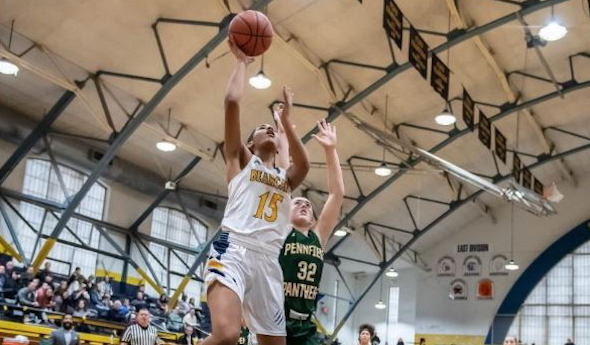
PHOTOS: (Top) The Battle Creek Central and Pennfield girls face off during the 50th Chuck Turner Classic. (Middle) Shaheen Shaheen scores two points for Flint Northern, which fell to Jackson 39-34 during the 1947 Motor City championship game. (Below left) Lansing Everett’s Earvin Johnson makes a move toward the basket against Detroit Northeastern during the 1975 Battle Creek event. (Below right) Box scores from the 1975 tournament include Johnson’s 22 points in the 63-58 loss. Photos courtesy of the Battle Creek Enquirer, Lansing State Journal and Ron Pesch archives.)